TEL:+86 132 6656 7067





As data center networks move toward 400G, 800G, and higher-speed interfaces, electrical signal integrity becomes increasingly difficult to maintain across copper connections. Active Electrical Cable (AEC) technology addresses this challenge by integrating retimer-based signal processing into the cable assembly. It helps extend practical copper reach while maintaining the low-latency characteristics and compact connectivity advantages of electrical interconnects.
1. What Is an Active Electrical Cable (AEC)?
An Active Electrical Cable is a copper interconnect assembly with integrated electronic signal-processing components, typically including retimer devices. Unlike passive DAC cables, which carry electrical signals directly through copper conductors, AEC processes the incoming signal before transmitting it toward the receiving equipment.
A typical AEC assembly includes:
Copper conductors: Carry high-speed electrical signals between the connected devices.
Retimer chips: Recover and retransmit signals to help restore signal quality.
Signal equalization: Compensates for channel frequency-dependent loss and other electrical impairments.
Power management circuitry: Supplies the active components with the required operating power.
High-speed connectors: Provide pluggable interfaces such as QSFP-DD, OSFP, and OSFP112, depending on the cable configuration.
AEC is particularly relevant to short-reach, high-bandwidth connections in AI data centers, GPU clusters, high-performance computing systems, and high-density switching environments.
2. How Does Retimer Technology Improve Signal Quality?
The retimer is the central component that distinguishes a retimer-based AEC from a passive copper cable. At high data rates, electrical signals become more vulnerable to attenuation, inter-symbol interference, jitter, and other channel impairments. These effects can reduce the receiver's ability to distinguish transmitted data reliably.
A retimer receives the incoming electrical signal, recovers its timing and data information, and generates a new output signal for the next part of the link. This process helps prevent accumulated channel degradation from directly carrying through the entire connection.
| Signal Processing Function | How It Works | Connectivity Benefit |
|---|---|---|
| Signal recovery | Recovers timing and data from the incoming electrical signal. | Helps manage accumulated signal degradation. |
| Signal retransmission | Generates a newly timed output signal. | Prevents the original channel impairment from simply passing through unchanged. |
| Equalization | Compensates for frequency-dependent channel loss. | Improves the electrical signal presented to the receiving interface. |
| Clock and data recovery | Extracts timing information and recovers the transmitted data. | Helps control timing-related signal degradation. |
| Link management | Uses supported monitoring, configuration, and link-training functions. | Helps establish operation within the supported electrical channel conditions. |
Retiming does not eliminate every source of transmission error. Overall link performance still depends on the retimer design, cable construction, host SerDes, connector quality, power delivery, and the electrical specifications of both endpoints.
3. How AEC Addresses the Limitations of Passive Copper
Passive DAC cables provide a direct electrical path and are effective for short connections. However, as data rates and signaling speeds increase, copper channel loss becomes more difficult to manage. Longer conductors and additional connector transitions can reduce the available signal margin.
AEC introduces active signal processing into the cable assembly. The retimer recovers and retransmits the signal, allowing the electrical channel to be divided into manageable sections rather than relying entirely on the original transmitter and final receiver to handle the complete cable path.
| Characteristic | Passive DAC | Active Electrical Cable (AEC) |
|---|---|---|
| Signal path | Direct electrical transmission | Electrical transmission with active retiming |
| Signal recovery | Handled by host equipment | Additional recovery and retransmission inside the cable |
| Channel loss management | Depends on the host electrical budget and cable characteristics | Retimer helps compensate for channel impairments |
| Reach potential | Generally shorter at comparable data rates | Can support longer copper links, depending on the design |
| Power requirement | No active cable-side signal processing | Requires power for integrated electronics |
| Latency | Very low, without an active retiming stage | Low, with additional retimer processing latency |
| Typical deployment | Short in-rack connections | Higher-speed or longer copper connections |
AEC is not simply a longer version of passive DAC. It is a different electrical architecture with additional processing, power, thermal, and compatibility requirements.
4. Why AEC Matters for 400G and 800G Data Center Networks
AI training clusters and high-performance computing systems require large volumes of data to move between GPUs, accelerators, servers, and network switches. These connections often carry sustained east-west traffic, making bandwidth, latency, and link stability important design considerations.
At 400G and 800G, the electrical interface operates at high per-lane signaling rates. Maintaining sufficient signal quality across copper becomes more challenging, particularly when equipment is distributed across rack positions.
AEC provides an additional option for these deployments by combining copper cabling with active signal recovery. Its advantages include:
High bandwidth: Supports high-speed electrical interconnect configurations designed for 400G and 800G environments.
Improved signal integrity: Retiming helps manage electrical channel loss and signal degradation.
Low-latency connectivity: Maintains an electrical connection without optical-to-electrical conversion across a fiber link.
Rack-level flexibility: Supports connections between equipment positioned in different locations within a rack or nearby rack environments, subject to the specified reach.
Compact copper architecture: Provides an alternative to optical cabling for selected short-reach connections.
These characteristics make AEC useful in AI infrastructure where many high-speed links are required between network switches and compute equipment.
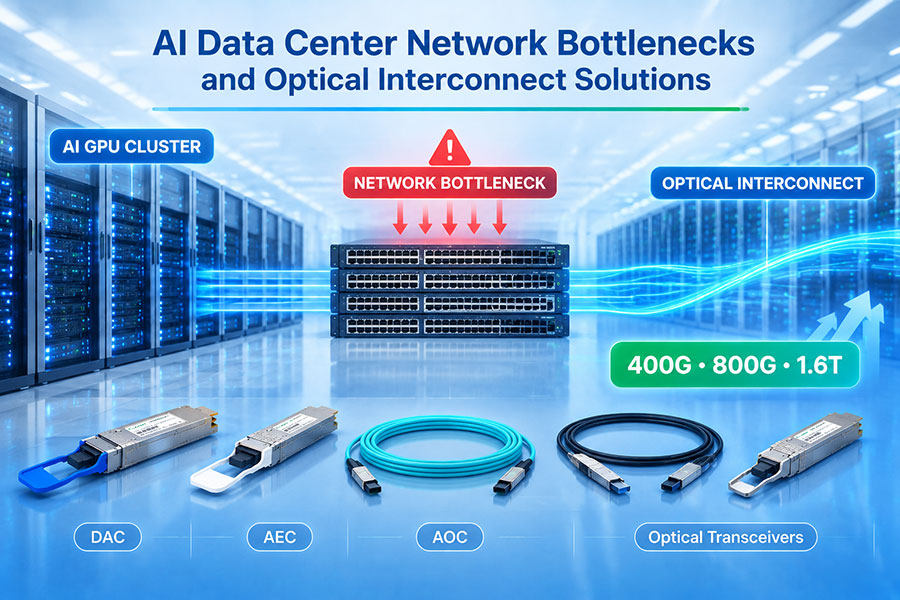
5. AEC, ACC, DAC, and AOC: Where Does AEC Fit?
Several cable technologies are used in modern data centers. Although DAC, ACC, AEC, and AOC may serve similar connection roles, their signal-processing architectures and transmission media differ.
| Technology | Transmission Medium | Signal Processing | Typical Application |
|---|---|---|---|
| Passive DAC | Copper | No active cable-side signal conditioning | Very short, low-cost connections |
| ACC | Copper | Active linear signal conditioning, commonly using redrivers | Short-reach links requiring additional signal conditioning |
| AEC | Copper | Retimer-based signal recovery and retransmission | High-speed copper links requiring improved signal integrity |
| AOC | Optical fiber | Electrical-to-optical and optical-to-electrical conversion | Longer-reach connections and EMI-sensitive environments |
The key distinction between ACC and AEC is their signal-processing architecture. ACC generally uses linear amplification or redriving, while AEC uses retiming to recover and retransmit the signal. AOC uses optical fiber rather than a copper electrical transmission path.
There is no single reach limit for each technology across all speeds and product designs. Actual supported distances depend on the cable specification, signaling rate, connector configuration, and host platform.
6. Power, Latency, and Thermal Considerations
Because AEC contains active electronics, it requires power from the connected equipment. This is an important difference from passive DAC, which does not need power for cable-side signal processing.
Retimer power consumption varies with the chip architecture, number of lanes, data rate, and operating conditions. In high-density installations, the combined power and thermal impact of multiple AEC links should be included in rack-level planning.
Latency also requires attention. AEC introduces retimer processing into the electrical path, so its latency is not identical to that of a passive DAC. However, it remains an electrical interconnect option for applications where short-reach connectivity and low latency are important.
Verify the host port's power capability for the selected AEC.
Account for active cable power in equipment and rack thermal planning.
Check the retimer's supported data rate, lane configuration, and latency characteristics.
Confirm that both endpoint devices support the selected AEC architecture.
7. C-LIGHT 800G AEC for AI Data Center Connectivity
As AI clusters adopt higher-bandwidth network interfaces, 800G AEC provides an electrical interconnect option for GPU servers, high-speed switches, and distributed rack architectures.
C-LIGHT's 800G AEC product family integrates high-performance retimer chips and Gearbox technology for supported 400G/800G dual-rate operation. Its signal-processing functions include retiming, noise suppression, and equalization compensation.
| Specification | C-LIGHT 800G AEC |
|---|---|
| Data rate | 800Gbps |
| Technology | Integrated retimer and Gearbox technology |
| Interfaces | QSFP-DD, OSFP, OSFP112 configurations |
| Cable length | 0.5m to 5m, depending on configuration |
| Signal functions | Signal retiming, noise suppression, equalization compensation |
| Applications | AI server clusters, GPU interconnects, HPC, distributed rack cabling |
Retimer-based signal conditioning: Integrated retimer chips help recover and retransmit high-speed electrical signals, supporting signal integrity across the specified cable configurations.
400G/800G flexibility: Gearbox technology supports dual-rate operation for compatible equipment and configurations. Actual operation depends on the endpoint interfaces and supported system settings.
Multiple cable configurations: QSFP-DD, OSFP, and OSFP112 options provide connectivity choices for different high-speed equipment platforms.
Flexible cable lengths: Configurations from 0.5m to 5m accommodate different rack layouts and equipment positions.
For detailed configuration and compatibility requirements, refer to the C-LIGHT 800G AEC product page.
8. What Should You Check Before Deploying AEC?
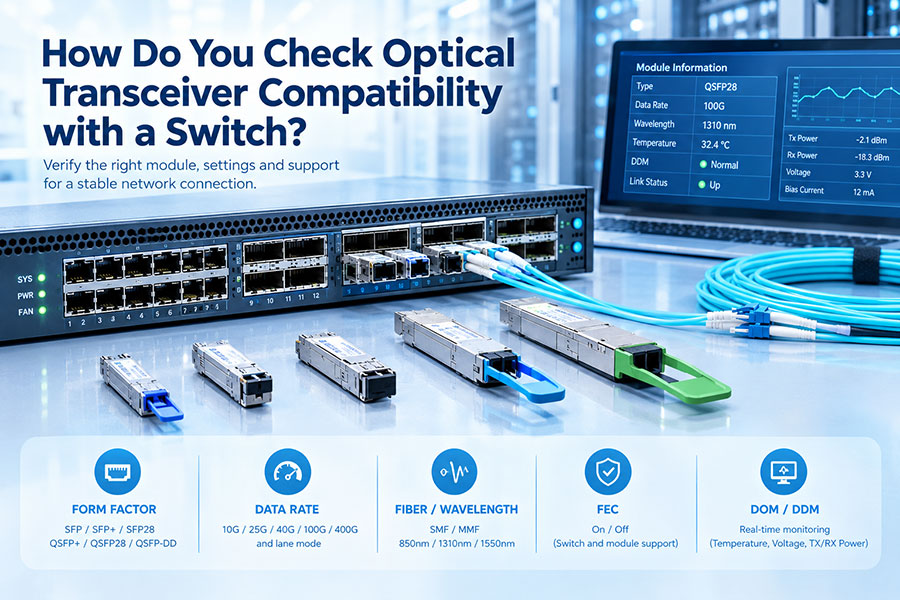
Retimer technology can improve electrical link performance, but a cable must still match the electrical and mechanical requirements of the connected equipment. Compatibility should be confirmed before large-scale deployment.
Port form factor: Confirm the required QSFP-DD, OSFP, OSFP112, or other connector configuration.
Data rate: Verify that the cable and both endpoint ports support the intended 400G or 800G operating mode.
Lane configuration: Check lane mapping, signaling rate, and any required breakout arrangement.
Retimer support: Confirm that the cable's retimer architecture is compatible with the host platform.
Power budget: Ensure the ports can supply the power required by the active cable.
Thermal conditions: Consider connector temperature and airflow in high-density installations.
Firmware and coding: Verify cable identification, firmware requirements, and vendor compatibility policies.
Physical reach: Select a cable length within the qualified operating range of the exact model.
For connections that exceed the supported copper reach, or where electromagnetic interference immunity is a major requirement, AOC or pluggable optical transceivers may be more appropriate.
9. Conclusion
Active Electrical Cable technology improves high-speed copper connectivity by integrating retimer-based signal recovery and retransmission into the cable assembly. This helps manage channel loss, improve signal integrity, and extend practical copper reach beyond what comparable passive DAC designs can support.
For 400G and 800G data center networks, AEC offers a useful balance of bandwidth, low-latency electrical connectivity, and rack-level deployment flexibility. Its power consumption, thermal characteristics, retimer architecture, and host compatibility must still be considered during system design.
As AI infrastructure continues to scale, AEC will remain an important option alongside passive DAC, ACC, and optical interconnect technologies. The most suitable solution depends on the required reach, electrical specifications, equipment architecture, and overall network design.
Share your equipment models, interface types, data rates, and cable length requirements with C-LIGHT for product selection and compatibility support.
Contact C-LIGHT >

 >
 >
 >
 >
 >
 >
 >