TEL:+86 132 6656 7067





Gray and colored optical transceivers are two common categories of optical interfaces used in fiber-optic networks. Their main distinction is how their optical wavelengths are used. Gray optics generally provide conventional single-channel connectivity over a dedicated fiber link, while colored optics operate on designated CWDM or DWDM wavelength channels designed for wavelength-division multiplexing.
By assigning different wavelengths to separate data channels, colored optics allow multiple services to share the same fiber infrastructure through compatible WDM multiplexers and demultiplexers. This can increase fiber utilization without requiring a separate fiber pair for every service. The choice between gray and colored optics therefore depends on available fiber resources, network architecture, wavelength planning, transmission distance and equipment compatibility.
1. What Are Gray Optical Transceivers?
Gray optical transceivers, also called uncolored optics, use conventional optical wavelengths for standard point-to-point fiber connections rather than dedicated CWDM or DWDM wavelength channels.
Common gray optical interfaces include 850 nm short-reach modules and single-mode modules operating around 1310 nm or 1550 nm. They are generally designed to connect two optical endpoints directly through a suitable fiber link without requiring an external WDM multiplexer to assign a channel wavelength.
Typical characteristics include:
Designed for conventional point-to-point optical connectivity.
Common wavelengths include 850 nm, 1310 nm and selected 1550 nm applications.
Often used for one optical service over a dedicated fiber link.
Can support multimode or single-mode fiber, depending on the module.
Available in SR, DR, FR, LR, ER and other optical interface variants.
Usually simpler to deploy when dedicated fiber is available and WDM multiplexing is not required.
For example, a conventional 10GBASE-LR or 100G single-wavelength 1310 nm module can provide a direct optical connection between two switches over single-mode fiber. The link does not need an external CWDM or DWDM channel filter simply to carry that optical service.
2. What Are Colored Optical Transceivers?
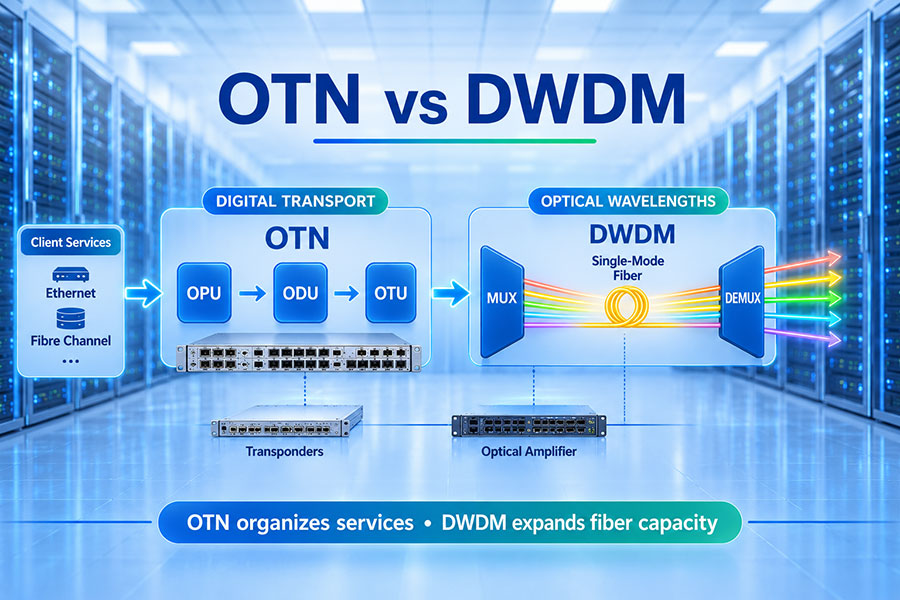
Colored optical transceivers are designed to operate at specific wavelength channels used in wavelength-division multiplexing systems. Instead of treating the fiber as a single-channel connection, a WDM network assigns different optical wavelengths to multiple independent data channels.
Each colored transceiver transmits or receives on a designated wavelength or frequency channel. A WDM multiplexer combines multiple channels onto a shared fiber, and a demultiplexer separates them at the receiving end.
Colored optics commonly include:
CWDM transceivers: Use coarse wavelength channel spacing, commonly based on a 20 nm grid.
DWDM transceivers: Use narrower wavelength or frequency spacing to support a higher channel density.
Tunable DWDM transceivers: Allow the operating wavelength to be configured within a supported tuning range.
Coherent DWDM transceivers: Use coherent transmission and digital signal processing for high-capacity optical transport.
Colored optics are commonly used in metro networks, data center interconnects, telecom transport, 5G fronthaul and backbone networks where multiple channels need to share limited fiber resources.
↓
WDM Multiplexer
↓
One Shared Optical Fiber
↓
WDM Demultiplexer
↓
Separate Optical Channels
The term "colored" refers to the assigned optical wavelength channel, not the physical color of the transceiver housing or its connector.
3. Gray vs Colored Optical Transceivers: Main Differences
Both gray and colored modules convert electrical data into optical signals and optical signals back into electrical data. Their key difference is whether the optical output is intended for a conventional single-channel link or a wavelength-specific WDM system.
| Technical Feature | Gray Optical Transceiver | Colored Optical Transceiver |
|---|---|---|
| Wavelength Assignment | Common optical wavelength for standard link connectivity | Specific CWDM or DWDM channel wavelength or frequency |
| Primary Function | Conventional point-to-point optical transmission | Wavelength-specific transmission for WDM networks |
| WDM Multiplexer | Not normally required for a direct single-channel link | Usually required in an external WDM architecture |
| Fiber Utilization | Often uses a dedicated fiber pair for each link | Multiple channels can share the same fiber infrastructure |
| Wavelength Matching | Endpoints must support compatible optical interfaces | Must match the assigned channel and WDM system plan |
| Channel Density | Typically one service channel per dedicated optical path | Multiple wavelength channels can operate on one fiber |
| Configuration | Usually fixed conventional wavelength | Fixed channel or tunable wavelength, depending on model |
| Deployment Complexity | Generally simpler for direct connections | Requires wavelength planning and WDM path engineering |
| Typical Applications | Ethernet links, server connections and standard fiber access | Metro WDM, DCI, optical transport and fiber capacity expansion |
These are general industry distinctions. Actual transceiver architecture varies by data rate, optical standard and product design. A fixed wavelength alone does not make a module a colored optic; its intended channel assignment and compatibility with the WDM grid are also important.
4. How Do Gray Optics Work in a Conventional Fiber Link?
A conventional gray optical link typically connects two switches, routers or other network devices through compatible optical transceivers and a suitable fiber connection.
Each module converts electrical data into an optical signal for transmission. At the opposite endpoint, the receiving transceiver detects the incoming optical signal and converts it back into electrical data.
↓
Gray Optical Transceiver A
↓
Dedicated Fiber Link
↓
Gray Optical Transceiver B
↓
Switch B
In a typical duplex single-mode connection, one fiber carries the transmit signal in one direction and another carries the return signal. The modules must have compatible data rates, wavelengths, fiber requirements and optical specifications.
Gray optics are widely used in:
Server-to-switch connections in data centers.
Switch-to-switch Ethernet links.
Enterprise network backbone connections.
Point-to-point campus fiber links.
Direct connections to the client ports of optical transport equipment.
The main advantage is straightforward deployment when sufficient dedicated fiber is available and there is no requirement to combine multiple optical services onto one fiber.
5. How Do Colored Optics Work in a WDM Network?
Colored optics use wavelength channels that are selected to work with a specific WDM grid. Each optical channel can carry an independent data stream, and multiple channels are combined onto the same fiber through a multiplexer.
For example, a CWDM system can use four channels with different wavelengths. Each transceiver transmits on its assigned channel, while the WDM multiplexer combines the optical signals for transmission over a shared fiber.
Channel 2: λ2 ─┤
Channel 3: λ3 ─┼→ CWDM MUX → Shared Fiber
Channel 4: λ4 ─┘
At the receiving site, the demultiplexer separates the wavelengths and directs each channel to its corresponding receiving interface.
↓
λ1 → Receiver 1
λ2 → Receiver 2
λ3 → Receiver 3
λ4 → Receiver 4
The multiplexing process increases the number of services that can be carried over the available fiber. It does not automatically increase the data rate of an individual transceiver. Each wavelength channel retains its own specified transmission rate and optical performance limits.
6. CWDM vs DWDM: Two Main Colored Optics Technologies
Colored optical transceivers are commonly divided into Coarse Wavelength Division Multiplexing (CWDM) and Dense Wavelength Division Multiplexing (DWDM) categories.
CWDM uses wider wavelength spacing. The ITU-T CWDM wavelength grid commonly uses 20 nm spacing across the 1271–1611 nm range. This wider spacing simplifies wavelength control and is often used in access, enterprise and metro optical networks.
DWDM uses much narrower channel spacing. The ITU-T DWDM frequency grid is referenced to 193.1 THz and supports channel spacings such as 100 GHz, 50 GHz, 25 GHz and narrower options. This allows more wavelengths to occupy a defined optical spectrum.
| Feature | CWDM Colored Optics | DWDM Colored Optics |
|---|---|---|
| Channel Spacing | Commonly 20 nm | Commonly 100 GHz or 50 GHz, with narrower options |
| Wavelength Planning | Broadly spaced wavelength channels | Precisely assigned optical frequencies |
| Channel Density | Lower than typical DWDM systems | Higher channel density |
| Wavelength Control | Fixed wavelength is common | Fixed or tunable wavelength implementations |
| System Complexity | Generally simpler wavelength planning | Requires tighter wavelength and system control |
| Typical Deployment | Enterprise, access and metro networks | Metro, regional, long-haul and high-capacity transport |
| Fiber Capacity Expansion | Combines multiple widely spaced channels | Combines a larger number of closely spaced channels |
The actual number of usable channels depends on the wavelength or frequency plan, optical bandwidth, mux/demux configuration and system design. A higher nominal channel count does not necessarily mean every channel can operate at the same distance or data rate.
7. Fixed-Wavelength vs Tunable Colored Transceivers
Colored optics can use fixed or tunable wavelength technology.
Fixed-wavelength transceivers: These modules operate on a specific optical wavelength or channel. The wavelength is assigned during product selection and cannot normally be changed by the user. A network may need several different part numbers to populate different DWDM channels.
Tunable DWDM transceivers: These modules can be configured to operate on different supported DWDM channels within their tuning range. Instead of stocking a separate fixed-wavelength module for every channel, an operator can provision a compatible tunable module to the required channel.
| Feature | Fixed-Wavelength Optics | Tunable DWDM Optics |
|---|---|---|
| Channel Selection | Defined by the specific module model | Configured within the supported tuning range |
| Inventory | Different channel wavelengths may require different part numbers | One model family can support multiple channels |
| Configuration | Usually predetermined | Requires channel provisioning and host support |
| Operational Flexibility | More limited when wavelength assignments change | Can simplify wavelength reassignment and maintenance |
| Typical Application | CWDM and fixed-channel DWDM deployments | Flexible DWDM systems and optical transport networks |
Tunable capability must be supported by the module, host equipment and optical management system. A tunable transceiver should not be assumed to support every channel in the DWDM spectrum or every channel spacing.
8. How Does WDM Reduce Fiber Consumption?
Fiber availability is an important consideration in metro and enterprise networks. A conventional point-to-point architecture may require a separate fiber pair for every independent optical link. When the number of services increases, the amount of required fiber can become a major deployment constraint.
WDM allows multiple optical channels to share the same fiber route. Each channel uses a different wavelength, and the MUX/DEMUX equipment combines and separates the signals.
| Network Architecture | Fiber Utilization | Expansion Method |
|---|---|---|
| Multiple Gray Links | Typically requires dedicated fiber paths for each link | Deploy additional fiber or use a WDM transport platform |
| CWDM Network | Multiple wavelength channels share a fiber | Add supported CWDM channels and compatible mux ports |
| DWDM Network | Multiple closely spaced wavelength channels share a fiber | Add channels within the available optical spectrum and line-system capacity |
WDM does not eliminate the need for capacity planning. The number of channels, aggregate bandwidth, optical power budget, mux/demux loss, fiber quality and available spectrum must all be considered.
9. Can Colored Optics Transmit Farther Than Gray Optics?
Colored optics are not automatically longer-reach than gray optics. Transmission distance depends on the complete optical interface and system design, including transmitter power, receiver sensitivity, fiber attenuation, dispersion, modulation, FEC and optical signal-to-noise ratio.
For example, a fixed-wavelength CWDM transceiver may support a 10 km or 40 km link, while a gray 1550 nm ER or ZR transceiver may be designed for an extended-reach point-to-point connection.
Similarly, some coherent DWDM transceivers support much longer optical transport distances through advanced modulation and digital signal processing. Their reach is the result of the coherent transmission architecture and optical line design, not simply because the optics are colored.
| Reach Factor | Why It Matters |
|---|---|
| Transmit Power | Determines the optical power launched into the link |
| Receiver Sensitivity | Determines the minimum received signal level for specified performance |
| Fiber Attenuation | Reduces optical power along the transmission path |
| Dispersion | Can distort the transmitted signal over distance |
| WDM Component Loss | Multiplexers, demultiplexers and other passive components consume optical budget |
| OSNR | Important for multi-channel and coherent optical transport systems |
| Modulation and FEC | Determine signal tolerance and error-correction capability |
The stated reach of a colored or gray transceiver must therefore be checked against its exact model specification and the intended optical path.
10. Gray Client Optics and Colored Line Optics in a Transponder System
Many optical transport systems use gray optics on the client side and colored optics on the line side. A transponder or muxponder connects these two interfaces and converts the client signal into a wavelength suitable for the WDM line system.
For example, a router may send a standard 100G client signal through a gray optical interface to a transponder. The transponder processes the signal and transmits it on a designated DWDM wavelength through its colored line interface.
↓
Gray Client Optical Interface
↓
Transponder / Muxponder
↓
Colored DWDM Line Interface
↓
DWDM MUX → Shared Fiber Network
At the receiving site, the line-side signal is separated from the WDM spectrum and converted back to a compatible client-side interface.
This architecture allows standard Ethernet or Fibre Channel equipment to connect to an optical transport system without requiring every client device to generate the final DWDM line wavelength itself.
In another deployment model, a router or switch may use a colored pluggable transceiver directly. In that case, the module itself generates the required WDM channel, avoiding a separate external transponder for that interface when the complete system supports direct colored optics.
11. Important Compatibility Requirements for Colored Optics
Colored transceiver deployment requires more than selecting a module with a suitable data rate. Its wavelength must be compatible with the WDM channel plan and the optical components in the transmission path.
Before deploying colored modules, verify the following:
Wavelength or frequency: The module must operate on an available channel in the WDM plan.
Channel spacing: The transceiver must match the CWDM or DWDM grid supported by the MUX/DEMUX.
Wavelength stability: The laser must remain within the required channel tolerance over the specified temperature range.
Data rate and protocol: Both endpoints must support compatible client or line-side interfaces.
Fiber type: The transceiver and WDM components must be designed for the installed single-mode fiber.
Optical power budget: Mux/demux insertion loss and other passive losses must be included.
Optical isolation: Adjacent-channel isolation and crosstalk performance must meet system requirements.
Host compatibility: The switch, router or transport platform must support the module's electrical interface, power and management requirements.
For bidirectional single-fiber WDM systems, the transmit and receive wavelength pair must also match the designated port arrangement. Two modules with the same package and data rate may still be incompatible if their wavelength assignments do not form a valid pair.
12. Common Applications of Gray and Colored Optical Transceivers
Gray optics are suitable for direct optical connections when fiber resources are available and the link does not require multiple wavelength channels on the same fiber.
Typical gray optics applications:
Server-to-switch and switch-to-switch data center connections.
Enterprise campus links over dedicated fiber pairs.
Standard Ethernet access and aggregation links.
Router-to-transponder client interfaces.
Point-to-point optical links with straightforward wavelength requirements.
Colored optics are valuable when the network must carry multiple services over limited fiber resources or needs wavelength-level routing and capacity expansion.
Typical colored optics applications:
Metro WDM networks connecting multiple sites.
Data Center Interconnect (DCI) over shared fiber infrastructure.
5G fronthaul and access network uplinks.
Enterprise networks with limited available fiber pairs.
DWDM transport and optical backbone networks.
High-capacity optical networks using coherent transmission.
13. How to Choose Between Gray and Colored Optical Transceivers
The selection depends primarily on fiber availability, network topology and the number of optical services that need to share the same fiber route.
| Network Requirement | Recommended Optics | Selection Reason |
|---|---|---|
| One direct optical connection | Gray optics | Simple point-to-point connectivity |
| Dedicated fiber pair is available | Gray optics | No external wavelength multiplexing is required |
| Several services must share one fiber | Colored CWDM or DWDM optics | Multiple wavelength channels can use the same fiber |
| Moderate channel count and simpler wavelength planning | CWDM optics | Wider channel spacing simplifies system design |
| High channel density | DWDM optics | Narrower channel spacing supports more channels within the available spectrum |
| Flexible wavelength assignment | Tunable DWDM optics | Allows supported channels to be configured without stocking every fixed wavelength variant |
| Long-distance high-capacity optical transport | Coherent DWDM optics | Provides advanced modulation and signal processing for engineered transport systems |
Operators should also compare the total cost of ownership, including transceivers, WDM components, fiber deployment, optical amplification where required, maintenance and future channel expansion.
14. C-LIGHT Gray and Colored Optical Transceiver Solutions
C-LIGHT provides conventional single-wavelength optical transceivers, CWDM modules, DWDM modules and coherent DCO transceivers for different optical network architectures.
Conventional Single-Wavelength Interface: 100G QSFP28 Single Lambda
C-LIGHT's 100G QSFP28 Single Lambda family uses 1310 nm single-mode optical transmission. Listed configurations include 500 m, 2 km, 10 km and 40 km options, depending on the model.
This is an example of a conventional single-wavelength optical interface rather than a dedicated CWDM or DWDM grid channel. It can be considered for point-to-point SMF connections where the network does not require an external WDM channel assignment.
CWDM 100G / 40G / 25G Optical Transceivers
C-LIGHT CWDM optical modules support multiple data rates and wavelength configurations. The product family includes 25G SFP28, 40G QSFP+ and 100G QSFP28 options, with selected models operating across CWDM wavelength ranges from 1270 nm to 1610 nm.
Depending on the model, the listed transmission distances include 10 km, 20 km and 40 km configurations. These modules are designed for CWDM networks that use compatible wavelength multiplexers and demultiplexers.
DWDM 100G / 40G / 25G Optical Transceivers
C-LIGHT DWDM modules support different data rates and DWDM wavelength configurations, including C-band channels and selected tunable options. The product family includes SFP28, QSFP+ and QSFP28 variants, with model-specific transmission distances ranging from 10 km to 120 km.
Selected configurations support 96-channel 50 GHz or 100 GHz wavelength plans. These modules are intended for wavelength-based optical transport where channel spacing, wavelength assignment and link engineering must match the DWDM system.
DWDM DCO Coherent Transceivers
C-LIGHT's DCO product family includes 100G, 200G, 400G and 800G coherent optical transceiver categories in supported form factors such as QSFP28, QSFP-DD, OSFP and CFP2.
Selected configurations support tunable C-band DWDM operation. These modules are designed for high-capacity optical transport, metro networks and data center interconnect applications where coherent modulation and digital signal processing are required.
CWDM MUX / DEMUX
C-LIGHT CWDM MUX/DEMUX products combine or separate multiple wavelength channels on a shared optical fiber. The product range includes 4-channel, 8-channel, 16-channel and 18-channel configurations, with rack, LGX and ABS packaging options on selected models.
These components work with compatible colored CWDM transceivers to expand fiber capacity in enterprise, metro and data center networks.
When selecting a C-LIGHT optical module, confirm the exact part number, wavelength or frequency channel, data rate, fiber type, transmission distance, connector, optical budget and host compatibility. Product-family specifications do not necessarily apply to every individual model.
15. Conclusion
Gray and colored optical transceivers serve different roles in fiber-optic networks. Gray optics provide conventional optical connectivity, generally for individual point-to-point links. Colored optics operate on assigned CWDM or DWDM channels and allow multiple optical services to share the same fiber through compatible wavelength multiplexing equipment.
Gray optics are often the simpler choice when dedicated fiber is available and only one optical service is required per link. Colored optics are more suitable when fiber resources are limited, multiple services need to share one route or the network requires wavelength-based capacity expansion.
The choice should not be made based on wavelength alone. The WDM channel plan, optical budget, transmission distance, mux/demux compatibility, host equipment and future network requirements all need to be considered. A correctly designed WDM system can increase fiber utilization while maintaining the required performance of each optical channel.
Looking for gray, CWDM or DWDM optical transceivers?
Contact C-LIGHT for conventional optical modules, fixed-wavelength CWDM/DWDM transceivers, tunable coherent solutions and compatible WDM connectivity products.
 >

 >
 >
 >
 >
 >
 >
 >