TEL:+86 132 6656 7067




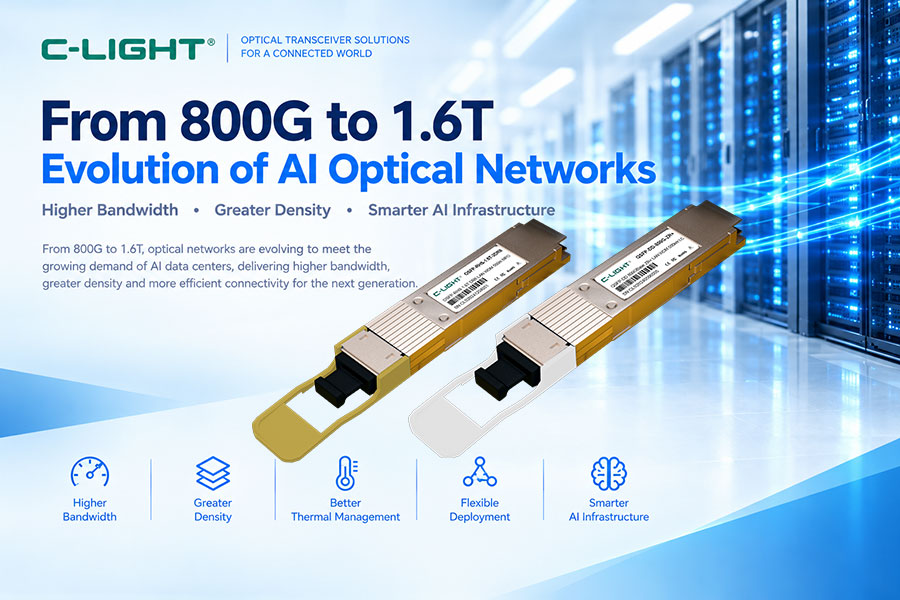
AI data centers are moving from 800G toward 1.6T optical connectivity as GPU clusters, switch bandwidth, and network traffic continue to increase. The transition is driven by higher lane speeds, improved bandwidth density, and the need for more efficient optical interconnects across next-generation AI networks.
1. Why AI Optical Networks Are Moving Beyond 800G
AI workloads generate significantly more east-west traffic between GPUs, servers, switches, and storage systems. As AI clusters scale, the network fabric must provide higher aggregate bandwidth without increasing the number of physical ports at the same rate.
800G has become an important generation for large-scale AI networking, while 1.6T is emerging as the next step for higher-density AI fabrics.
2. The Evolution from 400G to 800G and 1.6T
The development of AI optical networks can be broadly represented as:
| Generation | Typical Lane Architecture | Aggregate Data Rate |
|---|---|---|
| 400G | 8 × 50G | 400Gbps |
| 800G | 8 × 100G | 800Gbps |
| 1.6T | 8 × 200G | 1.6Tbps |
These are simplified representations. Actual optical modules can use different electrical and optical lane architectures depending on the switch ASIC, DSP, optical engine, and application.
3. 800G Optical Networks for AI Data Centers
800G optical transceivers provide a major increase in network bandwidth for AI clusters. A common architecture uses eight 100G-class lanes to deliver an aggregate 800Gbps connection.
800G modules are used in high-radix switches, GPU clusters, spine networks, and other high-bandwidth data center connections. Different optical configurations can support short-reach, 500m-class, and kilometer-scale links.
4. Why 200G per Lane Matters
The key technology behind the move toward 1.6T is the increase from 100G-class lanes to 200G-class lanes.
Instead of simply adding more physical lanes, the network can increase the amount of data carried by each lane. This helps maintain high bandwidth density as switch and AI accelerator performance increases.
For a simplified architecture, 800G can use 8 × 100G, while 1.6T can use 8 × 200G.
5. 1.6T Optical Transceivers
A 1.6T optical transceiver provides an aggregate bandwidth of approximately 1.6Tbps. A major architecture is based on eight 200G-class lanes, using PAM4 signaling and higher-speed electrical and optical interfaces.
1.6T modules are intended for next-generation AI data centers, high-density Ethernet fabrics, and other applications where 800G port bandwidth is no longer sufficient.
6. 800G vs. 1.6T Optical Transceivers
| Feature | 800G | 1.6T |
|---|---|---|
| Aggregate Bandwidth | 800Gbps | 1.6Tbps |
| Typical Lane Rate | 100G-class | 200G-class |
| Common Modulation | PAM4 | PAM4 |
| Application | AI clusters and hyperscale data centers | Next-generation AI fabrics |
| Bandwidth Density | High | Very High |
| Thermal Requirement | High | Higher |
7. PAM4 in Next-Generation AI Networks
PAM4 has become an important signaling technology for high-speed optical interconnects. Compared with traditional two-level signaling, PAM4 carries two bits per symbol, allowing higher data rates within the available electrical and optical bandwidth.
At 800G and 1.6T, PAM4 technology helps increase lane bandwidth while maintaining a practical number of electrical and optical channels.
8. The Role of Optical Transceivers in AI Fabrics
Optical transceivers connect the major components of an AI network, including GPU servers, top-of-rack switches, spine switches, and aggregation systems.
As the number of accelerators increases, the total number of optical links also grows. Higher-speed modules therefore become important for reducing port requirements and increasing network bandwidth density.
9. 800G and 1.6T Form Factors
800G and 1.6T optical modules are commonly associated with high-density form factors such as OSFP and next-generation OSFP variants. The larger thermal envelope of these form factors can help accommodate higher-speed optical components and increasing module power.
The exact form factor depends on the switch platform and module architecture.
10. Reach Options for AI Optical Networks
AI networks contain links with different distance requirements. Short intra-rack connections may use multimode or short-reach optical solutions, while connections between rows, racks, and network layers can require longer-reach single-mode optics.
| Network Segment | Typical Optical Requirement |
|---|---|
| GPU / Server Connections | Short Reach |
| ToR to Spine | Short to Medium Reach |
| Spine to Spine | Medium Reach |
| Data Center Interconnect | Longer Reach |
11. Power Consumption and Thermal Challenges
Higher-speed optical modules generally increase the challenges associated with power consumption and heat dissipation. Moving from 800G to 1.6T requires higher-speed electrical interfaces, optical components, DSPs, and supporting circuitry.
This makes thermal design increasingly important for high-density AI switches. Module power, heatsink design, airflow, and liquid cooling infrastructure may all become part of the overall network design.
12. 1.6T and Liquid-Cooled AI Data Centers
AI accelerator systems are already driving rack power density higher, increasing the importance of advanced cooling technologies. As optical module density and switch power continue to rise, liquid cooling can provide additional thermal management capacity for high-density AI infrastructure.
The relationship between optical networking and cooling is therefore becoming increasingly important when deploying large 1.6T AI fabrics.
13. 800G to 1.6T Network Migration
The migration from 800G to 1.6T is not simply a matter of replacing optical modules. The complete network architecture must be considered, including switch ASIC bandwidth, SerDes capability, host electrical interfaces, module form factor, optical reach, fiber infrastructure, power budget, and cooling.
For new AI clusters, 1.6T can provide a higher bandwidth ceiling. For existing deployments, 800G can remain a practical choice where the switch architecture and workload requirements do not yet justify a 1.6T upgrade.
14. 800G and 1.6T Optical Interconnect Technologies
The evolution toward 1.6T is also driving development in several supporting technologies, including high-speed DSPs, 200G-per-lane electrical interfaces, silicon photonics, advanced laser technology, linear optics, and co-packaged optics.
These technologies aim to improve bandwidth density, signal integrity, power efficiency, and scalability across future AI networks.
15. LPO, CPO and the Future of AI Optical Connectivity
Higher lane rates are increasing the electrical challenges between switch ASICs and optical modules. This has increased interest in architectures such as Linear Pluggable Optics (LPO), Co-Packaged Optics (CPO), and other approaches that move optical conversion closer to the switching silicon.
These architectures do not replace traditional pluggable optics in every application. Instead, they provide additional options for managing power, signal integrity, and bandwidth as AI networks scale.
16. 800G or 1.6T: Which Is Better?
Neither generation is universally better. The appropriate solution depends on the AI cluster size, switch generation, required port bandwidth, optical reach, power budget, cooling system, and deployment schedule.
800G remains highly suitable for current high-bandwidth AI and hyperscale networks, while 1.6T provides a higher bandwidth path for next-generation infrastructure.
17. The Future of AI Optical Networks
As AI accelerator performance continues to increase, optical networking will need to scale at a similar pace. The transition from 800G to 1.6T is an important step toward higher-density AI fabrics.
Future generations are expected to continue increasing lane speeds while improving optical integration, power efficiency, thermal management, and network scalability.
18. Frequently Asked Questions
Q1. Why are AI networks moving from 800G to 1.6T?
Q2. What is the main difference between 800G and 1.6T?
Q3. Does 1.6T use PAM4?
Q4. Does upgrading from 800G to 1.6T require new network equipment?
Q5. What form factors are used for 1.6T optical transceivers?
Q6. Will 800G still be used after 1.6T becomes available?
19. Summary
The evolution from 800G to 1.6T represents a major step in AI optical networking. The transition is driven primarily by the move toward 200G-class lanes, higher bandwidth density, and the growing connectivity requirements of large AI clusters. As 1.6T networks develop, optical transceivers, switch silicon, high-speed SerDes, cooling systems, and optical architectures will increasingly need to evolve together.
 >
>

 >
>
 >
>
 >
>
 >
>
 >
>
 >
>
 >
>