TEL:+86 132 6656 7067





Large AI clusters rely on fast communication between GPUs distributed across multiple servers and racks. Ethernet and InfiniBand are two major networking technologies used to build these scale-out fabrics. Both can support high-bandwidth communication and Remote Direct Memory Access (RDMA), but they differ in protocol design, congestion management, interoperability, deployment models, and ecosystem requirements.
1. Why AI Clusters Need Specialized Network Fabrics
During distributed AI training, GPUs exchange gradients, model parameters, activations, and other data through collective communication operations. The network must move these data flows efficiently while keeping communication delays predictable.
Several network characteristics directly affect cluster performance:
Bandwidth: Determines how much data can move between computing nodes.
Latency: Affects how quickly communication operations complete, especially when many GPUs synchronize.
Congestion control: Helps prevent overloaded links and queues from slowing down other traffic.
RDMA support: Allows data to move between application memory regions with reduced CPU involvement.
Path management: Helps distribute traffic across network paths and respond to link or switch failures.
Scalability: Determines how effectively the fabric can expand as more GPU servers are added.
A high-speed connection alone does not guarantee good distributed training performance. The network topology, traffic patterns, switch behavior, host adapters, and communication software all influence the result.
2. Ethernet: A Flexible Foundation for AI Networking
Ethernet is a widely deployed networking technology used in enterprise networks, cloud data centers, storage systems, and large-scale computing infrastructure. Its broad equipment ecosystem and familiar operational model make it attractive for organizations that need to integrate AI infrastructure with existing data center networks.
For AI scale-out networks, Ethernet is commonly used with RoCEv2 (RDMA over Converged Ethernet version 2). RoCEv2 enables RDMA communication over an Ethernet and IP network.
How RoCEv2 works
RoCEv2 carries RDMA traffic over UDP/IP. It allows applications and communication libraries to transfer data with reduced CPU overhead compared with conventional software-based networking paths.
However, RoCEv2 performance depends on how the Ethernet fabric is engineered. Network operators need to configure and validate congestion management, queue behavior, routing, traffic prioritization, and loss recovery.
Common Ethernet AI networking characteristics
Uses established Ethernet switching and IP networking technologies.
Supports RoCEv2 for RDMA-based communication.
Offers a broad ecosystem of switches, network adapters, optics, and cabling.
Can integrate AI traffic with other data center services when the architecture is designed appropriately.
Requires careful congestion management under demanding synchronized GPU traffic.
3. InfiniBand: A Fabric Designed for High-Performance Computing
InfiniBand is a high-performance interconnect architecture widely used in supercomputing, scientific computing, and large AI clusters. It provides a dedicated fabric with native RDMA capabilities and network mechanisms designed for low-latency communication.
InfiniBand uses its own protocol stack, link management, addressing, and switching architecture rather than relying on conventional Ethernet and IP forwarding.
Important InfiniBand characteristics
Native RDMA: Supports direct data movement between compatible host memory regions with low CPU overhead.
Fabric management: Uses a Subnet Manager to configure and manage the InfiniBand fabric.
Congestion control: Includes mechanisms for managing traffic and reducing congestion-related performance variation.
High-performance switching: Designed for tightly integrated HPC and AI network environments.
Specialized ecosystem: Requires compatible InfiniBand adapters, switches, cables, optics, and management tools.
InfiniBand is particularly relevant when predictable communication performance and a specialized high-performance computing environment are central design priorities.
4. Ethernet and InfiniBand: Architectural Differences
Both technologies can connect GPU servers through leaf-spine or multi-plane network topologies. Their main differences lie in the underlying network architecture and the way the fabric is managed.
| Feature | Ethernet with RoCEv2 | InfiniBand |
|---|---|---|
| Network foundation | Ethernet and IP networking | Dedicated InfiniBand fabric |
| RDMA support | RoCEv2 provides RDMA over Ethernet | Native RDMA capabilities |
| Congestion management | Uses mechanisms such as ECN, PFC, and vendor-specific congestion control | Uses InfiniBand fabric congestion-management mechanisms |
| Fabric management | Ethernet switch and IP network management tools | Subnet Manager and InfiniBand fabric management |
| Equipment ecosystem | Broad multi-vendor Ethernet ecosystem | Specialized InfiniBand-compatible ecosystem |
| Integration | Can align with existing Ethernet data center infrastructure | Typically deployed as a dedicated high-performance fabric |
| Operational requirements | Requires careful RoCEv2 and congestion configuration | Requires InfiniBand-specific fabric planning and administration |
| Common use cases | AI clouds, hyperscale data centers, enterprise and cloud infrastructure | HPC systems, supercomputing, and dedicated AI training clusters |
Neither technology is automatically faster in every deployment. End-to-end performance depends on the switch generation, network adapter, link speed, topology, congestion behavior, software stack, and workload.
5. Latency and Congestion Control in Distributed AI Training
AI training workloads often generate synchronized traffic bursts. For example, GPUs may exchange gradient data during collective operations such as AllReduce. If network traffic becomes congested, communication delays can affect the time required for an entire training step.
Ethernet congestion management
RoCEv2 deployments commonly use Explicit Congestion Notification (ECN) to signal congestion and allow endpoints to adjust their sending rates. Priority Flow Control (PFC) may also be configured to pause selected traffic classes when buffers become congested.
These mechanisms require careful engineering. Excessive or poorly coordinated PFC behavior can create operational problems, including head-of-line blocking and congestion spreading. Modern AI Ethernet platforms may add adaptive routing, telemetry, and hardware-assisted congestion control to improve performance.
InfiniBand congestion management
InfiniBand includes fabric-level mechanisms for congestion detection and response. Its architecture is designed to manage traffic in high-performance computing environments, where predictable communication behavior is important.
Its performance still depends on topology, switch configuration, link utilization, routing, and the behavior of the connected applications. A dedicated fabric does not eliminate congestion under every workload.
6. Bandwidth, 400G, 800G, and Next-Generation AI Fabrics
As GPU clusters expand, network interfaces and switches are moving toward higher aggregate bandwidth. 400G and 800G connections are important in current high-speed AI infrastructure, while 1.6T-class systems are part of the next generation of network development.
Both Ethernet and InfiniBand ecosystems support high-speed optical connectivity. The exact module, cable, and port configuration must match the network generation and equipment qualification requirements.
| Speed class | AI networking role | Key design checks |
|---|---|---|
| 100G / 200G | Existing high-performance server and switch links | Adapter generation, port support, lane configuration |
| 400G | High-bandwidth GPU server and switch connectivity | QSFP-DD or OSFP support, optical reach, breakout mode |
| 800G | High-density AI fabrics and switch interconnection | OSFP or supported interface, lane architecture, power and cooling |
| 1.6T | Emerging next-generation AI network platforms | Host SerDes capability, optical interface, thermal and system qualification |
It is important to distinguish the physical transmission rate from application throughput. Protocol overhead, network topology, congestion, routing, and the communication pattern of the AI workload affect the bandwidth that applications actually achieve.
7. Optical Transceivers and Cables in Both Network Technologies
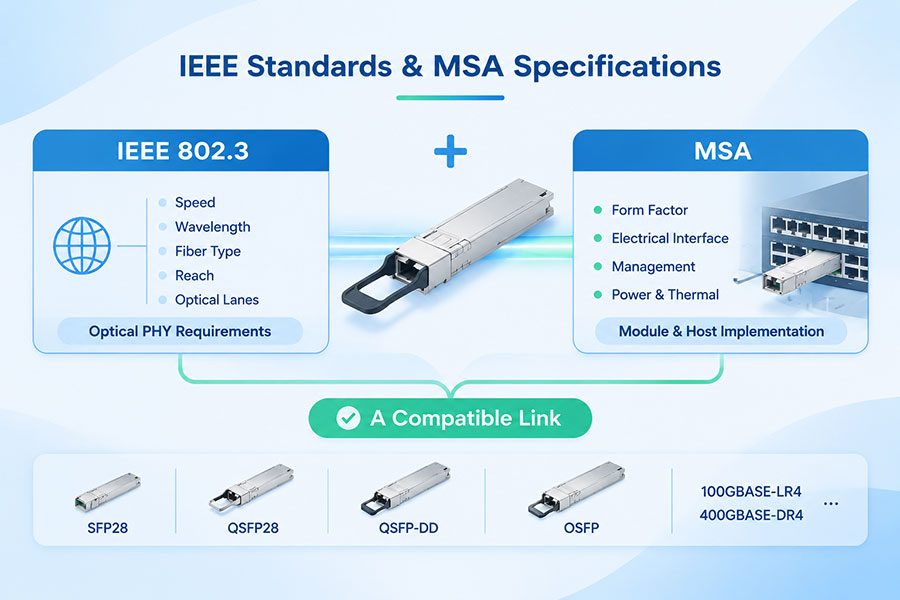
Ethernet and InfiniBand use different network protocols, but both depend on compatible physical connectivity. Depending on the distance and port architecture, AI networks can use DAC, AEC, AOC, or pluggable optical transceivers.
| Interconnect | Transmission medium | Typical application | Selection considerations |
|---|---|---|---|
| DAC | Twinaxial copper | Short server-to-switch and switch-to-switch links | Reach, cable gauge, signal integrity, port compatibility |
| AEC | Active copper | Supported short-reach links requiring signal conditioning | Active electronics, power, reach, host support |
| AOC | Integrated optical fiber | Fixed-length optical connections | Length, connector, protocol and platform compatibility |
| Optical transceiver | Pluggable optical module with separate fiber | Server-to-switch and switch-to-switch fiber links | Optical standard, wavelength, fiber type, reach and coding |
A critical procurement detail is that a matching data rate and connector do not guarantee cross-protocol compatibility. An Ethernet-qualified module should not automatically be assumed to work in an InfiniBand port, or vice versa. The module's supported protocol, coding, firmware, signaling rate, and host platform must all be checked.
8. When Should an AI Data Center Choose Ethernet or InfiniBand?
The decision should begin with the intended workload and operating model rather than a general assumption that one technology is always superior.
Ethernet is a strong option when:
The organization already operates a large Ethernet data center infrastructure.
Multi-vendor flexibility and integration with existing IP services are important.
The AI network needs to support multiple types of workloads and services.
The team has the expertise to engineer and monitor a high-performance RoCEv2 fabric.
The deployment strategy prioritizes a broad ecosystem and flexible infrastructure expansion.
InfiniBand is a strong option when:
The cluster is dedicated to demanding HPC or AI training workloads.
A specialized high-performance fabric is acceptable.
Native RDMA and tightly managed fabric behavior are key requirements.
The organization has the operational expertise and compatible equipment for InfiniBand.
The selected AI platform has been designed and qualified around InfiniBand connectivity.
Some data centers also operate separate networks for GPU communication, storage, management, and general application traffic. Ethernet and InfiniBand can therefore coexist in the same facility while serving different purposes.
9. C-LIGHT Connectivity Solutions for AI Networking
Both Ethernet and InfiniBand AI fabrics require high-speed interconnect products that match the network protocol, switch platform, adapter, and physical link requirements. C-LIGHT provides DAC, AOC, and optical connectivity options for data center and high-performance computing applications.
High-speed copper connectivity
400G DAC cables – short-reach copper connectivity for compatible 400G ports and supported breakout configurations.
800G DAC cables – high-bandwidth copper connections for compatible 800G systems.
800G AEC cables – active electrical connectivity for supported high-speed applications.
Optical cable assemblies
400G AOC cables – integrated optical cable assemblies for compatible 400G links.
800G AOC cables – optical connectivity for supported high-speed data center deployments.
Pluggable optical modules
C-LIGHT Optical Transceiver Portfolio – optical modules for different data rates, form factors, and transmission distances.
For InfiniBand or Ethernet deployments, the required protocol and equipment compatibility must be confirmed for each product model. A product's speed or form factor alone is not sufficient to establish compatibility.
10. Conclusion
Ethernet and InfiniBand are both capable of supporting large-scale AI networking, but they approach high-performance communication differently. Ethernet with RoCEv2 offers a flexible foundation that can integrate with established data center infrastructure, while InfiniBand provides a dedicated fabric with native RDMA and specialized congestion-management capabilities.
The best architecture depends on workload behavior, cluster scale, network performance targets, operational expertise, equipment ecosystem, and long-term infrastructure strategy. In either case, carefully selected DAC, AEC, AOC, and optical transceivers are essential to building reliable high-speed connections across GPU servers and network switches.
 >

 >
 >
 >
 >
 >
 >
 >