TEL:+86 132 6656 7067





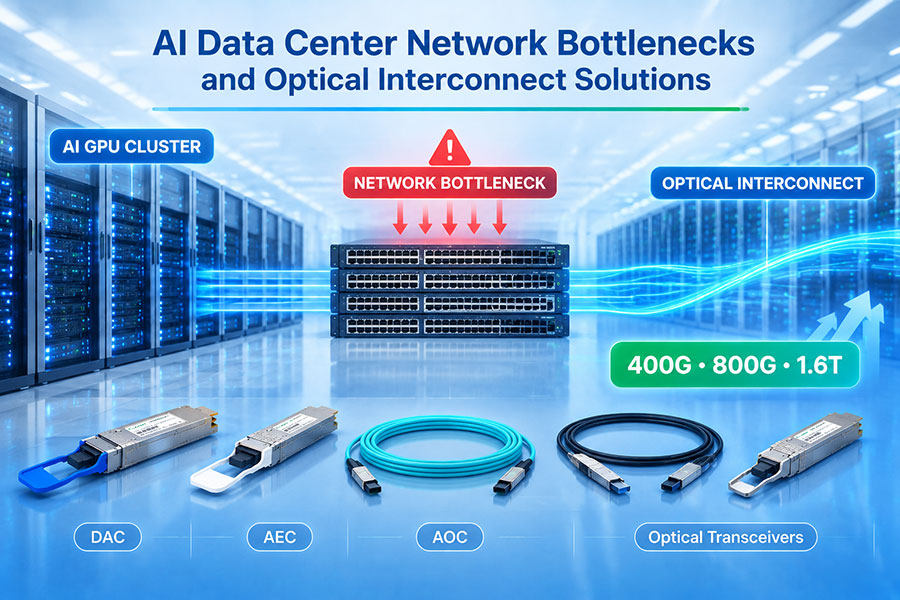
High-speed data center connections depend on maintaining signal integrity across increasingly demanding electrical channels. Passive and active Direct Attach Copper (DAC) cables both use copper conductors and integrated connector assemblies, but they differ in how electrical signals are handled along the link. The choice affects transmission distance, power requirements, cable cost, and equipment compatibility.
1. What Is a Passive DAC Cable?
A passive DAC cable is a factory-terminated copper assembly, typically using twinaxial conductors with integrated connectors at both ends. It carries electrical signals directly between compatible switch, server, storage, or network interface ports.
Unlike an active cable, a passive DAC does not contain signal-conditioning electronics that amplify, equalize, or regenerate the data signal. The transmitter and receiver circuits inside the connected equipment handle the electrical requirements of the connection.
This straightforward architecture makes passive DAC a practical option for short-distance connections inside data center racks.
No active signal-conditioning circuitry: The cable does not boost or regenerate the transmitted signal.
Low power requirement: It does not need active cable-side power for signal conditioning.
Low latency: The electrical signal travels directly through the copper channel without optical conversion or additional active signal processing.
Cost efficiency: Its simpler construction generally makes it less expensive than an equivalent active DAC.
Shorter practical reach: Signal attenuation and channel loss limit the distance supported at a given data rate.
Passive DAC cables are commonly used for switch-to-server, switch-to-switch, and server-to-storage connections where the equipment is close together and both ports support the required cable specification.
2. What Is an Active DAC Cable?
An active DAC cable also uses copper conductors and integrated connector assemblies, but it includes electronic components that condition the electrical signal. Depending on the design, these components may use equalization, amplification, or other signal-conditioning techniques to compensate for channel loss.
By improving signal quality across the copper connection, an active DAC can support cable lengths or electrical conditions that may exceed the practical capability of a comparable passive cable.
Integrated electronics: Active components are built into the connector assemblies.
Signal conditioning: Circuitry helps compensate for electrical loss and signal degradation.
Extended copper reach: It can support longer connections than a comparable passive design, subject to product and platform specifications.
Additional power: Active circuitry requires power from the host equipment.
Higher cost and complexity: Additional components increase design and qualification requirements.
The term active DAC describes a broad category rather than one universal circuit design. Some active copper assemblies use equalization or amplification, while retimer-based designs are commonly identified separately as Active Electrical Cables (AEC). The exact architecture should be confirmed from the product specification.
3. Passive DAC vs. Active DAC: Main Differences
Both cable types provide direct electrical connectivity, but their internal construction and operating requirements are different.
| Parameter | Passive DAC | Active DAC |
|---|---|---|
| Transmission medium | Twinaxial copper | Twinaxial copper |
| Signal-conditioning electronics | None in the cable signal path | Integrated into connector assemblies |
| Signal handling | Relies on host transmitter and receiver capabilities | Uses active circuitry to condition the electrical signal |
| Power consumption | No active signal-conditioning power required | Requires power for active circuitry |
| Transmission reach | Generally shorter | Can extend beyond comparable passive designs |
| Latency | Very low, with no active signal-processing stage | Depends on the signal-conditioning architecture |
| Cost | Generally lower | Generally higher |
| Design complexity | Relatively simple | Higher due to integrated electronics |
| Typical application | Short in-rack connections | Longer or more electrically demanding copper links |
There is no universal distance limit that applies to every passive or active DAC. Supported lengths depend on the data rate, lane speed, cable construction, connector design, electrical channel budget, and host platform qualification.
4. Transmission Distance and Signal Integrity
Transmission distance is one of the main factors when selecting between passive and active DAC cables. As data rates and per-lane signaling speeds increase, maintaining signal integrity across copper becomes more challenging.
Electrical signals experience attenuation and other channel impairments as they travel through copper conductors and connectors. Passive DAC cables rely on the host equipment's transmit and receive capabilities to handle these effects. Once the total channel loss exceeds the supported electrical budget, the connection may fail to establish or operate reliably.
Active DAC cables introduce signal-conditioning components to help compensate for some of these impairments. This can extend the practical reach of copper connectivity, although the improvement varies by design and data rate.
| Deployment condition | Passive DAC suitability | Active DAC suitability |
|---|---|---|
| Very short connections within a rack | Usually a strong option when qualified | Can work, but may add unnecessary cost and power |
| Longer copper connections | Limited by the available channel budget | Worth considering when supported by both endpoints |
| High-speed links with tight signal margins | Requires careful channel validation | May provide additional signal-conditioning margin |
| Links beyond the supported copper reach | Not suitable | May also be unsuitable; AOC or optical transceivers may be required |
For high-speed 400G and 800G connections, cable selection should be based on the specified lane configuration and validated electrical performance rather than connector appearance alone.
5. Power Consumption, Latency, and Cost
Passive DAC cables are attractive in large data center deployments because they do not require active signal-conditioning circuitry. This reduces cable-side power requirements and avoids the additional electronics found in active designs.
Active DAC cables require power from the connected equipment to operate their integrated circuitry. The actual power draw depends on the cable architecture, data rate, and product implementation. This should be included in port power and thermal planning, especially when many active connections are deployed in a high-density rack.
Latency is also worth considering. Passive DAC has no active signal-processing stage, while active DAC may introduce a small amount of processing delay depending on its circuitry. Retimer-based AEC designs have their own latency characteristics and should not automatically be treated as identical to other active DAC architectures.
In terms of cost, passive DAC is generally the more economical choice for short links. Active DAC carries a higher component and qualification cost, but may avoid the need to move to an optical solution when a modestly longer copper connection is required.
6. When Should You Choose Passive or Active DAC?
The best choice depends on the electrical requirements of the connection, not simply on whether one cable type is more advanced.
Choose passive DAC when:
The connected devices are located close together.
The required cable length is within the qualified passive DAC range.
Both endpoint ports support the cable's data rate and electrical interface.
Low power consumption and cost efficiency are priorities.
The host equipment can provide sufficient signal conditioning for the complete channel.
Consider active DAC when:
The required copper connection is longer than the available passive option supports.
Signal loss makes a passive connection unsuitable.
The network design requires copper connectivity rather than optical fiber.
The connected switches, servers, or NICs explicitly support the selected active cable architecture.
The additional power and cost are acceptable for the deployment.
7. Compatibility Considerations for 400G and 800G DAC
At 400G and 800G, selecting a DAC cable requires more than matching the connector form factor. The host interface, lane rate, modulation format, cable architecture, and supported breakout configuration must all align.
For example, a QSFP-DD or OSFP connector does not automatically guarantee that every cable with the same connector can operate at the required speed. The switch or server must support the specific passive or active cable type, and its firmware and cable qualification requirements may also affect interoperability.
Before deployment, verify the following:
Connector type: Confirm QSFP-DD, OSFP, QSFP112, or another required interface at each end.
Data rate and lane configuration: Match the cable to the required aggregate speed and electrical lane arrangement.
Cable architecture: Confirm whether the platform supports passive DAC, active DAC, ACC, or AEC as applicable.
Cable length: Check the qualified length for the exact cable model and data rate.
Vendor coding: Verify EEPROM identification and equipment compatibility requirements.
Breakout support: Confirm that the switch port supports the required breakout mode and lane mapping.
For short-reach, high-bandwidth data center connections, C-LIGHT provides DAC cable solutions for multiple network speeds and connector platforms.
400G DAC Cables – Designed for compatible 400G switch, server, and data center interconnections.
800G DAC Cables – For high-density 800G connectivity in next-generation data center environments.
Selection can be evaluated according to connector type, cable length, equipment model, data rate, and compatibility requirements.
8. Conclusion
Passive and active DAC cables both provide high-speed electrical connectivity over copper, but they serve different channel requirements. Passive DAC offers a simple, low-power, cost-effective solution for short connections where the host equipment can manage the electrical signal. Active DAC adds signal-conditioning electronics to support more demanding copper links, with additional power, cost, and compatibility considerations.
For data center deployments, the right decision should be based on actual cable distance, lane speed, host support, and electrical performance. A properly qualified passive DAC is often sufficient for short connections, while active copper can provide another option when additional reach or signal margin is required.
Share your equipment models, port types, data rates, and required cable lengths to identify a suitable configuration.
Contact C-LIGHT >

 >
 >
 >
 >
 >
 >
 >