TEL:+86 132 6656 7067





Optical transceiver quality depends on more than whether a module can establish a link. A reliable product must meet its electrical and optical specifications, maintain performance under defined operating conditions, and demonstrate consistent manufacturing quality. Optical module validation and production testing both support these objectives, but they serve different purposes and take place at different stages of the product lifecycle.
1. What Is Optical Module Validation?
Optical module validation is a systematic engineering process used to evaluate a transceiver design before it is approved for a particular application or released into production. It examines whether the product performs as intended across its specified operating conditions and interfaces.
Validation may take place during product development, after a design change, or when a module is being qualified for a new host platform or network application. Its scope is generally broader than a routine manufacturing test because it investigates design performance, operating margins, interoperability, and reliability.
Key objectives of validation
Confirm that optical and electrical parameters meet the product specification.
Evaluate performance across supported operating temperatures and supply conditions.
Verify interoperability with intended switches, routers, servers, and test platforms.
Assess signal quality and error performance under defined test conditions.
Identify design weaknesses and operating-margin limitations.
Evaluate reliability under applicable environmental and stress-test conditions.
2. What Is Optical Transceiver Production Testing?
Production testing is performed during manufacturing to determine whether each finished module, or each unit selected under an approved sampling plan, meets defined quality and performance requirements. The purpose is to prevent products with unacceptable characteristics from entering the supply chain.
Unlike design validation, production testing is designed around repeatability, throughput, traceability, and clear pass/fail criteria. Test procedures must be sufficiently consistent to identify manufacturing variation without creating unnecessary delays.
Key objectives of production testing
Verify critical optical and electrical parameters.
Identify defective components or assembly problems.
Confirm the module's basic operation and interface recognition.
Check that measured results fall within approved acceptance limits.
Record test results for manufacturing traceability.
Reduce the risk of nonconforming products being shipped.
3. Validation vs. Production Testing: Main Differences
| Comparison Item | Optical Module Validation | Production Testing |
|---|---|---|
| Primary purpose | Verify design performance and application suitability. | Verify manufacturing quality and product conformity. |
| Typical timing | During development, qualification, and design changes. | During manufacturing and before shipment. |
| Test scope | Broad evaluation of performance, interoperability, margins, and reliability. | Defined checks against production acceptance criteria. |
| Test samples | Representative engineering samples and qualification units. | Manufactured units or samples selected under the quality plan. |
| Test duration | May involve extended testing and multiple environmental conditions. | Usually optimized for repeatable manufacturing throughput. |
| Test methods | Detailed engineering measurements and application-specific evaluation. | Standardized production procedures and automated test sequences. |
| Typical output | Validation reports, design findings, and qualification decisions. | Pass/fail records, measured data, and product traceability. |
| Main responsibility | Engineering, product development, and qualification teams. | Manufacturing engineering and quality control teams. |
4. What Parameters Are Evaluated During Module Validation?
Validation covers the characteristics that determine whether a module can operate reliably in its intended environment. The exact test plan depends on the product type, data rate, optical reach, interface standard, and customer application.
Optical performance
Transmit optical power: Confirms that the transmitter output meets the specified range.
Receiver sensitivity: Evaluates the minimum received optical signal level required to achieve the specified performance.
Wavelength accuracy: Verifies that the transmitter operates within the required wavelength range.
Extinction ratio: Evaluates the optical modulation characteristics where applicable.
Optical return loss and reflectance: Evaluates reflection-related characteristics when required by the interface specification.
BER performance: Measures transmission error performance under defined test conditions.
Electrical performance
Electrical validation examines the interface between the transceiver and host equipment. Depending on the module architecture, testing may include signal integrity, lane operation, electrical input and output characteristics, power consumption, and high-speed signal quality.
Environmental performance
Modules may be evaluated across their specified operating temperature range and other applicable environmental conditions. The purpose is to confirm that optical and electrical performance remains within defined limits under the intended operating conditions.
Interoperability and host compatibility
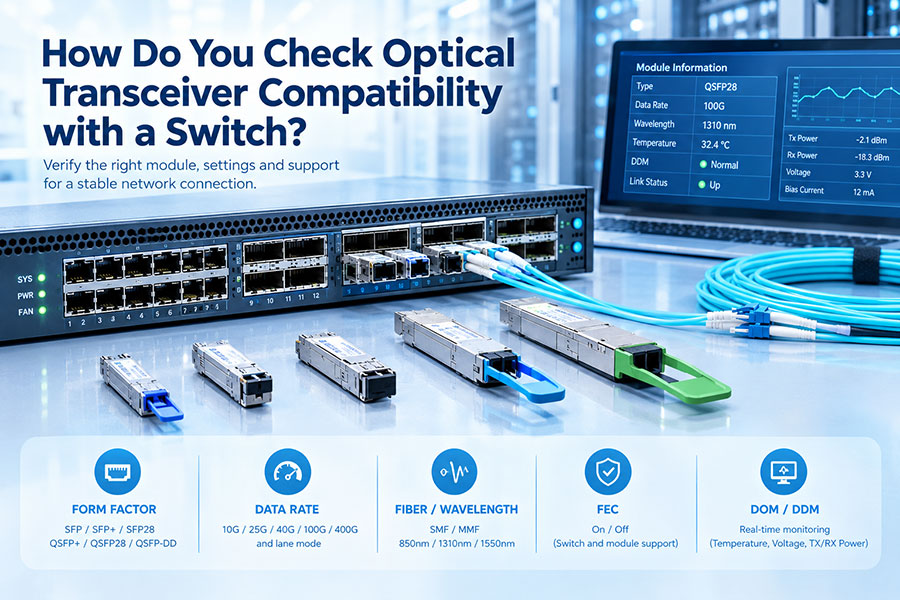
Validation may include testing with target switches, routers, servers, and network equipment. It checks module recognition, supported data rates, interface configuration, diagnostic reporting, and stable link operation. Compatibility should be verified against specific host models and firmware versions rather than assumed from connector or form-factor matching alone.
5. What Tests Are Commonly Performed During Production?
Production test plans focus on the parameters needed to confirm that each manufactured module meets its approved specifications. The selected measurements depend on the product design, manufacturing process, quality requirements, and customer agreement.
Optical power testing
Measures transmitter output power and, where included in the test setup, verifies receiver-related optical performance.
Wavelength measurement
Confirms that the transmitter wavelength falls within the specified product range.
Power consumption testing
Measures module power consumption under defined operating conditions.
Functional and link testing
Checks module recognition, basic operation, and link establishment using an appropriate test platform.
DOM/DDM verification
Checks diagnostic functions and reported parameters such as temperature, voltage, TX power, and RX power where supported.
Visual and mechanical inspection
Checks housing condition, connector interface, labeling, and other manufacturing requirements.
Not every production line performs every possible measurement on every unit. Some tests may be performed on representative samples, while critical acceptance checks may be required for each finished module. The actual inspection plan should be defined by the product quality specification.
6. The Role of BER Testing in Validation and Production
Bit Error Rate testing is important for high-speed optical transceivers because it evaluates whether the transmitted data can be recovered accurately under specified conditions. However, BER testing serves different purposes in validation and production.
| BER Test Aspect | During Validation | During Production |
|---|---|---|
| Test objective | Characterize performance and verify design margins. | Confirm that the unit meets its defined acceptance requirement. |
| Test conditions | May include multiple operating conditions and application scenarios. | Uses a controlled and repeatable test configuration. |
| Measurement scope | May include detailed lane-level and signal-quality analysis. | Uses the measurements specified in the production test plan. |
| Result interpretation | Supports design assessment and engineering improvement. | Determines whether the unit passes the acceptance criteria. |
FEC configuration must also be considered when interpreting BER results. Pre-FEC BER, corrected codewords, uncorrectable codewords, and post-FEC performance describe different aspects of link quality. Test reports should identify the measurement point and relevant FEC settings to make results meaningful.
7. Why Validation and Production Testing Are Both Necessary
Passing production testing does not replace design validation. A production test can confirm that a module meets a defined set of manufacturing limits, but it may not cover every environmental condition, host platform, or long-term reliability scenario.
Likewise, successful validation of a design does not guarantee that every manufactured unit will meet the same requirements. Component variation, assembly differences, and process changes can introduce unit-level defects.
8. How the Two Processes Fit Into Optical Module Manufacturing
A typical optical transceiver development and manufacturing workflow connects engineering qualification with ongoing production quality control. The exact sequence varies by manufacturer and product, but the relationship can be represented as follows:
Design and development: Define the module architecture, interface requirements, optical specifications, and electrical characteristics.
Engineering verification: Evaluate circuit and optical subsystem performance during development.
Design validation: Verify that the complete module meets its intended specifications and application requirements.
Qualification approval: Review test results and approve the design for the intended production or deployment scope.
Manufacturing: Assemble modules using controlled components and production processes.
Production testing: Measure defined parameters and identify units that do not meet acceptance criteria.
Final quality inspection: Review required records, labeling, packaging, and release requirements.
Design changes, component substitutions, or manufacturing process changes may require additional validation or requalification. The required level of retesting depends on the potential impact of the change.
9. What Should Buyers Ask About Optical Module Testing?
When sourcing optical transceivers, buyers should understand both the product qualification process and the manufacturing quality controls. A general statement that modules are tested is less informative than a clearly defined test scope and acceptance standard.
Which optical and electrical parameters are measured for each unit?
Are transmit power, wavelength, and power consumption recorded?
Is receiver sensitivity verified, and under what test conditions?
Is BER testing included for the applicable data rate and interface?
Which host platforms and firmware versions have been validated?
Are DOM/DDM functions and alarm thresholds checked?
Are test results traceable to individual modules or production batches?
What validation is required after a component or design change?
These questions help establish whether the supplier's quality process matches the technical and operational requirements of the intended network.
10. Conclusion
Optical module validation and production testing are related but distinct quality processes. Validation evaluates whether a transceiver design meets its performance, compatibility, and reliability requirements. Production testing checks whether manufactured units conform to the approved specifications before they are released.
For high-speed optical products, both processes are important. Design validation supports confidence in the module architecture, while consistent production testing helps control manufacturing variation and maintain product quality. Together, they provide a stronger foundation for reliable deployment across data center, enterprise, and telecom networks.
Looking for Qualified Optical Transceiver Solutions?
C-LIGHT provides optical transceivers and high-speed connectivity products for data center, enterprise, and telecom applications. Contact our team for product specifications, compatibility evaluation, and quality-related information.
Contact C-LIGHT >

 >
 >
 >
 >
 >
 >
 >