TEL:+86 132 6656 7067





An AI data center is not built around a single type of cable. GPU servers, top-of-rack switches, spine switches, and data center interconnects operate across different physical distances and network layers. DAC, AOC, and optical transceivers each address a different part of this infrastructure. Their roles are complementary: copper supports short electrical connections, AOC provides an integrated optical cable assembly, and pluggable optical transceivers enable flexible fiber-based network links.
1. The Physical Connectivity Structure of an AI Data Center
AI training and inference systems generate substantial traffic between GPUs, servers, switches, storage systems, and other computing resources. The network must provide sufficient bandwidth while controlling latency, power consumption, cable congestion, and deployment costs.
A typical AI data center uses a layered network architecture. The exact topology depends on the number of accelerators, switch capacity, network protocol, oversubscription target, and whether the system uses Ethernet or InfiniBand.
Different links in this structure have different physical requirements. A server and switch inside the same rack may need only a short cable, while connections between separate racks or network rooms may require fiber-based transmission.
2. DAC: Short-Reach Connectivity Inside the Rack
Direct Attach Copper (DAC) uses twinaxial copper conductors with connector assemblies integrated at both ends. Passive DAC does not require optical-to-electrical conversion or active signal processing inside the cable.
Its low power consumption, low latency, and relatively low cost make DAC suitable for short connections where the electrical channel remains within the equipment's signal-integrity limits.
Typical AI data center applications
GPU server to top-of-rack switch connections.
Short switch-to-switch links within a rack.
Server and network adapter connections.
Short-distance connections in compact AI and HPC systems.
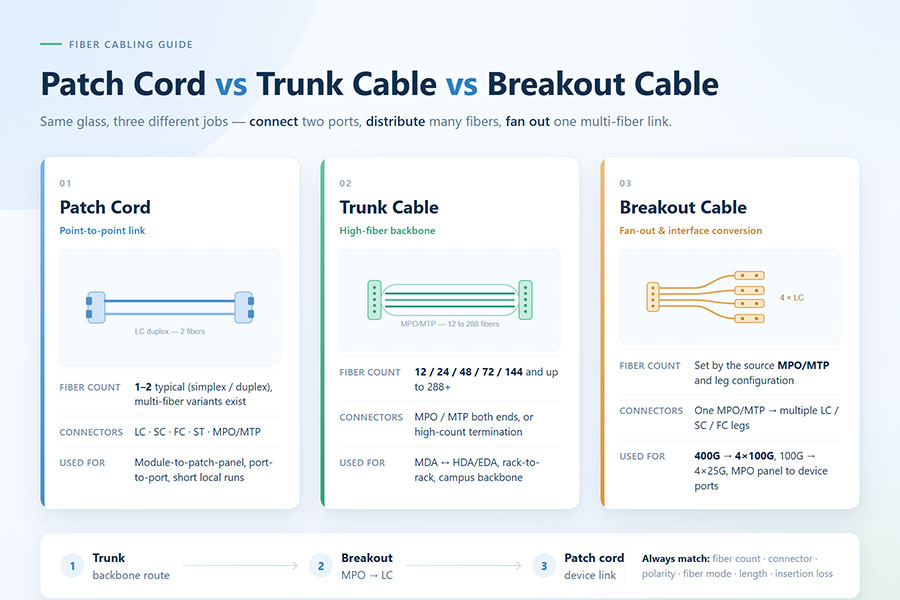
For high-speed systems, C-LIGHT provides 400G DAC cable solutions and 800G DAC cable solutions for short-reach connectivity. Available connector types, breakout configurations, and lengths should be matched to the target switch and server ports.
3. AOC: Optical Cabling for Flexible Rack-to-Rack Links
Active Optical Cable (AOC) integrates optical transmitters and receivers into the cable ends, with optical fiber connecting the two assemblies. Unlike a pluggable transceiver deployment, an AOC is supplied as a complete cable assembly and does not require separate optical patch cords for that link.
AOC is useful when a copper cable becomes impractical because of distance, cable weight, routing congestion, or electromagnetic interference considerations.
Where AOC is used
Rack-to-rack connections within a data hall.
Switch-to-switch links across equipment rows.
Longer server-to-switch connections where supported by the system.
High-density AI clusters that benefit from lighter fiber cabling.
Fiber-based AOC assemblies provide electrical isolation along the cable path and are generally lighter than equivalent high-speed copper assemblies. However, their integrated construction means that the cable length and connector configuration must be selected before deployment. If one end fails, the cable assembly is normally replaced as a unit.
C-LIGHT offers 400G AOC solutions and 800G AOC solutions for high-speed data center connectivity.
4. Optical Transceivers: Flexible Connectivity Across the Network Fabric
Pluggable optical transceivers convert electrical signals from a switch or network adapter into optical signals for transmission over fiber. At the receiving end, another transceiver converts the optical signal back into an electrical signal.
Unlike AOC, the transceiver and fiber cable are separate components. This modular structure gives network operators more flexibility when selecting fiber types, cable routes, connector interfaces, and transmission distances.
Common deployment scenarios
Leaf-to-spine switch connections across racks or rows.
High-bandwidth links between network equipment rooms.
Large AI fabric deployments requiring structured fiber cabling.
Longer campus or data center interconnect links, using suitable optical technologies.
Multimode optics are often selected for supported short-reach links, while single-mode optics provide options for longer distances and larger fiber infrastructures. The actual reach depends on the transceiver standard, wavelength, fiber specification, connector quality, and link budget.
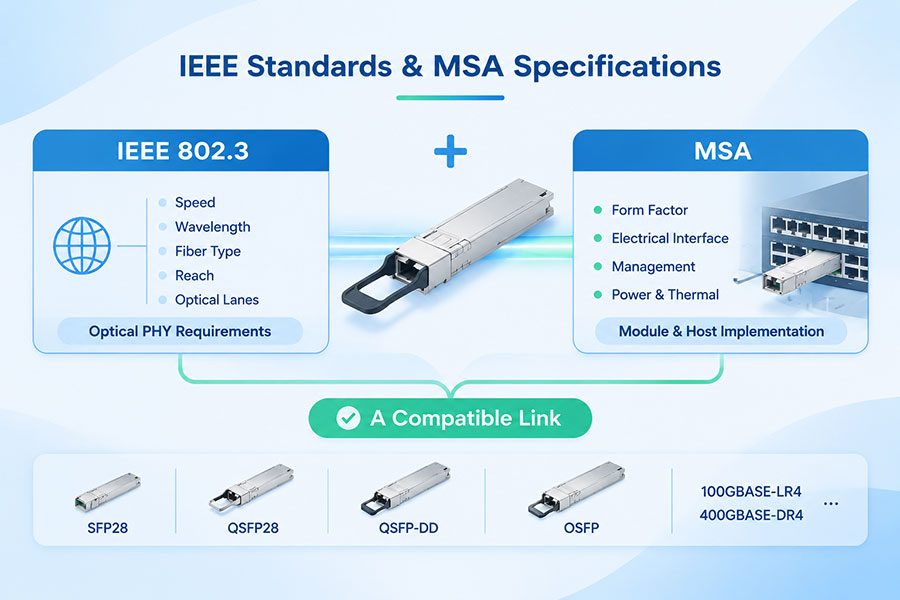
For AI networks using 400G and 800G equipment, optical modules may use form factors such as QSFP-DD and OSFP. C-LIGHT's optical transceiver portfolio includes solutions for different data rates and transmission requirements.
5. How the Three Technologies Work Together
DAC, AOC, and pluggable optical transceivers should be selected according to the physical layout of the network rather than treated as competing technologies. A single AI data center can use all three across different connection layers.
| Network connection | Potential solution | Primary reason |
|---|---|---|
| GPU server to ToR switch in the same rack | DAC | Short electrical path, low power, and cost efficiency |
| Connections between nearby racks | AOC or optical transceivers with fiber | More flexible optical routing and reduced cable weight |
| Leaf-to-spine links across rows | Optical transceivers with fiber | Modular fiber connectivity and scalable link planning |
| Connections between buildings or data center sites | Appropriate single-mode optics or coherent systems | Longer reach and higher-capacity transport options |
This is a general deployment model, not a fixed rule. Some systems use AOC for switch-to-switch connections, while others use pluggable optics for shorter links to simplify maintenance or standardize their cabling infrastructure. Port capability and platform qualification remain decisive.
6. Choosing the Right Solution for 400G and 800G AI Networks
As AI fabrics move toward 400G and 800G connectivity, the physical design becomes increasingly important. Higher lane rates place tighter requirements on electrical signal integrity, optical performance, connector quality, thermal management, and cable routing.
| Selection factor | DAC | AOC | Optical transceiver + fiber |
|---|---|---|---|
| Transmission medium | Copper | Integrated optical fiber | Separate optical fiber |
| Typical role | Short connections | Optical cable assemblies | Modular optical links |
| Power profile | Passive DAC has very low power use | Active optical conversion at cable ends | Power consumed by each transceiver |
| Cabling flexibility | Limited by electrical reach and cable routing | Fixed cable assembly and length | Separate transceivers and fiber cabling |
| Maintenance | Replace cable assembly | Replace cable assembly | Transceivers and fiber can be serviced separately |
| Important checks | Channel loss, length, AWG, host support | Reach, fiber type, connector, host support | Optical standard, wavelength, fiber, link budget |
400G deployment
400G DAC can support short connections between compatible switches and servers. 400G AOC provides an integrated optical alternative, while 400G pluggable modules allow separate fiber infrastructure for links that need a modular design.
For example, a 400G switch port may connect to a compatible 400G server adapter through a DAC, or connect to another switch through an AOC or two optical transceivers with a fiber link. Breakout configurations such as 400G to 4×100G or 8×50G are also possible when supported by the host ports, cable mapping, and network configuration.
800G deployment
At 800G, port density, signal integrity, power, and thermal design become even more significant. Short links may use 800G DAC where the electrical channel permits. AOC and 800G optical transceivers provide fiber-based alternatives for links that need greater physical reach or different cable-routing characteristics.
Product selection should include the exact form factor, host interface, modulation and lane architecture, firmware support, and required link distance. An 800G label alone does not guarantee that two devices or cable assemblies are interoperable.
7. What Network Designers Should Check Before Deployment
Choosing an interconnect based only on speed and distance can lead to compatibility or operational problems. A complete deployment review should include the following factors:
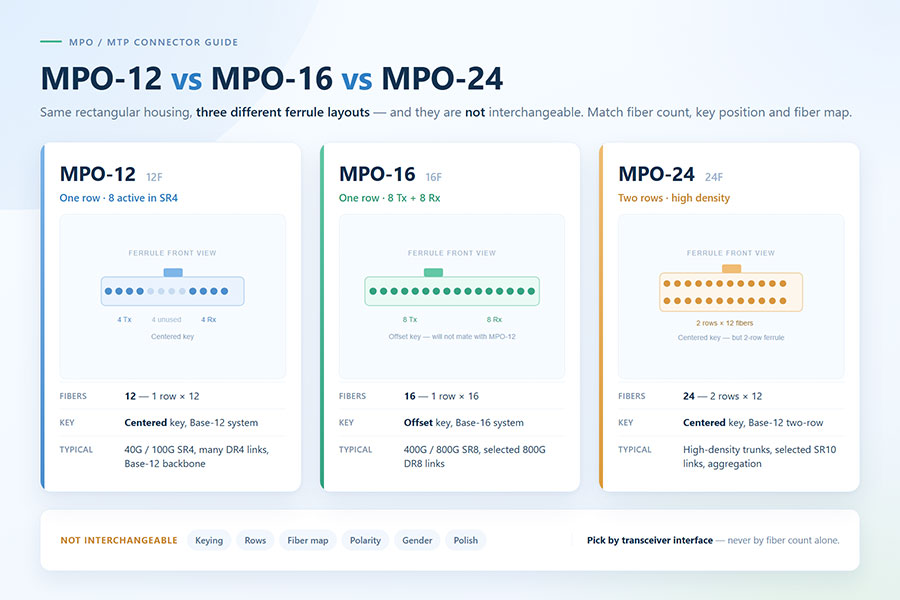
Port and form-factor compatibility: Confirm QSFP-DD, OSFP, QSFP112, or other required interfaces at both ends.
Protocol support: Verify Ethernet or InfiniBand operation and the supported device configuration.
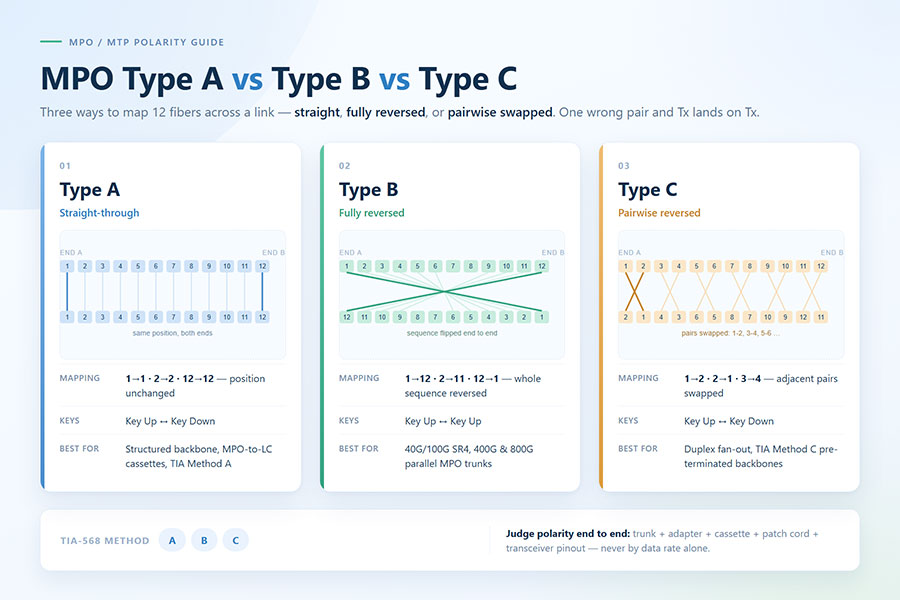
Lane mapping: Check breakout mode, lane assignment, and any required gearbox functionality.
Reach and cabling: Confirm cable length, fiber type, connector type, and the complete optical or electrical link budget.
Power and cooling: Account for transceiver power, airflow, module temperature, and cable congestion around high-density switches.
Monitoring and maintenance: Check diagnostic support, including DDM where applicable, and establish replacement procedures.
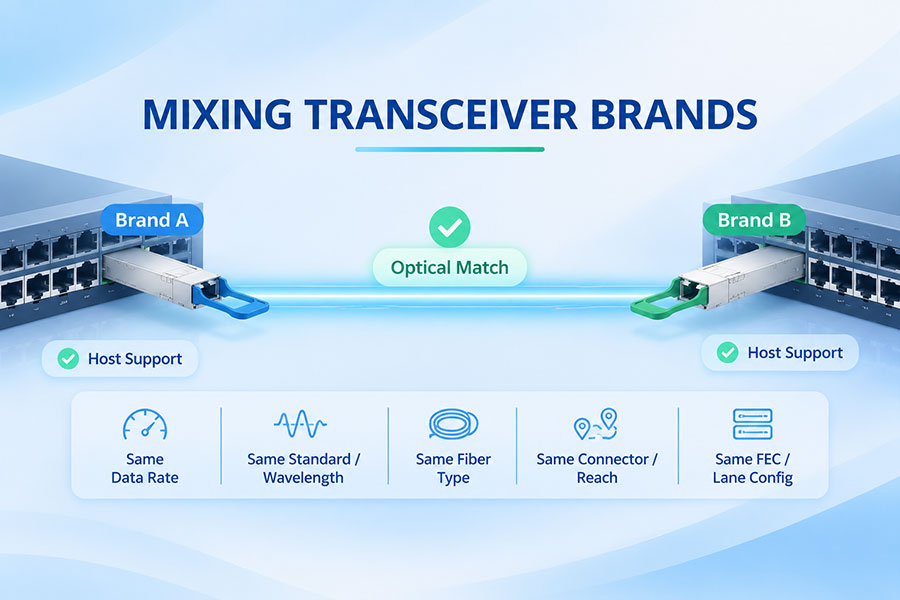
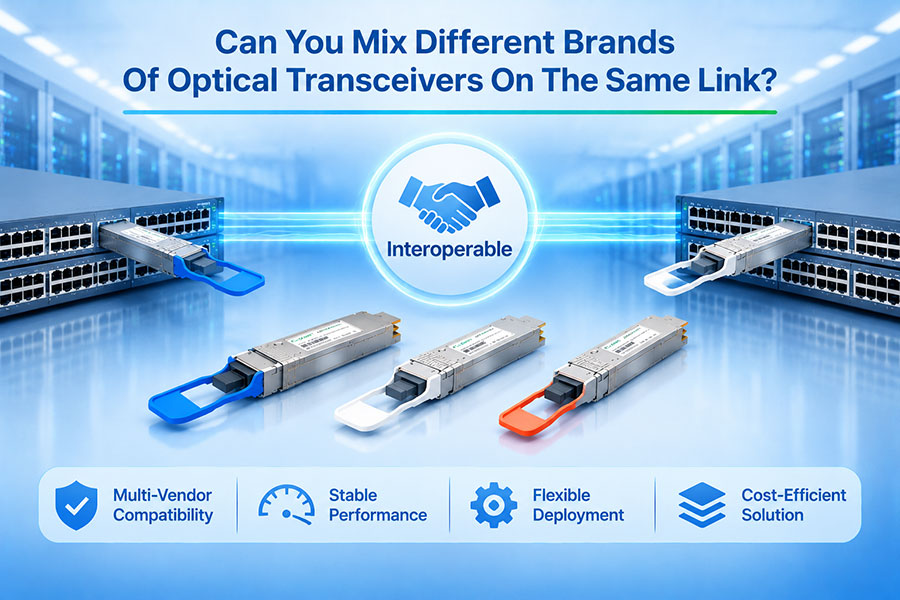
Interoperability: Validate coding, firmware, switch software, and the complete end-to-end connection before large-scale deployment.
8. C-LIGHT Connectivity Solutions for AI Data Centers
AI data center infrastructure requires multiple interconnect types to support different distances, bandwidth levels, and equipment layouts. C-LIGHT provides high-speed copper and optical connectivity options for data center, HPC, and AI networking applications.
Short-reach copper connectivity
400G DAC cables – for compatible short-distance 400G connections and supported breakout configurations.
800G DAC cables – for short-reach, high-bandwidth connections in compatible 800G systems.
Fiber-based cable assemblies
400G AOC cables – integrated optical cable assemblies for supported 400G links.
800G AOC cables – optical connectivity options for compatible high-speed network equipment.
Modular optical connectivity
Optical transceivers – pluggable optical solutions across multiple data rates, form factors, and reach requirements.
When planning a new AI network or upgrading an existing data center, the appropriate solution depends on the switch and adapter models, required bandwidth, link distance, port configuration, and operating environment. Contact C-LIGHT for product selection and compatibility support.
9. Conclusion
DAC, AOC, and optical transceivers form complementary parts of an AI data center connectivity strategy. DAC is well suited to short electrical connections where low power and cost are priorities. AOC provides integrated fiber connectivity for links that need optical transmission without separate patch cables. Pluggable optical transceivers offer modularity and flexibility across larger network fabrics.
The most effective architecture assigns each technology to the links where its physical characteristics provide the greatest benefit. By considering distance, bandwidth, compatibility, power, cooling, and maintenance together, network designers can build AI data center networks that are easier to scale and operate.
 >

 >
 >
 >
 >
 >
 >
 >