TEL:+86 132 6656 7067




Coherent and direct-detect optics represent two fundamentally different approaches to encoding and recovering information from light. Direct-detect, also called intensity-modulation direct-detection (IM/DD), measures only the intensity of received light. Coherent detection recovers the full optical field—amplitude, phase, and polarization—by mixing the received signal with a local oscillator laser. This fundamental difference in signal recovery drives everything that follows, including the power consumption profile of the module.
The power gap between these two technologies has been one of the most consequential factors in optical network design. At 100G, a coherent module consumed roughly ten times the power of its direct-detect counterpart. That gap made coherent optics economically unviable for anything except long-haul and metro transport, where the cost and power of regeneration and dispersion compensation outweighed the module premium. But as data rates have climbed from 400G to 800G and toward 1.6T, the power gap has narrowed dramatically. At 800G, both technologies are approaching the 20-watt class, and the choice between them increasingly depends on reach, fiber availability, and total system cost rather than raw power consumption alone.
Understanding why this convergence is happening—and where it will stabilize—requires examining the power consumption of each technology at the component level: the digital signal processor, the optical engine, the laser, and the thermal constraints of the form factor. It also requires understanding how power consumption scales differently with distance, because coherent and direct-detect systems use fundamentally different strategies to overcome optical impairments.
1. The Power Consumption Gap: From 10x to Near Parity
The power consumption trajectory of coherent and direct-detect optics tells a story of convergence driven by CMOS scaling, silicon photonics integration, and architectural innovation.
| Data Rate | Direct-Detect Power | Coherent Power | Power Ratio | Key Driver |
|---|---|---|---|---|
| 100G | 2–4 W | 20–25 W | ~10x | Coherent DSP overhead |
| 400G | 8–14 W | 15–20 W | 1.3–1.7x | DSP node shrink, PAM4 adoption |
| 800G | ~15–20 W | ~20–25 W | ~1.3x | CMOS scaling, silicon photonics |
| 1.6T | ~20–25 W | 28–35 W | ~1.3–1.5x | 3nm DSP, integrated optics |
At 100G, coherent modules consumed 20 to 25 watts while direct-detect equivalents drew only 2 to 4 watts—a gap of approximately 10x. The coherent DSP of that era had to perform chromatic dispersion compensation, polarization tracking, carrier phase recovery, and forward error correction in real time, all on comparatively large CMOS nodes. Direct-detect modules, by contrast, used little or no DSP for short-reach applications.
At 400G, the gap narrowed to approximately 1.3 to 1.7x. A direct-detect 400G module consumed 8 to 14 watts depending on reach and form factor, while a coherent 400G ZR module consumed 15 to 20 watts. Two factors drove this convergence: direct-detect modules adopted PAM4 modulation, which required their own DSP for equalization and FEC, and coherent DSPs migrated to smaller CMOS nodes that reduced their power proportionally.
At 800G, the gap has narrowed to approximately 1.3x, with both technologies approaching the 20-watt class. A direct-detect 800G module consumes roughly 15 to 20 watts, while a coherent 800G ZR module consumes 24 to 30 watts depending on implementation and reach. The convergence continues because both technologies are benefiting from the same underlying advances: advanced CMOS nodes, silicon photonics integration, and more efficient signal processing algorithms.
The projection for 1.6T suggests the gap will stabilize in the 1.3 to 1.5x range, with coherent modules consuming 28 to 35 watts and direct-detect modules consuming 20 to 25 watts. The gap will not disappear entirely because coherent detection requires fundamentally more signal processing and a local oscillator laser that direct-detect does not need.
2. Why Coherent Modules Consume More Power
Coherent modules consume more power than direct-detect modules for several fundamental reasons, each rooted in the physics of coherent detection.
2.1 The Coherent DSP: The Dominant Power Consumer
The digital signal processor is the single largest power consumer in a coherent module, accounting for 50 to 60 percent of total module power in typical 400ZR designs. In a 400ZR module consuming 18 to 20 watts total, the DSP accounts for approximately 10 to 12 watts.
The coherent DSP performs functions that direct-detect DSPs do not need:
Chromatic dispersion compensation: The DSP must compensate for the differential delay across the signal spectrum. This is computationally intensive and scales quadratically with baud rate, making it one of the most power-hungry DSP blocks.
Polarization tracking and demultiplexing: Coherent systems transmit two independent polarization streams and must recover them dynamically, requiring continuous estimation and correction of the polarization state.
Carrier phase recovery: The DSP must estimate and correct for the phase noise of both the transmitter and local oscillator lasers.
Forward error correction: Coherent systems typically use stronger FEC than direct-detect, with soft-decision decoding that adds computational complexity.
Adaptive equalization: Coherent signals require more taps and more sophisticated equalization than direct-detect PAM4.
The DSP power fraction has fallen steadily as CMOS process nodes have shrunk. Early coherent DSPs on 28nm consumed the majority of module power. The migration to 16nm and then 7nm and 5nm has reduced DSP power per bit while enabling higher-order modulation and stronger FEC. The next generation on 3nm is expected to bring the DSP fraction closer to 40 percent of total module power, though absolute DSP power continues to rise with data rate.
2.2 The Optical Engine: Laser, Modulator, and Receiver
The optical engine—comprising the tunable laser, IQ modulator, driver amplifiers, photodetectors, and transimpedance amplifiers—accounts for approximately 35 percent of total module power in a 400ZR design.
The most power-hungry element of the optical engine is the tunable laser. C-band tunable lasers require precise temperature stabilization via a thermoelectric cooler, and the laser alone can draw 2 to 3 watts. This is a fundamental difference from direct-detect modules, which typically use uncooled or lightly cooled lasers—VCSELs for multimode, DMLs or EMLs for single-mode—that consume far less power and do not require the same level of thermal stabilization.
Coherent receivers also require a 90-degree optical hybrid, balanced photodetectors, and a local oscillator laser, all of which add power consumption that direct-detect receivers do not need. The local oscillator must be tuned and stabilized, and the balanced detection scheme requires additional transimpedance amplifiers.
2.3 Higher-Order Modulation and Stronger FEC
Coherent systems can use higher-order modulation formats such as 16-QAM and 64-QAM, which encode more bits per symbol and therefore achieve higher spectral efficiency. But higher-order modulation requires higher SNR at the receiver and more complex DSP for signal recovery. The DSP power cost of supporting 16-QAM instead of QPSK is substantial, and it scales with the square of the constellation size.
Coherent systems also typically use stronger FEC than direct-detect. Soft-decision FEC, which provides higher coding gain, requires more computational power than the hard-decision FEC used in many direct-detect links. This additional FEC power is part of the DSP budget and contributes to the overall power gap.
3. Why Direct-Detect Modules Consume Less Power
Direct-detect modules consume less power because they do less. The simplicity of IM/DD is both its advantage and its limitation.
3.1 No Local Oscillator
Direct-detect receivers have no local oscillator laser. The receiver simply measures the intensity of the incoming light with a photodiode. This eliminates the power consumption of the local oscillator itself, the thermoelectric cooler needed to stabilize it, and the power associated with the optical hybrid and balanced detection scheme.
3.2 Simpler DSP
Direct-detect PAM4 modules use DSP for equalization and FEC, but the algorithms are far less complex than those required for coherent detection. There is no chromatic dispersion compensation (or only minimal compensation for long-reach direct-detect), no polarization tracking, and no carrier phase recovery. The equalizer may still require dozens of taps to compensate for channel loss and PAM4 nonlinearity, but the computational load is a fraction of what coherent DSP demands.
Recent direct-detect PAM4 transceivers have achieved impressive power efficiency. An 800GbE PAM-4 PHY transceiver in 7nm process has demonstrated 2.59 pJ/bit analog power efficiency for low-swing drive mode, and a 212 Gb/s DSP-based PAM-4 transceiver in 5nm FinFET has achieved 2.69 pJ/bit.
3.3 Simpler Laser Requirements
Direct-detect modules use simpler, less power-hungry lasers. Multimode modules use VCSELs, which are inexpensive, efficient, and can operate without cooling. Single-mode direct-detect modules use DMLs or EMLs, which require more power than VCSELs but still far less than coherent tunable lasers. The absence of a local oscillator and the simpler thermal management requirements further reduce power consumption.
4. Power Consumption by Component: A Detailed Breakdown
To understand where the power goes in each type of module, it helps to break down consumption by component.
4.1 Coherent Module Power Breakdown
| Component | Share of Power (400ZR) | Typical Watts | Notes |
|---|---|---|---|
| Coherent DSP | 50–60% | 10–12 W | CD compensation, polarization tracking, carrier recovery, FEC |
| Tunable laser + TEC | 10–15% | 2–3 W | C-band tunable requires precise temperature stabilization |
| IQ modulator + drivers | 10–15% | 2–3 W | Mach-Zehnder modulators with high-speed drivers |
| Receiver (photodiodes, TIAs) | 5–10% | 1–2 W | Balanced detection with 90-degree hybrid |
| Power regulation | 10–15% | 2–3 W | DC-DC converters, voltage regulators |
The DSP dominates, and its share is expected to fall to approximately 40 percent with 3nm process technology. The optical engine’s share—laser, modulator, and receiver—will remain relatively stable because these are analog components whose power consumption does not scale with CMOS process nodes.
4.2 Direct-Detect Module Power Breakdown
| Component | Share of Power (400G DR4) | Typical Watts | Notes |
|---|---|---|---|
| PAM4 DSP | 40–50% | 4–6 W | Equalization, FEC, gearbox |
| EML/DML laser + drivers | 20–25% | 2–3 W | Uncooled or lightly cooled |
| Photodiodes + TIAs | 10–15% | 1–2 W | Direct detection, no hybrid |
| Power regulation | 10–15% | 1–2 W | Similar overhead to coherent |
The direct-detect DSP is simpler and consumes less power, and the laser requirements are less demanding. The absence of a local oscillator, optical hybrid, and balanced detection further reduces power consumption.
5. The Role of CMOS Process Nodes
CMOS process scaling is the single most important factor driving the convergence of coherent and direct-detect power consumption. Every shrink in process node reduces the power per logic operation, and DSP power scales roughly linearly with the process node’s feature size.
| Process Node | Coherent DSP Power | Direct-Detect DSP Power | Typical Application |
|---|---|---|---|
| 28 nm | Majority of module power | Not competitive at high rates | Early 100G/200G coherent |
| 16 nm | Below 20 W total module | Emerging | 400G ZR coherent |
| 7 nm | ~10–12 W DSP | 2.6 pJ/bit analog | 400G–800G both technologies |
| 5 nm | ~8–10 W DSP | 2.69 pJ/bit | 800G both technologies |
| 3 nm | Target ~40% of module | Sub-13 W 800G modules | 1.6T both technologies |
The migration from 28nm to 16nm was a turning point for coherent pluggable modules. Marvell’s advance to 16nm CMOS finally achieved coherent DSP power below 20 watts, opening the door to pluggable coherent modules for metro and data center interconnect applications. Subsequent migration to 7nm and 5nm has further reduced DSP power per bit, and the next generation on 3nm is expected to bring coherent DSP power closer to 40 percent of total module power.
Direct-detect DSPs have followed the same trajectory. An 800GbE PAM-4 PHY transceiver in 7nm achieves 2.59 pJ/bit analog power efficiency, and a 212 Gb/s PAM-4 transceiver in 5nm achieves 2.69 pJ/bit. These figures compare favorably with coherent DSP power per bit, especially when the different functionality requirements are accounted for.
6. Power Consumption vs Reach: The Hidden Trade-Off
The power consumption comparison between coherent and direct-detect is incomplete without considering reach. The two technologies use fundamentally different strategies to overcome optical impairments, and those strategies have very different power implications.
6.1 Direct-Detect Power vs Reach
Direct-detect modules consume more power as reach increases, because they must compensate for chromatic dispersion and other impairments using DSP and higher launch power. A 400G DR4 module for 500-meter reach consumes less power than a 400G FR4 module for 2-kilometer reach, which in turn consumes less than a 400G LR4 module for 10-kilometer reach. Beyond 10 to 40 kilometers, direct-detect becomes impractical because the DSP power required to compensate for dispersion and maintain link margin exceeds the power budget.
Direct-detect also requires more fiber for the same capacity. A 400G direct-detect link may use 8 parallel fibers (one per lane), while a coherent 400G link uses a single fiber pair with two polarizations and higher-order modulation. In fiber-constrained environments, this multiplies the effective cost and power of the direct-detect approach.
6.2 Coherent Power vs Reach
Coherent module power consumption is relatively insensitive to reach over its supported distance range. A coherent 400G ZR module for 80 kilometers consumes approximately the same power as a coherent 400G ZR+ module for 500 kilometers, because the DSP does the heavy lifting regardless of distance. The DSP compensates for chromatic dispersion and polarization effects electronically, eliminating the need for dispersion-compensating fiber and reducing the need for optical amplification.
This insensitivity to reach is coherent’s greatest power advantage in long-reach applications. At 80 kilometers, coherent and direct-detect may have similar module power. But at 500 kilometers, direct-detect would require multiple regenerators, each consuming additional power, while coherent reaches the distance with a single module. The system-level power comparison strongly favors coherent at long distances.
6.3 System-Level Power Comparison
| Distance | Direct-Detect System Power | Coherent System Power | Preferred Technology |
|---|---|---|---|
| < 2 km | Low (8–14 W module) | High (15–25 W module) | Direct-detect |
| 2–10 km | Moderate (10–16 W module) | Moderate (18–25 W module) | Direct-detect or coherent-lite |
| 10–40 km | High (requires amplification, regeneration) | Moderate (18–25 W module) | Coherent |
| > 40 km | Very high (multiple regenerators) | Moderate (24–30 W module) | Coherent |
The system-level crossover point is typically in the 10 to 40 kilometer range. Below 10 kilometers, direct-detect’s lower module power and simpler infrastructure make it the clear winner. Above 40 kilometers, coherent’s ability to reach distance without regeneration makes it the only practical option. In between, the decision depends on fiber availability, DWDM requirements, and power budget constraints.
7. The Thermal Constraint: Why Form Factor Matters
Power consumption is not just about watts consumed—it is also about watts dissipated. The form factor of a module sets a hard ceiling on how much power can be dissipated before the case temperature exceeds safe operating limits, and this constraint shapes which technologies can be deployed in which form factors.
| Form Factor | Typical Power Budget | Maximum Practical | Best Suited For |
|---|---|---|---|
| QSFP28 | 3.5–5 W | ~5.5 W | 100ZR coherent, 100G direct-detect |
| QSFP-DD | 12–15 W | ~20 W (Class 8) | 400ZR coherent, 400G direct-detect |
| OSFP | 15–20 W | 25 W+ | 400ZR+, 800ZR coherent, 800G direct-detect |
| OSFP-XD | 25–35 W | 40 W | 1.6T coherent, 1.6T direct-detect |
OSFP’s larger physical size and integrated heatsink give it roughly 5 to 7 watts more thermal headroom than QSFP-DD, which is why most 800G coherent designs and high-power ZR+ variants ship in OSFP. QSFP-DD is the most common form factor for 400G coherent today, but it runs into thermal limits with ZR+ modules that reach 22 to 25 watts.
The thermal constraint is particularly relevant for coherent modules because their power consumption is higher and their optical components are more temperature-sensitive. Tunable lasers require precise temperature stabilization, and the DSP generates significant heat that must be conducted away from the module. In high-density switch deployments, where dozens of modules are packed into a single chassis, the thermal challenge compounds: a 32-port switch fully populated with 800G ZR modules consuming 28 watts each would dissipate nearly 900 watts from the optical modules alone, before accounting for the switch ASIC, power supplies, or cooling.
8. Emerging Low-Power Alternatives
The power consumption landscape is not static. Several emerging technologies are changing the calculus by reducing power consumption in ways that blur the traditional boundaries between coherent and direct-detect.
8.1 Coherent-Lite
Coherent-lite is a simplified coherent approach that uses a lower-complexity DSP and relaxed optical specifications to reduce power consumption. By targeting shorter reaches—typically 10 to 40 kilometers—coherent-lite can eliminate some of the most power-hungry DSP blocks, such as long-haul chromatic dispersion compensation, while retaining the core benefits of coherent detection: higher spectral efficiency and better link budget than direct-detect.
A 1.6T coherent-lite module is projected to consume approximately 39 watts with 0.024 watts per gigabit, compared to 0.030 watts per gigabit for a standard 800G ZR module. The per-bit efficiency improvement reflects the simplification of the DSP and the higher data rate.
8.2 Linear Pluggable Optics
Linear pluggable optics (LPO) removes the DSP from the optical module entirely, moving equalization and signal conditioning to the host ASIC. For direct-detect applications, LPO can dramatically reduce module power: a 200G LPO module targets approximately 10 watts, compared to 23 to 25 watts for a retimed DSP-based module and 16 watts for a retimer-based linear receive optics (RTLR) design. At 1.6T, LPO modules target 10 watts, compared to 30 watts for first-generation DSP modules and 25 watts for 3nm DSP-based modules.
LPO is a direct-detect technology, and it does not address the fundamental power consumption of coherent detection. But it changes the baseline against which coherent power is compared, making the coherent premium appear larger for short-reach applications.
8.3 Co-Packaged Optics
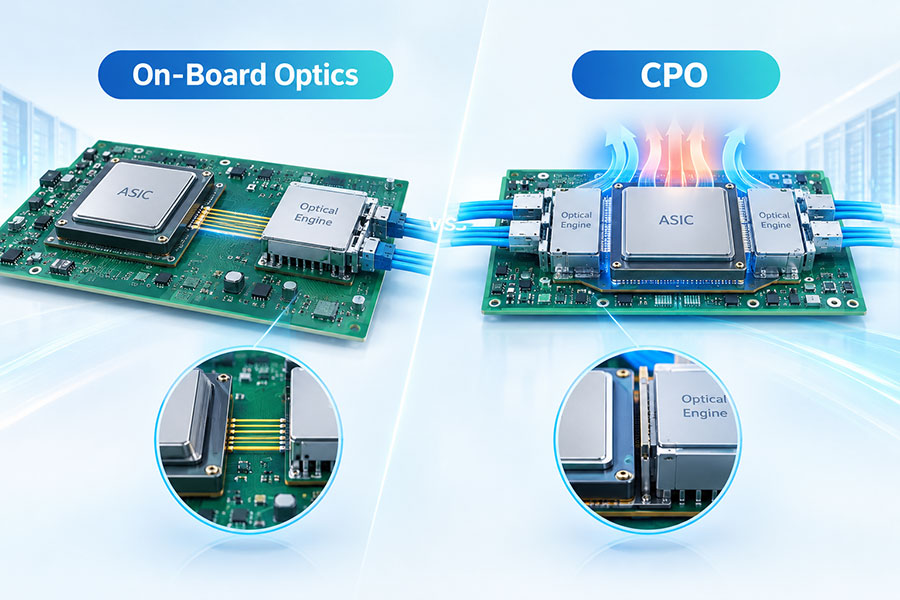
Co-packaged optics (CPO) integrates the optical engine directly into the switch package, eliminating the pluggable module and its associated power regulation and thermal overhead. CPO can reduce total system power for optical interconnect by improving the electrical path between the switch ASIC and the optical engine, but it is a packaging innovation rather than a modulation innovation. It applies equally to coherent and direct-detect approaches, though direct-detect CPO is currently more mature.
9. Where Each Technology Wins on Power
The power consumption comparison between coherent and direct-detect depends critically on the application. Neither technology is universally more power-efficient.
9.1 Direct-Detect Wins in Short-Reach, Fiber-Rich Environments
Direct-detect is the clear power winner for:
Intra-data-center links under 2 kilometers: Module power is 8 to 14 watts at 400G and 15 to 20 watts at 800G, with no need for dispersion compensation or local oscillator.
Fiber-rich environments: Where parallel fiber is available, direct-detect’s use of multiple fibers per link is not a constraint, and its lower module power translates directly to lower system power.
Thermally constrained deployments: Direct-detect modules generate less heat, making them easier to cool in dense chassis.
Cost-sensitive deployments: Direct-detect modules are simpler and less expensive to manufacture, and their lower power consumption reduces operational costs.
9.2 Coherent Wins in Long-Reach, Fiber-Constrained Environments
Coherent is the clear power winner for:
Links beyond 40 kilometers: Coherent reaches distances that would require multiple direct-detect regenerators, each consuming additional power. The system-level power comparison strongly favors coherent.
Fiber-constrained environments: Coherent’s single-fiber-pair operation means one coherent link replaces multiple direct-detect links, reducing total fiber count and the associated power of amplification and management.
DWDM applications: Coherent’s wavelength tunability and spectral efficiency enable dense wavelength division multiplexing, which direct-detect cannot match.
Applications where total cost of ownership is dominated by fiber and regeneration: Coherent typically becomes the lower-TCO option beyond 10 to 40 kilometers even when the module itself costs more.
9.3 The Middle Ground: 10 to 40 Kilometers
In the 10 to 40 kilometer range, the power comparison is close enough that other factors dominate. Fiber availability, DWDM requirements, operational familiarity, and capital budget often determine the choice more than raw power consumption. Coherent-lite is emerging as a middle-ground option that combines the reach and spectral efficiency of coherent with a simplified DSP that reduces power consumption.
10. Power Consumption Trends for 1.6T and Beyond
The power consumption trajectory for 1.6T and future generations will be shaped by several factors.
CMOS scaling continues to deliver. The migration from 5nm to 3nm and eventually 2nm will further reduce DSP power per bit for both coherent and direct-detect. Marvell’s 1.6T coherent DSP on a 2nm process is expected to significantly reduce power per bit compared to existing solutions, though absolute module power will remain in the 28 to 35 watt range because higher data rates require more DSP throughput.
Silicon photonics integration reduces optical engine power. Integrating multiple optical functions onto a single die reduces interconnect losses and eliminates redundant temperature control loops. Indium phosphide and silicon photonics integration is expected to reduce the power consumption of the optical engine, which currently accounts for approximately 35 percent of coherent module power.
The power gap will stabilize, not disappear. Coherent detection will always require more signal processing and a local oscillator that direct-detect does not need. The gap may stabilize in the 1.3 to 1.5x range at 1.6T, with coherent modules consuming 28 to 35 watts and direct-detect modules consuming 20 to 25 watts. The gap will not close entirely because the fundamental physics of coherent detection demand more components and more computation.
Per-bit efficiency will improve for both. A 800G ZR coherent module consumes approximately 0.030 watts per gigabit, while a 1.6T coherent-lite module is projected to consume 0.024 watts per gigabit. Direct-detect per-bit efficiency is also improving, with 800G modules in the 0.020 to 0.025 watts per gigabit range. The absolute power consumption rises with data rate, but the power per bit continues to fall.
11. Practical Implications for Network Design
The power consumption differences between coherent and direct-detect have several practical implications for network architects and operators.
| Design Factor | Implication |
|---|---|
| Rack power budget | Coherent modules require larger power budgets per port; a 32-port 800G switch with coherent modules may draw nearly 1 kW from optics alone |
| Thermal design | Coherent modules generate more heat and require more thermal headroom; OSFP is often necessary for 800G coherent |
| Cooling infrastructure | Higher power density from coherent modules may require liquid cooling or enhanced airflow |
| Switch platform selection | Not all switch platforms support the power classes required by high-power coherent modules |
| Total cost of ownership | Coherent’s lower per-bit cost at long reach can offset its higher module power and cost |
| Fiber management | Direct-detect requires more fibers per link; coherent reduces fiber count but requires DWDM infrastructure |
| Future-proofing | Direct-detect module power will improve with LPO and CPO; coherent module power will improve with CMOS scaling and coherent-lite |
The most important practical implication is that power consumption should be evaluated at the system level, not the module level alone. A coherent module that consumes 25 watts but reaches 80 kilometers without regeneration may consume less total system power than a direct-detect module that consumes 12 watts but requires three regenerators to cover the same distance. Conversely, a direct-detect module that consumes 15 watts and reaches 2 kilometers may be far more power-efficient than a coherent module that consumes 20 watts for the same link, because the coherent module’s additional capabilities are unnecessary.
12.Conclusion
Coherent and direct-detect optics differ fundamentally in power consumption, and the gap between them has narrowed dramatically as data rates have increased. At 100G, coherent modules consumed ten times the power of direct-detect equivalents. At 400G, the gap narrowed to 1.3 to 1.7x. At 800G, both technologies are approaching the 20-watt class, and the gap has stabilized at approximately 1.3x.
Coherent modules consume more power because they do more: they recover the full optical field, requiring a local oscillator laser, a 90-degree optical hybrid, balanced photodetectors, and a DSP that performs chromatic dispersion compensation, polarization tracking, carrier phase recovery, and strong forward error correction. Direct-detect modules consume less power because they do less: they measure only intensity, requiring no local oscillator and only a simplified DSP for equalization and FEC.
The convergence in power consumption is driven by CMOS process scaling and silicon photonics integration, which benefit both technologies. Coherent DSPs have migrated from 28nm to 16nm to 7nm and 5nm, reducing DSP power per bit while enabling higher-order modulation and stronger FEC. Direct-detect DSPs have followed the same trajectory, achieving sub-3 pJ/bit power efficiency at 800G.
The choice between coherent and direct-detect on power grounds depends on distance and fiber availability. Below 10 kilometers and in fiber-rich environments, direct-detect’s lower module power makes it the clear winner. Above 40 kilometers and in fiber-constrained environments, coherent’s ability to reach distance without regeneration makes it the system-level power winner despite its higher module power. In between, the decision depends on the specific requirements of the deployment, and coherent-lite is emerging as a middle-ground option.
As data rates advance toward 1.6T and beyond, the power gap will stabilize rather than disappear. Coherent detection will always require more computation and more optical components than direct-detect, but CMOS scaling and architectural innovation will continue to improve per-bit efficiency for both. The organizations that understand the component-level drivers of power consumption—and evaluate it at the system level rather than the module level—will be best positioned to make the right technology choices for their networks.
 >
>

 >
>
 >
>
 >
>
 >
>
 >
>
 >
>
 >
>