TEL:+86 132 6656 7067




Optical networking has evolved along two parallel tracks. Telecom operators built their networks around coherent detection, a technology that encodes information in the amplitude, phase, and polarization of light and uses powerful digital signal processing to recover it over hundreds or thousands of kilometers. Data centers built theirs around PAM4 direct detection, a simpler approach that modulates only light intensity and relies on straightforward photodiodes to recover the signal over distances measured in meters to a few kilometers.
These two tracks produced fundamentally different technologies with different cost structures, power profiles, and design philosophies. Coherent optics became synonymous with high performance and high cost, optimized for spectral efficiency and reach. PAM4 optics became synonymous with low cost and low power, optimized for density and manufacturability at short distances. For years, the boundary between them was clear: coherent for long haul, PAM4 for everything inside the data center.
That boundary is now shifting. As AI clusters expand beyond single buildings into multi-building campuses spanning 2 to 20 kilometers, and as data rates climb from 800G toward 1.6T and 3.2T, PAM4 direct detection is running into physical limits. Coherent technology, meanwhile, has been scaling down—both in cost and power consumption—to the point where it is becoming viable for distances that were once the exclusive domain of direct detection. A new category, coherent-lite, is emerging to bridge the gap.
This guide examines the two technologies in depth: how they work, where each performs best, how their power and cost profiles compare, and how the emergence of coherent-lite is redrawing the boundaries between telecom and datacom optics.
1. The Fundamental Architectural Divide
The difference between coherent and PAM4 optics begins with what they measure. A direct-detect receiver, which PAM4 modules use, measures only the intensity of incoming light. When the transmitter varies the optical power across four levels, the photodiode converts those intensity variations into electrical current, and the DSP decodes the four levels back into two bits per symbol. The receiver discards all information about phase, frequency, and polarization.
A coherent receiver measures the full optical field. It mixes the incoming signal with a local oscillator laser in a 90-degree optical hybrid, producing outputs that preserve amplitude, phase, and polarization. This additional information allows coherent systems to use higher-order modulation formats such as 16-QAM, which encode four bits per symbol, and dual-polarization transmission, which doubles capacity per wavelength. The DSP then compensates for chromatic dispersion, polarization mode dispersion, and carrier phase noise electronically, rather than requiring optical compensation in the fiber plant.
The architectural consequence is that PAM4 systems are simple but limited in spectral efficiency and reach, while coherent systems are complex but capable of far higher capacity over far greater distances.
| Dimension | PAM4 Direct Detect | Coherent Detection |
|---|---|---|
| Signal Dimensions Used | Intensity only | Amplitude, phase, polarization |
| Typical Modulation | PAM4 (2 bits/symbol) | DP-16QAM (8 bits/symbol), DP-QPSK |
| Receiver Structure | Photodiode | 90° hybrid + balanced photodiodes + local oscillator |
| DSP Complexity | Low to moderate | High |
| Spectral Efficiency | Low | High |
| Reach (without regeneration) | 100 m to 40 km | 80 km to 1000+ km |
| Fiber per Link | Multiple parallel fibers | Single fiber pair |
| Dominant Application | Intra-data center | Long-haul and metro telecom |
2. Modulation and Spectral Efficiency
The most visible difference between the two technologies is the number of bits carried per symbol. PAM4 encodes two bits by varying optical intensity across four levels. Coherent DP-16QAM encodes eight bits by combining 16 amplitude-phase states across two polarizations. The spectral efficiency difference is fourfold: coherent carries four times the data in the same optical bandwidth.
This difference has profound implications for fiber utilization. A PAM4 link at 400G requires eight parallel fibers (one per lane at 50G PAM4), each carrying a single wavelength. A coherent 400G ZR link uses a single fiber pair, with one wavelength carrying both polarizations and 16-QAM modulation. In fiber-constrained environments—where trenching new fiber is expensive or impossible—coherent’s fourfold advantage in spectral efficiency is decisive.
The modulation format also affects dispersion tolerance. PAM4 signals are sensitive to chromatic dispersion, particularly at higher symbol rates. A 200G PAM4 signal at 106 GBaud suffers significant dispersion penalty over more than a few kilometers, requiring either dispersion-compensating modules or reduced reach. Coherent receivers handle dispersion digitally in the DSP, tolerating up to 2400 ps/nm of chromatic dispersion without optical compensation—enough to span hundreds of kilometers of standard single-mode fiber.
3. DSP: The Heart of the Difference
The digital signal processor is the single largest cost and power component in both module types, but the two DSPs perform fundamentally different functions.
3.1 PAM4 DSP Functions
A PAM4 DSP performs equalization, clock and data recovery, and forward error correction. It may also handle gearbox functions, converting between different lane configurations. The equalizer compensates for channel loss and intersymbol interference, but the algorithms are comparatively simple. The FEC is typically KP4 or a similar hard-decision code with moderate coding gain. The DSP does not need to compensate for chromatic dispersion, polarization effects, or carrier phase noise because the direct-detect receiver does not capture that information in the first place.
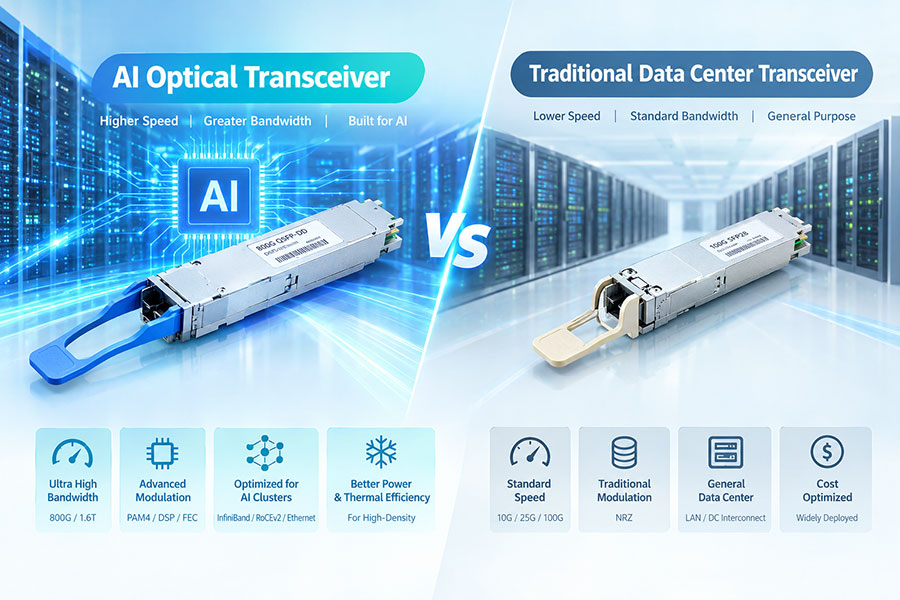
The complexity of PAM4 DSPs has grown as data rates have increased, but the fundamental algorithms remain relatively straightforward. A 1.6T PAM4 DSP on a 3nm node consumes approximately 22 watts, and recent designs target sub-20-watt module power.
3.2 Coherent DSP Functions
A coherent DSP performs all the functions of a PAM4 DSP plus a set of computationally intensive signal processing blocks that have no PAM4 equivalent:
Chromatic dispersion compensation: Compensates for the differential delay across the signal spectrum. This is computationally intensive and scales quadratically with baud rate.
Polarization tracking and demultiplexing: Recovers the two polarization streams from the mixed received signal, requiring continuous estimation and correction.
Carrier phase recovery: Estimates and corrects for phase noise from both the transmitter and local oscillator lasers.
Adaptive equalization: Compensates for polarization mode dispersion and other dynamic impairments, requiring more taps and more sophisticated algorithms than PAM4 equalization.
Soft-decision FEC: Provides higher coding gain than hard-decision FEC but requires significantly more computational power.
These additional functions make the coherent DSP far more complex than a PAM4 DSP. In a 400ZR module, the coherent DSP accounts for 50 to 60 percent of total module power, consuming 10 to 12 watts. The DSP’s power share has fallen as CMOS nodes have shrunk—from 28nm to 16nm to 7nm and 5nm—but the absolute complexity remains far greater than that of a PAM4 DSP.
4. Power Consumption: The Gap Is Narrowing
Power consumption has historically been coherent’s greatest disadvantage in data center applications. The gap has narrowed significantly as CMOS scaling and architectural innovation have reduced coherent DSP power while PAM4 DSP power has risen with data rate.
| Data Rate | PAM4 Module Power | Coherent Module Power | Ratio |
|---|---|---|---|
| 100G | 2–4 W | 20–25 W | ~10x |
| 400G | 8–14 W | 15–20 W | 1.3–1.7x |
| 800G | ~15–20 W | 25–30 W | ~1.5x |
| 1.6T | ~20–25 W | 28–35 W | ~1.3–1.5x |
At 100G, coherent modules consumed roughly ten times the power of PAM4 equivalents. By 400G, the gap had narrowed to 1.3 to 1.7x. At 800G, the gap is approximately 1.5x, with PAM4 modules consuming 15 to 20 watts and coherent modules consuming 25 to 30 watts. At 1.6T, the projected gap is 1.3 to 1.5x.
Two factors drive this convergence. First, PAM4 DSP power has risen sharply as data rates have increased, because equalization and FEC become more demanding at higher symbol rates and with more complex channel characteristics. Second, coherent DSP power per bit has fallen as process nodes have shrunk, and architectures have been simplified for shorter-reach applications.
A critical nuance is that PAM4’s power advantage shrinks with distance. At 2 kilometers, a PAM4 module may consume 15 watts. At 10 kilometers, the same module may require additional amplification and dispersion compensation, pushing system power higher. Coherent module power is relatively insensitive to distance over its supported range, because the DSP handles dispersion regardless of reach. At longer distances, coherent’s system-level power can be lower even when its module power is higher.
5. Cost and Total Cost of Ownership
PAM4 modules are less expensive to manufacture than coherent modules for several reasons. They use simpler, uncooled or lightly cooled lasers rather than tunable C-band lasers with thermoelectric coolers. They omit the local oscillator, 90-degree hybrid, and balanced photodiodes that coherent receivers require. Their DSPs are smaller and less complex. And they benefit from enormous manufacturing volume, since every data center port uses one.
A 400G PAM4 module costs hundreds of dollars, while a 400G ZR coherent module can cost several thousand dollars. This price difference reflects the fundamental complexity gap between the two technologies.
But module price is not the whole story. The total cost of ownership comparison depends heavily on distance, fiber availability, and whether DWDM is required.
| Cost Element | PAM4 400G Link | Coherent 400G ZR Link |
|---|---|---|
| Transceivers (2x) | $1,500–$3,000 | $8,000–$13,000 |
| Dispersion Compensation | $2,000–$5,000 | $0 (DSP handles it) |
| Amplifiers / Regenerators | $5,000–$15,000 | $0–$2,000 |
| Mux / Demux | $1,000–$3,000 | $1,000–$3,000 |
| Installation and Test | $2,000–$4,000 | $1,500–$3,000 |
| 5-Year Power and Cooling | $1,500–$2,500 | $2,500–$4,000 |
| Estimated 5-Year TCO | $13,000–$32,500 | $12,500–$25,000 |
At 100 kilometers, the higher module cost of coherent is offset by the elimination of dispersion compensation, amplifiers, and regenerators that a PAM4 link would require over the same distance. The total cost of ownership for coherent becomes competitive or lower at distances beyond roughly 40 kilometers, and decisively lower for DWDM applications where coherent’s spectral efficiency allows many wavelengths to share a single fiber pair.
For links under 10 kilometers without DWDM requirements, PAM4 remains the economic choice. For links over 80 kilometers or where DWDM capacity is needed, coherent is typically the better solution. The crossover point depends on fiber quality, amplifier spacing, labor costs, and energy prices.
6. Reach: Where the Physics Draws the Line
The reach of each technology is determined by the physical impairments it can tolerate and the impairments it can compensate for.
PAM4 direct detection has no mechanism to compensate for chromatic dispersion at the receiver. The signal degrades as it propagates, and the DSP’s equalizer can only partially compensate. At 100G per lane, PAM4 can reach approximately 10 to 40 kilometers with dispersion compensation and amplification. At 200G per lane for 1.6T, reach shrinks to under 10 kilometers. Beyond those distances, the signal quality falls below what FEC can correct.
Coherent detection compensates for chromatic dispersion, polarization mode dispersion, and carrier phase noise in the digital domain. The DSP can handle dispersion that would render a PAM4 signal unusable. As a result, coherent links reach 80 to 120 kilometers in standard DCI configurations, and hundreds of kilometers in long-haul telecom applications with appropriate amplification.
The practical boundary between the two technologies has historically been around 10 to 40 kilometers. Below that range, PAM4 is simpler and cheaper. Above it, coherent is the only viable option for high-capacity transmission without regeneration. At 800G and 1.6T, that boundary is moving lower—PAM4 reach is shrinking while coherent reach remains stable—which is pulling coherent into the data center campus.
7. Coherent-Lite: Bridging the Campus Gap
The gap between intra-data center PAM4 and traditional telecom coherent is precisely where AI campus networks live. Large AI data centers now span multiple buildings across campuses of 2 to 20 kilometers, with power and space constraints forcing compute distribution across distances that PAM4 cannot reliably cover at 1.6T but that do not require the full reach and cost of telecom-grade coherent.
Coherent-lite addresses this gap. It is a simplified coherent approach that uses a lower-complexity DSP and relaxed optical specifications to reduce power and cost while retaining the core benefits of coherent detection: better receiver sensitivity, dispersion tolerance, and spectral efficiency than PAM4. The simplified DSP architecture reduces power consumption and latency, creating a sustainable solution for campus connectivity.
Marvell’s Aquila DSP, announced in December 2024, is the industry’s first coherent-lite DSP optimized for 1.6 Tbps operation at O-band wavelengths. It is designed specifically for 2 to 20 kilometer campus data center interconnects, delivering power and performance optimized for this emerging market. The DSP combines advanced coherent modulation with scalable O-band optics, enabling cost efficiency and power savings for distributed campus architectures. Shipments of coherent-lite solutions are expected to grow from sample volumes to over 1 million units per year by 2029.
Coherent-lite occupies a middle ground in the cost and complexity spectrum. It is more capable than PAM4 but less expensive and power-hungry than full ZR coherent. For 2 to 20 kilometer campus links, it offers the reach and spectral efficiency of coherent without the overhead that telecom-grade coherent carries for distances it does not need to cover.
8. Application Mapping: Which Technology for Which Link
The choice between PAM4 and coherent depends primarily on distance, fiber availability, and whether DWDM is required. The following table maps common link types to recommended technologies.
| Link Type | Distance | Recommended Technology | Rationale |
|---|---|---|---|
| Server-to-ToR | < 3 m | DAC / AEC | Copper is cheapest and lowest power |
| ToR-to-Leaf | 3–100 m | PAM4 (AOC or optics) | PAM4 reach and cost optimal |
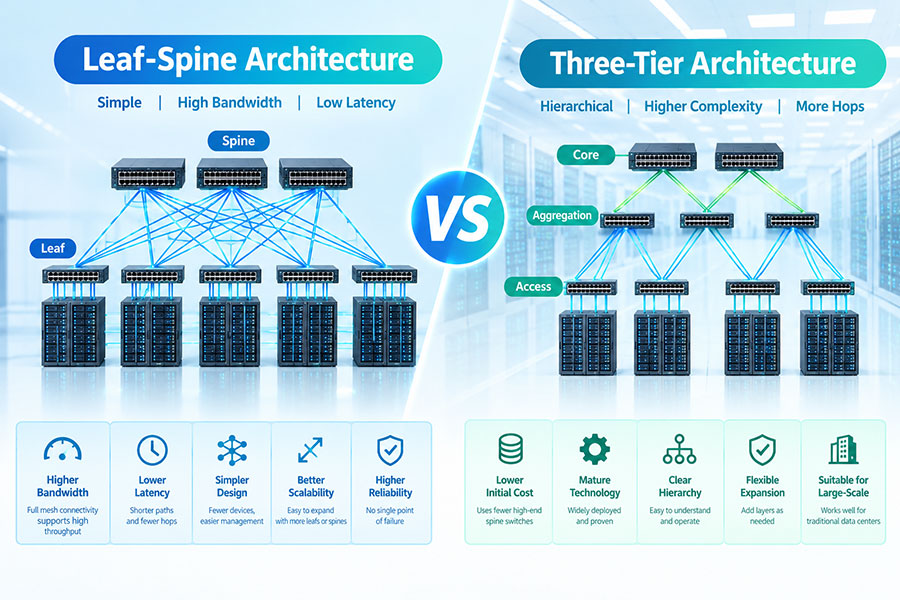
| Leaf-to-Spine | 100–500 m | PAM4 optics | Within PAM4 reach at 800G |
| Campus building-to-building | 2–20 km | Coherent-lite or PAM4 (lower rates) | Coherent-lite adds reach and margin |
| Metro DCI | 20–80 km | Coherent 400ZR / 800ZR | PAM4 cannot reach without regeneration |
| Regional DCI | 80–300 km | Coherent 800ZR+ / 1.6T | Coherent only viable option |
| Long-haul | > 300 km | Coherent with amplification | Coherent only viable option |
The mapping is not rigid. In some cases, PAM4 with amplification and dispersion compensation can reach 40 kilometers. In others, coherent-lite at 2 kilometers may be justified by the need for DWDM or by fiber constraints that make PAM4’s multi-fiber requirements impractical. The decision should be based on total system requirements, not on distance alone.
9. Market Dynamics and Standardization
The two technologies are supported by different standardization ecosystems. PAM4 Ethernet is standardized by IEEE 802.3, with form factors defined by MSAs such as QSFP-DD and OSFP. Coherent DCI is standardized by the OIF, which has published implementation agreements for 400ZR, 800ZR, and now 1600ZR.
The OIF’s 1600ZR implementation agreement, published in September 2026, defines an interoperable 1.6T coherent line interface for amplified DWDM links up to 120 kilometers. It doubles the capacity of the 800ZR specification, enabling a single 1.6T Ethernet client to be transported over a single coherent wavelength. The agreement is designed for multi-vendor implementation, providing a common technical foundation for interoperable 1.6T coherent solutions in data center interconnect applications.
On the PAM4 side, 1.6T modules are entering volume production. Marvell’s Ara 3nm PAM4 DSP has demonstrated 22-watt module power, a 20 percent reduction from earlier 1.6T implementations. Credo’s Bluebird DSP targets sub-20-watt 1.6T transceivers. These power reductions are essential for AI data centers where thermal headroom is constrained.
The market for both technologies is growing rapidly. PAM4 remains the workhorse for intra-data center connectivity, with hundreds of millions of ports deployed. Coherent is growing from its telecom base into DCI and now campus applications, driven by AI infrastructure buildouts and the need to connect distributed data centers across metro and regional distances.
10. The Convergence Trajectory
The boundary between coherent and PAM4 is not static. Several trends are pushing the two technologies closer together.
PAM4 is extending its reach downward. As coherent moves into shorter distances, PAM4 is also improving. Advanced DSP techniques, better FEC, and improved optical components allow PAM4 to reach 10 to 40 kilometers at 100G per lane, and 10 kilometers at 200G per lane. But physics imposes limits: as symbol rates increase, dispersion penalties grow, and PAM4 cannot compensate for them digitally the way coherent can.
Coherent is scaling down in cost and power. The coherent DSP has migrated from 28nm to 16nm to 7nm and 5nm, reducing power per bit. Coherent-lite simplifies the DSP further for campus distances. As coherent module volumes increase, manufacturing economies of scale will reduce costs, making coherent competitive with PAM4 in more applications. As volume production of coherent transceivers increases, their price will become competitive with direct detect solutions.
Silicon photonics benefits both. Silicon photonics has become the platform of choice for coherent receivers because it adds optical functionality with minimal impact on cost and yield. The same platform is increasingly used for PAM4 modules. As silicon photonics matures, it reduces the cost of coherent’s optical complexity while improving PAM4’s integration.
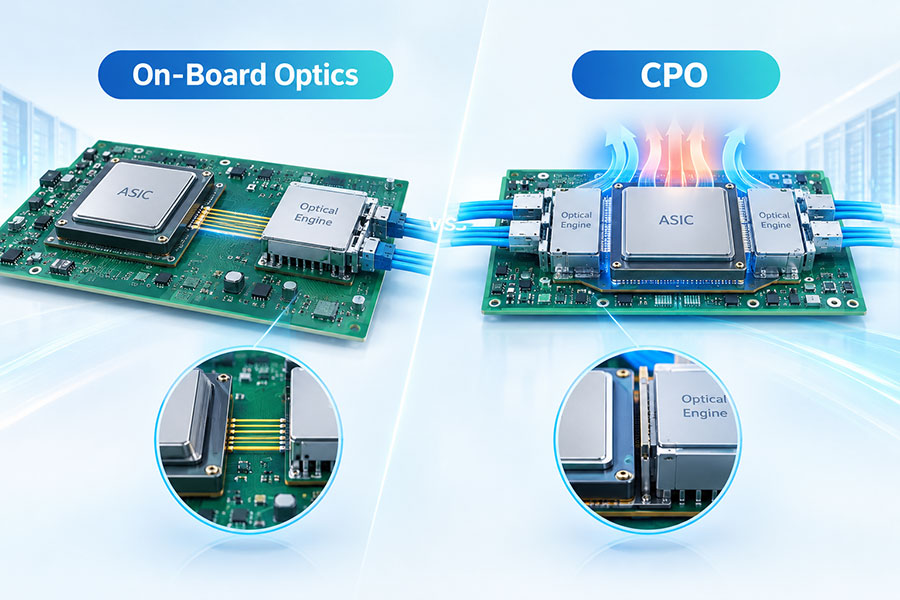
Co-packaged optics changes the equation. CPO integrates optical engines into switch packages, eliminating pluggable modules and their associated power and thermal overhead. CPO applies to both coherent and PAM4 approaches, though PAM4 CPO is currently more mature. If CPO reduces the cost of coherent optical engines, it could accelerate coherent’s penetration into shorter-reach applications.
11.Conclusion
Coherent telecom optics and data center PAM4 optics represent two fundamentally different design philosophies. Coherent detection recovers the full optical field and uses powerful DSP to compensate for fiber impairments, achieving high spectral efficiency and long reach at the cost of complexity and power. PAM4 direct detection measures only intensity and relies on simple, low-cost components, achieving low power and low cost at the expense of reach and spectral efficiency.
For most of the past two decades, the boundary between them was clear. PAM4 dominated everything inside the data center; coherent dominated everything outside it. That boundary is now shifting. PAM4 reach is shrinking as data rates increase toward 1.6T and beyond. Coherent cost and power are falling as CMOS scaling and architectural innovation reduce the overhead of coherent detection. And AI campus networks spanning 2 to 20 kilometers are creating demand for a technology that sits between the two.
Coherent-lite is the industry’s answer to that demand. By simplifying the coherent DSP and relaxing optical specifications, it delivers the reach and spectral efficiency of coherent at a cost and power point closer to PAM4. It is not a replacement for either technology but a complement that fills the gap between intra-data center PAM4 and metro DCI coherent.
The future will include all three: PAM4 for the shortest reaches where cost and power are paramount, coherent-lite for campus and intermediate distances, and full coherent for metro, regional, and long-haul applications where reach and spectral efficiency justify the additional complexity. Understanding the strengths and limitations of each technology is essential for designing networks that deliver the right performance at the right cost for every link in the AI infrastructure.
 >
>

 >
>
 >
>
 >
>
 >
>
 >
>
 >
>
 >
>