TEL:+86 132 6656 7067




Recently, customers have been inquiring about the Cisco-compatible SFP-1GB-FX-I-SGMII-C module, with a specific requirement for SGMII (Serial Gigabit Media Independent Interface) support.
This module belongs to a specialized category of industrial-grade optical transceivers and is significantly different from standard 1000BASE SFP modules.
1、What Is the SFP-1GB-FX-I-SGMII-C Module?
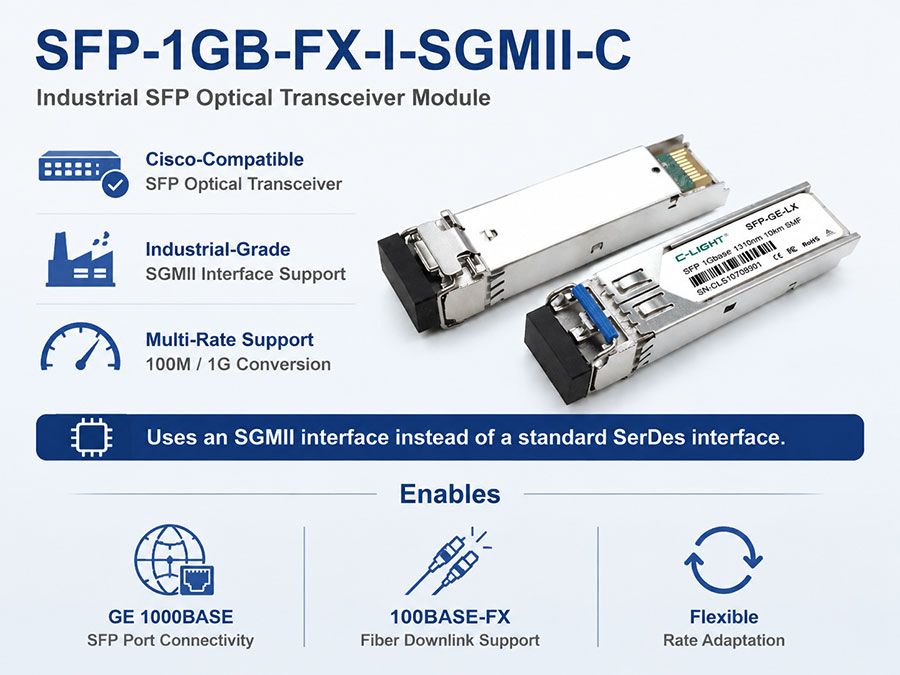
The SFP-1GB-FX-I-SGMII-C is a:
Cisco-compatible SFP optical transceiver module
Industrial-grade module with SGMII interface support
Multi-rate solution supporting 100M and 1G conversion
Its key characteristic is that it uses an SGMII interface instead of a standard SerDes interface.
This design enables:
GE 1000BASE SFP port connectivity
Downlink 100BASE-FX fiber support
Flexible rate adaptation capability
2、Why Is It Considered a “Special Module”?
As engineers noted: “This is a very special module.”
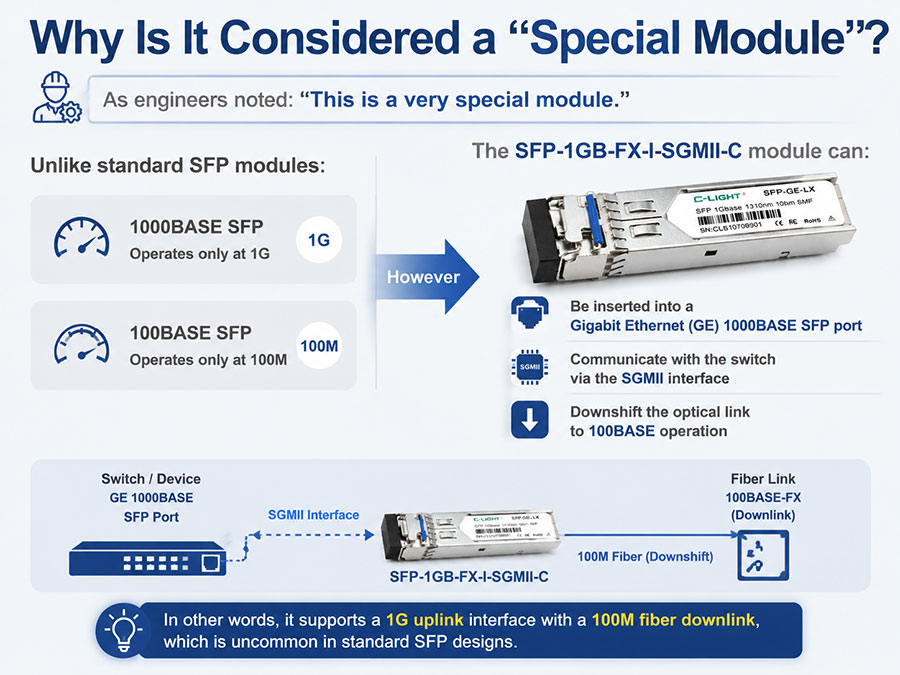
Unlike standard SFP modules:
1000BASE SFP modules typically operate only at 1G
100BASE SFP modules typically operate only at 100M
However, the SFP-1GB-FX-I-SGMII-C module can:
Be inserted into a Gigabit Ethernet (GE) 1000BASE SFP port
Communicate with the switch via the SGMII interface
Downshift the optical link to 100BASE operation
In other words, it supports a 1G uplink interface with a 100M fiber downlink, which is uncommon in standard SFP designs.
3、What Is SGMII?
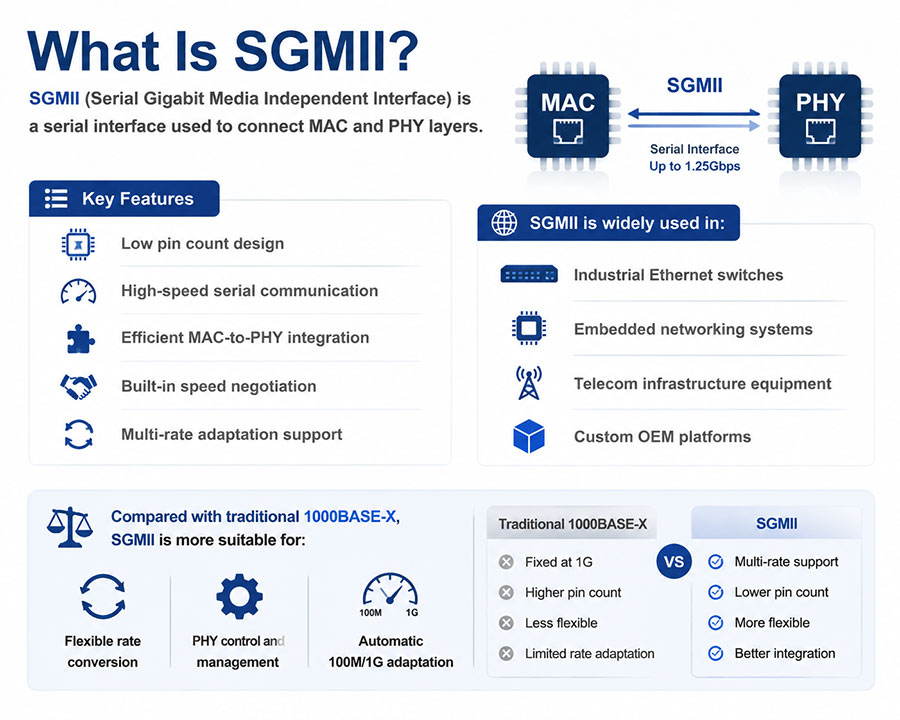
SGMII (Serial Gigabit Media Independent Interface) is a serial interface used to connect MAC and PHY layers.
Key features include:
Low pin count design
High-speed serial communication
Efficient MAC-to-PHY integration
Built-in speed negotiation
Multi-rate adaptation support
SGMII is widely used in:
Industrial Ethernet switches
Embedded networking systems
Telecom infrastructure equipment
Custom OEM platforms
Compared with traditional 1000BASE-X, SGMII is more suitable for:
Flexible rate conversion
PHY control and management
Automatic 100M/1G adaptation
4、How the Module Works
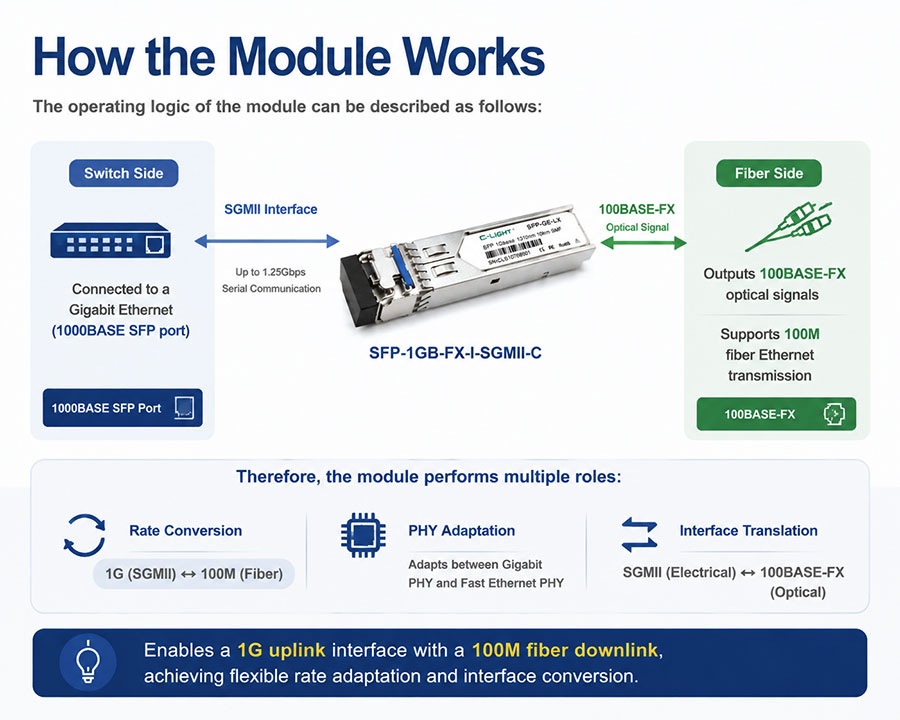
The operating logic of the module can be described as follows:
Switch Side
Connected to a Gigabit Ethernet (1000BASE SFP port)
Uses SGMII interface communication
Fiber Side
Outputs 100BASE-FX optical signals
Supports 100M fiber Ethernet transmission
Therefore, the module performs multiple roles:
Rate conversion
PHY adaptation
Interface translation
5、Why Must It Be Used in a GE 1000BASE Port?
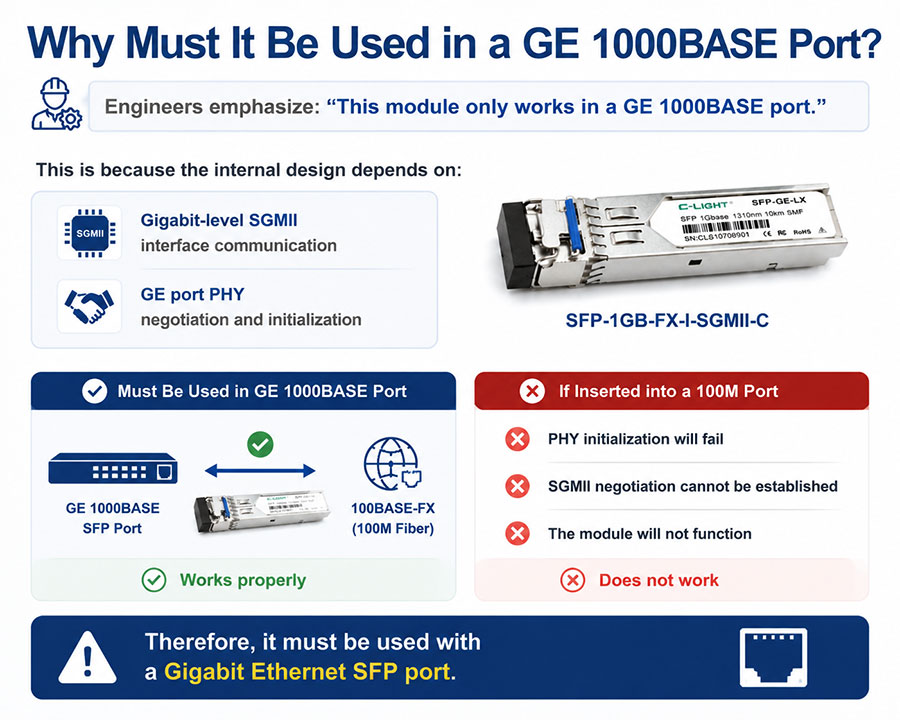
Engineers emphasize: “This module only works in a GE 1000BASE port.”
This is because the internal design depends on:
Gigabit-level SGMII interface communication
GE port PHY negotiation and initialization
If inserted into a 100M port:
PHY initialization will fail
SGMII negotiation cannot be established
The module will not function
Therefore, it must be used with a Gigabit Ethernet SFP port.
6、Why Can It Downshift to 100BASE?
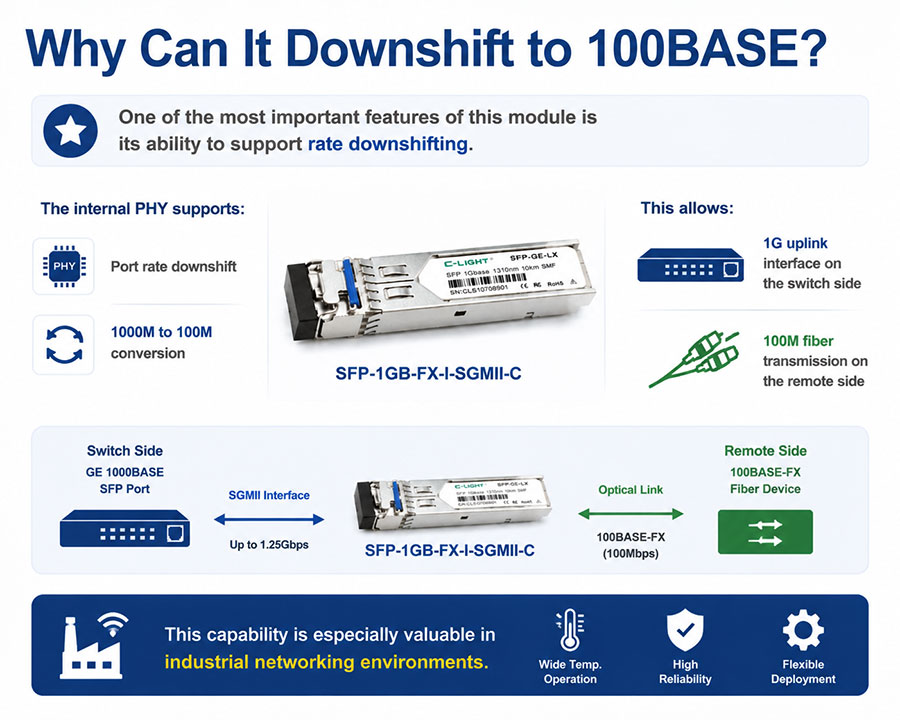
One of the most important features of this module is its ability to support rate downshifting.
The internal PHY supports:
Port rate downshift
1000M to 100M conversion
This allows:
1G uplink interface on the switch side
100M fiber transmission on the remote side
This capability is especially valuable in industrial networking environments.
7、Typical Application Scenarios
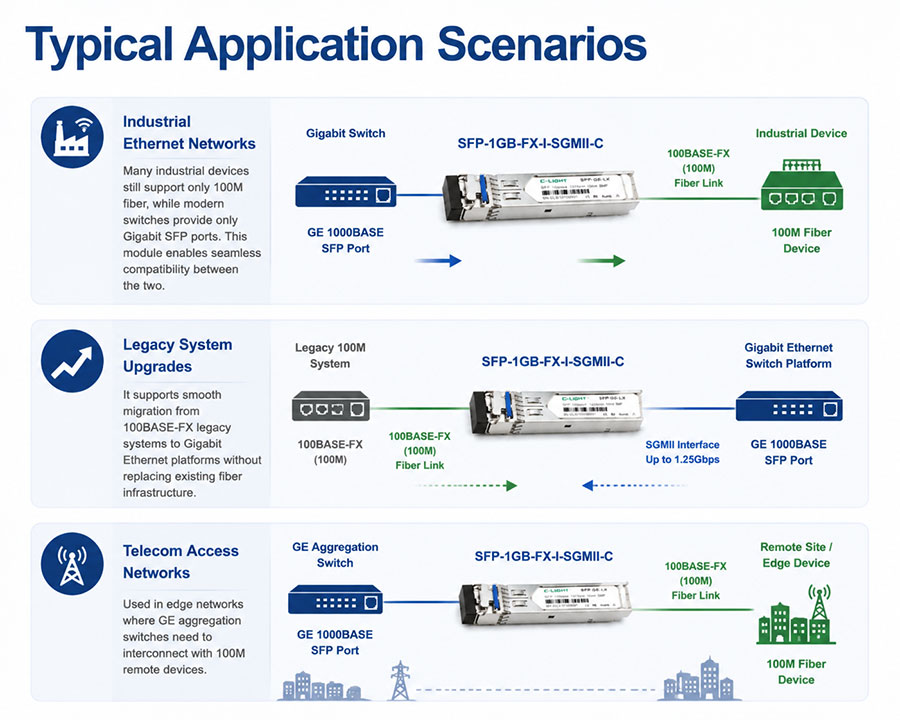
Industrial Ethernet Networks
Many industrial devices still support only 100M fiber, while modern switches provide only Gigabit SFP ports. This module enables seamless compatibility between the two.
Legacy System Upgrades
It supports smooth migration from 100BASE-FX legacy systems to Gigabit Ethernet platforms without replacing existing fiber infrastructure.
Telecom Access Networks
Used in edge networks where GE aggregation switches need to interconnect with 100M remote devices.
8、Why Cisco Compatibility Matters
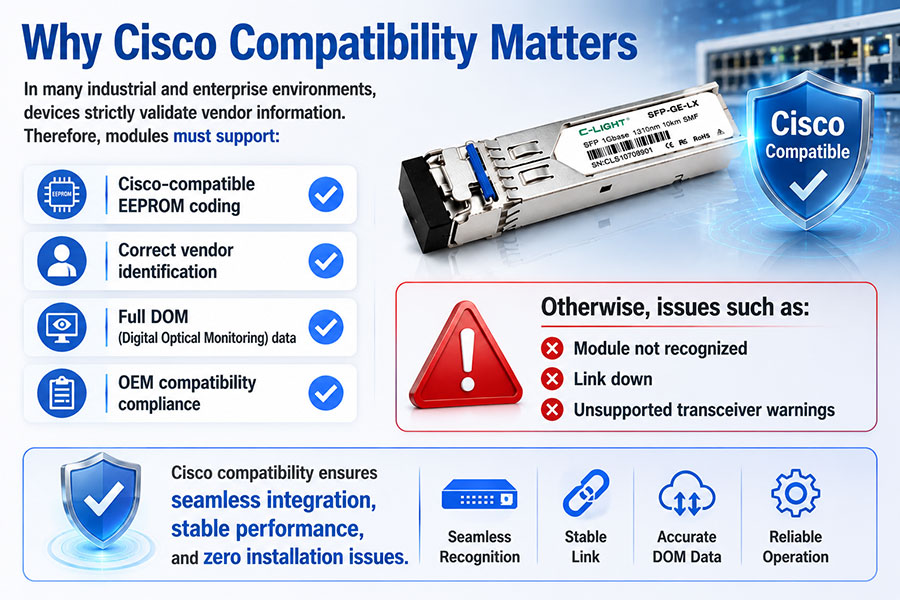
In many industrial and enterprise environments, devices strictly validate vendor information. Therefore, modules must support:
Cisco-compatible EEPROM coding
Correct vendor identification
Full DOM (Digital Optical Monitoring) data
OEM compatibility compliance
Otherwise, issues such as:
Module not recognized
Link down
Unsupported transceiver warnings
may occur.
9、Summary
The SFP-1GB-FX-I-SGMII-C module is a highly specialized SGMII-based optical transceiver.
Its key characteristics include:
Cisco-compatible design
SGMII interface architecture
Support for Gigabit Ethernet SFP ports
100BASE-FX downlink capability
100M to 1G rate conversion
Unlike standard SFP modules, it not only transmits optical signals but also performs advanced functions such as:
Interface translation
PHY conversion
Rate downshift processing
As a result, it is widely used in industrial networks, telecom access systems, legacy infrastructure upgrades, and OEM platforms requiring mixed 100M and 1G compatibility.
 >
>

 >
>
 >
>
 >
>
 >
>
 >
>
 >
>
 >
>