TEL:+86 132 6656 7067




1. What Is a 180km~200km 100Mbps SFP Optical Transceiver?
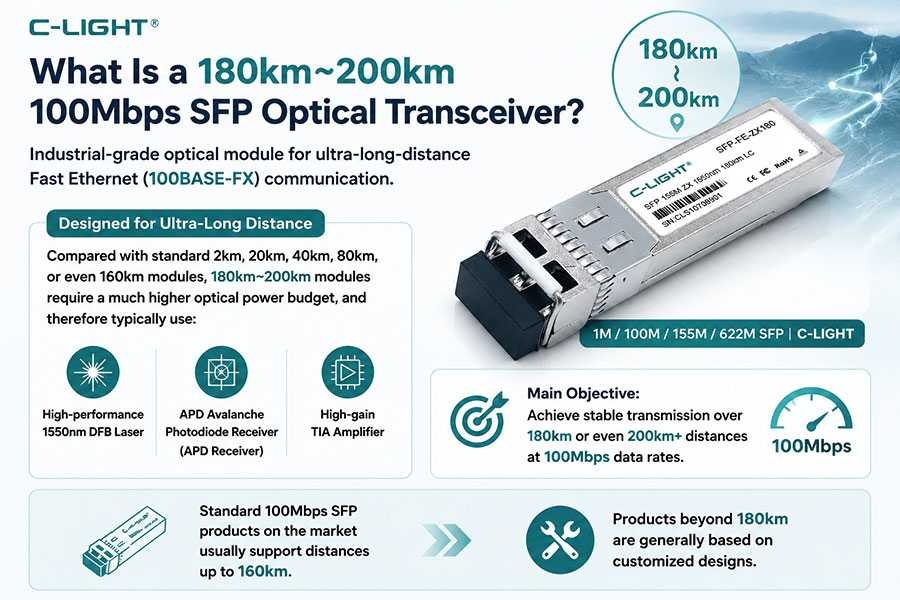
The C-LIGHT 180km~200km 100Mbps SFP optical transceiver is an industrial-grade optical module designed for ultra-long-distance Fast Ethernet (100BASE-FX) communication.
Compared with standard 2km, 20km, 40km, 80km, or even 160km optical modules, 180km~200km modules require a much higher optical power budget, and therefore typically use:
High-performance 1550nm DFB laser
APD Avalanche Photodiode receiver (APD Receiver)
High-gain TIA amplifier
The main objective is to achieve stable transmission over 180km or even 200km+ distances at 100Mbps data rates.
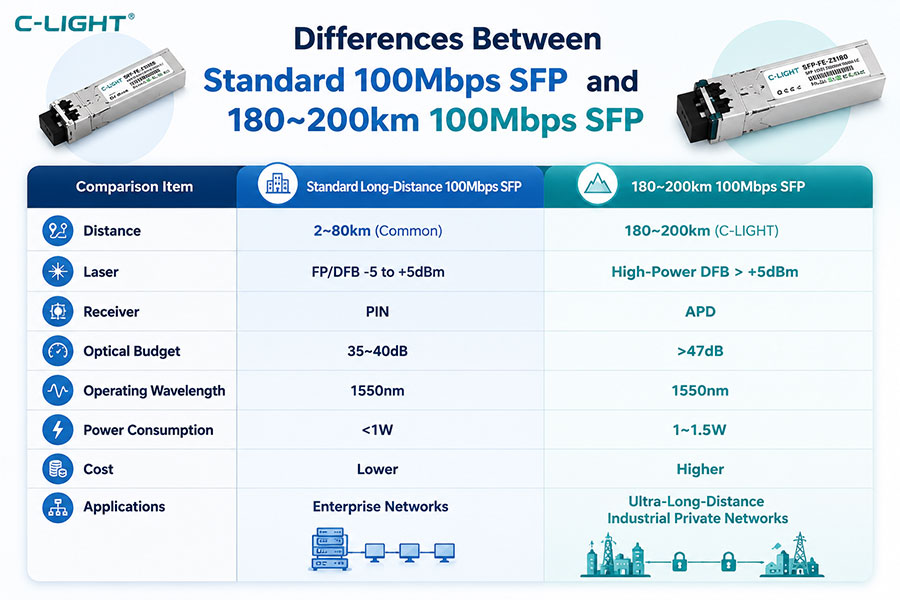
Standard 100Mbps SFP products on the market usually support distances up to 160km, while products beyond 180km are generally based on customized designs.
2. Core Parameters of 180km~200km 100Mbps SFP Optical Transceiver
Typical product specifications of C-LIGHT CLSFP1515ZX180I are as follows:
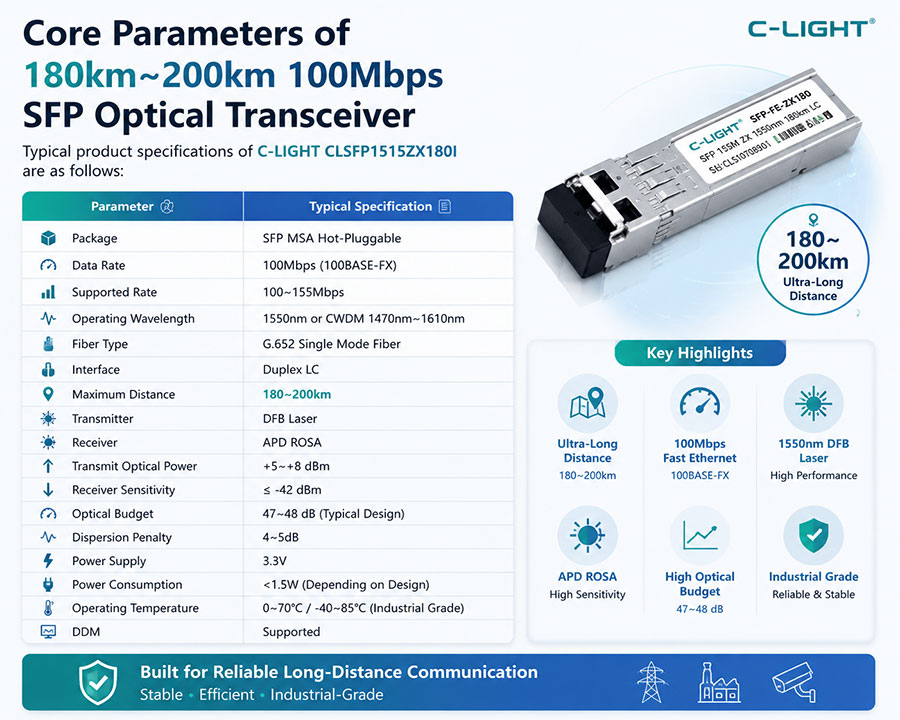
Since standard 160km products usually provide an optical budget of approximately 35~39dB, 180km~200km products require higher transmit power and improved receiver sensitivity.
3. Why Do 180km+ Optical Modules Usually Use 1550nm/1530nm?
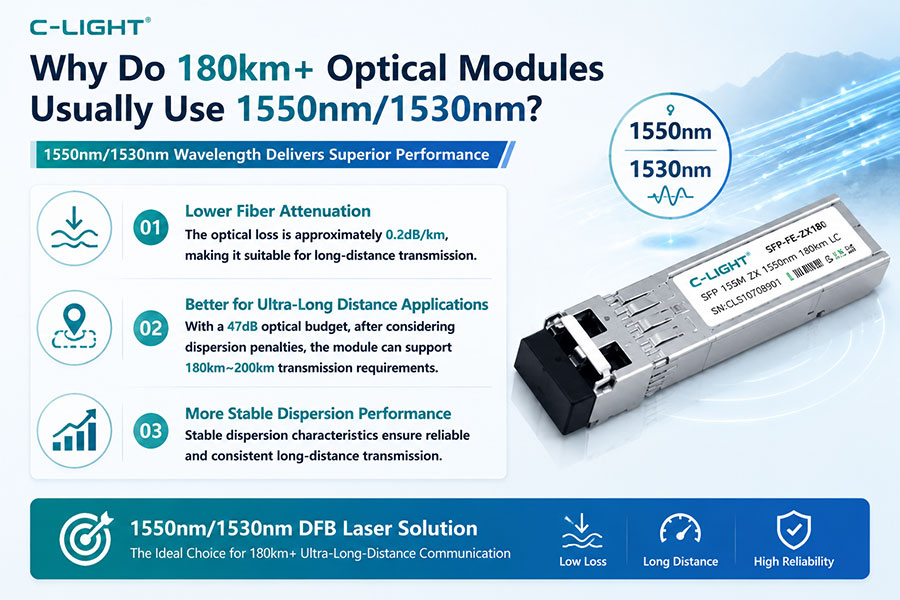
The 1550nm/1530nm wavelength provides the following advantages:
① Lower Fiber Attenuation
The optical loss is approximately 0.2dB/km, making it suitable for long-distance transmission.
② Better for Ultra-Long Distance Applications
With a 47dB optical budget, after considering dispersion penalties, the module can support 180km~200km transmission requirements.
③ More Stable Dispersion Performance
Therefore, most 180km~200km optical modules use a 1550nm/1530nm DFB laser solution for ultra-long-distance communication.
4. Typical Application Scenarios
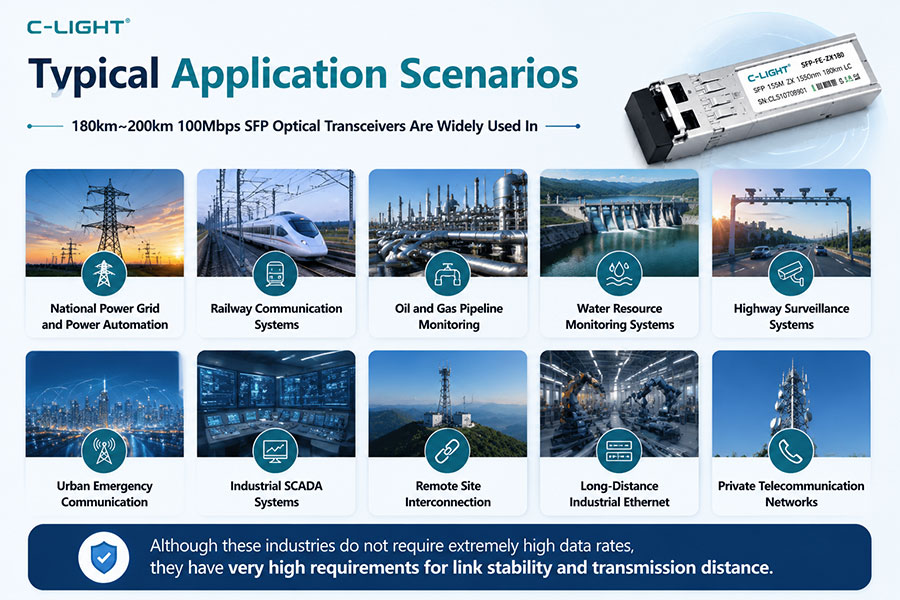
180km~200km 100Mbps SFP optical transceivers are mainly used in:
National power grid and power automation
Railway communication systems
Oil and gas pipeline monitoring
Water resource monitoring systems
Highway surveillance systems
Urban emergency communication
Industrial SCADA systems
Remote site interconnection
Long-distance industrial Ethernet
Private telecommunication networks
Although these industries do not require extremely high data rates, they have very high requirements for link stability and transmission distance.
5. Differences Between Standard 100Mbps SFP and 180~200km 100Mbps SFP
6. C-LIGHT Ultra-Long-Distance 100Mbps Optical Solutions
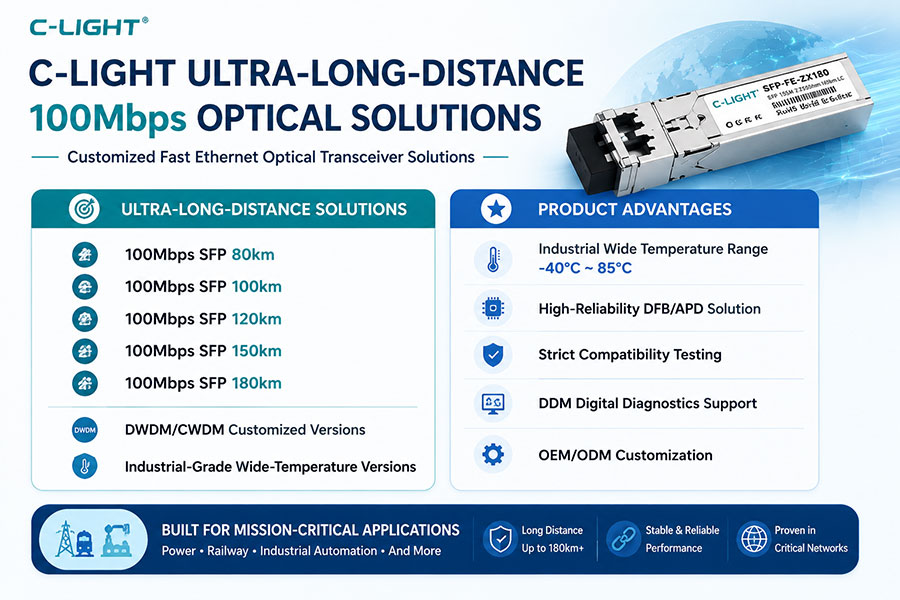
C-LIGHT provides customized ultra-long-distance Fast Ethernet optical transceiver solutions, including:
100Mbps SFP 80km
100Mbps SFP 100km
100Mbps SFP 120km
100Mbps SFP 150km
100Mbps SFP 180km
Industrial-grade wide-temperature versions
DWDM/CWDM customized versions
Product Advantages:
Industrial wide temperature range (-40℃~85℃)
High-reliability DFB/APD solution
Strict compatibility testing
DDM digital diagnostics support
OEM/ODM customization
Support for power, railway, and industrial automation projects
7. How to Select a 180km~200km Optical Transceiver?
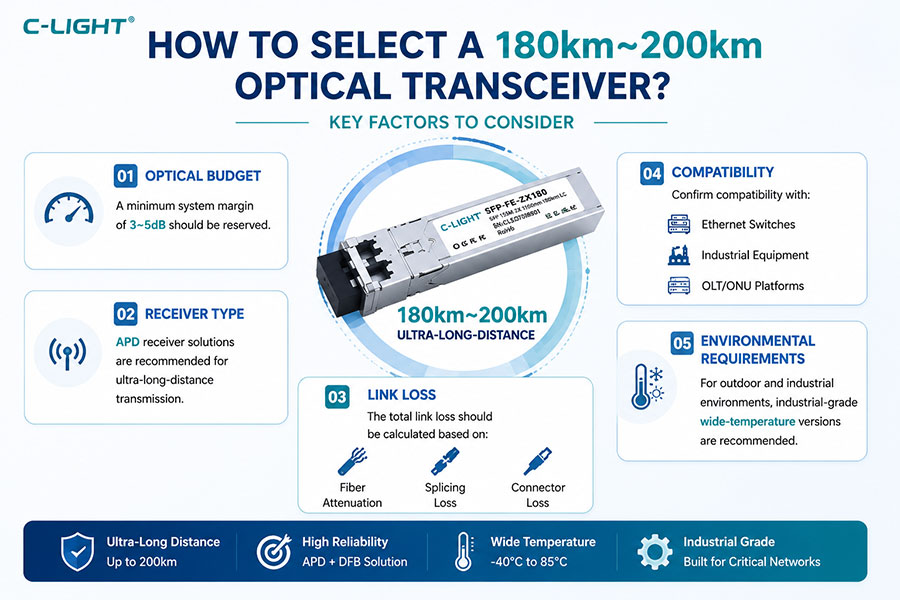
The following factors should be considered:
Optical Budget
A minimum system margin of 3~5dB should be reserved.
Receiver Type
APD receiver solutions are recommended for ultra-long-distance transmission.
Link Loss
The total link loss should be calculated based on:
Fiber attenuation
Splicing loss
Connector loss
Compatibility
Confirm compatibility with:
Ethernet switches
Industrial equipment
OLT/ONU platforms
Environmental Requirements
For outdoor and industrial environments, industrial-grade wide-temperature versions are recommended.
8. Summary
The 180km~200km 100Mbps SFP optical transceiver is an ultra-long-distance Fast Ethernet optical communication product.
With a 1550nm DFB laser, high-sensitivity APD receiver, and larger optical link budget, it can meet long-distance transmission requirements in applications such as:
Power automation
Railway communication
Industrial automation
Operator private networks
For projects requiring stable, reliable, and low-bandwidth long-distance communication, 180km~200km SFP optical transceivers still provide significant application value.
9. Frequently Asked Questions (FAQ)
Q1. Can a 100Mbps SFP optical transceiver really support 200km?
Answer: Yes. It is available as a customized C-LIGHT solution. It requires a high-power 1550nm DFB laser, APD receiver, and higher optical budget design. Standard products usually support distances up to 160km.
Q2. Why do 200km optical modules use 1550nm wavelengths?
Answer: Because 1550nm provides lower transmission loss in single-mode fiber, making it more suitable for ultra-long-distance links. It can also work with optical amplifiers to achieve longer transmission distances.
Q3. What is the biggest difference between 180km and 160km optical modules?
Answer: The main differences include higher transmit optical power, higher sensitivity APD receivers, and a larger optical budget, which enable stable transmission over longer distances.
Q4. Which industries are suitable for 180km~200km optical transceivers?
Answer: They are suitable for power automation, railway communication, oil and gas industries, SCADA monitoring, industrial automation, smart cities, and private telecommunication networks requiring ultra-long-distance transmission.
Q5. Does C-LIGHT support customized 180km~200km optical transceivers?
Answer: Yes. C-LIGHT provides OEM/ODM ultra-long-distance 100Mbps SFP optical transceiver solutions based on customer requirements, including different transmission distances, wavelengths, industrial temperature grades, and protocol compatibility.
 >
>

 >
>
 >
>
 >
>
 >
>
 >
>
 >
>
 >
>