TEL:+86 132 6656 7067





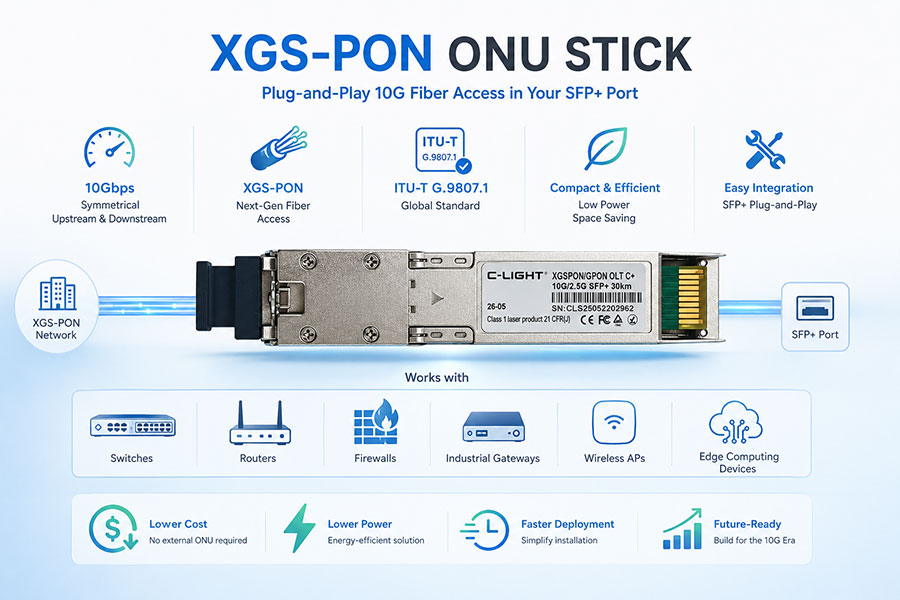
With the rapid development of 10G Fiber Broadband, FTTH, Smart Campus, Enterprise Private Networks, 5G Fronthaul, and Industrial Ethernet, operators are gradually upgrading traditional GPON networks to XGS-PON. Compared with GPON, XGS-PON provides symmetrical 10Gbps downstream and upstream bandwidth, making it an ideal solution for cloud computing, AI applications, ultra-HD video, Wi-Fi 7, and enterprise digital transformation. XGS-PON is standardized by ITU-T G.9807.1 and is widely deployed as the next-generation passive optical access technology.
Traditional ONU/ONT devices require independent power supplies, occupy installation space, and introduce additional Ethernet connections. As network equipment becomes increasingly compact and integrated, operators and system integrators are adopting XGS-PON ONU STICK, which integrates a complete ONU into a standard SFP+ form factor.
The XGS-PON ONU STICK allows switches, routers, firewalls, industrial gateways, wireless APs, and edge computing devices equipped with SFP+ ports to connect directly to XGS-PON networks without requiring an external ONU, simplifying deployment while reducing installation cost and power consumption.
1、What Is an XGS-PON ONU STICK?
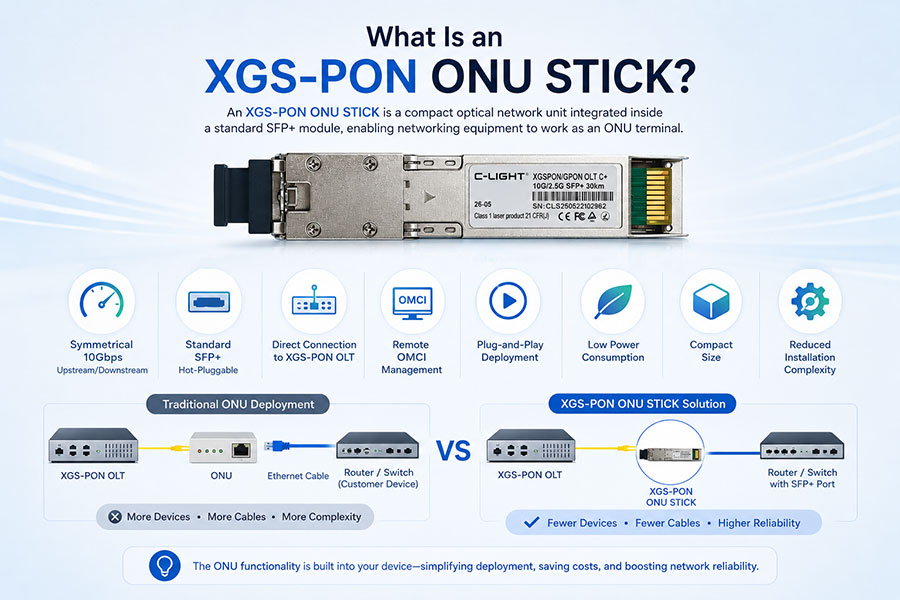
An XGS-PON ONU STICK is a compact optical network unit integrated inside a standard SFP+ module. It contains the complete XGS-PON PHY, MAC, OMCI management, burst-mode optical transmitter and receiver, allowing compatible networking equipment to function directly as an ONU terminal.
XGSPON OLT/ONU SFP+/SFP-DD丨C-LIGHT
Compared with conventional ONU devices, an C-LIGHT XGS-PON ONU STICK(CLXGSP-ONU-STK) provides:
· Symmetrical 10Gbps upstream/downstream transmission
· Standard SFP+ hot-pluggable interface
· Direct connection to XGS-PON OLT
· Remote OMCI management
· Plug-and-play deployment
· Low power consumption
· Compact size
· Reduced installation complexity
Instead of deploying a standalone ONU and Ethernet patch cable, the ONU functionality is embedded directly into the networking device, improving reliability while reducing equipment count.
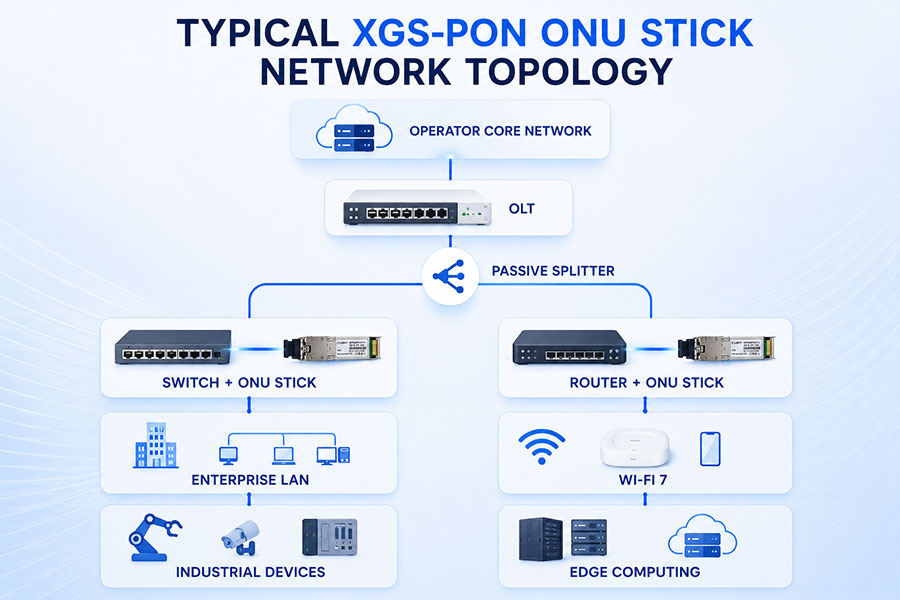
2、Typical XGS-PON Network Architecture
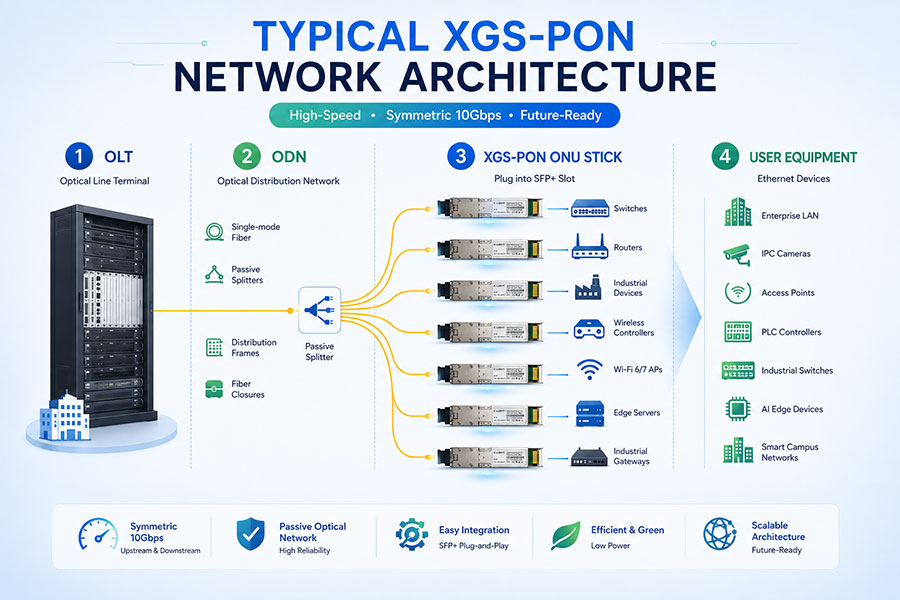
A standard XGS-PON network consists of four major components:
2.1 OLT (Optical Line Terminal)
Located in the central office or data center, the OLT manages subscriber registration, bandwidth allocation, QoS, VLAN, DBA scheduling, authentication, and network management.
2.2 ODN (Optical Distribution Network)
The passive optical distribution network consists of:
· Single-mode fiber
· Passive optical splitters
· Optical distribution frames
· Fiber closures
The ODN enables one OLT port to serve multiple subscribers simultaneously.
2.3 XGS-PON ONU STICK
Installed directly into the SFP+ slot of:
· Ethernet Switches
· Enterprise Routers
· Industrial Ethernet Devices
· Wireless Controllers
· Wi-Fi 6/7 Access Points
· Edge Servers
· Industrial Gateways
The ONU STICK registers with the OLT and converts XGS-PON traffic into standard Ethernet.
2.4 User Equipment
Connected Ethernet devices include:
· Enterprise LAN
· IPC Cameras
· Access Points
· PLC Controllers
· Industrial Switches
· AI Edge Devices
· Smart Campus Networks
3、XGS-PON ONU STICK Working Process
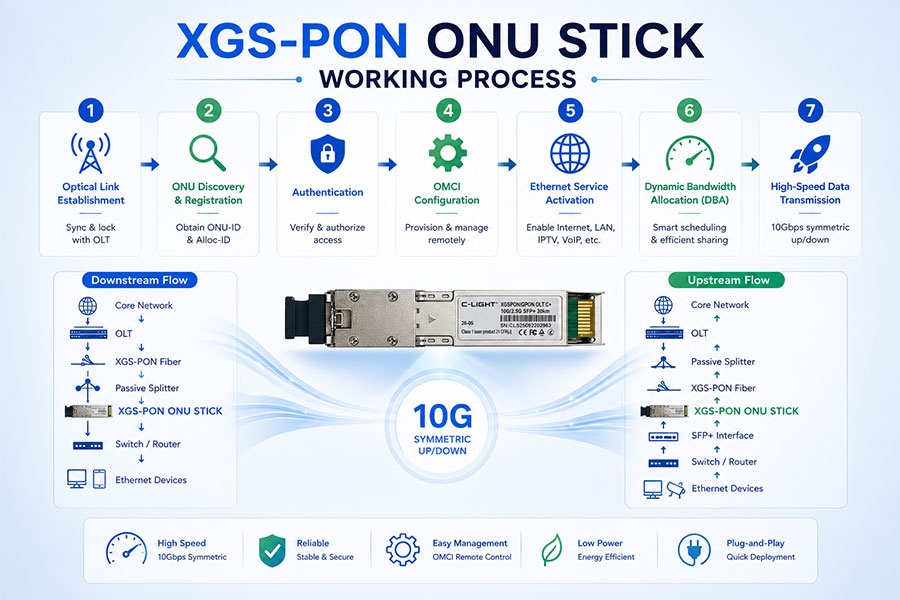
The XGS-PON ONU STICK integrates the functions of a traditional Optical Network Unit (ONU) into a compact SFP+ form factor, allowing switches, routers, firewalls, industrial gateways, and other networking devices with SFP+ ports to connect directly to an XGS-PON network. Its working process includes optical synchronization, ONU registration, authentication, OMCI configuration, service provisioning, and high-speed data transmission. The overall activation process is defined by the ITU-T G.9807.1 XGS-PON standard.
Step 1. Optical Link Establishment
After the ONU STICK is inserted into an SFP+ slot and connected to the Optical Distribution Network (ODN), it immediately begins monitoring the downstream optical signal transmitted by the OLT.
At this stage, the ONU STICK:
· Detects downstream XGS-PON frames
· Synchronizes with the OLT clock
· Locks onto the downstream wavelength
· Measures optical signal quality
· Enters the initialization state
Only after successful optical synchronization can the ONU proceed with registration.
Step 2. ONU Discovery and Registration
Once downstream synchronization is complete, the OLT starts the ONU discovery process.
The ONU STICK sends its identification information, including:
· Serial Number (SN)
· Vendor ID
· Equipment ID
· Registration Information
The OLT verifies whether the ONU is authorized to join the network.
If accepted, the OLT assigns:
· ONU-ID
· Alloc-ID
· Default OMCI Channel
This registration process ensures that every ONU on the passive optical network has a unique logical identity before user traffic begins.
Step 3. Authentication
After registration, authentication is performed according to the operator's network policy.
Common authentication methods include:
· Serial Number (SN)
· LOID Authentication
· PLOAM Password
· OMCI-based Authentication
· IEEE 802.1X Authentication (optional)
Carrier networks may use one or more authentication mechanisms before allowing service access. XGS-PON also supports mutual authentication through OMCI or IEEE 802.1X where required.
Step 4. OMCI Configuration
After successful authentication, the ONU reaches the operational state and the OLT establishes the ONU Management and Control Interface (OMCI).
Through OMCI, the OLT remotely provisions the ONU STICK by configuring:
· GEM Ports
· T-CONTs
· VLAN Rules
· QoS Policies
· DBA Parameters
· Ethernet Bridge
· Traffic Mapping
· Multicast Services
This centralized management allows operators to remotely deploy, monitor, upgrade, and maintain ONU devices without on-site intervention.
Step 5. Ethernet Service Activation
After OMCI provisioning is completed, Ethernet services become active.
The ONU STICK bridges Ethernet traffic between the host device and the XGS-PON network.
Typical services include:
· Internet Access
· Enterprise LAN
· IPTV
· VoIP
· Industrial Ethernet
· Smart Campus Networks
· Wi-Fi 6/7 Backhaul
At this point, the connected switch or router can access the operator's network just as if it were connected through a conventional external ONU.
Step 6. Dynamic Bandwidth Allocation (DBA)
Unlike point-to-point Ethernet, XGS-PON is a shared passive optical network.
The OLT continuously performs Dynamic Bandwidth Allocation (DBA) by:
· Monitoring ONU traffic demand
· Scheduling upstream transmission windows
· Assigning bandwidth dynamically
· Preventing transmission collisions
· Maximizing fiber utilization
DBA enables multiple ONU STICKs connected through passive splitters to efficiently share the same 10G PON bandwidth while maintaining service quality.
Step 7. High-Speed Data Transmission
After activation, the ONU STICK enters normal operation.
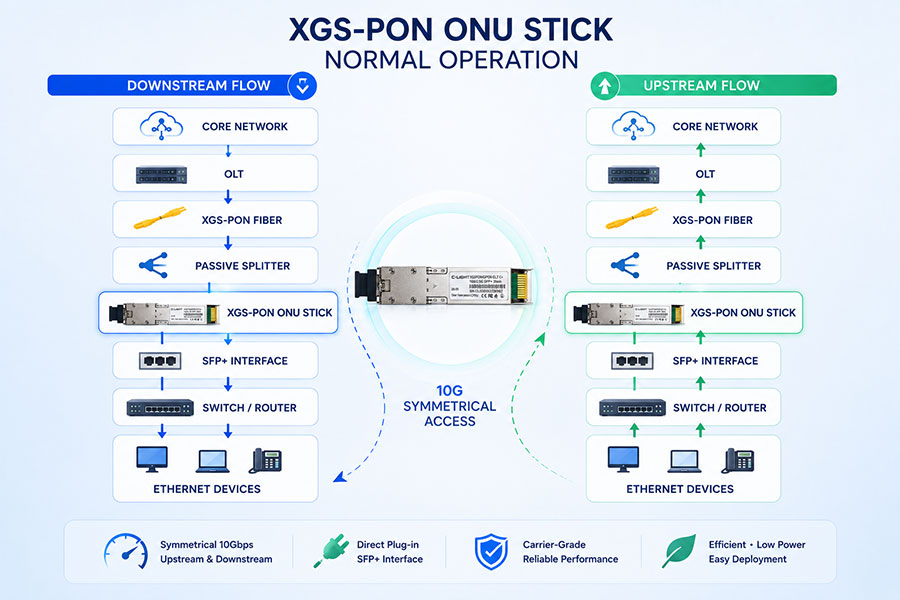
The ONU STICK converts Ethernet frames into XGS-PON frames for upstream transmission and converts downstream XGS-PON frames back into standard Ethernet, enabling transparent Layer 2 connectivity.
4、Advantages of XGS-PON ONU STICK
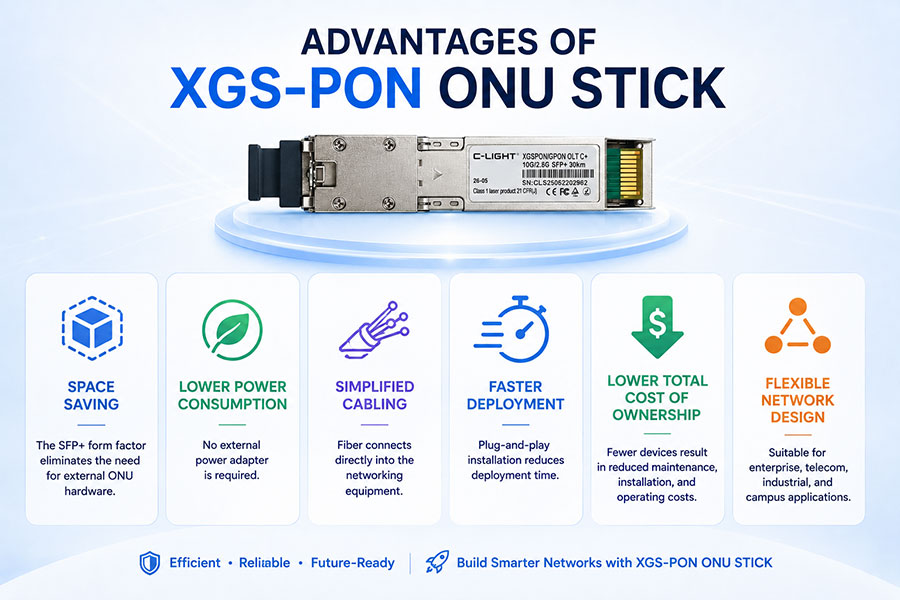
Compared with traditional ONU deployment, XGS-PON ONU STICK offers significant benefits.
Space Saving
The SFP+ form factor eliminates the need for external ONU hardware.
Lower Power Consumption
No external power adapter is required.
Simplified Cabling
Fiber connects directly into the networking equipment.
Faster Deployment
Plug-and-play installation reduces deployment time.
Lower Total Cost of Ownership
Fewer devices result in reduced maintenance, installation, and operating costs.
Flexible Network Design
Suitable for enterprise, telecom, industrial, and campus applications.
5、Typical Application Scenarios
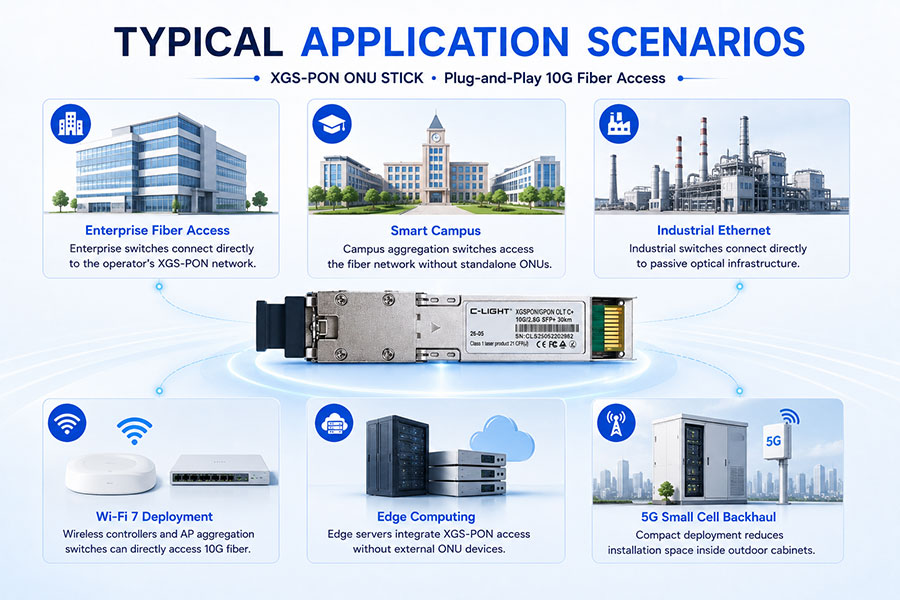
Enterprise Fiber Access
Enterprise switches connect directly to the operator's XGS-PON network.
Smart Campus
Campus aggregation switches access the fiber network without standalone ONUs.
Industrial Ethernet
Industrial switches connect directly to passive optical infrastructure.
Wi-Fi 7 Deployment
Wireless controllers and AP aggregation switches can directly access 10G fiber.
Edge Computing
Edge servers integrate XGS-PON access without external ONU devices.
5G Small Cell Backhaul
Compact deployment reduces installation space inside outdoor cabinets.
6、Typical XGS-PON ONU STICK Network Topology
7、Key Features of C-LIGHT XGS-PON ONU STICK
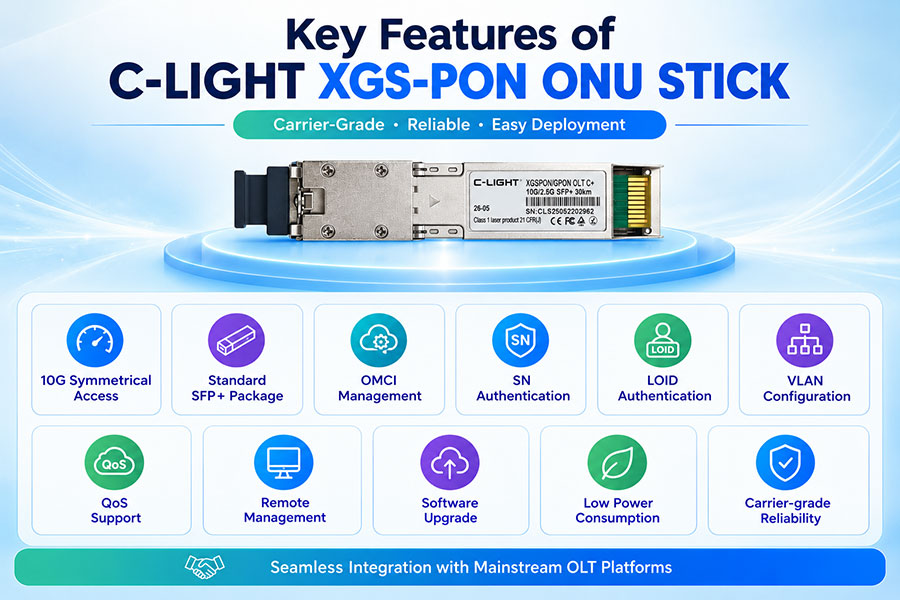
C-LIGHT XGS-PON ONU STICK is designed for carrier-grade interoperability and enterprise deployment.
Key capabilities include:
· XGS-PON 10G Symmetrical Access
· Standard SFP+ Package
· OMCI Management
· SN Authentication
· LOID Authentication
· VLAN Configuration
· QoS Support
· Remote Management
· Software Upgrade
· Low Power Consumption
· Carrier-grade Reliability
The module is designed for seamless integration with mainstream OLT platforms while supporting flexible deployment across telecom and enterprise networks.
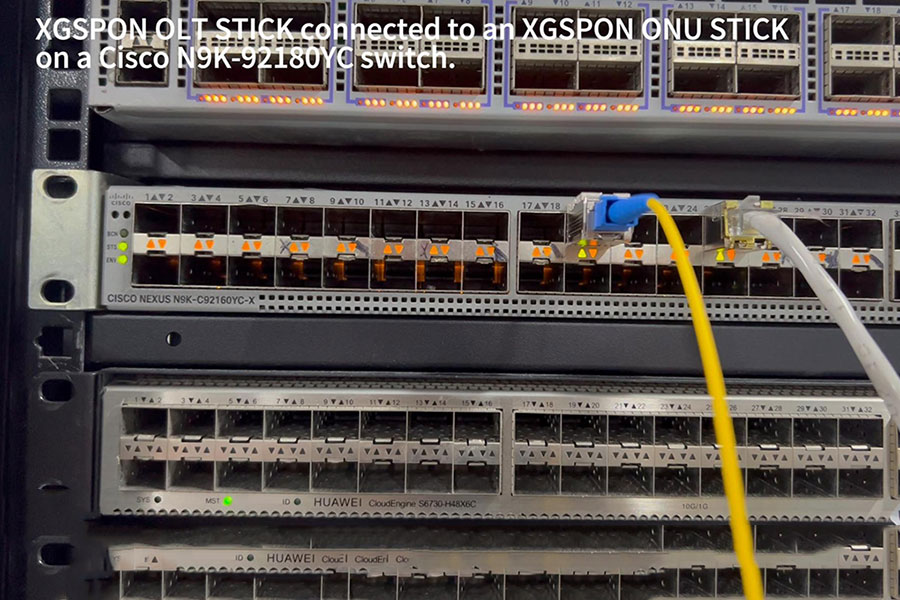
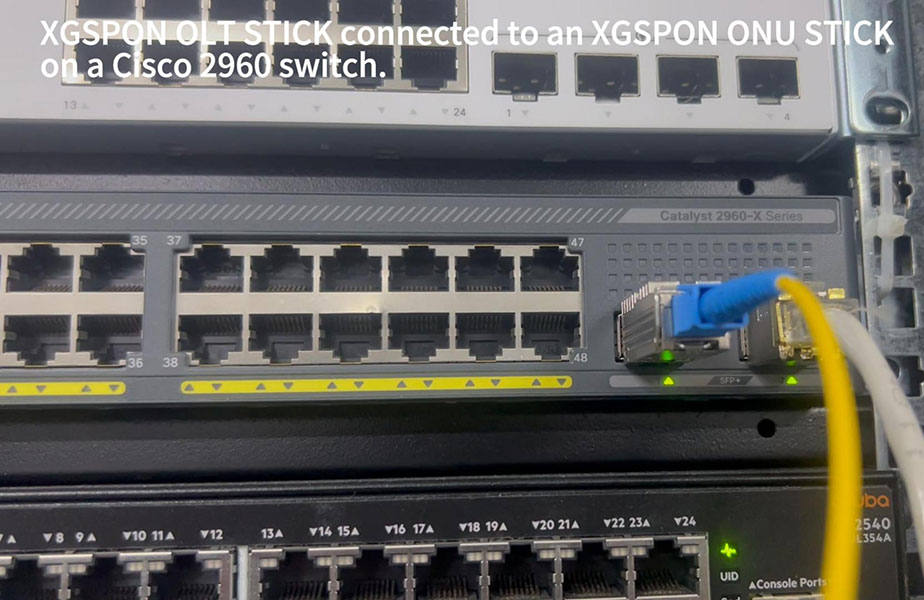
8、XGS-PON ONU STICK Compatibility Testing
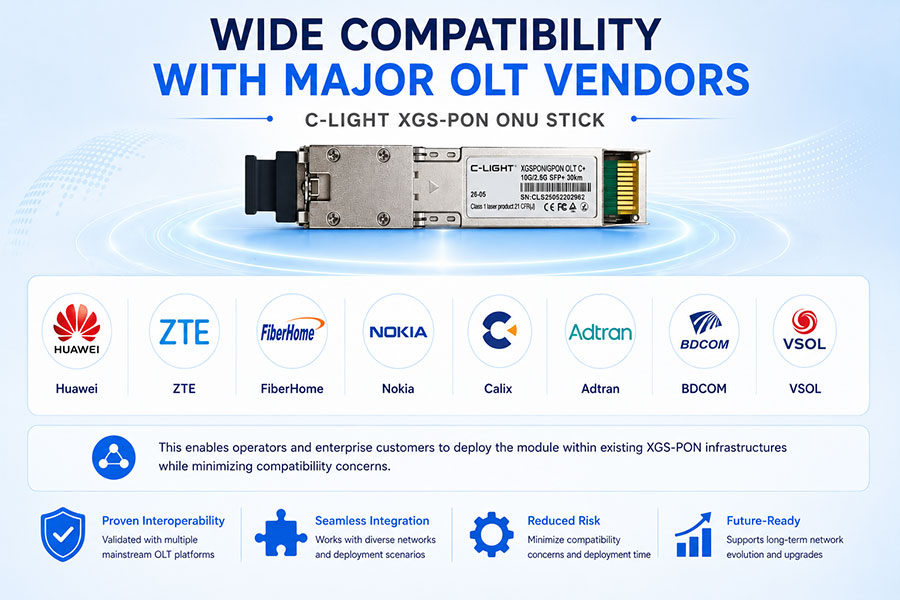
Through extensive interoperability testing, C-LIGHT XGS-PON ONU STICK supports compatibility with major OLT vendors, including:
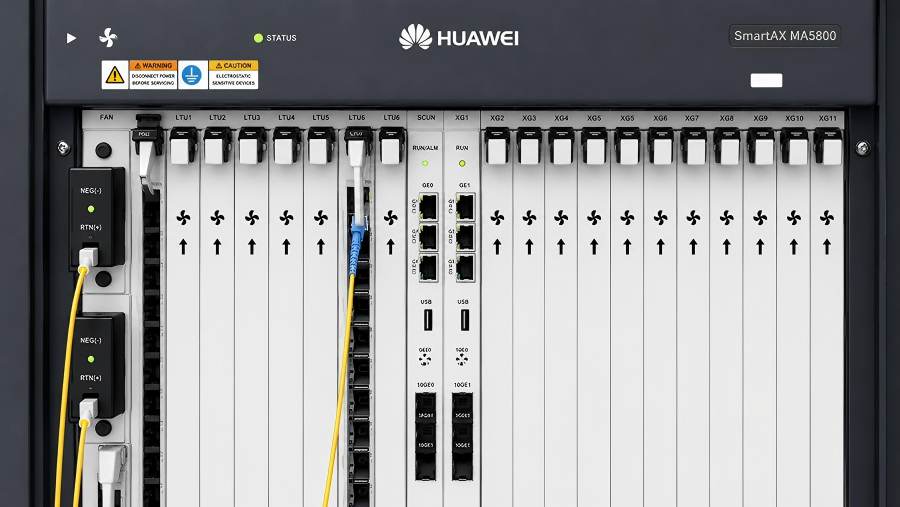
●Huawei MA5800 Series
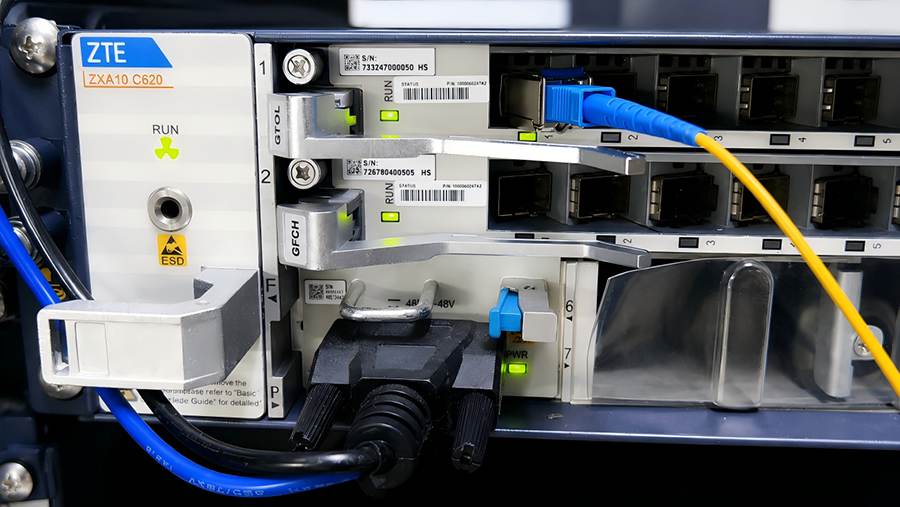
●ZTE C600/C300 Series
●Nokia 7360 Series
●FiberHome OLT

●Raisecom OLT
●VSOL OLT
●BDCOM OLT
●C-Data OLT
●HSGQ OLT
●Ubiquiti OLT
●Calix E9-2 / E7-2
Primary Test Items
●ONU registration
●OMCI protocol compatibility
●VLAN service validation
●DBA bandwidth management
●Multicast service verification
●Long-term stability testing
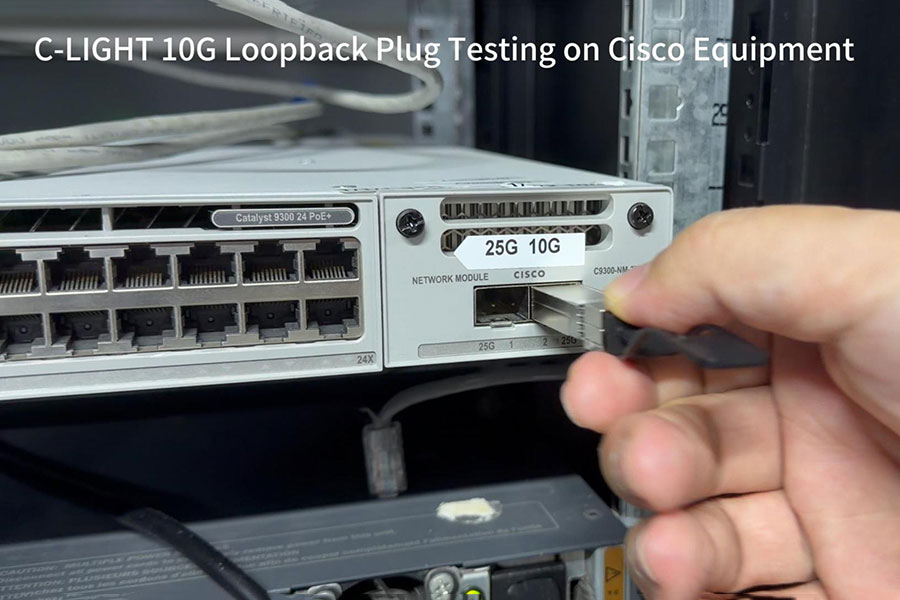
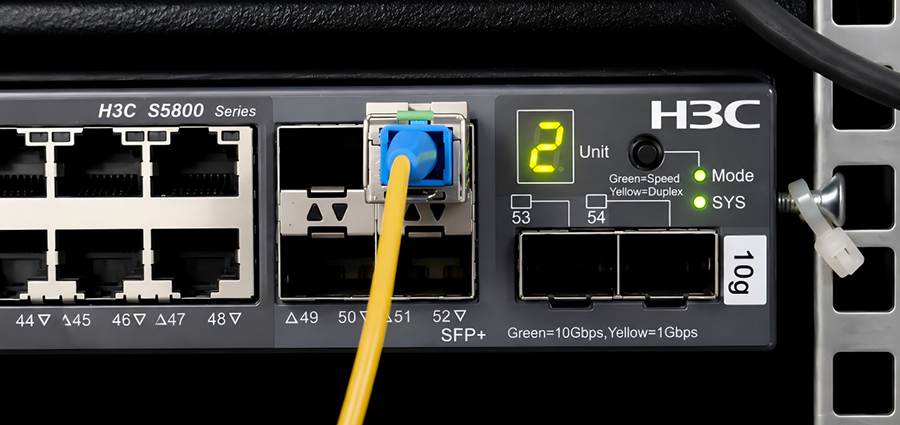
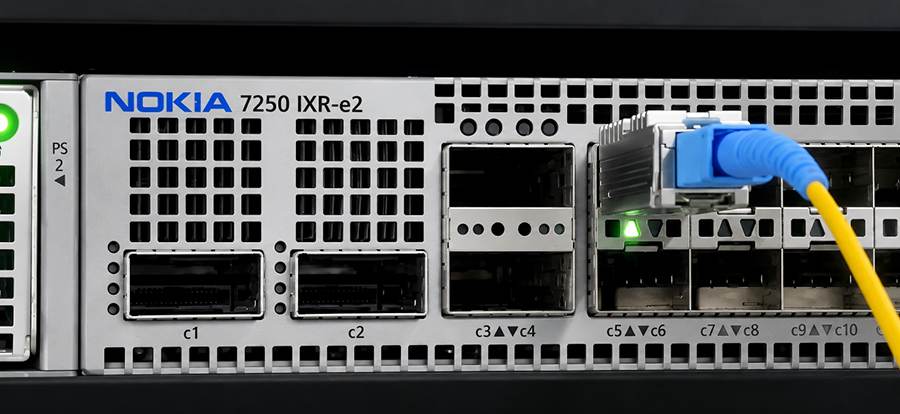
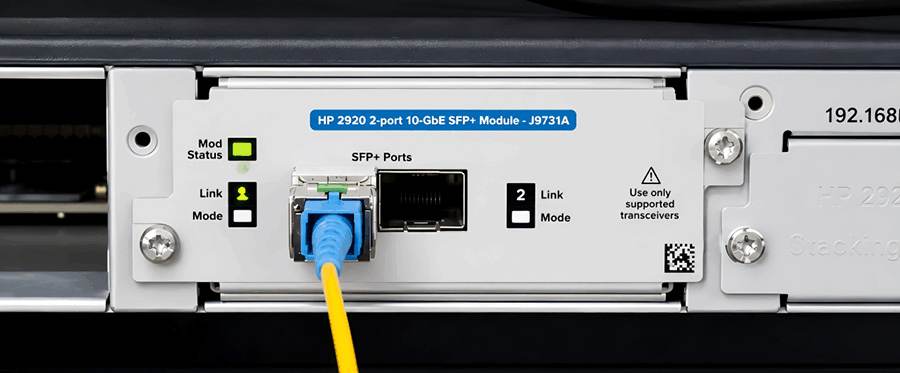
Tested Switch Brands
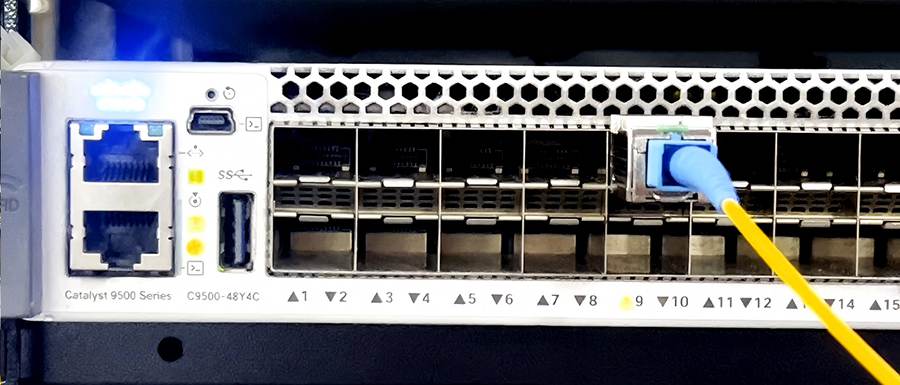
Cisco C9500 / Nexus 9000 / NCS5001 Series
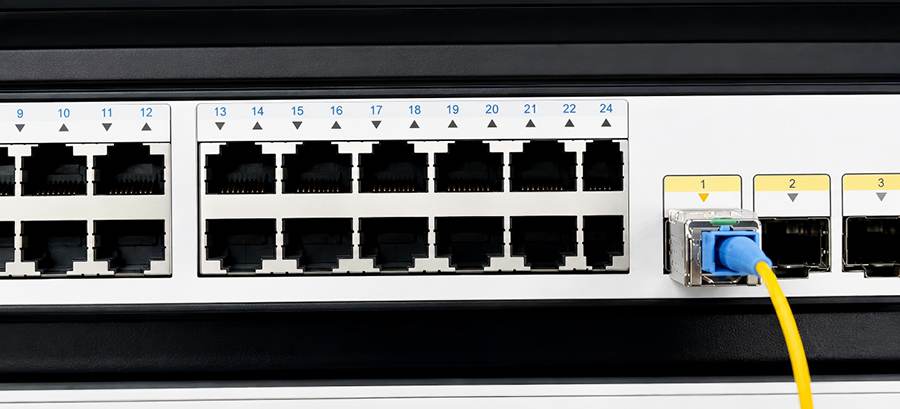
Huawei S5700 / S6700 Series
Dell Power Switch Series
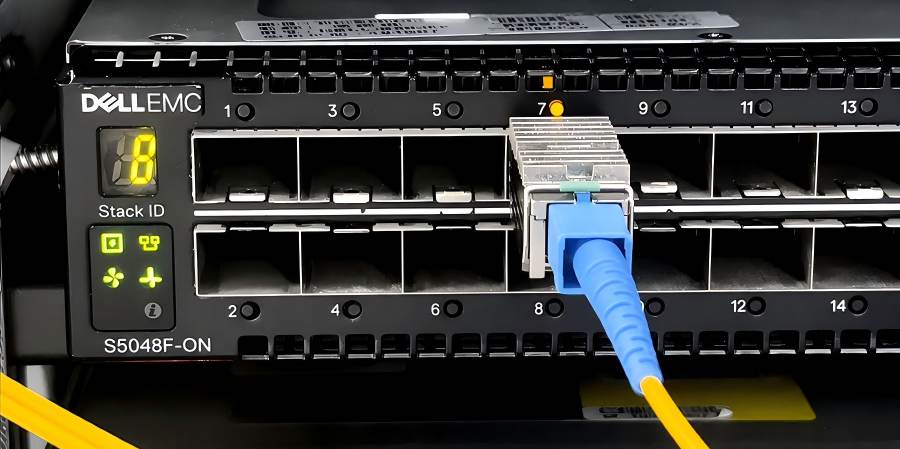
Juniper EX4300 / EX5300 Series
Aruba CX 8300 / CX 6300M Series
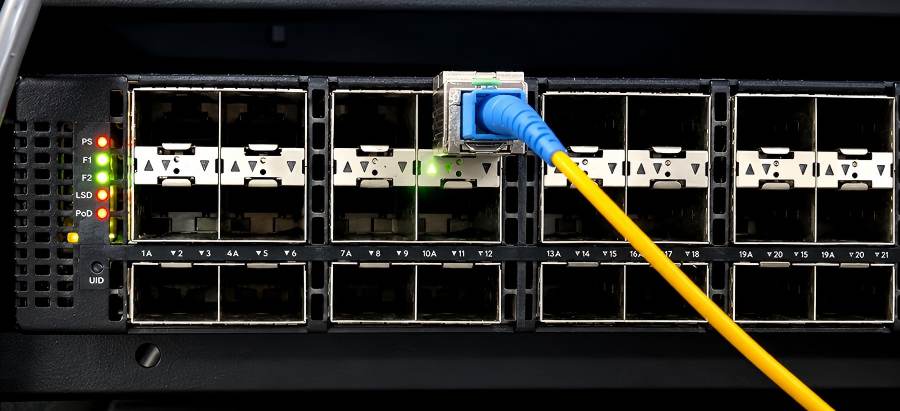
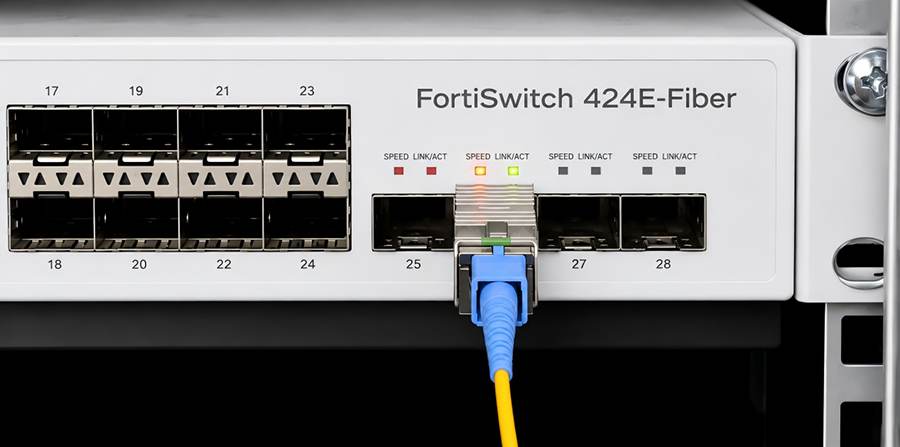
Fortinet 424E-Fiber
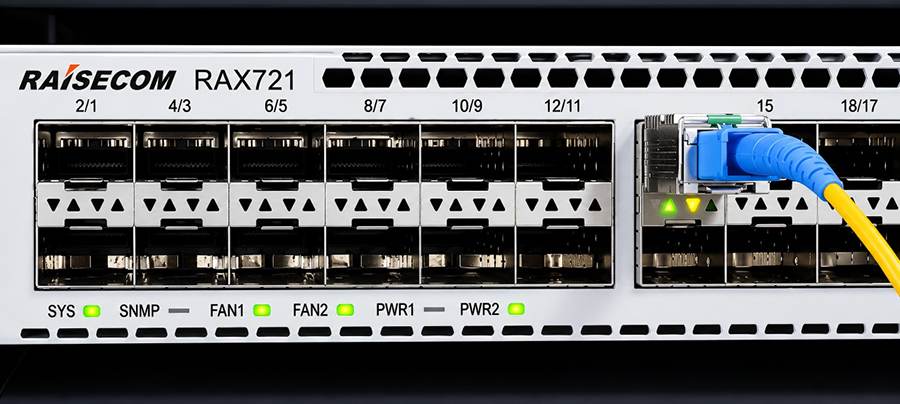
Raisecom RAX721
H3C S5800 Series
Nokia 7250 Series
HP Aruba Switches
Test Scope
●SFP module recognition
●Link establishment
●Auto-negotiation
●VLAN transparency
●Jumbo frame support
●QoS policy implementation
●Long-term operational stability
This enables operators and enterprise customers to deploy the module within existing XGS-PON infrastructures while minimizing compatibility concerns. C-LIGHT's earlier PON Stick validation also demonstrates interoperability across multiple mainstream OLT platforms.
9、Why Choose C-LIGHT XGS-PON ONU STICK?
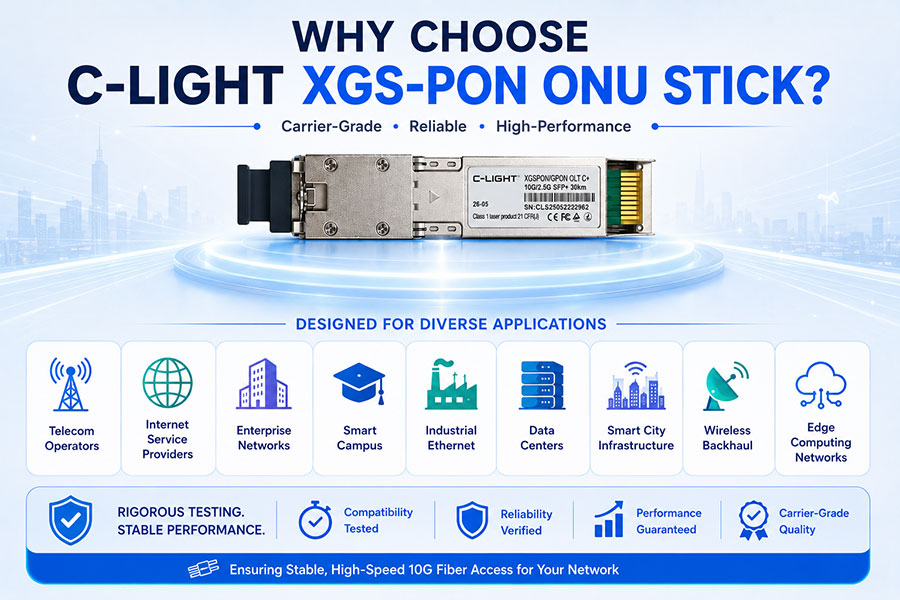
C-LIGHT provides carrier-grade XGS-PON ONU STICK solutions designed for:
· Telecom Operators
· Internet Service Providers
· Enterprise Networks
· Smart Campus
· Industrial Ethernet
· Data Centers
· Smart City Infrastructure
· Wireless Backhaul
· Edge Computing Networks
Every product undergoes rigorous compatibility, reliability, and performance testing to ensure stable operation in demanding 10G fiber access environments.
10. Frequently Asked Questions (FAQ)
Q1. What is an XGS-PON ONU STICK?
Answer: An XGS-PON ONU STICK is an SFP+ optical module that integrates a complete XGS-PON ONU, allowing networking equipment with SFP+ ports to connect directly to a 10G passive optical network without requiring an external ONU.
Q2. What transmission speed does XGS-PON support?
Answer: XGS-PON provides 10 Gbps downstream and 10 Gbps upstream, delivering symmetrical bandwidth for bandwidth-intensive services.
Q3. Which devices can use an XGS-PON ONU STICK?
Answer: It can be installed in switches, routers, firewalls, industrial gateways, wireless controllers, and other networking devices equipped with compatible SFP+ interfaces.
Q4. Does the ONU STICK support remote management?
Answer: Yes. It supports OMCI-based remote provisioning, configuration, software upgrades, monitoring, and maintenance.
Q5. Is the C-LIGHT XGS-PON ONU STICK compatible with mainstream OLTs?
Answer: Yes. C-LIGHT validates interoperability with multiple major OLT vendors, making deployment easier in existing XGS-PON access networks.
 >

 >
 >
 >
 >
 >
 >
 >