TEL:+86 132 6656 7067





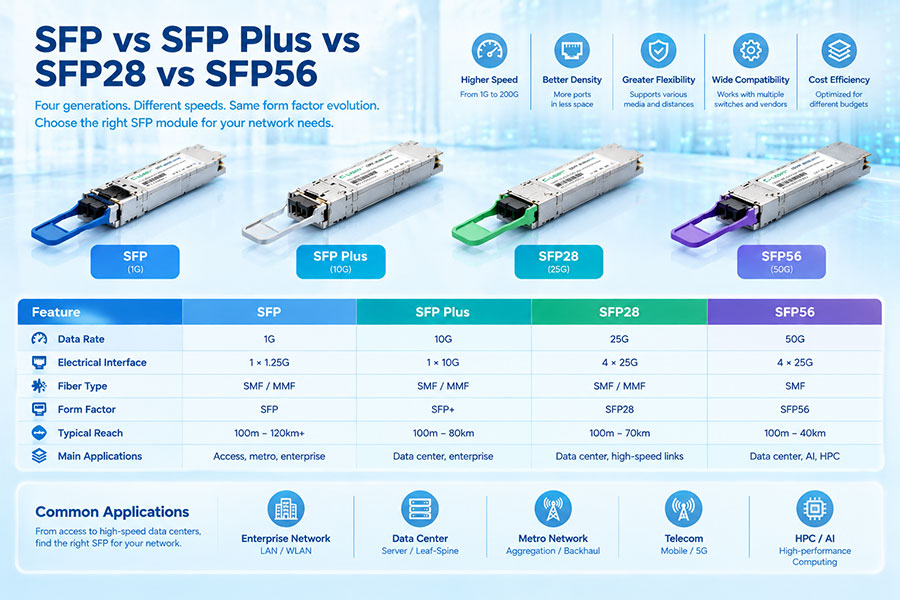
SFP28 and SFP+ transceivers share a similar mechanical design, allowing an SFP28 module to fit into many SFP+ physical cages. However, fitting into a port does not guarantee that the transceiver can establish a working link. SFP28 is primarily designed for 25GbE, while SFP+ is commonly used for 10GbE.
An SFP28 transceiver may operate in an SFP+ port at 10Gbps when the module supports 10G operation and the host device supports the required electrical interface and configuration. A 25G-only SFP28 module should not be expected to work in a conventional 10G-only SFP+ port.
1. Can an SFP28 Transceiver Work in an SFP+ Port?
Yes, under specific compatibility conditions. An SFP28 transceiver can physically fit into an SFP+ port because both belong to the same compact pluggable module family. Some SFP28 modules also support lower operating rates, allowing them to establish a 10G link when installed in a compatible SFP+ host.
However, compatibility depends on three independent requirements:
Mechanical compatibility: The module must fit the host cage and connector arrangement.
Electrical compatibility: The host port and transceiver must support the same operating data rate and electrical interface.
Operational compatibility: The switch firmware, module coding and port configuration must support the selected module and speed.
↓
Compatible with SFP+ Physical Cage
↓
Check Whether Module Supports 10G Operation
↓
Check Host Port and Firmware Support
↓
Compatible 10G Link, If All Requirements Are Met
The key point is that a 25G SFP28 module does not automatically reduce its speed to 10G simply because it is installed in an SFP+ port.
2. Why Do SFP28 and SFP+ Have Similar Physical Dimensions?
SFP28 was developed as a higher-speed member of the SFP-family pluggable interface. It retains a closely related mechanical form factor to SFP+ while supporting a faster electrical signaling interface for 25GbE applications.
This design allows equipment manufacturers to develop high-density 25G ports without requiring a completely different module package from 10G SFP+.
| Feature | SFP+ | SFP28 |
|---|---|---|
| Primary Data Rate | 10GbE class | 25GbE class |
| Mechanical Design | SFP-family pluggable package | Closely related SFP-family package |
| Electrical Signaling | Designed for 10G-class operation | Designed for higher-speed 25G-class operation |
| Typical Optical Application | 10G SR, LR, ER and other interfaces | 25G SR, LR, ER, BiDi and other interfaces |
| Host Port Requirement | SFP+ compatible port | SFP28 compatible 25G port |
| Lower-Speed Operation | 10G and selected lower-rate options | 10G or 1G only when explicitly supported by the module and host |
The shared package design provides mechanical flexibility, but the host electrical interface still determines which data rates are possible.
3. What Is the Main Electrical Difference Between SFP+ and SFP28?
The major technical difference is the host-side signaling rate. A conventional SFP+ interface is designed for 10GbE-class electrical signaling, while SFP28 supports a higher-speed electrical lane for 25GbE-class applications.
Traditional 10GBASE-R uses a line rate of approximately 10.3125 Gb/s. A common 25GbE SFP28 interface uses a higher line rate of approximately 25.78125 Gb/s.
| Electrical Interface | Approximate Line Rate | Typical Ethernet Application |
|---|---|---|
| SFP+ 10GBASE-R | 10.3125 Gb/s | 10GbE |
| SFP28 25GBASE-R | 25.78125 Gb/s | 25GbE |
The host equipment must provide the corresponding electrical signaling and processing capability. A standard 10G SFP+ port cannot operate at the 25G electrical line rate required by a 25G-only SFP28 module.
Some SFP28 modules are designed with multi-rate support and can operate at both 10G and 25G. In these cases, the module uses the appropriate operating mode when connected to a compatible host. The exact supported rates must be confirmed from the individual product specification.
4. Can a 25G SFP28 Module Automatically Run at 10G?
Not necessarily. The ability to operate at 10G depends on the transceiver's supported data rates and its implementation.
There are three common module categories:
| SFP28 Module Type | Supported Rate | Use in a 10G SFP+ Host |
|---|---|---|
| 25G-only SFP28 | 25G | Normally not supported by a 10G-only host |
| 10G/25G SFP28 | 10G and 25G | Possible at 10G when host and firmware support it |
| 1G/10G/25G SFP28 | 1G, 10G and 25G | Possible at 10G when host and firmware support it |
A dual-rate or triple-rate module provides greater deployment flexibility, but its multi-rate capability does not override the limitations of the host port.
For example, a 10G/25G SFP28 module may support 10G optical operation, but it still needs an SFP+ port that recognizes the module and supports the appropriate electrical mode.
5. What Happens When a 25G-Only SFP28 Module Is Installed in an SFP+ Port?
A 25G-only SFP28 transceiver is designed for a 25G electrical interface. A conventional SFP+ port is designed for 10G operation and cannot provide the required 25G host signaling.
Depending on the switch and module implementation, the following conditions may occur:
The switch detects the physical module but reports an unsupported transceiver.
The interface remains down because the host cannot establish the required electrical link.
The switch reports an unsupported data rate or module compatibility error.
The port cannot configure the module at 25G because the host only supports 10G.
Some equipment may not recognize the module at all. Other equipment may display its identification information but still fail to establish a usable link.
The exact response is platform-dependent. It should not be treated as proof of a defective transceiver until the host's supported module list and operating rate have been checked.
6. Can an SFP28 Module Establish a 10G Link in an SFP+ Port?
Yes, if the transceiver supports 10G operation and the host equipment supports that module and operating mode.
For a compatible dual-rate SFP28 module, the link can operate at 10G when connected to a 10G SFP+ interface. The 10G host port remains the speed limitation, so the connection does not operate at 25G.
↓
10G SFP+ Host Port
↓
Host and Module Support 10G Mode
↓
10GbE Optical Link
Some switch platforms require manual port-speed configuration. Autonegotiation behavior varies between devices and optical interfaces, so engineers should follow the equipment manufacturer's instructions.
The far-end device must also support the same 10G link configuration. Using a 10G-compatible module at one end and a 25G-only module at the other does not create a valid link unless the two modules and host interfaces support a common operating mode.
7. Is an SFP+ Port Backward Compatible with SFP28?
Compatibility is possible, but it is not guaranteed across all switches, routers and optical modules.
The shared mechanical design makes SFP28 modules suitable for many SFP+ cages. Some network platforms also support 10G operation with SFP28 modules, particularly when the module explicitly supports both 10G and 25G.
However, the host must recognize the transceiver, provide a compatible electrical interface, and support the required speed through its firmware and port configuration.
Vendor documentation illustrates this platform-specific behavior. Cisco notes that SFP28 modules can be inserted into SFP+ sockets but requires host software support. Extreme Networks documents SFP28/SFP+ compatibility for supported platforms and notes that manual speed configuration may be required.
Therefore, backward compatibility should be verified for the exact host model rather than assumed from the SFP-family form factor.
8. SFP28 in SFP+ vs SFP+ in SFP28: Are They Different?
These two installation directions are related, but they should not be treated as universally interchangeable.
An SFP+ module installed in an SFP28 port is commonly supported by SFP28 hosts that provide backward-compatible 10G operation. The host operates at 10G rather than 25G.
An SFP28 module installed in an SFP+ port is more dependent on whether the SFP28 module itself supports 10G operation and whether the SFP+ host supports the module's electrical and management requirements.
| Installation Direction | Possible Operating Speed | Main Compatibility Requirement |
|---|---|---|
| 10G SFP+ module in a 25G SFP28 port | Usually 10G, if supported | SFP28 host must support 10G modules |
| 25G-only SFP28 module in a 10G SFP+ port | Normally no working link | 25G module requires a 25G-capable host |
| 10G/25G SFP28 module in a 10G SFP+ port | 10G, if supported | Module must support 10G and host must recognize it |
| 10G/25G SFP28 module in a 25G SFP28 port | 10G or 25G, depending on configuration | Host and module must support the selected rate |
The actual compatibility matrix depends on the device manufacturer, hardware revision, firmware and module part number.
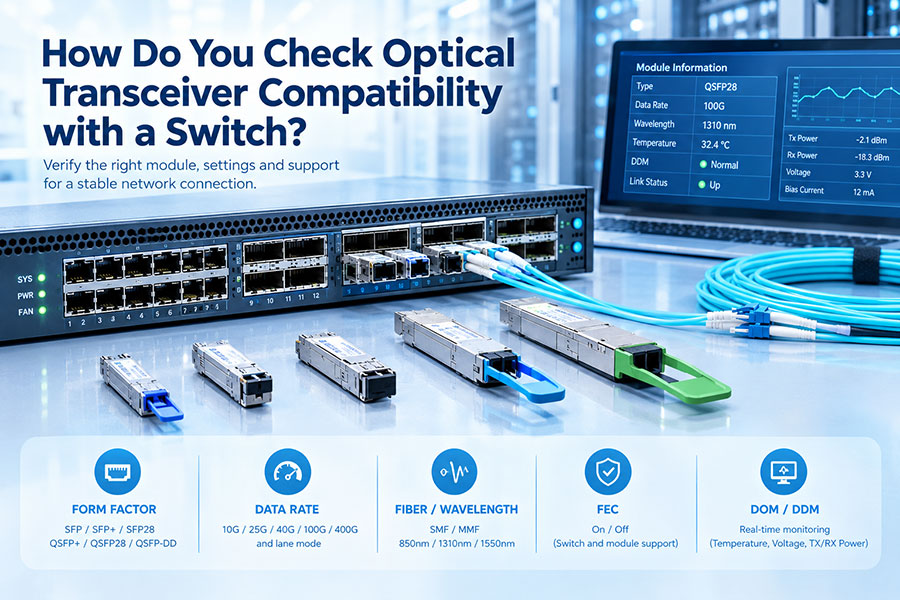
9. What Should You Check Before Using an SFP28 Module in an SFP+ Port?
Before installing the module, verify the following information:
Host port specification: Confirm whether the port supports 10G only or multiple speeds.
Module data-rate range: Check whether the SFP28 model supports 10G/25G or 25G only.
Electrical compatibility: Verify that the module can operate with the host's 10G electrical interface.
Firmware support: Check whether the device software supports the module's identification and operating mode.
Port configuration: Confirm whether manual 10G speed configuration is required.
Fiber compatibility: Match single-mode or multimode fiber and the appropriate wavelength.
Remote module: Confirm that the far-end transceiver and host support the same data rate and optical interface.
Optical power budget: Verify the transmitter power, receiver sensitivity and link-loss requirements.
Checking only the physical port type is insufficient. The most reliable approach is to confirm the exact module model against the switch manufacturer's compatibility documentation.
10. Can SFP28 Support 1G, 10G and 25G?
Some SFP28 transceivers support multiple data rates, including 1G, 10G and 25G. However, other SFP28 models are designed specifically for 25G operation.
The distinction is determined by the module's internal design and product specification, not simply by the SFP28 label.
| Module Classification | Typical Data-Rate Support | Deployment Advantage |
|---|---|---|
| Standard 25G SFP28 | 25G | Designed for dedicated 25GbE access and aggregation ports |
| 10G/25G SFP28 | 10G and 25G | Supports selected mixed-speed network environments |
| 1G/10G/25G SFP28 | 1G, 10G and 25G | Provides additional speed flexibility when supported by the host |
Multi-rate capability is particularly useful for network migration. An operator can use a suitable module in different access or aggregation environments, provided that the specific host port supports the required electrical mode.
11. What Is the Difference Between SFP28 and SFP+ Optical Reach?
SFP28 and SFP+ describe form factor and data-rate families, not a fixed transmission distance. Both can be available in different optical types, including SR, LR, ER and other specialized variants.
For example, a 25G SFP28 module may use 850 nm multimode optics for a short-distance connection or 1310 nm single-mode optics for a longer transmission link.
| Optical Type | Typical Wavelength | Fiber Type | Example Reach Category |
|---|---|---|---|
| 25G SR | 850 nm | MMF | 100 m class |
| 25G LR | 1310 nm | SMF | 10 km class |
| 25G ER | 1310 nm | SMF | 40 km class, depending on specification |
| 25G ZR | 1310 nm or other specified wavelength | SMF | Longer-reach variant, model-dependent |
These reach categories do not determine SFP28/SFP+ host compatibility. Even when a 25G SFP28 module has an optical reach suitable for an existing 10G link, it still needs compatible electrical signaling and host support.
12. Common SFP28 and SFP+ Compatibility Problems
When an SFP28 module is installed in an SFP+ port, several issues can prevent the connection from becoming operational.
| Problem | Possible Cause | Recommended Verification |
|---|---|---|
| Module is not recognized | Unsupported module coding or host compatibility restriction | Check the device compatibility list and module identification |
| Module is detected but link remains down | Unsupported electrical rate or incompatible host interface | Check module speed support and host port capability |
| Link does not establish at 10G | 25G-only transceiver or incorrect port configuration | Confirm dual-rate support and configure the supported speed |
| One end operates but the other does not | Different speed settings or incompatible transceiver types | Compare both endpoints' supported rates and optical specifications |
| Link is detected but unstable | Fiber mismatch, optical power issue or unsupported module pairing | Check wavelength, fiber type, optical power and compatibility |
| Switch reports unsupported transceiver | Firmware, vendor coding or platform restrictions | Review supported module list and software requirements |
Physical insertion and module detection are only initial checks. A reliable link must also pass the electrical, optical and protocol compatibility requirements.
13. C-LIGHT SFP28 Multi-Rate Optical Transceiver Options
C-LIGHT provides SFP28 optical transceivers in standard 25G configurations and selected multi-rate models. These options are relevant to network environments where 10G and 25G equipment may coexist.
10G/25G SFP28 Single-Mode Transceiver
The C-LIGHT 25G SFP28 product family includes the CLSFP10G/25GLR model, specified for 10G/25G operation over single-mode fiber at 1310 nm with a 10 km transmission distance.
This model provides a multi-rate option for compatible 10G and 25G host interfaces. Its use in a particular SFP+ port still depends on the switch's electrical interface, firmware and transceiver compatibility support.
1G/10G/25G SFP28 Single-Mode Transceiver
C-LIGHT also lists the CLSP1G/10G/25GLR model with 1G, 10G and 25G data-rate support, 1310 nm wavelength, single-mode fiber and a 10 km reach.
Its multi-rate specification makes it suitable for evaluation in mixed-speed network designs, subject to the supported data rates and compatibility requirements of the host equipment.
10G/25G SFP28 Multimode Transceiver
The CLSFP10G/25GSR model is listed for 10G/25G operation at 850 nm over multimode fiber, with a 100 m transmission distance.
It is intended for compatible short-reach network links where the host supports the selected data rate and multimode optical interface.
In addition to multi-rate models, the C-LIGHT range includes 25G-only SFP28 transceivers. These should not be assumed to operate in an SFP+ host unless the exact model specification confirms 10G support.
14. Conclusion
An SFP28 transceiver can work in an SFP+ port under the right conditions, but physical compatibility does not guarantee operational compatibility. The SFP28 module must support 10G operation, and the SFP+ host must recognize the module and provide the correct electrical interface and configuration.
A 25G-only SFP28 module cannot normally establish a 25G link through a conventional 10G SFP+ port. A dual-rate 10G/25G SFP28 module may operate at 10G when both the module and host support that mode.
Before deployment, verify the exact transceiver part number, supported data rates, host port specifications, firmware, optical interface and far-end compatibility. These checks help avoid modules that fit mechanically but cannot establish the required link.
Looking for 10G/25G SFP28 multi-rate optical transceivers?
Contact C-LIGHT with your switch model, port type and required optical distance. Our team can help check module specifications, multi-rate operation and equipment compatibility.
 >

 >
 >
 >
 >
 >
 >
 >