TEL:+86 132 6656 7067





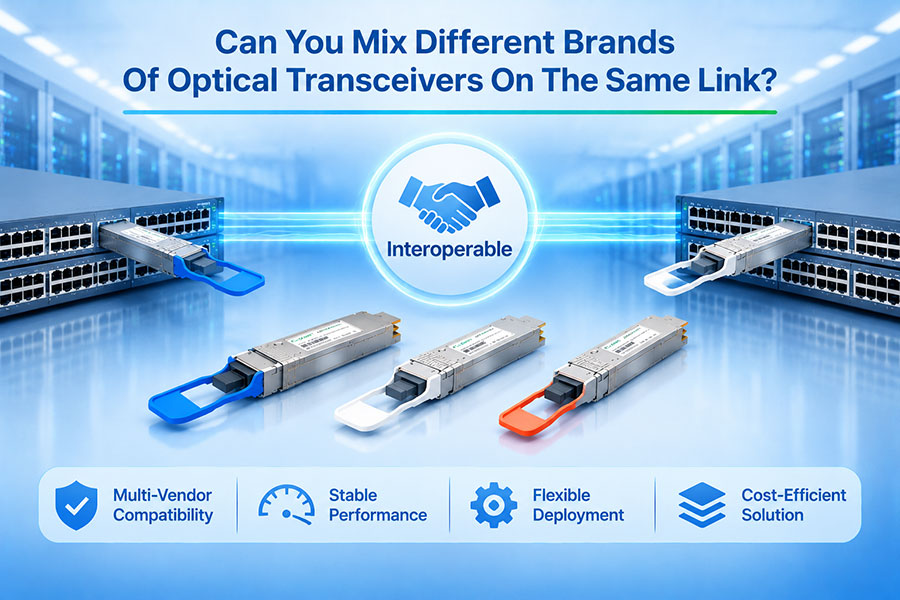
A Direct Attach Copper (DAC) cable can connect switches from different manufacturers, provided that both devices support the cable's electrical interface, data rate, connector type, and identification requirements. Multi-vendor connectivity is common in data centers where network infrastructure combines equipment from different suppliers.
However, matching connectors and transmission speeds does not guarantee that a link will come up. Some switches apply vendor-specific cable recognition policies, while others accept compliant third-party DAC assemblies. The cable's EEPROM coding, port configuration, and platform qualification can all affect interoperability.
1. Can a DAC Cable Connect Two Different Switch Brands?
Yes. A compatible DAC can connect switches from different vendors, such as a switch from one manufacturer to a switch from another. The key requirement is that both ports recognize and support the same electrical connection.
Vendor A
Compatible DAC port
Vendor B
Compatible DAC port
For example, a passive 10G SFP+ DAC may connect two switches from different manufacturers if both ports support the required SFP+ electrical interface and accept the cable's identification information. The same principle applies to higher-speed connections such as 25G SFP28, 100G QSFP28, 400G QSFP-DD, and 800G OSFP or QSFP-DD800, subject to their respective specifications.
Multi-vendor compatibility is therefore possible, but it must be confirmed for the specific equipment models and cable configuration rather than assumed from the brand names alone.
2. Why Can Multi-Vendor DAC Compatibility Be Difficult?
DAC connectors contain identification information that allows the host switch to recognize the attached cable. Depending on the product and interface generation, this information may be stored in an EEPROM within the connector assembly.
The host reads this information to identify characteristics such as cable type, supported data rate, manufacturer details, and other product-specific parameters. Some equipment platforms also use vendor-specific identification fields to determine whether a cable is approved for use.
3. What Is DAC Cable EEPROM Coding?
EEPROM coding refers to the identification data programmed into the cable's connector electronics. It helps the switch determine what type of cable is installed and whether its characteristics are suitable for the port.
In a single-vendor network, a cable carrying identification information recognized by that vendor's equipment may be straightforward to deploy. In a mixed-vendor environment, the two ends may have different recognition requirements.
For example, consider a connection between Switch A and Switch B. If Switch A expects one vendor's identification profile and Switch B expects another, a cable programmed identically at both ends may not satisfy both systems.
For this reason, multi-vendor DAC solutions may use different coding profiles at the two ends. Each connector can be configured to meet the identification requirements of its respective host, provided the cable design and both platforms support the arrangement.
4. Single-Vendor Coding vs. Multi-Vendor DAC Coding
| Parameter | Single-Vendor DAC | Multi-Vendor DAC |
|---|---|---|
| Host environment | Both ends typically use the same vendor's equipment | Each end may connect to a different manufacturer's equipment |
| EEPROM identification | Usually programmed for one vendor's recognition requirements | May use different identification profiles at each end |
| Deployment objective | Connect equipment within a single-vendor network | Connect switches or devices across mixed-vendor infrastructure |
| Compatibility verification | Check the target vendor's cable requirements | Check both endpoint platforms independently |
| Typical application | Homogeneous data center infrastructure | Multi-vendor enterprise and cloud data centers |
5. What Specifications Must Match Between Different Switches?
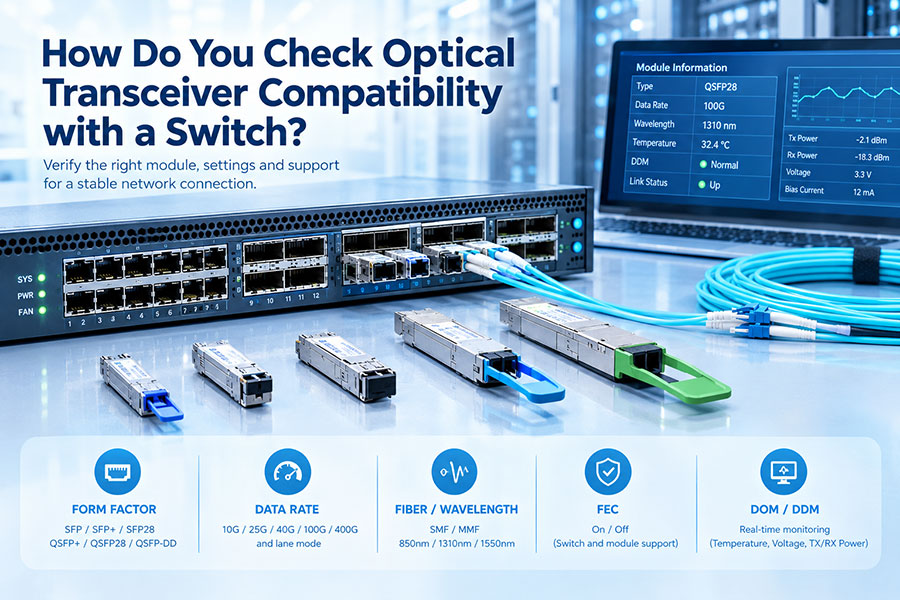
Even when the cable is recognized by both switches, the physical and electrical specifications must still match. The following factors should be checked before deployment.
Connector form factor: Confirm that both ports accept the required cable interfaces, such as SFP+, SFP28, QSFP28, QSFP-DD, or OSFP.
Data rate: Verify that both switches support the cable's rated speed and intended operating mode.
Electrical interface: Check lane count, lane rate, signaling, and relevant electrical specifications.
Cable type: Confirm whether the application requires passive DAC or an active copper cable such as AEC or ACC.
Cable length: Ensure the selected length is within the supported range for both host platforms.
EEPROM coding: Verify that each end is recognized by its connected switch.
Firmware support: Check the equipment manufacturer's compatibility documentation and software requirements.
Link configuration: Confirm that both ports use compatible speed, FEC, and other required settings.
6. Common Multi-Vendor DAC Connection Scenarios
Different network architectures require different cable configurations. The following examples illustrate typical multi-vendor deployment considerations.
| Connection Scenario | Possible DAC Type | Main Compatibility Check |
|---|---|---|
| 10G switch to 10G switch | SFP+ DAC | SFP+ support, 10G operation, and cable recognition at both ends |
| 25G switch to 25G switch | SFP28 DAC | 25G electrical compatibility and supported cable length |
| 100G switch to 100G switch | QSFP28 DAC | 100G port support, lane configuration, and EEPROM identification |
| 400G switch to 400G switch | QSFP-DD or OSFP DAC | Matching form factor, electrical interface, and platform qualification |
| 800G switch to 800G switch | OSFP112 or QSFP-DD800 DAC | 800G host support, connector configuration, lane architecture, and cable coding |
These are interface examples, not guarantees of cross-vendor interoperability. The exact switch models and port specifications determine whether a particular cable can establish a stable link.
7. How to Verify a DAC Cable Before Connecting Different Vendors
A structured compatibility check can reduce installation problems and avoid unnecessary cable replacement.
Identify both switch models: Record the complete model numbers and relevant port types.
Confirm the connection speed: Check the supported speed at each endpoint rather than relying only on the port's physical appearance.
Review supported cable lists: Consult the equipment manufacturers' compatibility documentation for the exact platform and software version.
Confirm cable coding: Check whether both switches accept third-party DAC assemblies or require different identification profiles.
Validate electrical specifications: Review cable length, signal integrity, lane mapping, and the required passive or active architecture.
Test both ends: Verify that each switch recognizes the cable and that the link establishes at the intended speed.
Monitor link stability: Check interface status, error counters, and relevant diagnostics during operation.
For large deployments, testing a representative cable on the actual switch models before purchasing the full quantity is a practical way to confirm interoperability.
8. C-LIGHT Multi-Vendor DAC Cable Solutions
C-LIGHT provides DAC cable solutions for enterprise networks, data centers, AI infrastructure, and high-speed Ethernet or InfiniBand applications. Available product families cover multiple data rates and connector form factors.
Designed for short-reach 400G connections between compatible switches, servers, and network equipment. Connector configurations and host compatibility should be selected according to the target devices.
Designed for high-density 800G connectivity in next-generation data center and AI network environments. Available configurations include OSFP112 and QSFP-DD-related options, subject to the specific product model.
For multi-vendor deployments, cable selection should include the switch manufacturer and exact model at each end. C-LIGHT can assess the required connector configuration, coding requirements, data rate, and cable length to help identify a suitable solution. Compatibility should be confirmed against the actual equipment rather than assumed across an entire vendor product range.
9. Conclusion: Multi-Vendor DAC Connectivity Depends on Both Endpoints
A DAC cable can connect switches from different vendors when both devices support its electrical interface, data rate, connector configuration, and identification requirements. The main challenge is not simply whether the cable physically fits, but whether each switch recognizes and supports the cable correctly.
EEPROM coding, platform policies, firmware, lane architecture, and link configuration all influence interoperability. In mixed-vendor networks, selecting a correctly configured cable and validating it on both endpoints helps establish reliable connectivity while avoiding unnecessary hardware restrictions or compatibility issues.
Need a DAC cable for a multi-vendor network?
Provide both switch brands and models, port speeds, connector types, and required cable length. C-LIGHT can help evaluate the appropriate cable configuration.
Contact C-LIGHT >

 >
 >
 >
 >
 >
 >
 >