TEL:+86 132 6656 7067




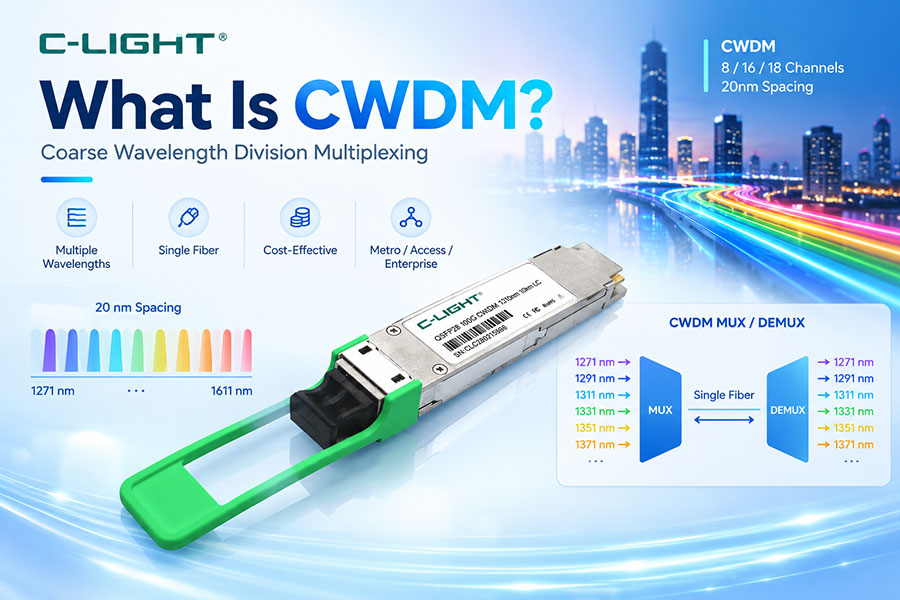
What is the CWDM transceiver? The CWDM transceiver is an optical transceiver that uses CWDM technology to implement the connection between the existing network device and the CWDM mux/demux. When used with a CWDM mux/demux, CWDM transceiver can increase network capacity by transmitting multiple data channels with separate optical wavelengths (1270 nm to 1610 nm) on the same single fiber.
What is the difference between a CWDM transceiver and normal dual-fiber transceiver? A common optical transceiver belongs to a photoelectric conversion device and belongs to an active optical module. Each module has one receiving and two transmitting ports, and the inside of the transmitting port is a laser.The CWDM optical module is a passive module that does not emit laser light itself. Generally, a light plane waveguide (PLC) technology is used to divide a beam of light into several beams of light.
What are the CWDM transceiver package types?
CWDM SFP+ transceiver
The CWDM SFP+ transceiver combines optical signals of different wavelengths and transmits them through one optical fiber through an external wavelength division multiplexer, saving optical fiber resources. At the same time, the receiving end needs to decompose the complex optical signal using a wave decomposition multiplexer. It is divided into 18 bands, from 1270nm to 1610nm, separated by 20nm between each two bands.
CWDM XFP transceiver
The CWDM XFP transceiver is larger than the CWDM SFP+ transceiver. The CWDM XFP optical module complies with the SFP MSA protocol, while the CWDM SFP+ optical module complies with the IEEE802.3ae and SFF-8431, SFF-8432 protocol.
CWDM SFP transceiver
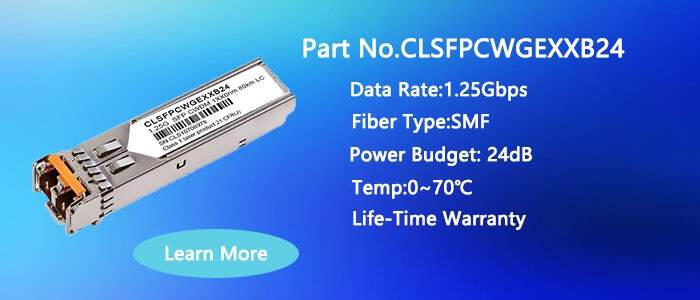
The CWDM SFP transceiver is an optical module that combines CWDM technology. Similar to a traditional SFP, It is a hot-swappable input/output device that plugs into SFP port of a router and connects to the fiber network through this port.
It is an economical and efficient network connectivity solution for networking applications such as Gigabit Ethernet and Fibre Channel (FC) in campus, data center, and metropolitan area networks.
CWDM GBIC transceiver
The GBIC is a hot-swappable input/output device that plugs into a Gigabit Ethernet port or slot to complete a network connection. GBIC is also a transceiver standard, usually used in conjunction with Gigabit Ethernet and Fibre Channel, and is mainly used in Gigabit Ethernet machines and routers. A simple upgrade from the standard LH section, using DFB lasers with specific wavelengths, has facilitated the development of CWDM GBIC modules and DWDM GBIC modules. GBIC transceivers are commonly used for Gigabit Ethernet fiber optic transmission but are also involved in some cases, such as fiber-optic network deceleration, speed-up, and multi-rate transmission applications around 2.5 Gbps.
What are the applications of CWDM transceivers? CWDM transceivers are widely used in CATV (cable TV), FTTH (Fiber to the Home), 1G and 2G Fibre Channel, 100M and Gigabit Ethernet, Synchronous Optical Network SONET OC-3 (155Mbps), OC-12 (622Mbps) And O***8 (2.488Gbps), security and protection systems and other fields.
CWDM Optical Transceiver FAQ
Q1: What is a CWDM optical transceiver?
Answer: A CWDM optical transceiver is a wavelength division multiplexing optical module that uses different CWDM wavelengths to transmit multiple independent data channels over a single fiber. It combines optical transmission and wavelength multiplexing technology to increase fiber capacity without deploying additional fiber cables.
Q2: What is the difference between CWDM optical transceivers and standard optical modules?
Answer: The main difference is wavelength utilization and network capacity. Standard optical modules usually transmit data through a single wavelength, while CWDM optical transceivers use multiple wavelength channels to carry different data streams over the same fiber. This allows operators to expand network capacity while reducing fiber deployment costs.
Q3: Why are CWDM optical transceivers important for fiber networks?
Answer: CWDM optical transceivers help solve fiber resource limitations by enabling multiple channels on existing fiber infrastructure. They are especially valuable in environments where deploying new fiber is expensive or difficult, such as metropolitan networks, enterprise campuses, telecom access networks, and data center interconnect applications.
Q4: What are the advantages of CWDM optical transceivers?
Answer: The main advantages of CWDM optical transceivers include:
Improved fiber utilization efficiency
Lower network expansion cost
Simple deployment and management
Lower power consumption compared with active transport solutions
Support for multiple transmission rates and distances
CWDM provides a cost-effective solution for networks requiring additional bandwidth without major infrastructure upgrades.
Q5: What transmission distances do CWDM optical transceivers support?
Answer: CWDM optical transceivers support different transmission distances depending on the module type and application requirements. Common solutions include short-distance connections for enterprise networks and longer-distance links for metro networks and telecom applications. C-LIGHT CWDM optical modules support multiple rates and reach options, including 10km, 40km, 80km, and beyond depending on the product series.
Q6: What are the typical applications of CWDM optical transceivers?
Answer: CWDM optical transceivers are widely used in:
Data center interconnect (DCI)
Metro optical networks
Enterprise backbone networks
Telecom access networks
5G fronthaul and transport networks
Fiber resource optimization projects
They are suitable for scenarios requiring higher bandwidth capacity without increasing fiber deployment.
Q7: What is the difference between CWDM and DWDM optical solutions?
Answer: CWDM and DWDM both use wavelength division multiplexing technology, but they target different network requirements. CWDM uses wider wavelength spacing and provides a cost-effective solution for short and medium-distance applications. DWDM uses tighter wavelength spacing, supporting higher channel capacity and longer-distance optical transport networks.
Q8: How do I choose the right CWDM optical transceiver for my network?
Answer: The selection of a CWDM optical transceiver depends on several factors, including transmission rate, wavelength channel, fiber type, transmission distance, optical budget, and equipment compatibility. Network designers should choose the appropriate CWDM module based on application requirements such as data center connectivity, telecom transport, or enterprise network expansion.
 >
>

 >
>
 >
>
 >
>
 >
>
 >
>
 >
>
 >
>