TEL:+86 132 6656 7067




1. Introduction
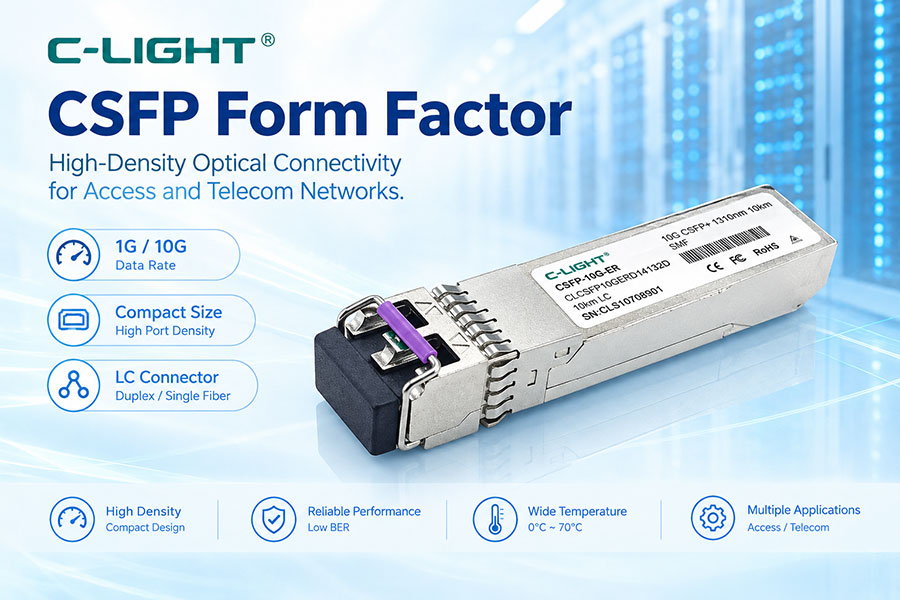
CSFP stands for Compact Small Form-factor Pluggable. It is a compact optical transceiver form factor developed primarily for high-density fiber access and bidirectional networking applications. Its key feature is the ability to integrate two independent bidirectional optical channels into an SFP-class package.
2. What Is the CSFP Form Factor?
CSFP is designed to increase fiber-port density without proportionally increasing the physical size of network equipment. A dual-channel CSFP can integrate two independent BiDi optical interfaces within the footprint of a conventional SFP module.
3. Why Was CSFP Developed?
Traditional SFP deployment generally follows a one-module, one-link architecture. CSFP improves this utilization by combining two bidirectional optical channels into one compact module, making it useful when front-panel space, line-card capacity, or fiber resources are limited.
4. CSFP and Port Density
The primary benefit of CSFP is higher port density. Two optical links can be provided within approximately the same host-module footprint occupied by one conventional SFP, allowing equipment designers to increase the number of supported connections.
5. Dual-Channel CSFP Architecture
A typical dual-channel CSFP contains two independent optical transmit and receive paths. Each channel operates as a bidirectional link, allowing two separate network connections to share one compact module package.
6. CSFP and BiDi Technology
CSFP is closely associated with BiDi transmission. Instead of using separate transmit and receive fibers, each optical channel uses different wavelengths for upstream and downstream transmission over a single fiber.
7. Wavelength Pairing
BiDi channels require matched wavelength combinations at the two ends of a link. For example, one module may transmit at one wavelength and receive at another, while the remote module uses the complementary wavelength arrangement.
8. CSFP Mechanical Design
The CSFP MSA defines a compact pluggable mechanical architecture with an SFP-like electrical interface and latching mechanism. Dual-channel CSFP implementations can use the same general mechanical dimensions as standard SFP modules.
9. CSFP Cage Compatibility
Dual-channel CSFP modules are designed for compatible CSFP host systems and can use an SFP-like cage architecture. However, mechanical insertion should not be confused with complete operational compatibility; the host must support the corresponding CSFP electrical and management implementation.
10. CSFP Electrical Interface
CSFP uses an SFP-like electrical interface for power, high-speed data, module management, and control. The host-side implementation must support the electrical requirements of the selected CSFP module.
11. CSFP Power Supply
Many CSFP implementations use a single 3.3V power supply. The actual power requirement depends on the laser technology, receiver design, monitoring circuitry, data rate, and operating temperature.
12. CSFP Optical Interface
LC interfaces are commonly used for CSFP optical modules. The exact connector arrangement depends on the implementation and the number of optical channels integrated into the module.
13. CSFP Optical Components
A typical CSFP can include multiple laser transmitters, photodetectors, optical WDM filters, laser drivers, receiver amplifiers, monitoring circuits, and control electronics. Integration of these functions is essential to fitting two optical channels into a compact package.
14. Laser Technology
CSFP modules can use different semiconductor laser technologies according to data rate, wavelength, reach, and application. FP and DFB lasers are common examples in Gigabit-class BiDi implementations.
15. Photodetector
The receiver section uses a photodetector to convert incoming optical energy into an electrical signal. PIN photodiodes are commonly used in Gigabit-class CSFP designs, although the exact receiver technology depends on the module architecture.
16. WDM Filter
Because each BiDi channel uses one fiber for bidirectional communication, wavelength-selective optical filtering is required. The WDM filter separates the transmit and receive wavelength paths inside the transceiver.
17. CSFP Data Rates
CSFP is commonly used for 155M, 1.25G, and other lower-speed access applications. Compact CSFP implementations can also be developed for higher rates, but the data rate should always be checked against the specific module and host specification.
18. CSFP for Gigabit Ethernet
Gigabit Ethernet is an important CSFP application. Dual-channel BiDi modules can provide two independent 1000BASE-BX-style links while maintaining a compact SFP-family package.
19. CSFP for FTTH Networks
CSFP can be useful in fiber access and FTTH environments where many subscriber or point-to-point optical connections must be concentrated into limited equipment space. Its dual-channel architecture can improve line-card utilization.
20. CSFP for Point-to-Point Links
CSFP can provide two independent point-to-point optical links from one compact module position. Each optical channel operates independently and requires a compatible remote transceiver.
21. CSFP and Single-Mode Fiber
CSFP BiDi modules commonly use single-mode fiber because the technology is frequently deployed in access and longer-reach applications. The actual fiber specification should match the optical design of the module.
22. CSFP Transmission Distance
Reach depends on transmitter output power, receiver sensitivity, wavelength, fiber attenuation, connector loss, and optical budget. Common CSFP products can support distances such as 10km or 20km, while specialized versions may support other ranges.
23. CSFP Optical Budget
The optical budget should be calculated independently for each channel. Transmitter output power, fiber attenuation, connector losses, and receiver sensitivity determine whether sufficient margin is available for reliable transmission.
24. CSFP Module Management
CSFP modules can provide identification, status, and diagnostic information through the host management interface. Depending on the implementation, the host can monitor module operating parameters and optical conditions.
25. CSFP and Digital Diagnostics
Some CSFP modules support digital diagnostic monitoring based on the SFF-8472 framework. Available parameters can include temperature, supply voltage, transmit power, receive power, and laser bias.
26. CSFP vs Standard SFP
| Feature | Standard SFP | Dual-Channel CSFP |
|---|---|---|
| Optical Channels | Typically one | Two independent channels |
| Transmission | Optical or BiDi | Typically dual BiDi |
| Module Footprint | SFP class | SFP-class package |
| Port Density | Standard | Higher link density |
| Typical Application | General networking | High-density access and fiber networks |
27. CSFP vs BiDi SFP
A BiDi SFP uses one optical channel over one fiber. A dual-channel CSFP extends the concept by integrating two independent BiDi channels into one compact package, allowing two links to be supported within a similar SFP module footprint.
28. CSFP vs SFP+
SFP+ is primarily designed for 10Gbps-class networking, while conventional CSFP implementations have historically focused on lower-speed access and Gigabit-class applications. Compact high-speed CSFP variants also exist, so the exact data rate must be checked for each design.
29. CSFP Mechanical Density
In high-density equipment, CSFP can reduce the physical space required per optical connection. This can be particularly valuable in access systems and line cards where connector and module positions are constrained.
30. CSFP Thermal Design
Thermal requirements depend on the number of integrated channels, laser technology, operating temperature, and data rate. Although CSFP emphasizes compactness, proper heat dissipation remains necessary for stable optical performance.
31. CSFP Reliability
Reliability depends on the optical components, WDM filters, electrical circuitry, packaging, fiber coupling, thermal conditions, and manufacturing quality. Integrating two optical channels also places greater emphasis on optical isolation and stable channel performance.
32. CSFP Compatibility
Compatibility should be checked at several levels, including mechanical interface, electrical interface, data rate, wavelength pair, fiber type, reach, optical budget, module coding, management interface, and host support.
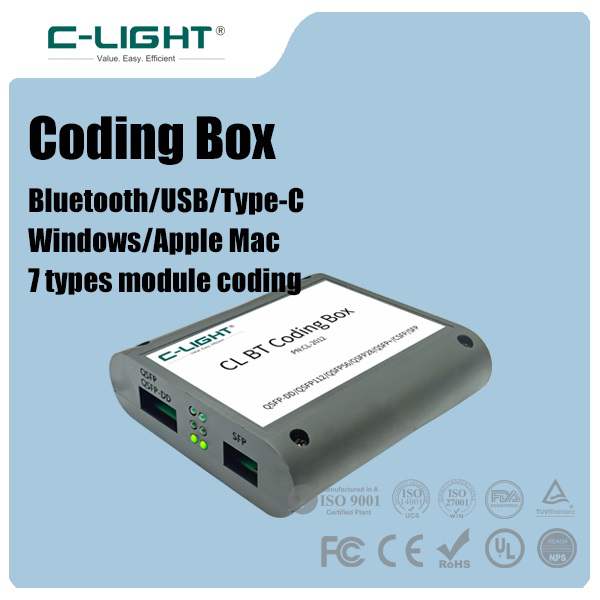
33. CSFP Module Coding
Module identification memory can contain vendor information, part number, serial number, wavelength, optical characteristics, and diagnostic information. Correct coding may be important when installing CSFP modules in vendor-specific equipment.
34. CSFP Applications
Typical applications include FTTH access equipment, Gigabit Ethernet aggregation, point-to-point fiber connections, telecom access systems, optical line cards, and other high-density fiber networking environments.
35. Advantages of the CSFP Form Factor
CSFP provides high connection density, compact packaging, dual-channel integration, single-fiber bidirectional transmission, and efficient use of equipment space. It can be particularly useful when increasing the number of fiber connections without expanding the equipment footprint.
36. Limitations of CSFP
CSFP requires compatible host equipment and carefully matched BiDi wavelength pairs. It is also less widely deployed than conventional SFP, SFP+, or higher-speed QSFP-family technologies, so product and host compatibility should be verified before deployment.
37. CSFP Selection Guide
When selecting a CSFP module, check the number of optical channels, data rate, wavelength pair, transmission distance, fiber type, connector, optical budget, temperature range, DOM support, host compatibility, and module coding requirements.
38. Frequently Asked Questions
Q1. What is the CSFP form factor?
Q2. How many channels does a typical dual-channel CSFP provide?
Q3. What is the main advantage of CSFP?
Q4. Does CSFP use BiDi transmission?
Q5. Can CSFP use standard SFP cages?
Q6. What fiber is normally used with CSFP?
Q7. What speeds can CSFP support?
Q8. What should be checked before using CSFP?
39. Summary
CSFP is a compact pluggable transceiver architecture designed to increase optical connection density. Its defining concept is the integration of two independent bidirectional optical channels within a compact SFP-class package. By combining BiDi transmission, wavelength-selective components, optical transmitters and receivers, and SFP-like host connectivity, CSFP can provide two fiber links while using limited equipment space. It is particularly suitable for high-density access, FTTH, Gigabit Ethernet, and point-to-point fiber applications. Successful deployment depends on correct wavelength pairing, optical budget, host compatibility, module coding, and the specific CSFP implementation supported by the network equipment.
 >
>

 >
>
 >
>
 >
>
 >
>
 >
>
 >
>
 >
>