TEL:+86 132 6656 7067





5G fronthaul transport is evolving from dedicated CPRI links toward packet-based Ethernet architectures. Traditional CPRI transports digitized in-phase and quadrature (IQ) radio samples through a continuous, constant-bit-rate stream. Ethernet-based fronthaul, including eCPRI and O-RAN Open Fronthaul implementations, transports radio information in packets and supports more flexible functional splits. This change affects bandwidth utilization, network topology, synchronization, equipment integration, and optical infrastructure.
1. CPRI and Ethernet: Two Different Fronthaul Transport Approaches
CPRI, or Common Public Radio Interface, was developed to connect radio equipment with baseband processing equipment in mobile networks. It uses a dedicated serial interface to transport digitized radio signals, control information, and synchronization information between the Radio Equipment (RE) and Radio Equipment Control (REC).
Ethernet is a packet-based networking technology. In 5G fronthaul, Ethernet can carry radio-related traffic through protocols such as eCPRI or Radio over Ethernet (RoE). It also provides a transport infrastructure that can support switching, aggregation, traffic prioritization, and network management.
The difference is not simply the physical medium. Both approaches can use optical fiber and optical transceivers. The important distinction is how radio information is represented, transported, scheduled, and managed across the link.
Traditional CPRI
Continuous serial data stream
Time-division multiplexing
Constant line-rate transmission
Dedicated fronthaul connection
Predominantly fixed radio/baseband split
Ethernet-Based Fronthaul
Packet-based data transport
Ethernet switching and aggregation
Traffic-dependent bandwidth utilization
Flexible network topologies
Supports multiple functional split options
2. How Traditional CPRI Works
Traditional CPRI transports digitized baseband IQ samples between the radio unit and baseband processing equipment. The radio-side equipment performs RF conversion and related radio functions, while a substantial portion of the baseband physical-layer processing remains in the centralized baseband unit.
The CPRI interface organizes the transmitted information into a continuous serial stream. Time-division multiplexing allocates recurring transmission resources to different antenna-carrier streams. Each stream receives a defined portion of the frame structure, regardless of whether the corresponding radio carrier is currently carrying a high volume of user traffic.
Radio interface
TDM framing
Radio protocols
The fixed-rate structure provides predictable transport behavior and a relatively straightforward point-to-point architecture. However, it also means that transmission capacity is reserved according to the configured radio streams rather than dynamically following actual user-plane traffic.
Traditional CPRI specifications define a set of standardized line rates. Common historical rates include 2.4576 Gbit/s, 4.9152 Gbit/s, 9.8304 Gbit/s, and 10.1376 Gbit/s. Higher CPRI options extend the rate range, but the interface remains based on its dedicated serial transport model.
3. How Ethernet-Based Fronthaul Works
Ethernet-based fronthaul transports radio-related information using packet frames. Instead of maintaining a continuous TDM stream for every antenna-carrier combination, packet traffic can be forwarded through Ethernet switches and transport equipment.
eCPRI is one of the main protocols used for this architecture. It defines a packet-based interface for carrying user-plane data, control information, and other specified services between radio and baseband functions.
Lower PHY functions
QoS and aggregation
Baseband processing
A packet-based architecture enables more flexible bandwidth allocation and network aggregation. When the selected functional split produces traffic that varies with radio activity, Ethernet transport can take advantage of statistical multiplexing. Multiple connections can share network infrastructure, provided that capacity, latency, and traffic-priority requirements are properly engineered.
Ethernet also supports established networking functions, including VLANs, QoS, traffic classification, protection mechanisms, and network operations and management. These capabilities make it suitable for building larger and more flexible fronthaul transport networks.
4. CPRI, Ethernet, eCPRI, and Radio over Ethernet
These terms are related but describe different things. Understanding their roles is important when selecting fronthaul equipment or planning a network migration.
| Technology | Definition | Transport Characteristics | Typical Role |
|---|---|---|---|
| CPRI | Common Public Radio Interface | Dedicated serial interface with TDM-based transport | Traditional radio-to-baseband connection |
| Ethernet | Packet-based networking technology | Frame-based transport with switching and aggregation | Fronthaul network infrastructure |
| eCPRI | Enhanced Common Public Radio Interface | Packet-based radio interface designed for Ethernet transport | Modern packet-based radio fronthaul |
| RoE | Radio over Ethernet | Encapsulation or mapping of radio-related information into Ethernet frames | Transporting radio information across Ethernet networks |
| O-RAN Open Fronthaul | Open interface specifications for the O-RU and O-DU | Defines protocol and management requirements across functional planes | Multi-vendor open RAN fronthaul architecture |
A critical distinction is that eCPRI is not synonymous with Ethernet itself. Ethernet provides the underlying packet transport, while eCPRI defines radio-related packet formats and procedures. O-RAN Open Fronthaul specifies a broader interface architecture, including user, control, synchronization, and management requirements.
Ethernet can also transport legacy CPRI information through RoE mechanisms. Therefore, deploying Ethernet infrastructure does not automatically mean that the radio interface has been converted to eCPRI.
5. Bandwidth Efficiency: Why Ethernet-Based Fronthaul Scales Better
Bandwidth consumption is one of the major differences between traditional CPRI and packet-based fronthaul. In a conventional CPRI architecture, the line rate is determined by the configured radio bandwidth, sampling parameters, antenna-carrier streams, and interface option. The stream continues at its configured rate even when user traffic is low.
This structure becomes increasingly demanding as radio systems adopt wider channel bandwidths, carrier aggregation, and massive MIMO configurations. More antenna streams and higher sampling requirements can substantially increase the required fronthaul capacity.
Ethernet-based fronthaul can reduce this pressure through a combination of functional split selection, radio data processing, compression, and packet transport. In an intra-PHY split, some lower-layer processing is performed closer to the radio unit, reducing the amount of information that must cross the fronthaul interface.
| Bandwidth Factor | Traditional CPRI | Ethernet-Based Fronthaul |
|---|---|---|
| Traffic behavior | Constant configured line rate | Can vary with transported radio traffic |
| Antenna scaling | Strong relationship with antenna-carrier streams | Depends on selected functional split and radio processing |
| Functional processing | Typically transports time-domain IQ samples | Can transport processed radio data at a lower-layer split |
| Multiplexing | Dedicated TDM resources | Packet statistical multiplexing is possible |
| Capacity planning | Based on configured CPRI rates | Based on traffic profiles, peak demand, and engineering margin |
The actual bandwidth reduction is not determined by Ethernet alone. It depends primarily on where the radio functional split is placed and what information is transported across the interface. Using eCPRI with a split close to the traditional CPRI arrangement can retain many of the original bandwidth characteristics.
6. Latency and Jitter: Deterministic Transport Requirements
Fronthaul transport has strict timing requirements because radio processing must remain synchronized with scheduled transmission and reception activities. Latency and packet delay variation can affect the ability of the DU and RU to exchange time-sensitive information.
Traditional CPRI uses a continuous serial stream with fixed framing and dedicated link resources. This provides predictable transport behavior and avoids the packet queuing mechanisms commonly found in shared Ethernet networks.
Ethernet introduces packet forwarding and potentially variable queuing delay. However, this does not mean Ethernet fronthaul is inherently unsuitable for low-latency applications. Carrier-grade packet transport can be engineered with mechanisms that control congestion, scheduling, synchronization, and packet delay variation.
Important technologies include:
IEEE 1588 PTP: Distributes accurate time and phase information across packet networks.
Synchronous Ethernet (SyncE): Provides frequency synchronization through the Ethernet physical layer.
IEEE 802.1CM: Defines Time-Sensitive Networking profiles for fronthaul applications.
QoS: Assigns priority to time-sensitive traffic and controls congestion behavior.
Traffic scheduling: Helps ensure predictable packet transmission under network load.
7. Functional Split: The Main Factor Behind CPRI-to-Ethernet Evolution
The functional split determines which radio processing tasks are performed in the RU and which remain in the DU. It directly influences the amount and type of information transported over fronthaul.
Traditional CPRI is commonly associated with a low-layer interface corresponding to the traditional Option 8 split, where time-domain IQ samples are transported between radio and baseband equipment.
Modern 5G architectures can move selected physical-layer functions into the radio unit. This reduces the amount of raw radio information crossing the transport link and enables more efficient packet-based interfaces.
| Functional Split | Processing Distribution | Transport Impact |
|---|---|---|
| Option 8 | Most PHY processing remains in the baseband unit, with radio functions at the remote unit. | Transports time-domain IQ samples and requires substantial continuous capacity. |
| Option 7.2x | PHY processing is divided between the O-RU and O-DU. | Transports frequency-domain information and supports more efficient fronthaul bandwidth utilization. |
| Higher-layer splits | More processing is performed closer to the radio unit. | Can further reduce transport requirements, depending on the selected split and service architecture. |
O-RAN Open Fronthaul commonly uses the 7.2x functional split to define the interface between the O-RU and O-DU. This provides a standardized basis for interoperability while allowing operators to build more flexible radio access architectures.
The selected split also affects RU processing complexity, DU computing requirements, transport capacity, and the overall cost of the radio access network.
8. Optical Fiber and Transceiver Requirements
Both CPRI and Ethernet-based fronthaul can use optical fiber for physical transmission. The optical interface must match the equipment port, transmission rate, fiber type, wavelength, and link distance.
In traditional CPRI deployments, dedicated optical links are commonly used between radio and baseband equipment. The required optical module depends on the CPRI line rate and the supported electrical and optical interface specifications.
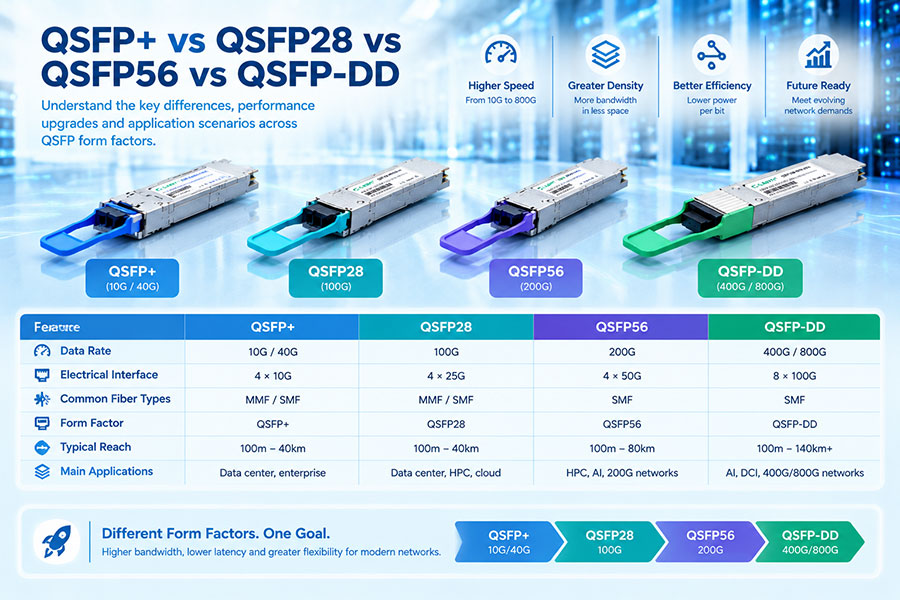
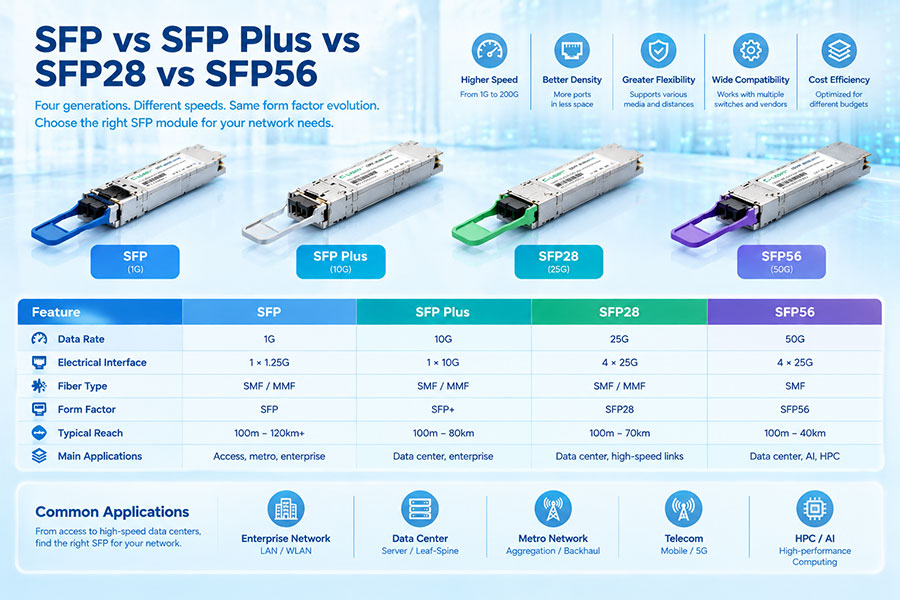
Ethernet-based fronthaul can use standard Ethernet optical interfaces where supported by the radio and transport equipment. Depending on the network design, SFP+, SFP28, SFP56, and higher-rate interfaces may be considered.
| Optical Interface | Form Factor | Potential Application | Key Design Factors |
|---|---|---|---|
| 10GbE | SFP+ | Selected legacy and lower-capacity fronthaul links | Interface rate, fiber type, and link budget |
| 25GbE | SFP28 | 5G radio access and packet fronthaul | Host compatibility, optical reach, and timing architecture |
| 50GbE | SFP56 | Selected higher-capacity radio and aggregation interfaces | Supported modulation and electrical interface |
| 100GbE | QSFP28 | Fronthaul aggregation and high-capacity transport | Traffic aggregation, fiber infrastructure, and optical budget |
| 400GbE | QSFP-DD / OSFP | Large-scale transport aggregation and core infrastructure | Port density, platform support, and network capacity planning |
These are representative Ethernet interface rates, not mandatory rates for every 5G fronthaul connection. A CPRI interface cannot be connected directly to an Ethernet optical port simply because both use fiber. The electrical interface, protocol, line rate, and equipment configuration must be compatible.
For packet-based transport, optical link engineering should include transmitter output power, receiver sensitivity, fiber attenuation, connector insertion loss, dispersion considerations where relevant, and sufficient link margin.
C-LIGHT provides optical transceiver solutions for access and high-capacity optical transport networks. The optical transceiver portfolio includes different data rates and form factors for network connectivity and infrastructure applications.
9. Network Topology and Infrastructure Utilization
Traditional CPRI deployments are commonly organized around dedicated point-to-point connections. Each radio-to-baseband link has a defined transmission path and reserved capacity. This arrangement offers straightforward link planning but can increase fiber and wavelength requirements as the number of radio units grows.
Ethernet-based fronthaul supports more flexible topologies. Ethernet switches can aggregate traffic from multiple radio units and forward it toward centralized DU resources. Depending on latency and synchronization requirements, the network can be designed with point-to-point, ring, or other engineered topologies.
The main infrastructure benefits include:
Fiber aggregation: Multiple radio connections can share transport infrastructure.
Flexible routing: Packet switching provides more options for network topology and traffic engineering.
Resource utilization: Statistical multiplexing can improve the use of shared capacity when traffic profiles permit.
Network expansion: Additional radio sites can be integrated through appropriately sized aggregation nodes.
Unified operations: Ethernet-based management and monitoring tools can simplify transport network administration.
These advantages depend on correct network dimensioning. Shared infrastructure must still provide sufficient capacity for peak traffic and maintain the delay, jitter, and synchronization performance required by the radio interface.
10. CPRI-to-Ethernet Migration Considerations
Moving from traditional CPRI to Ethernet-based fronthaul is an architectural upgrade rather than a direct cable replacement. Existing radio equipment, baseband platforms, optical modules, and transport systems must all support the selected interface and functional split.
A migration project should evaluate the following technical factors:
Radio interface support: Confirm whether the RU and DU support eCPRI, RoE, or O-RAN Open Fronthaul.
Functional split compatibility: Verify the supported split option and the processing functions assigned to each device.
Ethernet port capacity: Confirm the required interface rate, packet size, VLAN configuration, and switching capacity.
Synchronization architecture: Validate PTP and SyncE support, timing accuracy, and network clock distribution.
Optical compatibility: Match transceiver data rate, wavelength, reach, connector type, and host coding requirements.
Network performance: Test latency, packet delay variation, packet loss, congestion behavior, and redundancy.
Interoperability: Verify protocol profiles and implementation compatibility between radio, baseband, and transport equipment.
For multi-vendor Open RAN deployments, interface conformance and interoperability testing are particularly important. Supporting Ethernet or eCPRI at a product level does not automatically guarantee that two devices from different vendors will operate together without configuration or profile alignment.
11. CPRI vs. Ethernet: Which Technology Is More Suitable for 5G?
The choice depends on the installed equipment, functional split, radio configuration, and transport architecture. Traditional CPRI remains relevant in existing deployments where the radio and baseband equipment use established CPRI interfaces. Ethernet-based fronthaul is generally more suitable for new architectures that require packet aggregation, flexible processing splits, and scalable transport.
| Evaluation Factor | Traditional CPRI | Ethernet-Based Fronthaul |
|---|---|---|
| Existing equipment integration | Suitable for compatible legacy radio and baseband systems | Requires compatible packet-based interfaces or adaptation |
| Bandwidth utilization | Fixed-rate transport | Can support traffic-dependent capacity utilization |
| Functional split flexibility | Traditionally associated with Option 8 | Supports multiple packet-based split architectures |
| Network aggregation | More dedicated-link oriented | Supports Ethernet switching and aggregation |
| Latency behavior | Predictable dedicated-link behavior | Requires engineered QoS, scheduling, and synchronization |
| Network scalability | More constrained by dedicated link resources | More flexible for large packet transport networks |
| Typical deployment direction | Established radio infrastructure | Modern 5G and Open RAN architectures |
For operators upgrading existing networks, CPRI may remain part of the transport environment while Ethernet is introduced for new radio sites or aggregation layers. Hybrid architectures can therefore coexist during network evolution.
12. Conclusion
CPRI and Ethernet-based fronthaul differ in how they transport radio information and allocate network resources. Traditional CPRI uses a dedicated TDM-based serial stream to carry digitized IQ samples at a configured line rate. Ethernet-based fronthaul uses packet transport, with eCPRI and O-RAN Open Fronthaul supporting more flexible functional splits and scalable network architectures.
The main advantages of Ethernet-based fronthaul are packet switching, aggregation, flexible capacity planning, and integration with modern transport networks. However, meeting 5G radio requirements still depends on precise synchronization, deterministic traffic handling, correct functional split selection, and compatible optical interfaces.
As 5G networks expand their use of massive MIMO, centralized RAN, and Open RAN architectures, Ethernet-based fronthaul provides a flexible foundation for future radio transport. Optical transceivers and fiber infrastructure remain essential to delivering the required bandwidth, reach, and link reliability.
Planning optical connectivity for 5G fronthaul and transport networks?
Review optical transceiver options for Ethernet access, aggregation, and high-capacity fiber infrastructure.
 >

 >
 >
 >
 >
 >
 >
 >