TEL:+86 132 6656 7067




Choosing between CAT6 Ethernet cable and fiber optic cable affects network reach, installation methods, equipment requirements, and future expansion. CAT6 is a practical copper solution for conventional Ethernet connections, especially where computers, switches, cameras, and wireless access points need straightforward connectivity. Fiber optic cable is designed to transmit data using light and is particularly useful for longer links, high-capacity network connections, and electrically noisy environments.
The two media serve different purposes rather than competing on a single performance metric. CAT6 supports Gigabit Ethernet over a compliant channel up to 100 meters and may support 10GBASE-T over shorter distances. Fiber can support a wide range of Ethernet speeds and distances, depending on whether multimode or single-mode fiber is used and which optical transceivers are installed.
The right choice depends on the complete link, not just the cable. Network planners should consider required speed, distance, electromagnetic interference, Power over Ethernet (PoE), transceiver costs, connector compatibility, and the expected life of the infrastructure.
1. What Are CAT6 and Fiber Optic Cables?
CAT6 Ethernet Cable
CAT6, or Category 6, is a twisted-pair copper cabling category specified for bandwidth up to 250 MHz. It typically contains four pairs of copper conductors and commonly uses 8P8C modular connectors, often called RJ45 in Ethernet networking.
A compliant CAT6 channel supports 1000BASE-T Gigabit Ethernet at up to 100 meters. CAT6 may also support 2.5GBASE-T and 5GBASE-T over qualified channels. For 10GBASE-T, commonly cited guidance identifies 37 meters as a baseline distance, while operation between 37 and 55 meters depends on alien-crosstalk conditions. Longer links may require mitigation and testing.
CAT6 is convenient for network endpoints that need both data and electrical power over the same cable. When the cable, connectors, installation, and equipment meet the applicable requirements, CAT6 can be used for supported PoE applications such as IP cameras, access points, and VoIP phones.
Fiber Optic Cable
Fiber optic cable carries data as optical signals through glass or other suitable optical fiber material. A fiber link generally requires compatible optical transceivers, connectors, and fiber types at both ends. Unlike copper Ethernet, fiber does not carry electrical power through the optical transmission medium itself.
Two major fiber types are used in networking. Multimode fiber, including OM3 and OM4, is common in many short-reach data center applications. Single-mode fiber, commonly OS2 in structured cabling, supports a wide range of applications, including links extending several kilometers or more when used with appropriate transceivers.
Fiber is well suited to connections between network rooms, buildings, data center switches, and other locations where copper distance limits, electrical noise, or higher-speed requirements become important. Actual speed and reach depend on the optical standard, fiber specification, transceiver, connectors, and link budget.
2. CAT6 vs Fiber: Key Differences at a Glance
| Feature | CAT6 Copper Cable | Fiber Optic Cable |
|---|---|---|
| Transmission medium | Electrical signals over copper conductors | Optical signals through fiber |
| Specified cable bandwidth | 250 MHz | Depends on fiber type and optical transmission system; not directly comparable to CAT6's MHz rating |
| Typical Gigabit Ethernet reach | Up to 100 m on a compliant channel | Depends on the fiber type and transceiver; suitable systems can reach hundreds of meters or several kilometers |
| 10GbE reach | Usually limited to shorter distances; channel conditions determine the result | Examples include 300 m on OM3 with 10GBASE-SR or 10 km on OS2 with 10GBASE-LR |
| Higher data rates | Limited by the copper category, Ethernet standard, and channel conditions | Supports a wide range of rates through different optical standards and transceivers |
| Electromagnetic interference | Can be affected by EMI and crosstalk | Optical transmission in the fiber is inherently immune to electrical EMI |
| PoE support | Can carry data and supported electrical power on the same cable | Fiber itself does not carry PoE; separate power or suitable conversion equipment is required |
| Connector types | Commonly 8P8C/RJ45 | LC, SC, MPO/MTP, and other connector systems, depending on the optical interface |
| Installation equipment | Compatible Ethernet ports and copper cabling hardware | Compatible optical ports or transceivers, fiber connectors, and possibly media converters |
| Typical applications | Desktop connections, access points, cameras, and short Ethernet links | Switch uplinks, building connections, data center backbones, and longer high-speed links |
Fiber is not a single universal cable specification. Multimode and single-mode fiber support different combinations of wavelength, transmission distance, and data rate. The transceiver must match the fiber type and intended Ethernet standard.
CAT6, meanwhile, remains useful where the required data rate and channel length fall within its supported applications. For many shorter endpoint connections, it can be more economical and simpler to deploy than a fiber link requiring optical modules at both ends.
3. Speed and Transmission Distance
The transmission medium influences which Ethernet standards and distances are practical, but neither copper nor fiber has one universal maximum speed. The supported data rate and reach depend on the physical-layer standard, cable or fiber specification, interface hardware, and quality of the complete link.
| Example Ethernet Application | CAT6 Copper | Fiber Optic Cable |
|---|---|---|
| 1000BASE-T | Up to 100 m on a compliant channel | 1G fiber standards support different distances depending on fiber type and optical interface |
| 10GBASE-T | Qualified shorter links; performance depends on channel and crosstalk conditions | Not the fiber designation; optical alternatives use standards such as 10GBASE-SR or 10GBASE-LR |
| 10GBASE-SR | Not applicable to CAT6 copper | Up to 300 m on OM3 under the standard; OM4 can support up to 400 m |
| 10GBASE-LR | Not applicable to CAT6 copper | Up to 10 km on compliant single-mode fiber with compatible optics |
| 40G and 100G Ethernet | CAT6 is not the standard cabling solution for these high-speed optical applications | Supported by multiple multimode and single-mode optical standards, each with its own reach limits |
For CAT6, Gigabit Ethernet can operate over a compliant channel up to 100 meters. Although qualified CAT6 installations may support 10GBASE-T over shorter distances, CAT6 should not be treated as a guaranteed full-distance 10GbE solution. New copper installations requiring 10GbE across 100 meters commonly use CAT6A.
Fiber distances vary widely. As examples, 10GBASE-SR can reach up to 300 meters on OM3 multimode fiber or 400 meters on OM4 under the applicable standard, while 10GBASE-LR supports up to 10 kilometers over suitable single-mode fiber. Other optical standards support different distances, so these figures should not be applied to every fiber link.
For links extending beyond 100 meters, fiber is often the more practical choice. It is widely used between buildings, in campus networks, and for backbone connections where standard four-pair copper Ethernet would exceed its supported channel length.
4. EMI Resistance, Reliability, and Physical Installation
Electromagnetic interference can affect electrical signals in copper cabling, particularly in environments with motors, industrial equipment, power cables, or other significant sources of electrical noise. CAT6 uses twisted pairs to control crosstalk, and shielded versions can provide additional protection when correctly specified and installed.
Fiber optic transmission uses light rather than electrical signals in the fiber itself, making the optical medium inherently immune to electrical EMI. This is one reason fiber is attractive for electrically noisy environments and connections between buildings with different electrical grounding systems.
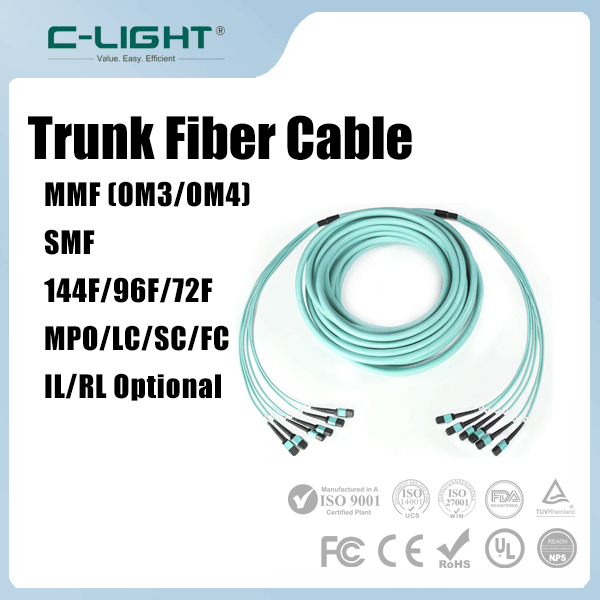
Fiber also offers advantages in cable size, weight, and bandwidth scaling for many network designs. Fiber trunk cables can support large numbers of optical channels in a relatively compact arrangement, which is useful for data center backbones and high-density network infrastructure.
However, optical cabling requires care as well. Connectors must be clean, fiber bends must remain within specified limits, and the link budget must account for cable attenuation, connector losses, and any splices. Damaged fiber or contaminated connector end faces can result in higher insertion loss or unstable links.
Reliability depends on the whole installation rather than the medium alone. Proper cable routing, qualified components, suitable environmental protection, and appropriate testing are necessary for both CAT6 and fiber.
5. Power over Ethernet and Equipment Requirements
One of the main practical differences between CAT6 and fiber is how they handle power. CAT6 can carry both Ethernet data and supported electrical power over the same copper cable, making it suitable for Power over Ethernet applications.
Common PoE endpoints include wireless access points, IP cameras, VoIP phones, access-control systems, and other network devices. A suitable CAT6 installation can reduce the need for separate electrical outlets at each endpoint, provided the network switch or injector supplies the required power.
Fiber optic cable carries optical signals and does not provide electrical power to the endpoint. A fiber-connected device therefore needs local power, a separate power cable, or an appropriate architecture that combines fiber data with a separate power path.
| Consideration | CAT6 Copper | Fiber Optic Cable |
|---|---|---|
| Electrical power through the data cable | Supported for compliant PoE configurations | Not carried through the optical fiber itself |
| Typical endpoint installation | One cable can provide both data and PoE power | Data fiber plus local or separate power |
| Switch interface | Standard copper Ethernet port; PoE-capable port when power is required | Compatible optical port or transceiver |
| Media converter | Usually unnecessary between compatible copper Ethernet devices | May be required when converting between copper Ethernet and fiber |
| Maintenance focus | Connectors, copper pairs, PoE power budget, and cabling condition | Connector cleanliness, optical power, transceiver compatibility, and fiber integrity |
For installations with many powered network endpoints, CAT6 may simplify deployment. For long uplinks or high-bandwidth links between switches, fiber can provide the required reach while PoE or other electrical power is handled separately at the endpoints.
6. Cost and Typical Applications
The total cost of a copper or fiber link includes more than the cable price. Connector hardware, switches, transceivers, media converters where needed, installation labor, testing, power requirements, and future maintenance all influence the final cost.
CAT6 is often cost-effective for short Ethernet links because it works with widely available copper ports and can support PoE. Fiber can involve additional optical components, but it may reduce the need for repeaters or intermediate equipment over longer distances and can provide greater flexibility for higher-speed backbone connections.
| Application | CAT6 | Fiber Optic Cable |
|---|---|---|
| Desktop and office connections | Practical for compliant short Ethernet links | Useful when the design requires optical connectivity |
| IP cameras and PoE access points | Can provide data and power on one cable | Requires separate endpoint power or a suitable power architecture |
| Switch uplinks within a building | Suitable if distance and bandwidth requirements fit the channel | Useful for longer distances and high-capacity links |
| Connections between buildings | Standard Ethernet channel length is a major limitation | Commonly preferred for long-distance data links and electrical isolation |
| Data center high-speed networks | Useful for supported copper access links | Widely used for high-speed switch-to-switch and backbone connectivity |
| Electrically noisy environments | May require suitable cable selection, routing, or shielding | Optical transmission is inherently immune to electrical EMI |
| Future bandwidth expansion | Limited by the Ethernet standard supported by the cable channel | Can support higher rates by changing compatible optical interfaces when the installed fiber and link budget permit |
The lowest initial cable price does not always produce the lowest installed cost. Short copper links may be economical and convenient, especially when PoE is needed. For long links, high-capacity backbones, or electrically noisy routes, the value of fiber can outweigh the additional cost of optical interfaces.
7. How to Choose Between CAT6 and Fiber
Start with the required Ethernet rate, the distance between endpoints, and whether power must be delivered through the network cable. These factors usually narrow the available options before cable pricing is considered.
| Network Requirement | Recommended Direction |
|---|---|
| Gigabit Ethernet over a channel up to 100 m | CAT6 is often sufficient |
| Short connection requiring PoE | CAT6 is often convenient |
| 10GbE over a full 100 m copper channel | Consider CAT6A; CAT6 should not be assumed to meet this requirement |
| Link distance beyond 100 m | Evaluate fiber with optics rated for the required distance |
| High-speed switch uplink or data center backbone | Evaluate multimode or single-mode fiber according to reach and data rate |
| Strong electrical interference | Fiber is attractive because optical transmission is immune to electrical EMI |
| High-speed link with future capacity expansion | Assess fiber and compatible optical interfaces against the upgrade roadmap |
Multimode fiber is commonly considered for short-reach data center connections, while single-mode fiber is used for longer links and many high-capacity backbone applications. The choice depends on the optical standard and the required distance; the two fiber types are not interchangeable without compatible optics.
For a new installation, consider the complete infrastructure over its expected service life. A mixed design is often practical: use copper for suitable endpoint connections and PoE, then use fiber for longer runs, switch uplinks, and higher-capacity links where it provides a clear benefit.
Before ordering, verify the required data rate, link length, connector type, transceiver support, optical budget, PoE needs, and applicable cabling standard. Testing the completed link helps confirm that the selected medium meets the intended performance.
8. Conclusion
CAT6 and fiber optic cable serve different networking needs. CAT6 is convenient for short Ethernet connections, supports Gigabit Ethernet over compliant channels up to 100 meters, and can carry data and supported PoE power on the same cable. It may also support 10GBASE-T over shorter distances, depending on channel conditions.
Fiber provides a wider range of high-speed and long-distance options through multimode and single-mode designs. It is especially useful for switch uplinks, data center backbones, inter-building connections, and environments where electrical interference is a concern. Its actual reach depends on the fiber type, optical standard, transceivers, and link budget.
Neither medium is the best choice for every application. CAT6 remains practical for many endpoint connections, while fiber is often the stronger option for longer distances and high-capacity links. For new 10GbE copper channels up to 100 meters, CAT6A is generally the mainstream choice. Matching the medium to the required speed, distance, power delivery, and upgrade plan leads to a more reliable and cost-effective network.
 >
>

 >
>
 >
>
 >
>
 >
>
 >
>
 >
>
 >
>