TEL:+86 132 6656 7067




850 nm and 1550 nm are two wavelength windows used in optical communications. 850 nm is the standard for short-reach multimode fiber links, driven by vertical-cavity surface-emitting lasers (VCSELs). 1550 nm is the standard for long-reach single-mode fiber links, driven by distributed feedback (DFB) and electro-absorption modulated lasers (EMLs), and it is the foundation of DWDM and coherent transmission.
The choice between them is determined by fiber type, reach, attenuation, dispersion, laser technology, power budget, and cost. 850 nm offers low-cost transceivers and low power consumption for distances under a few hundred meters. 1550 nm offers the lowest fiber attenuation and supports distances from tens of kilometers to thousands of kilometers, at higher component cost and tighter thermal requirements.
1. Wavelength Fundamentals
Both 850 nm and 1550 nm fall in the near-infrared region of the electromagnetic spectrum. 850 nm is in the O-band, near the lower edge of the infrared window used for fiber transmission. 1550 nm is in the C-band, the central band of the low-loss window of standard single-mode fiber.
The 850 nm window is used almost exclusively with multimode fiber. The 1550 nm window is used almost exclusively with single-mode fiber. The two wavelengths do not compete for the same fiber plant; they serve different segments of the network.
| Parameter | 850 nm | 1550 nm |
|---|---|---|
| Band | O-band (near infrared) | C-band (low-loss window) |
| Typical Fiber | Multimode (OM3/OM4/OM5) | Single-mode (G.652) |
| Primary Light Source | VCSEL | DFB, EML, tunable laser |
| Primary Application | Short-reach data center | Long-reach telecom, DCI, coherent |
2. Fiber Attenuation and Dispersion
Fiber attenuation and dispersion determine the reach and the usable bandwidth of a wavelength window. The two wavelengths differ significantly in both parameters.
2.1 Attenuation
Standard single-mode fiber has its lowest attenuation at 1550 nm, approximately 0.2 dB/km. At 1310 nm, attenuation is approximately 0.35 dB/km. At 850 nm, single-mode fiber attenuation is much higher, but 850 nm is not used with single-mode fiber. In multimode fiber, the attenuation at 850 nm is approximately 2.5 to 3.5 dB/km, depending on the fiber grade.
The attenuation difference means that 1550 nm can span tens of kilometers with the same power budget that 850 nm would consume in a few hundred meters. This is the primary reason 1550 nm dominates long-reach transmission.
2.2 Dispersion
Chromatic dispersion in single-mode fiber is near zero at 1310 nm and approximately 17 ps/nm/km at 1550 nm. The higher dispersion at 1550 nm is compensated in coherent systems by digital signal processing, and in direct-detect systems by dispersion-compensating modules or by operating over shorter reaches.
Modal dispersion in multimode fiber is the dominant impairment at 850 nm. The signal spreads in time as different modes travel different path lengths, limiting the reach-bandwidth product. OM3 and OM4 fiber reduce modal dispersion through optimized refractive index profiles, but the reach at 850 nm remains limited to a few hundred meters at high data rates.
| Parameter | 850 nm (MMF) | 1550 nm (SMF) |
|---|---|---|
| Attenuation | 2.5–3.5 dB/km | ~0.2 dB/km |
| Dominant Dispersion | Modal dispersion | Chromatic dispersion |
| Typical Reach at 100G | 100 m (OM4) | 10–80 km |
| Reach Limiting Factor | Modal dispersion and attenuation | Chromatic dispersion, OSNR |
3. Laser Sources: VCSEL vs DFB/EML
The light source is one of the most significant differences between the two wavelengths. 850 nm uses VCSELs; 1550 nm uses DFB lasers, EMLs, or tunable lasers.
3.1 850 nm VCSEL
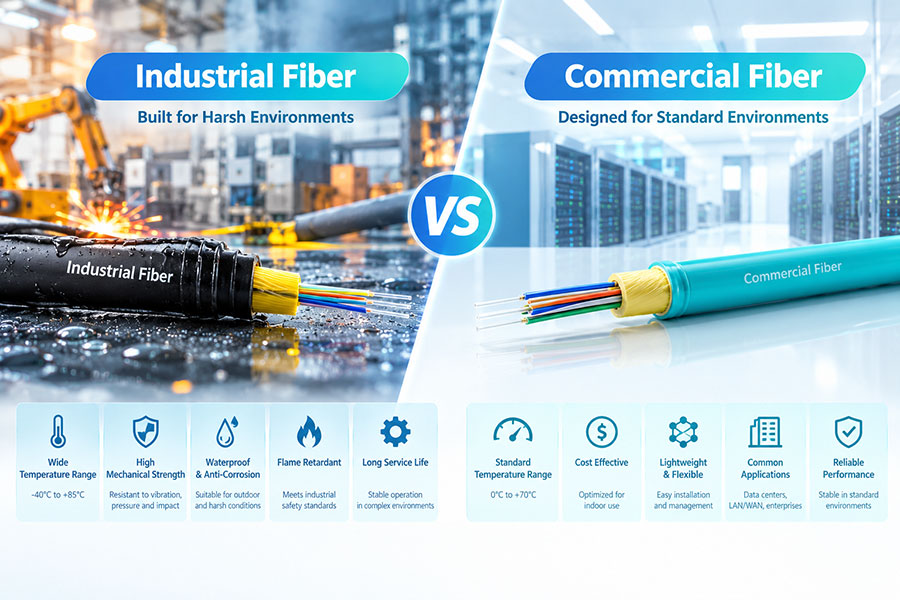
VCSELs emit light perpendicular to the chip surface, which allows on-wafer testing and low-cost manufacturing. They operate uncooled over a wide temperature range, typically 0°C to 70°C for commercial grades and -40°C to 85°C for industrial grades. VCSELs have low threshold current, low power consumption, and high reliability. They are the dominant light source for short-reach multimode links.
3.2 1550 nm DFB and EML
DFB lasers emit light from the edge of the chip and use a diffraction grating to stabilize the wavelength. They provide narrow linewidth and stable single-mode operation, which is essential for DWDM and coherent transmission. EMLs integrate a DFB laser with an electro-absorption modulator on the same chip, providing high extinction ratio and low chirp for long-reach direct-detect links.
1550 nm lasers typically require temperature control using a thermoelectric cooler to maintain wavelength stability. This adds power consumption, cost, and thermal complexity compared with uncooled VCSELs.
| Parameter | 850 nm VCSEL | 1550 nm DFB/EML |
|---|---|---|
| Emission Direction | Surface-emitting | Edge-emitting |
| Cooling | Uncooled | Temperature-controlled (TEC) |
| Wavelength Stability | Broad (±5–7 nm over temperature) | Narrow (±0.1 nm or better) |
| Power Consumption | Low | Higher (TEC adds 0.5–2 W) |
| Cost | Low | Higher |
| Primary Fiber | Multimode | Single-mode |
4. Fiber Types: Multimode vs Single-Mode
850 nm and 1550 nm are used with different fiber types. The fiber type determines the core diameter, the modal behavior, the connector type, and the cabling cost.
4.1 Multimode Fiber for 850 nm
Multimode fiber has a core diameter of 50 µm or 62.5 µm. The large core allows easy coupling from VCSELs and low-cost connectors. OM3, OM4, and OM5 fiber grades are optimized for 850 nm transmission, with effective modal bandwidth of 2000 MHz·km, 4700 MHz·km, and 4700 MHz·km respectively. Multimode links use MPO or LC connectors and are common in data centers for reaches up to 100 meters.
4.2 Single-Mode Fiber for 1550 nm
Single-mode fiber has a core diameter of approximately 9 µm. The small core supports only one propagation mode, eliminating modal dispersion. Single-mode fiber is used for all long-reach applications, from 10 km to 1000 km and beyond. It uses LC or SC connectors and is the standard fiber for telecom, DCI, and PON outside plant.
| Parameter | Multimode (850 nm) | Single-Mode (1550 nm) |
|---|---|---|
| Core Diameter | 50 or 62.5 µm | ~9 µm |
| Modal Dispersion | Present; limits reach | None |
| Typical Connector | LC, MPO | LC, SC |
| Typical Reach | Up to 100 m at 100G | 10 km to 1000+ km |
| Cabling Cost | Lower | Higher for long distances |
5. Reach and Power Budget
Reach is determined by the optical power budget and the impairments in the fiber. The two wavelengths have different reach characteristics.
5.1 850 nm Reach
850 nm multimode links reach 70 to 100 meters over OM3 and OM4 fiber at 100G, depending on the number of lanes and the modulation format. At 400G, the reach is typically 100 meters over OM4 with SR8 parallel optics. At 800G, the reach is 50 to 100 meters depending on the variant. The reach is limited by modal dispersion and attenuation.
5.2 1550 nm Reach
1550 nm single-mode links reach 10 km with 10GBASE-LR, 40 km with 10GBASE-ER, 80 km with 400ZR and 800ZR coherent modules, and hundreds of kilometers with amplification and coherent detection. The reach is limited by chromatic dispersion, optical signal-to-noise ratio, and nonlinear effects, not by fiber attenuation in the same way as 850 nm.
| Application | 850 nm Reach | 1550 nm Reach |
|---|---|---|
| 100G | 100 m (OM4) | 10–80 km |
| 400G | 100 m (OM4, SR8) | 80 km (400ZR) |
| 800G | 50–100 m | 80–120 km (800ZR) |
| 1.6T | 50 m (emerging) | 80–120 km (coherent) |
6. Data Rates and Modulation
Both wavelengths support NRZ and PAM4 modulation, but the reach and capacity differ. 850 nm links use parallel optics with multiple lanes to achieve high aggregate rates. 1550 nm links use wavelength division multiplexing and coherent modulation to achieve high capacity over long distances.
6.1 850 nm Modulation
850 nm VCSELs are directly modulated, which limits the modulation bandwidth and the reach at high data rates. NRZ is used up to 25G per lane; PAM4 is used for 50G and 100G per lane. Parallel optics with 4, 8, or 16 lanes achieve 100G, 400G, and 800G aggregate rates. Coherent modulation is not used at 850 nm.
6.2 1550 nm Modulation
1550 nm lasers can be directly modulated or externally modulated. Direct-detect PAM4 is used for 400G and 800G DCI over 80 to 120 km. Coherent modulation with DP-QPSK, DP-16QAM, and DP-64QAM is used for long-haul and ultra-long-haul transmission, with per-wavelength rates of 100G to 800G and beyond.
| Parameter | 850 nm | 1550 nm |
|---|---|---|
| Modulation Formats | NRZ, PAM4 | NRZ, PAM4, coherent (QPSK, 16QAM, 64QAM) |
| Per-Lane Rate | 25G–100G | 25G–800G |
| Aggregate Rate | 100G–800G parallel | 400G–1.6T per wavelength |
| WDM Support | No (multimode) | Yes (CWDM, DWDM) |
| Coherent Support | No | Yes |
7. Cost and Power Consumption
Cost and power consumption differ significantly between the two wavelengths. 850 nm VCSEL-based transceivers are the lowest-cost optical modules in volume production. 1550 nm DFB and EML-based transceivers are more expensive because of the laser technology, temperature control, and more complex optics.
7.1 850 nm Cost and Power
850 nm transceivers use uncooled VCSELs, silicon photodiodes, and simple drivers. They consume 1 to 3 watts for 100G and 400G modules. The low cost and low power make them the default choice for intra-data center links.
7.2 1550 nm Cost and Power
1550 nm transceivers use DFB or EML lasers with thermoelectric coolers, wavelength lockers, and more complex optical assemblies. They consume 3 to 15 watts for 400G and 800G modules. The higher cost and power are justified by the reach and capacity they provide.
| Parameter | 850 nm | 1550 nm |
|---|---|---|
| Laser Type | VCSEL, uncooled | DFB/EML, cooled |
| Typical Module Power | 1–3 W (100G–400G) | 3–15 W (400G–800G) |
| Module Cost | Low | Higher |
| Cost per Gbps | Low for short reach | Low for long reach |
8. Applications
850 nm and 1550 nm serve different segments of the network. The application determines the wavelength.
8.1 850 nm Applications
Intra-data center: Server-to-switch, switch-to-switch within a rack or between adjacent racks.
SR4/SR8 optics: 100G, 400G, and 800G multimode parallel optics.
Active optical cables: AOC for short-reach rack-to-rack connections.
Campus short-reach: Links under 100 meters.
Consumer and industrial: HDMI over fiber, USB over fiber, and short-reach sensing.
8.2 1550 nm Applications
Telecom long-haul: Metro, regional, and long-haul transmission.
Data center interconnect: 400ZR, 800ZR, and 1.6T coherent DCI.
DWDM: C-band dense wavelength division multiplexing.
PON video overlay: 1550 nm for RF video over GPON.
Coherent transmission: DP-QPSK and DP-16QAM long-haul systems.
Fiber sensing: Distributed acoustic sensing and temperature sensing.
| Application | 850 nm | 1550 nm |
|---|---|---|
| Intra-data center | Primary | Not used |
| DCI | Not used | Primary |
| Telecom long-haul | Not used | Primary |
| PON | Not used | Video overlay |
| Coherent | Not used | Primary |
9. WDM and Coexistence
1550 nm supports wavelength division multiplexing, which allows multiple wavelengths to share a single fiber. 850 nm does not support WDM because it operates over multimode fiber, where wavelength multiplexing is not practical.
9.1 1550 nm WDM
The C-band around 1550 nm is the standard window for DWDM. The ITU-T G.694.1 grid defines 100 GHz, 50 GHz, and 25 GHz channel spacing, supporting 40, 80, or 160 channels on a single fiber pair. CWDM also uses wavelengths around 1550 nm, with 20 nm spacing. DWDM is the foundation of long-haul and metro transport.
9.2 850 nm WDM
850 nm does not support WDM in multimode fiber. Each lane uses a separate fiber, and parallel optics is the method for increasing capacity. Short-wavelength division multiplexing (SWDM) uses multiple wavelengths around 850 nm over a single multimode fiber pair, but it is a niche technology compared with DWDM.
| Parameter | 850 nm | 1550 nm |
|---|---|---|
| WDM Support | No (parallel optics instead) | Yes (CWDM, DWDM) |
| Channel Count | N/A | 40–160 per fiber pair |
| Standard Grid | N/A | ITU-T G.694.1 |
| Primary Multiplexing | Parallel fiber | Wavelength |
10. Emerging Trends
10.1 850 nm at Higher Speeds
VCSEL technology continues to advance. 100G per lane VCSELs are in development, and 200G per lane is being researched. These higher-speed VCSELs will extend the life of multimode fiber in data centers, but the reach will remain limited to 50–100 meters.
10.2 1550 nm Coherent Pluggables
Coherent pluggable modules at 400ZR, 800ZR, and 1.6T are driving the adoption of 1550 nm in DCI. These modules use tunable lasers in the C-band and coherent DSP to deliver 400G to 1.6T per wavelength over 80 to 120 kilometers.
10.3 Silicon Photonics
Silicon photonics is used for both 850 nm and 1550 nm. At 850 nm, silicon photonics is less common because VCSELs are inexpensive and efficient. At 1550 nm, silicon photonics enables integrated coherent transceivers with tunable lasers, modulators, and photodetectors on a single chip.
10.4 Co-Packaged Optics
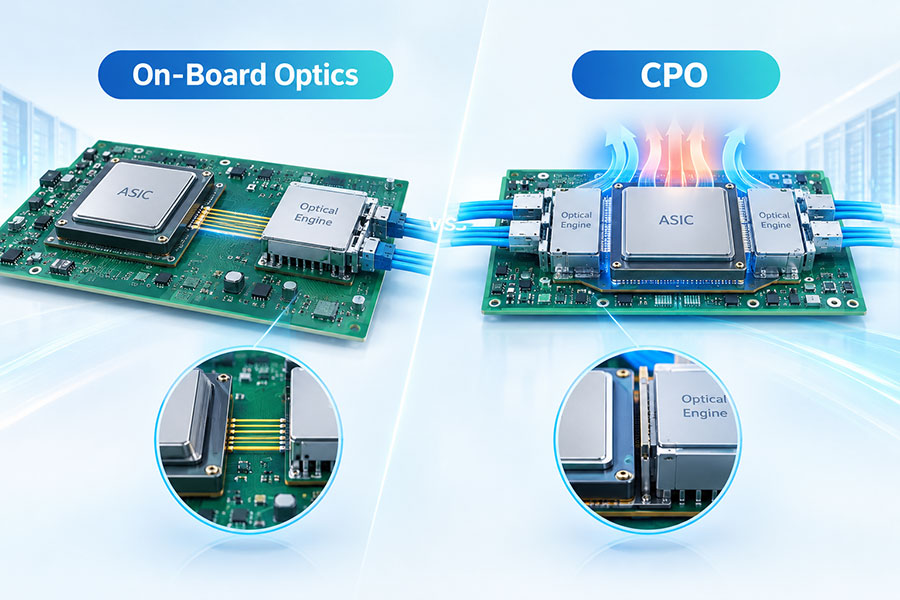
Co-packaged optics integrates optical engines with switch ASICs. Both 850 nm and 1550 nm are candidates, depending on the reach requirement. 850 nm is used for short-reach multimode CPO, while 1550 nm is used for longer-reach single-mode CPO.
11. Key Differences at a Glance
| Dimension | 850 nm | 1550 nm |
|---|---|---|
| Fiber Type | Multimode | Single-mode |
| Attenuation | 2.5–3.5 dB/km | ~0.2 dB/km |
| Dominant Impairment | Modal dispersion | Chromatic dispersion |
| Light Source | VCSEL | DFB, EML, tunable laser |
| Cooling | Uncooled | Temperature-controlled |
| Typical Reach | 50–100 m | 10–1000+ km |
| Modulation | NRZ, PAM4 | NRZ, PAM4, coherent |
| WDM Support | No | Yes (CWDM, DWDM) |
| Module Power | 1–3 W | 3–15 W |
| Module Cost | Low | Higher |
| Primary Application | Intra-data center | Telecom, DCI, coherent |
12. Selection Framework
| Evaluation Factor | Recommendation |
|---|---|
| Reach under 100 m | 850 nm multimode |
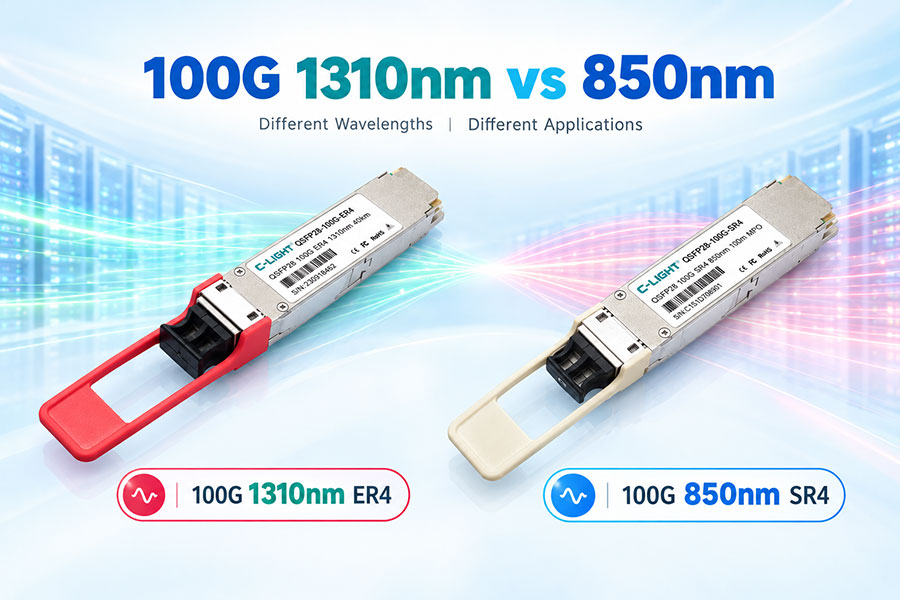
| Reach 100 m to 10 km | 1310 nm single-mode or 1550 nm |
| Reach over 10 km | 1550 nm single-mode |
| Cost-sensitive short reach | 850 nm VCSEL |
| Long reach and DWDM | 1550 nm DFB/EML |
| Coherent transmission | 1550 nm |
| Existing multimode fiber | 850 nm |
| Existing single-mode fiber | 1550 nm or 1310 nm |
| Power-constrained | 850 nm |
| Capacity-constrained long haul | 1550 nm DWDM/coherent |
13. Conclusion
850 nm and 1550 nm are two wavelength windows that serve different segments of optical networking. 850 nm is the short-reach workhorse, using VCSELs over multimode fiber for distances up to 100 meters. It offers the lowest cost, lowest power, and highest port density for intra-data center connectivity. 1550 nm is the long-reach workhorse, using DFB and EML lasers over single-mode fiber for distances from 10 km to 1000+ km. It supports DWDM and coherent transmission, enabling the capacity and reach required for telecom, DCI, and long-haul networks.
The two wavelengths do not compete for the same fiber plant. 850 nm is used with multimode fiber; 1550 nm is used with single-mode fiber. The choice between them is determined by the reach requirement, the existing fiber plant, the bandwidth demand, and the cost and power budget. For short-reach data center links, 850 nm remains the default. For long-reach telecom and DCI, 1550 nm is the only viable option.
 >
>

 >
>
 >
>
 >
>
 >
>
 >
>
 >
>
 >
>