TEL:+86 132 6656 7067




The rapid growth of artificial intelligence, cloud computing, and high-performance computing is increasing the demand for higher-bandwidth optical connectivity. As AI clusters expand, data center networks are progressing from 800G toward 1.6T optical interfaces to support greater traffic capacity, higher port density, and increasingly demanding switching architectures.
An 800G optical transceiver provides a nominal aggregate data rate of 800Gbps, while a 1.6T optical transceiver supports 1.6Tbps, or 1,600Gbps. Doubling the bandwidth per interface creates opportunities to increase network capacity and reduce the number of ports required for a given bandwidth target.
However, 1.6T introduces more demanding requirements for electrical signaling, optical lane architecture, packaging, thermal management, and host compatibility. Choosing between 800G and 1.6T therefore requires more than comparing data rates. Network designers must evaluate optical standards, transmission distance, fiber infrastructure, power consumption, switching platforms, and expected upgrade requirements.
1. What Is an 800G Optical Transceiver?
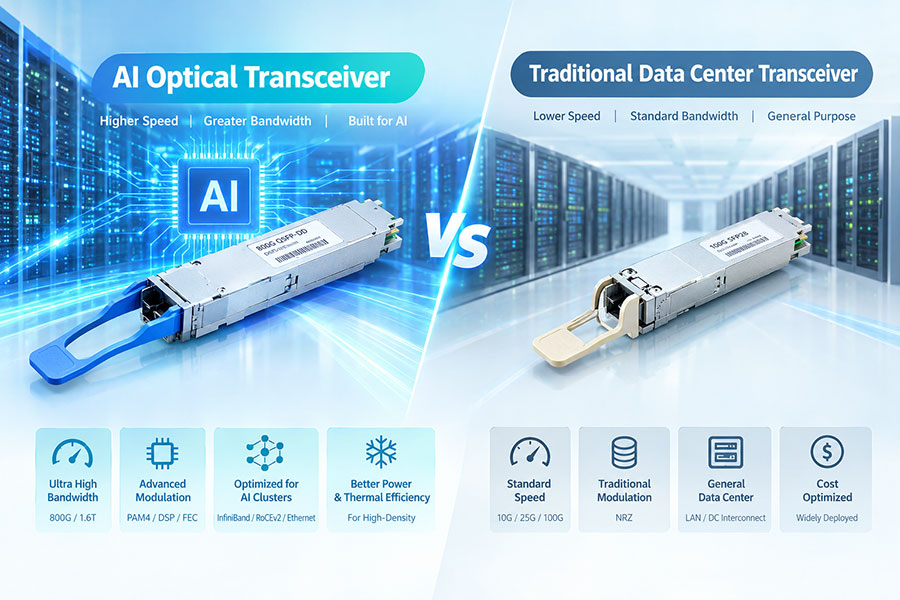
An 800G optical transceiver is a pluggable module designed to transmit and receive data at a nominal aggregate rate of 800Gbps. It converts electrical signals into optical signals for transmission through fiber and converts incoming optical signals back into electrical signals at the receiving end.
OSFP and QSFP-DD800 are common form factors for 800G optical transceivers. Different modules support different optical architectures, including parallel multimode, parallel single-mode, wavelength-multiplexed, and coherent transmission designs.
Common 800G optical module types include:
800G SR8: A short-reach multimode design using eight optical lanes.
800G DR8: A parallel single-mode design commonly supporting 500m-class links.
800G DR8-2: A single-mode variant designed for up to 2km in supported implementations.
800G 2xFR4: A design that provides two 400G FR4 optical interfaces within one module.
800G ZR/ZR+: Coherent options for supported data center interconnect and DWDM transport applications, with reach depending on the specific module and line system.
These module categories are not interchangeable. They differ in optical technology, fiber count, connector arrangement, reach, power requirements, and intended application. Exact capabilities must be verified against the product datasheet and applicable standard.
2. What Is a 1.6T Optical Transceiver?
A 1.6T optical transceiver supports a nominal aggregate data rate of 1.6Tbps. It targets next-generation high-capacity networking applications, including AI data centers, hyperscale cloud infrastructure, and high-performance switching platforms with compatible interfaces.
OSFP1600 is a form-factor category developed for 1.6T optical connectivity. Implementations can differ in mechanical design, heat sink arrangement, and optical architecture according to the host platform and product specification.
Many 1.6T client optical designs use eight approximately 200G-class lanes with PAM4 signaling. This architecture doubles the per-lane data rate compared with an eight-lane 800G design using approximately 100G-class lanes, while retaining eight optical lanes where the selected optical architecture supports this arrangement.
Potential 1.6T module configurations include:
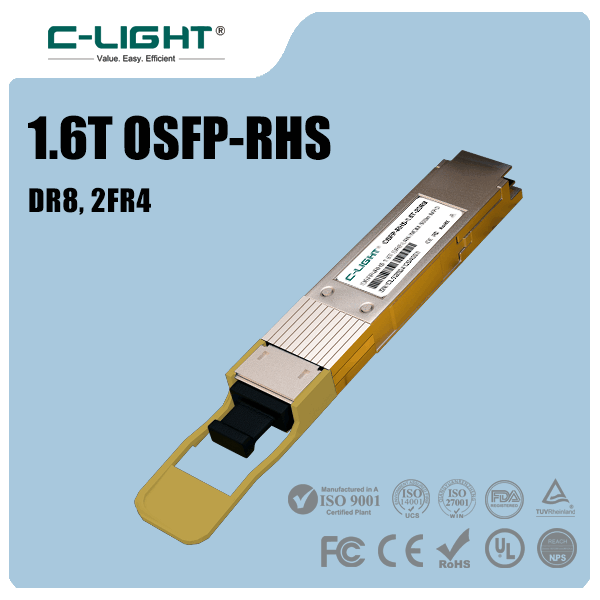
1.6T DR8: An eight-lane parallel single-mode design for supported high-speed data center links.
1.6T 2xDR4: An architecture providing two 800G-class parallel single-mode interfaces in one module.
1.6T FR-family designs: Wavelength-multiplexed or multi-interface solutions for supported single-mode distances, depending on product availability.
1.6T integrated optical solutions: Advanced optical-engine implementations for compatible next-generation platforms.
Not every architecture is available in every form factor or at every reach. Exact lane rates, fiber arrangements, connectors, wavelengths, and supported distances depend on the specific product and applicable specification.
3. 800G vs 1.6T: Key Differences at a Glance
| Characteristic | 800G Optical Transceiver | 1.6T Optical Transceiver |
|---|---|---|
| Aggregate Data Rate | 800Gbps | 1.6Tbps |
| Common Form Factors | OSFP, QSFP-DD800 | OSFP1600-class designs and platform-specific variants |
| Common Lane Architecture | Eight approximately 100G-class lanes in many client designs | Eight approximately 200G-class lanes in many client designs |
| Short-Reach Example | 800G SR8 | Product-specific 1.6T multimode solutions where available |
| Single-Mode Example | 800G DR8 or 2xFR4 | 1.6T DR8 or 2xDR4 |
| Bandwidth per Port | 800Gbps nominal aggregate rate | 1.6Tbps nominal aggregate rate |
| Signal Integrity | Depends on lane rate and electrical channel design | More demanding lane-rate and package-integrity requirements |
| Power and Cooling | Depends on reach, optical architecture, and implementation | Depends on lane rate, optics, integration, and cooling |
| Typical Upgrade Goal | High-capacity AI and data center connectivity | Greater bandwidth density for next-generation networks |
The main difference is nominal aggregate capacity: 1.6T provides twice the bandwidth of 800G per interface. Actual application throughput depends on protocol overhead, network utilization, switch capacity, topology, and whether the connected equipment can use the additional bandwidth.
4. Form Factor: OSFP and QSFP-DD800 vs OSFP1600
The form factor defines the physical package and electrical interface of an optical transceiver. It affects host compatibility, port density, available power, heat dissipation, and installation requirements.
OSFP and QSFP-DD800 are common formats for 800G modules. Their mechanical dimensions, cooling designs, and host-port interfaces differ, so the correct form factor must be selected for the specific switch or network platform.
For 1.6T, OSFP1600-class designs support the higher data rate through a compatible electrical interface and optical architecture. Some implementations use an integrated heat sink, while others use a riding heat sink designed to work with the host platform's thermal solution.
When selecting a module, confirm:
The host platform explicitly supports the target data rate and form factor.
The module dimensions and mechanical interface match the host port.
The electrical lane configuration and signaling rate are compatible.
The host provides sufficient power and cooling capacity.
The optical architecture and required breakout modes are supported.
A 1.6T module should not be assumed to work in an 800G port simply because the modules appear mechanically similar. Physical fit and operational compatibility are separate requirements.
5. Optical Lane Architecture and Aggregate Bandwidth
High-speed transceivers combine multiple optical lanes or wavelength channels to reach their aggregate data rates. The number of lanes, per-lane rate, modulation format, and optical interface depend on the module's architecture.
Many 800G client modules use eight approximately 100G-class optical lanes. Many 1.6T client designs use eight approximately 200G-class optical lanes. Other architectures can divide the aggregate data rate into multiple optical interfaces or use different wavelength-multiplexing arrangements.
| Example Architecture | Aggregate Rate | General Design Approach |
|---|---|---|
| 800G SR8 | 800Gbps | Eight optical lanes over multimode fiber |
| 800G DR8 | 800Gbps | Eight parallel single-mode optical lanes |
| 800G 2xFR4 | 800Gbps | Two 400G FR4 optical interfaces |
| 1.6T DR8 | 1.6Tbps | Eight approximately 200G-class single-mode optical lanes |
| 1.6T 2xDR4 | 1.6Tbps | Two parallel 800G-class optical interfaces |
These are representative architectures rather than universal definitions for every product. The exact lane rate, optical channel arrangement, connector, and host interface should be confirmed in the module documentation.
6. PAM4 Signaling and Higher Lane Rates
PAM4 modulation is widely used in modern high-speed optical interfaces. It encodes two bits per symbol using four amplitude levels, compared with NRZ signaling, which uses two levels and one bit per symbol.
PAM4 enables higher data rates without requiring the symbol rate to increase proportionally with the bit rate. However, the smaller amplitude margin between adjacent levels makes the link more sensitive to noise, distortion, transmitter nonlinearity, and receiver performance.
Moving from 800G to 1.6T increases the demands on electrical SerDes, optical transmitters, receivers, DSP, equalization, and error correction. Many 1.6T client designs use approximately 200G-class lanes, requiring the host platform and optical interface to support the higher lane rate.
Forward Error Correction (FEC) is important in many high-speed link architectures. Its requirements depend on the applicable interface standard, optical module design, host configuration, and link implementation.
A 1.6T module is therefore not simply an 800G module with a larger aggregate data rate. It requires a compatible system architecture designed around higher bandwidth and more demanding lane-rate requirements.
7. Transmission Distance: 800G vs 1.6T
Both 800G and 1.6T technologies target different reach requirements. Transmission distance depends on the specific optical standard, wavelength, fiber characteristics, transmitter output, receiver sensitivity, channel loss, and capabilities of the optical interface.
| Reach Category | 800G Example | 1.6T Example |
|---|---|---|
| Short-Reach Multimode | SR8 or related modules; reach varies by standard and fiber grade | Product-specific multimode designs where available |
| 500m-Class Single-Mode | DR8 | DR8 in supported implementations |
| 2km-Class Single-Mode | 2xFR4 or other supported designs | Product-specific FR-family or other supported solutions |
| Longer-Reach Single-Mode | Specific LR or coherent implementations | Product-specific designs depending on architecture and availability |
| Data Center Interconnect | 800G ZR/ZR+ coherent modules in supported systems | Specialized transport solutions subject to module and line-system support |
These are representative reach categories, not universal guarantees. In particular, not every 1.6T module supports all the distances available in the 800G generation. Product selection should be based on a verified optical specification rather than aggregate bandwidth alone.
8. Multimode vs Single-Mode Fiber
Fiber type is critical when selecting 800G or 1.6T optical connectivity. Multimode fiber is commonly used for short-reach data center links, while single-mode fiber supports a wider range of distances and optical architectures.
Multimode modules typically operate around 850nm and commonly use VCSEL technology. Their supported distance depends on the fiber grade, link loss, connector arrangement, and optical specification.
Single-mode modules commonly operate around 1310nm for data center applications. Depending on the design, the transmitter may use DFB lasers, EML technology, silicon photonics, or other suitable optical implementations.
| Characteristic | Multimode Fiber | Single-Mode Fiber |
|---|---|---|
| Common Wavelength | 850nm for many short-reach applications | 1310nm and other wavelengths, depending on design |
| Typical Laser Technology | VCSEL | DFB, EML, and other supported implementations |
| Common Fiber Grades | OM3, OM4, OM5 | OS1, OS2, depending on system requirements |
| Typical Application | Short-reach data center connectivity | Short-, medium-, and longer-reach links |
| Selection Priority | Supported distance and channel loss | Optical budget, wavelength, and required reach |
Moving from 800G to 1.6T does not automatically require a different fiber type. Existing cabling can be reused only when the fiber grade, connector arrangement, polarity, optical loss, and supported link architecture meet the requirements of the selected module.
9. Wavelength and Optical Architecture
Wavelength depends on the optical architecture rather than the aggregate data rate alone. Many short-reach multimode modules use 850nm VCSELs, while single-mode data center modules commonly operate around 1310nm.
Parallel optics transmit data across multiple optical paths and generally use multi-fiber connectors. Wavelength-division multiplexing combines multiple optical channels over fewer fibers, potentially reducing the number of fibers required for a given aggregate data rate.
For example, 800G 2xFR4 provides two 400G FR4 optical interfaces within one module. Many 1.6T client implementations instead use eight higher-rate optical lanes, although other architectures may use different lane or wavelength arrangements.
Before selecting a module, confirm:
The operating wavelength or wavelength set.
Single-mode or multimode fiber compatibility.
The number of optical transmit and receive lanes.
The connector type and fiber arrangement.
The specified optical power budget and transmission distance.
Optical interoperability requires compatible transmit and receive characteristics at both ends. Matching only the aggregate data rate is insufficient.
10. Connector Types and Fiber Cabling
800G and 1.6T modules can use different connector arrangements depending on their optical lane architecture. Parallel-optics designs commonly use MPO/MTP interfaces, while wavelength-multiplexed designs may use duplex LC or other specified connectors.
| Module Example | Connector Approach | General Fiber Arrangement |
|---|---|---|
| 800G SR8 | MPO-16 or specified parallel interface | Parallel multimode fiber |
| 800G DR8 | Dual MPO-12 or other specified interface | Parallel single-mode fiber |
| 800G 2xFR4 | Two duplex LC interfaces in common designs | Two 400G FR4 optical links |
| 1.6T DR8 | MPO-12/APC or other product-specified interface | Parallel single-mode fiber |
| 1.6T 2xDR4 | Dual parallel-optics interfaces in supported implementations | Two 800G-class optical links |
| Other 1.6T Designs | Product-specific interface | Parallel or wavelength-multiplexed architecture |
Connector details can differ between products. Before deployment, verify the connector family, polish type, fiber count, polarity, and compatibility with patch panels, cassettes, and existing cabling. APC and UPC connector interfaces should not be mated together.
11. Bandwidth Density and Port Capacity
One of the main advantages of 1.6T over 800G is the ability to provide twice the nominal bandwidth per interface. This can reduce the number of ports required to achieve a particular aggregate capacity when suitable 1.6T platforms are available.
For example, four 1.6T ports provide 6.4Tbps of nominal aggregate bandwidth, while eight 800G ports provide the same nominal capacity.
Higher bandwidth per port can reduce some pressure on switch-port counts and front-panel space. However, the overall benefit depends on switching capacity, network topology, breakout requirements, optical cabling, and workload traffic patterns.
Moving to 1.6T may also require newer switches, different electrical interfaces, updated cabling, and more demanding thermal management. Network planners should evaluate the complete switching system rather than considering the optical module alone.
12. Power Consumption and Thermal Management
Power consumption becomes increasingly important as optical bandwidth increases. High-speed transceivers generate heat, and the aggregate power demand of multiple modules influences the electrical and cooling requirements of an AI data center.
A 1.6T module may require more power than a comparable 800G module because of its higher lane rates, signal processing, optical architecture, and packaging. However, actual power consumption varies by product and should not be estimated from the aggregate data rate alone.
Check the following parameters before deployment:
Typical and maximum module power consumption.
Power allowance supported by the host port.
Switch airflow direction and cooling capacity.
Operating temperature range.
Thermal performance when multiple ports are populated.
As an example of the range across product implementations, some 1.6T OSFP designs specify power requirements in the approximate 16W to 28W range. This is not a universal value for all 1.6T modules; the exact module datasheet must be used for power and thermal planning.
For dense AI networking systems, power per bit and total system capacity can provide useful comparisons, but values should be based on products operating under comparable conditions.
13. Breakout Capability and Network Migration
Breakout allows a higher-speed port to connect to multiple lower-speed interfaces when the module, cable assembly, and host platform support the required configuration.
Some 800G modules and host platforms support configurations such as 2x400G, 4x200G, or 8x100G. Supported 1.6T implementations may provide modes such as 2x800G, 4x400G, or 8x200G, depending on the optical architecture and host configuration.
Breakout can help network operators connect lower-speed devices to newer high-capacity switches. However, the switch, module, cabling, remote interfaces, and software configuration must all support the intended mode.
Before selecting a breakout design, verify:
The exact breakout modes supported by the host platform.
The electrical and optical lane mapping.
The required cable type, connector, and polarity.
The data rates and protocols supported by remote endpoints.
The required FEC and switch configuration.
Breakout capability is not universal across all products. Always confirm the intended configuration in the module datasheet and platform documentation.
14. Compatibility with Ethernet and InfiniBand
Optical transceivers must be selected according to the target network protocol and host platform. A module with the correct aggregate rate may still be incompatible if its electrical interface, optical standard, firmware requirements, or protocol support differ from those of the network equipment.
800G connectivity is used in supported Ethernet and InfiniBand environments. 1.6T connectivity targets compatible next-generation platforms and requires hardware designed to support its higher-speed interface.
Before deployment, verify:
The host supports the module's form factor and data rate.
The network protocol and interface generation are supported.
The optical architecture matches the remote endpoint.
The module coding and firmware requirements are satisfied.
The required breakout and FEC configuration are available.
Compatibility testing is especially important when migrating to a new bandwidth generation. Successful operation requires both the host interface and optical link to meet their specifications.
15. Optical Power Budget and Link Reliability
The optical power budget determines whether a transmitted signal reaches the receiver with sufficient power after accounting for losses along the fiber path. Both 800G and 1.6T systems must remain within their specified optical operating limits.
A simplified calculation is:
Available Optical Budget = Minimum Transmitter Output Power − Receiver Sensitivity
Estimated path loss should include fiber attenuation, connector loss, patch panels, splices, and other optical components. An appropriate engineering margin should be retained for operating variation and maintenance.
It is equally important to confirm the receiver's maximum permitted input power. A module designed for a longer link may require an appropriate optical attenuator when used over a short path, depending on its specification.
After installation, verify optical power, link status, error counters, connector cleanliness, fiber polarity, and FEC configuration. These checks help identify problems that cannot be detected by comparing module data rates alone.
16. Applications of 800G Optical Transceivers
800G optical transceivers are suitable for high-capacity data center networks that require 800Gbps interfaces. They remain important for hyperscale cloud infrastructure, AI computing clusters, high-performance computing, and supported high-speed switching architectures.
AI Data Center Networks
Large GPU clusters exchange substantial volumes of data between computing nodes. 800G transceivers provide high-speed connectivity for supported switch architectures and help increase the capacity of the network fabric.
Hyperscale Cloud Infrastructure
Cloud data centers use high-speed optical links between switching tiers and computing resources. 800G can provide substantial bandwidth per port while using established pluggable optical architectures.
High-Performance Computing
HPC systems require reliable, high-throughput communication between computing nodes. 800G optics can provide high-capacity links where the network platform supports the required interface.
The appropriate module depends on link distance, fiber infrastructure, network protocol, optical standard, and host-platform requirements.
17. Applications of 1.6T Optical Transceivers
1.6T optical transceivers target next-generation networking systems that require substantially more bandwidth per interface. They are particularly relevant to AI data centers, high-density switching, hyperscale networks, and compatible high-performance computing platforms.
Next-Generation AI Networks
Large GPU clusters generate significant east-west traffic during distributed training and inference. 1.6T interfaces can provide higher aggregate link capacity where the switches and network architecture support the required rate.
High-Density Switching
Higher bandwidth per port creates opportunities to increase network capacity while managing interface counts and chassis space. The practical benefit depends on the supported switch architecture, power limits, and cooling design.
Future Optical Interconnect Platforms
As 1.6T technologies develop, optical engines, advanced photonic integration, and higher-speed electrical interfaces will play increasingly important roles in system design.
Deployment planning must account for product availability, platform compatibility, power consumption, thermal requirements, and the optical architecture supported by the selected module.
18. Cost and Total Cost of Ownership
The purchase price of an optical transceiver is only one part of total deployment cost. Network operators should also consider switching hardware, power consumption, cooling, cabling, installation, compatibility testing, maintenance, and future network upgrades.
800G may be more economical when existing infrastructure already provides sufficient capacity. 1.6T can provide stronger long-term value when port bandwidth is a major constraint or when a new AI network is designed around higher-speed interfaces from the beginning.
For an effective comparison, evaluate:
Transceiver purchase price and required quantity.
Switch and network adapter upgrade costs.
Fiber cabling, connectors, and patch-panel requirements.
Power consumption and cooling overhead.
Installation, qualification, and compatibility-testing effort.
Expected bandwidth growth and future upgrade frequency.
A higher-speed module is not automatically more economical for every connection. The best choice is the one that meets the required capacity and operating constraints at an acceptable lifecycle cost.
19. Common Mistakes When Choosing 800G or 1.6T
Several mistakes can lead to incompatibility, unexpected expenses, or link failures when upgrading to higher-speed optical networking.
Choosing by bandwidth alone: The module must also match reach, fiber, connector, optical standard, and host interface.
Assuming form factors are interchangeable: Physical similarity does not guarantee electrical or operational compatibility.
Ignoring the lane architecture: Electrical lane rate and optical lane rate may differ, and the host must support the intended interface.
Overlooking power and cooling: Higher bandwidth can introduce different module and platform thermal requirements.
Assuming every 1.6T module has the same reach: Reach and optical architecture vary by product.
Assuming existing fiber can always be reused: Reuse depends on fiber grade, connector arrangement, polarity, loss, and the intended standard.
Skipping interoperability testing: Host support, remote endpoints, FEC, and breakout configuration must all be verified.
Verifying these parameters before purchasing helps reduce deployment risk and improves the likelihood of a successful network upgrade.
20. How to Choose Between 800G and 1.6T Optical Transceivers
The selection should begin with the required network capacity and the capabilities of the host platform. 800G remains appropriate for established high-capacity networks, while 1.6T becomes attractive when significantly higher bandwidth per interface is needed and compatible hardware is available.
| Requirement | Recommended Direction |
|---|---|
| Existing 800G network with sufficient capacity | 800G optical transceivers |
| Short-reach multimode connection | 800G SR8 or a supported 1.6T multimode solution |
| 500m-class single-mode link | 800G DR8 or a supported 1.6T DR8 design |
| Higher bandwidth per switch port | 1.6T on a compatible platform with an appropriate optical interface |
| Large-scale AI fabric with increasing port capacity | Evaluate 1.6T against switch support, topology, power, cooling, and total cost |
| Gradual bandwidth migration | Use supported breakout configurations and verify every endpoint |
| Budget-constrained upgrade | Compare total lifecycle cost rather than module price alone |
Before ordering, confirm the host device model, network protocol, form factor, port rate, optical reach, fiber grade, connector, lane configuration, power requirements, and supported breakout modes. These details help establish whether 800G or 1.6T is appropriate for the intended deployment.
21.Conclusion
800G and 1.6T optical transceivers serve different generations of high-speed networking. An 800G interface supports a nominal aggregate rate of 800Gbps, while a 1.6T interface provides 1.6Tbps, twice the nominal capacity.
The difference extends beyond bandwidth. Form factor, lane rate, electrical signal integrity, optical architecture, fiber type, transmission distance, power consumption, thermal management, and host compatibility all influence selection. Many 1.6T client designs use eight approximately 200G-class lanes, introducing stricter requirements for electrical and optical performance.
For existing networks with sufficient 800G capacity, upgrading every link to 1.6T may not be necessary. For next-generation AI data centers and high-density switching platforms, 1.6T can offer greater capacity per port when the host system and optical architecture support it. The best choice is the one that meets the complete link requirements while balancing performance, reliability, compatibility, and total deployment cost.
 >
>

 >
>
 >
>
 >
>
 >
>
 >
>
 >
>
 >
>