TEL:+86 132 6656 7067




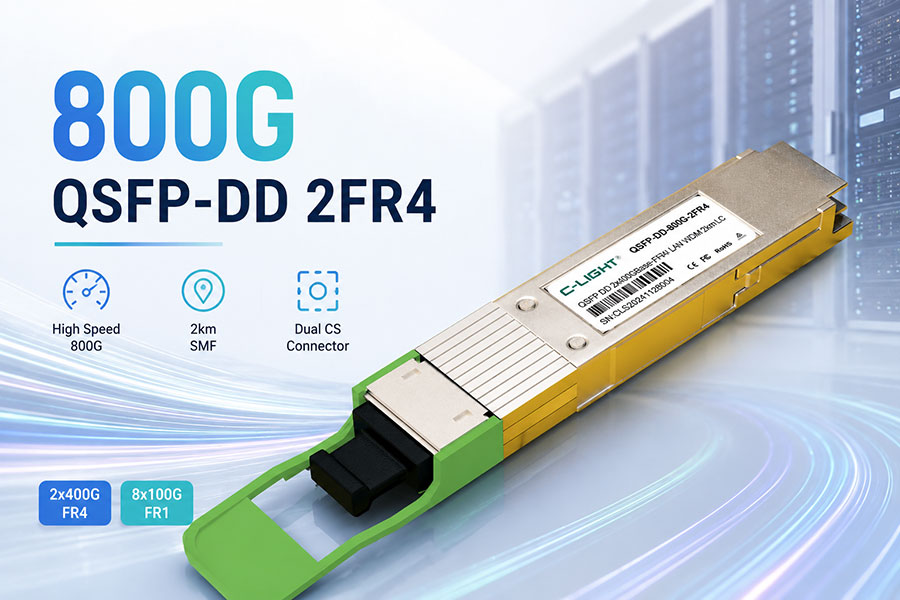
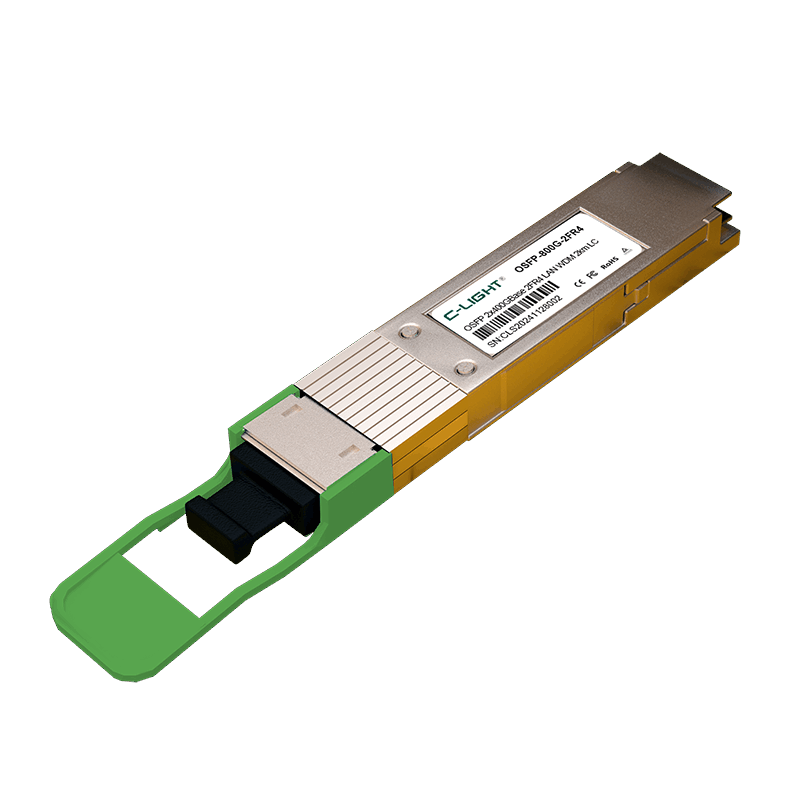
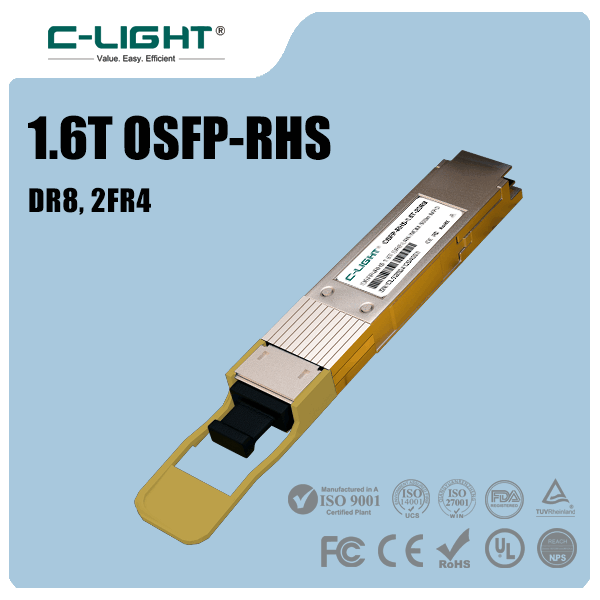
The 800G OSFP 2xFR4 2km Transceiver is a high-speed module in OSFP form factor. It achieves 800Gbps transmission via 2xFR4 technology, operates at 1310nm over single-mode fiber for 2km reach, and consumes Max 18w power. Designed for high-bandwidth applications like Data Center Interconnects, metro networks, and AI clusters.
| Product Features |
●Compliant with IEEE 802.3cu-2021 - 2x400GBASE-FR4 optical interface ●Compliant with IEEE P802.3ck D3.0 - 2x400GAUI-4 C2M electrical interface ●Compliant with OSFP MSA HW Rev 4.1 ●Type 2 housing with dual LC connector ●Compliant with CMIS Rev 5.0 ●Case operating temperature 0°C to 70°C ●Two wire serial Interface with digital diagnostic monitoring ●Complies with EU Directive 2011/65/EU (RoHS compliant) ●Class 1 Laser |
| Data Sheet |
| 800G-OSFP-2xFR4-2km-Transceiver.pdf |
If you are interested in the 800G OSFP 2xFR4 2km Transceiver, please contact us sales@c-light.com
800G OSFP 2×FR4 2km Transceiver FAQ
Q1: What is an 800G OSFP 2×FR4 2km transceiver?
An 800G OSFP 2×FR4 2km transceiver is a high-speed optical module that delivers 800Gbps transmission over single-mode fiber. Based on 2×400G FR4 technology, it is designed for short- to medium-reach data center interconnects and AI networking.
Key features include:
800Gbps data rate
2×400G FR4 architecture
Up to 2km over SMF
Dual LC connector
OSFP hot-pluggable form factor
It is ideal for AI clusters, cloud data centers, and high-performance computing.
Q2: How does an 800G OSFP 2×FR4 transceiver work?
The module uses PAM4 modulation and 2×400G FR4 optical channels over single-mode fiber. It provides high-bandwidth, low-latency connectivity between switches, servers, and AI computing platforms while maintaining efficient fiber utilization.
Q3: What are the key features of the C-LIGHT 800G OSFP 2×FR4 2km transceiver?
The C-LIGHT module is built for next-generation 800G Ethernet and AI networks.
Key features include:
800Gbps transmission
2km reach over SMF
IEEE 802.3cu compliant
OSFP MSA Rev 4.1
CMIS Rev 5.0 support
Digital Diagnostic Monitoring (DDM)
Power consumption up to 18W
These features ensure stable, high-density optical connectivity.
Q4: What are the advantages of an 800G OSFP 2×FR4 transceiver?
Compared with lower-speed optical modules, it offers:
Higher bandwidth density
Longer transmission distance
Reduced switch port usage
Efficient fiber utilization
Scalable AI networking
It is an ideal solution for next-generation 800G infrastructures.
Q5: Where are 800G OSFP 2×FR4 transceivers commonly used?
These modules are widely deployed in high-speed optical networks.
Typical applications include:
AI data centers
Hyperscale cloud networks
Data Center Interconnect (DCI)
High-performance computing (HPC)
Enterprise backbone networks
Metro data center campuses
These applications require high bandwidth, low latency, and reliable 2km optical transmission.
Q6: Why choose an 800G OSFP 2×FR4 instead of an 800G DR8 module?
The 2×FR4 design uses dual LC interfaces and supports longer transmission distances than DR8 while simplifying fiber management.
Its advantages include:
Up to 2km transmission
Duplex LC connectivity
Lower fiber count
Easier deployment
Excellent compatibility
It is well suited for campus and inter-building data center links.
Q7: How do you choose the right 800G OSFP transceiver?
When selecting an 800G OSFP module, consider:
Transmission distance
Fiber type
Connector type
OSFP compatibility
Power consumption
Application scenario
Choosing the right module ensures reliable 800G network performance and future scalability.
Q8: Why choose the C-LIGHT 800G OSFP 2×FR4 2km transceiver?
The C-LIGHT 800G OSFP 2×FR4 combines ultra-high bandwidth, reliable 2km transmission, and excellent compatibility in a compact OSFP package.
It provides:
800Gbps bandwidth
2km SMF transmission
Dual LC interface
Low-latency performance
Broad platform compatibility
It is an ideal solution for AI clusters, cloud computing, hyperscale data centers, and next-generation Ethernet networks.
 >
>

 >
>
 >
>
 >
>
 >
>
 >
>
 >
>
 >
>