TEL:+86 132 6656 7067





5G and 6G mobile networks both depend on optical transport to connect radio equipment, aggregation sites, edge computing facilities, and the core network. Wavelength Division Multiplexing (WDM) allows multiple optical channels to share a fiber, helping operators expand capacity without deploying a separate fiber for every connection.
The main difference between current 5G WDM deployments and emerging 6G-oriented optical networks is not a new wavelength multiplexing principle. It is the expected evolution of per-channel capacity, network flexibility, optical resource management, energy efficiency, synchronization, and end-to-end service coordination. As of October 2026, 6G optical transport is still evolving alongside IMT-2030 and related standardization work; proposed capabilities should not be treated as finalized universal deployment requirements.
1. 5G WDM vs 6G WDM: Fundamental Differences
WDM is an optical transport technology rather than a mobile radio generation. The same basic technology can support 5G and future 6G networks. The distinction lies in how the optical layer is engineered to meet the capacity, latency, topology, and operational requirements of each network generation.
| Technical Dimension | 5G WDM | 6G-Oriented WDM |
|---|---|---|
| Deployment status | Commercially deployed in fronthaul, midhaul, backhaul, and metro transport networks. | Under research, architecture development, and standardization alignment with IMT-2030. |
| Primary objective | Expand fiber utilization and meet the transport requirements of deployed 5G radio architectures. | Prepare scalable optical transport for higher data rates, denser connectivity, intelligent services, and evolving radio architectures. |
| Wavelength technology | CWDM, DWDM, passive WDM, active WDM, and other implementations selected according to cost and network requirements. | Continued use of WDM, with expected advances in flexible wavelength allocation, optical routing, and network control. |
| Channel capacity | Selected according to the radio split, interface rate, reach, and aggregation requirements. | Planning trends point toward higher-capacity fronthaul and greater metro and backbone throughput. Actual rates will depend on the selected architecture. |
| Latency and synchronization | Designed to satisfy the transport, timing, and synchronization requirements of the deployed 5G interface. | Expected to support stringent latency, jitter, synchronization, and reliability requirements across diverse services. |
| Wavelength management | May use fixed channel plans, centralized provisioning, or more advanced control depending on the deployment. | Greater emphasis is expected on dynamic provisioning, telemetry, automation, and service-aware optical resource allocation. |
| Network intelligence | Automation and centralized management vary with the operator's architecture and equipment. | AI-assisted planning, optimization, fault analysis, and operational autonomy are important development directions. |
| Energy efficiency | Capacity expansion must balance equipment power, optical reach, and deployment cost. | More emphasis on energy per bit, adaptive resource use, and coordination between transport and computing resources. |
These are architectural trends rather than a strict division between two sets of WDM standards. A well-designed 5G optical network can already use sophisticated DWDM equipment, automation, and reconfigurable optical elements. Conversely, a future 6G deployment may continue to use economical CWDM or fixed-wavelength links wherever their capacity and reach are sufficient.
2. 5G WDM Architecture: Fronthaul, Midhaul and Backhaul
In 5G networks, WDM is particularly valuable where multiple radio connections must be transported over limited fiber resources. In centralized or distributed radio access architectures, the optical transport network carries traffic between radio units, distributed units, centralized processing resources, aggregation nodes, and the mobile core.
The exact interfaces depend on the chosen radio architecture. In an O-RAN-style deployment, for example, the open fronthaul interface connects an O-RU and its serving O-DU. Other deployments may use different functional splits and equipment arrangements, which affect bandwidth and latency requirements.
| Transport Segment | Typical Connection | WDM Engineering Priority |
|---|---|---|
| Fronthaul | Radio unit or AAU to a distributed processing unit, depending on the architecture. | Meet interface bandwidth, latency, synchronization, optical reach, and channel isolation requirements. |
| Midhaul | Distributed and centralized radio processing functions where the deployment separates them. | Provide suitable aggregate capacity, traffic separation, and predictable transport performance. |
| Backhaul | Radio access aggregation toward the mobile core network. | Scale capacity over metro and regional links while supporting protection, traffic engineering, and service growth. |
Direct fiber connections remain appropriate when fiber is readily available and the cost is justified. Where fiber resources are constrained, WDM allows multiple wavelengths to use the same optical strand, increasing fiber utilization and reducing the need for additional cable routes.
5G fronthaul WDM may use passive, active, or semi-active arrangements. Passive systems use optical filters and do not require powered electronics at the multiplexing point. Active systems use powered equipment to manage or convert optical channels. The preferred arrangement depends on reach, channel count, fault management, remote-site power availability, and operational requirements.
For existing 5G deployments, C-LIGHT provides 5G fronthaul WDM solutions designed around wavelength multiplexing and fiber-resource utilization. The actual module, channel plan, and transmission parameters must match the radio interface and network design.
3. Optical Capacity: From 5G Requirements to 6G Planning Targets
The capacity of a WDM system depends on more than the number of wavelengths. It is determined by the data rate per wavelength, the number of channels, the optical spectrum in use, spectral efficiency, transmission distance, and the reach of the optical components.
In 5G networks, optical interfaces are selected according to the radio functional split and traffic demand. Some links use 10G or 25G-class interfaces, while higher-capacity transport may use 50G, 100G, or faster channels. These figures are examples of available interface classes, not universal 5G fronthaul requirements.
For future optical networks, ITU-T's ION-2030 framework identifies higher-rate transport as a planning direction. It discusses a 100GE-class fronthaul interface as a potential balance between bandwidth and cost, as well as higher-capacity metro and backbone networks. These are planning objectives and technology directions, not finalized requirements for every 6G link.
| Capacity Factor | 5G-Oriented Design | 6G-Oriented Planning |
|---|---|---|
| Per-link rate | Matched to current radio-interface and aggregation needs. | Designed to accommodate higher-rate fronthaul and evolving radio architectures. |
| Per-wavelength rate | Depends on the selected transceiver, distance, and channel plan. | Higher-rate optical interfaces are expected to become more important as transport demand grows. |
| Number of wavelengths | Determined by available spectrum, channel spacing, optical budget, and equipment capacity. | May increase through denser channel plans and broader usable optical bands where technically and economically justified. |
| Fiber utilization | WDM reduces the number of separate fibers needed for multiple optical channels. | More flexible use of optical resources may improve utilization across different traffic demands. |
| Aggregation capacity | Sized around radio traffic, mobile core connectivity, and expected growth. | Must accommodate mobile traffic alongside edge computing, AI services, sensing, and other high-bandwidth applications. |
As a simplified example, four independent 25G optical channels provide 100G of aggregate line rate before accounting for implementation overhead and any additional network constraints. Increasing the number of wavelengths or raising the rate per wavelength can expand the capacity carried over the same fiber infrastructure.
However, higher line rate does not guarantee a proportional increase in usable network capacity. Optical signal-to-noise ratio, reach, fiber dispersion, filter characteristics, transceiver power, and amplification requirements all affect the achievable system design.
4. CWDM vs DWDM in 5G and Future 6G Optical Networks
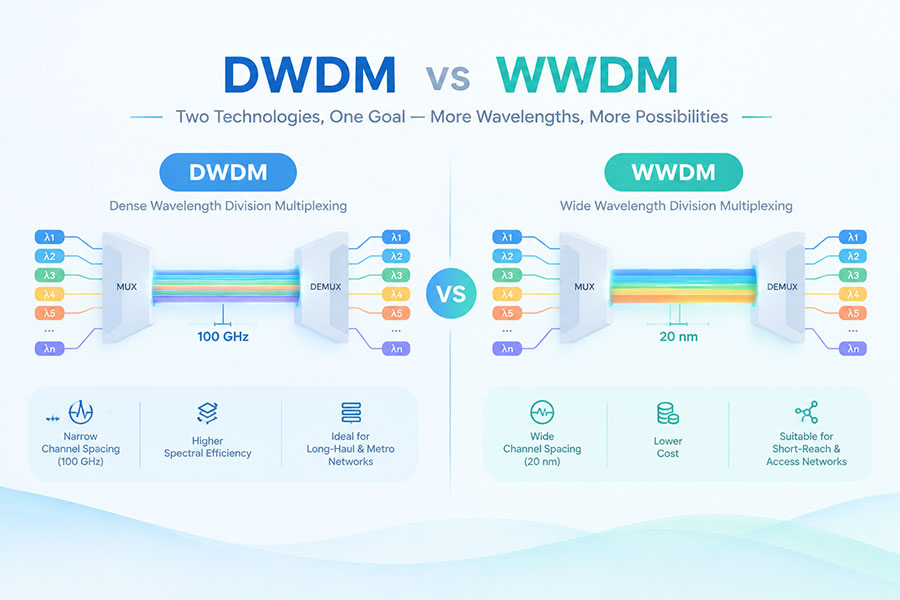
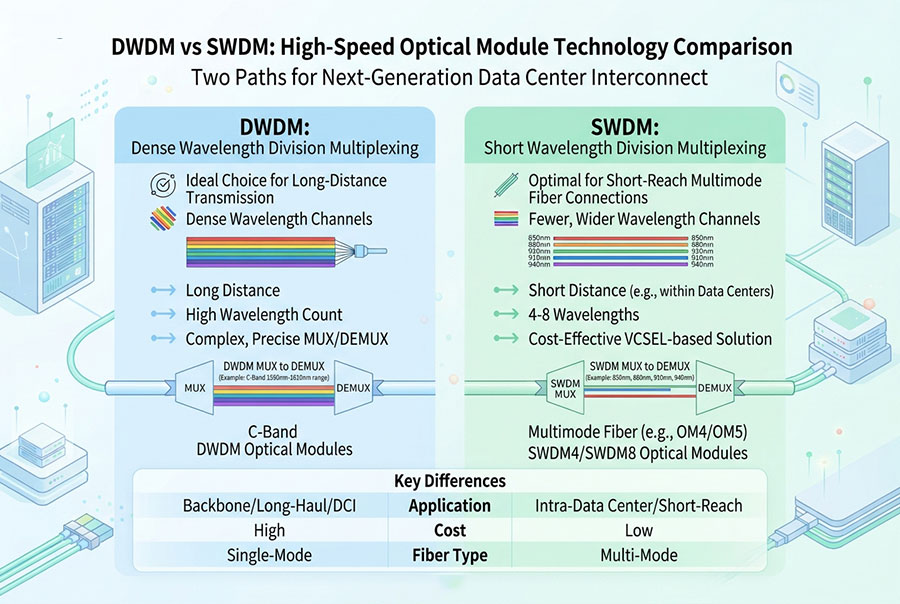
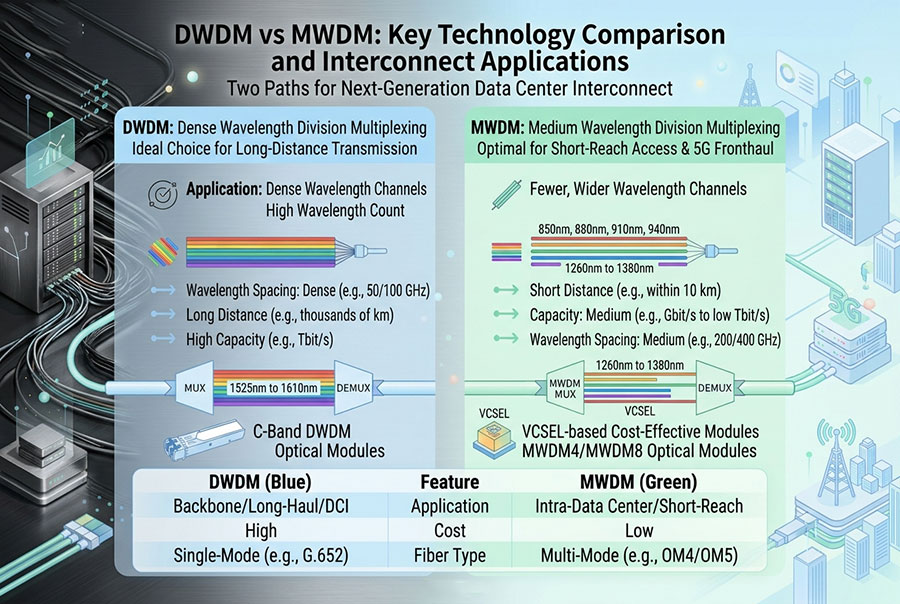
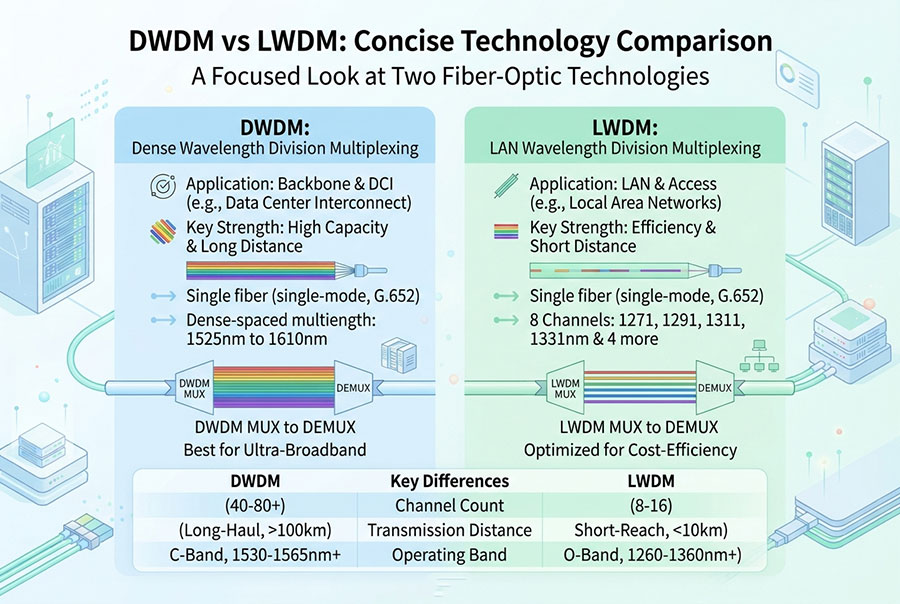
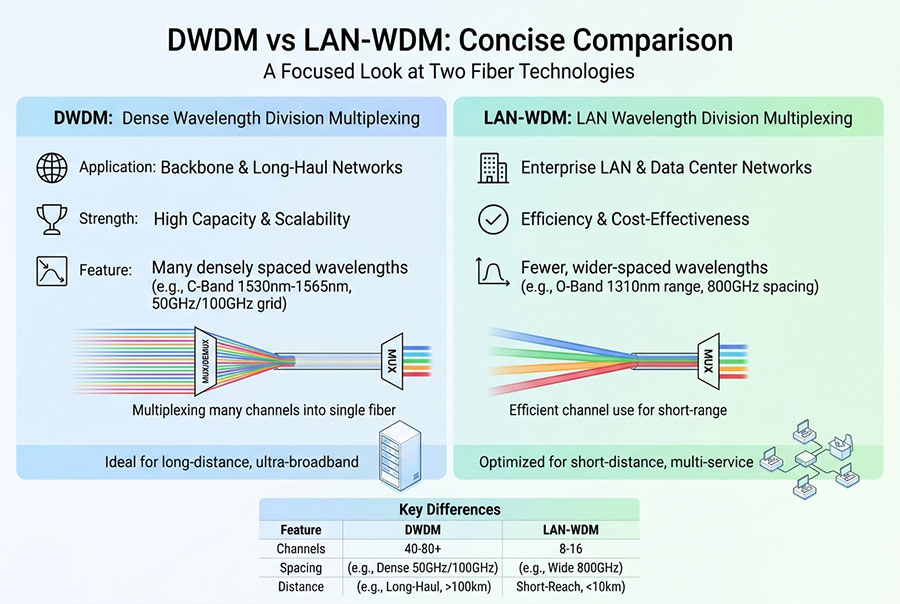
Coarse Wavelength Division Multiplexing (CWDM) and Dense Wavelength Division Multiplexing (DWDM) are both relevant to mobile optical transport. The choice is based on the number of channels required, wavelength spacing, transmission reach, budget, and future expansion plans—not solely on whether the network is 5G or 6G.
| Feature | CWDM | DWDM |
|---|---|---|
| Channel spacing | Uses comparatively wide wavelength spacing, commonly 20 nm in standard CWDM plans. | Uses much tighter channel spacing; common fixed-grid examples include 100 GHz and 50 GHz. |
| Channel density | Generally suited to lower or moderate channel counts. | Can support more densely packed wavelengths within the usable optical spectrum. |
| Typical network role | Cost-conscious access and selected mobile fronthaul deployments. | Capacity-intensive aggregation, metro transport, and backbone links. |
| Equipment considerations | Often simpler channel planning, with suitability depending on the optical interface and reach. | Requires tighter wavelength control and more detailed optical engineering. |
| Expansion potential | Limited by the available CWDM wavelengths and system configuration. | Can provide substantial channel expansion where spectrum, optical budget, and equipment support it. |
| Potential 6G role | Remains relevant for links whose capacity and cost requirements fit the available channels. | Likely to remain important for high-capacity optical transport where dense wavelength use is justified. |
DWDM is not automatically the better choice for every future 6G connection. A short, lower-capacity fronthaul link may be adequately served by CWDM, while a heavily aggregated metro route may benefit from DWDM's denser wavelength plan. A mixed network can use both technologies in different layers.
Coherent transmission, tunable transceivers, reconfigurable optical add-drop multiplexers (ROADMs), and flexible-grid systems may also become important as networks require greater capacity and more adaptable optical paths. Their inclusion should be based on a link budget and operational model rather than assumed for all 6G deployments.
For current wavelength-based transport, C-LIGHT offers 100G, 40G, and 25G DWDM optical transceivers. These are existing optical transport options; compatibility with any future 6G architecture must be evaluated against its actual interfaces and requirements.
5. Latency, Synchronization and Reliability Requirements
Low latency is a critical consideration for radio transport, but it is not determined by WDM alone. Propagation delay, optical and electrical conversion, buffering, switching, forward error correction where applicable, and network topology all contribute to end-to-end performance.
In 5G networks, fronthaul interfaces can have strict timing and latency budgets because radio processing functions are separated across the network. The selected WDM design must preserve the required interface behavior while keeping insertion loss, channel isolation, and reach within the system limits.
Future 6G systems are expected to support more demanding combinations of immersive communications, reliable low-latency services, integrated sensing and communication, and AI-assisted applications. Such services may place additional pressure on transport latency, jitter, synchronization accuracy, and fault recovery. The exact optical-layer targets will depend on the eventual service and architecture specifications.
| Engineering Parameter | 5G WDM Design Focus | 6G-Oriented Design Focus |
|---|---|---|
| Latency | Meet the budget of the selected radio split and transport interface. | Support evolving low-latency services without assuming the same budget applies to every link. |
| Jitter | Control delay variation across the transport path. | Coordinate latency-sensitive services across increasingly distributed radio and computing resources. |
| Synchronization | Deliver the timing and frequency accuracy required by deployed radio equipment. | Support advanced radio coordination and emerging sensing-related use cases where specified. |
| Reliability | Use appropriate protection, monitoring, and fault recovery mechanisms. | Improve resilience and service continuity across more dynamic and heterogeneous networks. |
| Optical channel quality | Maintain sufficient power budget, isolation, and receiver margin. | Preserve channel performance while supporting higher capacity and potentially more flexible optical routing. |
WDM multiplexers introduce insertion loss, and filter characteristics can affect optical power margins and channel isolation. A network designer must therefore assess the entire path, including connectors, splices, passive components, optical amplification if used, and the receiver sensitivity of each channel.
Adding optical channels to an existing fiber is only useful if the multiplexers, demultiplexers, transceivers, and transmission path can support them. Higher-density wavelength plans require careful consideration of adjacent-channel isolation, wavelength accuracy, optical power levels, and the applicable link budget.
6. Dynamic Wavelength Management and AI-Native Optical Networking
Many 5G WDM deployments use planned wavelength assignments and managed optical paths. More advanced systems may already support tunable optics, centralized control, automatic fault monitoring, and reconfiguration. The level of automation depends on the equipment and network architecture rather than on 5G itself.
For optical networks supporting 6G and other 2030-era services, industry planning increasingly emphasizes more flexible resource allocation, service-aware control, and intelligent operations. These capabilities could help operators adjust optical paths as traffic moves between radio sites, edge computing facilities, and regional data centers.
Dynamic wavelength provisioning: Allocate or reassign wavelengths as network demand changes, when supported by the transceivers and optical switching infrastructure.
ROADM-based optical routing: Add, drop, or redirect wavelengths at supported network nodes without manually rebuilding every optical path.
AI-assisted operations: Use telemetry and performance records to help detect degradation, predict capacity pressure, and optimize resource allocation.
Automated fault management: Improve fault localization and coordinate recovery across optical and packet layers.
Energy-aware resource planning: Adjust capacity and equipment states where operational policies permit, without compromising service-level requirements.
AI-assisted management should not be confused with AI being mandatory for every WDM link. It is an evolving network-operations direction. The practical benefits depend on data quality, control-system integration, interoperability, and the extent to which the optical infrastructure supports programmable behavior.
Similarly, wavelength-on-demand is not simply a software feature that can be added to every fixed optical system. It requires compatible transceivers, optical switching or filtering equipment, control interfaces, and a validated process for establishing and monitoring the requested path.
7. 6G WDM: Optical Network Architecture and Technology Evolution
Future optical transport planning is broader than mobile fronthaul alone. The International Telecommunication Union's ION-2030 framework considers optical networks supporting IMT-2030, AI, data center interconnection, and broadband access. These domains may share an optical infrastructure while requiring different latency, capacity, availability, and management characteristics.
Several technology directions are relevant to 6G-oriented transport planning:
Higher-rate interfaces: Future fronthaul and aggregation layers may require higher-capacity optical interfaces as radio bandwidth and site density grow.
Coherent optical transmission: Coherent technology can support high-capacity links over appropriate metro and regional distances, subject to optical budget and implementation requirements.
Flexible optical routing: ROADMs and flexible-grid systems can support adaptable channel placement and routing in suitable transport networks.
Optical transport convergence: Coordinated fronthaul, midhaul, backhaul, and data center connectivity can reduce fragmentation between transport domains.
Integrated sensing support: Future systems may use optical infrastructure and additional sensing technologies to provide network or environmental measurements, where supported by the design.
Energy-aware design: Higher capacity should be balanced against equipment power, optical reach, cooling, and lifecycle cost.
These directions do not mean that every 6G network will use coherent optics in fronthaul, a single unified WDM system, or one fixed channel rate. Access, fronthaul, metro aggregation, and backbone links have different engineering constraints. A practical design will select the optical technology that matches each segment.
It is also important to distinguish mobile radio standardization from optical transport standardization. IMT-2030 defines the developing framework for 6G radio interfaces and usage scenarios, while optical transport technologies are developed through related but separate standards and industry processes.
8. Deployment Strategy: Evolving 5G WDM Toward 6G Readiness
Operators do not necessarily need to replace an entire 5G optical transport network to prepare for future capacity growth. A phased approach can preserve usable infrastructure while identifying which fiber routes, optical components, transceivers, and management systems are likely to become constraints.
| Planning Stage | Recommended Assessment | Expected Benefit |
|---|---|---|
| Fiber infrastructure | Review route availability, fiber condition, loss, and spare-pair capacity. | Identifies whether capacity can expand over existing fiber or requires new routes. |
| Wavelength plan | Review channel spacing, occupied wavelengths, isolation, and expansion headroom. | Prevents channel conflicts and clarifies the capacity available for growth. |
| Transceiver capabilities | Check supported data rates, tuning range, reach, optical budget, and host interface. | Shows which links can be upgraded without changing every network component. |
| Transport architecture | Evaluate passive WDM, active WDM, DWDM, OTN, and reconfigurable optical routing where appropriate. | Aligns equipment complexity with capacity, reach, management, and protection needs. |
| Operations and monitoring | Assess performance telemetry, fault localization, controller integration, and automation. | Improves visibility and prepares the transport layer for more dynamic services. |
| Future capacity requirements | Model demand from radio evolution, edge computing, AI traffic, and aggregation growth. | Reduces overbuilding while preserving realistic upgrade options. |
Backward compatibility must be checked at every layer. A higher-rate optical transceiver may require a compatible host interface, different power or thermal provisions, a revised optical budget, or new line-side equipment. Existing WDM filters can also restrict which wavelengths or channel spacings are supported.
For operators planning a transition, a useful strategy is to separate immediate 5G capacity upgrades from longer-term 6G planning assumptions. Deploy established products for current requirements, preserve room for capacity expansion where economically justified, and avoid committing to unfinalized 6G interface assumptions before the relevant standards and equipment specifications become available.
9. Conclusion
5G WDM and 6G-oriented WDM use the same basic principle of carrying multiple optical wavelengths over shared fiber. Current 5G deployments use WDM to conserve fiber resources and meet fronthaul, midhaul, backhaul, and metro transport requirements. Future 6G networks are expected to place greater demands on capacity, flexibility, energy efficiency, synchronization, and intelligent optical network management.
The practical evolution will involve higher-rate interfaces where needed, denser or more flexible wavelength plans where justified, reconfigurable optical routing, improved automation, and stronger coordination across mobile and computing networks. These are development directions rather than a finalized, universal 6G WDM specification.
For network planners, the priority is to design around the actual link budget, channel plan, radio architecture, and service requirements while retaining a clear upgrade path. CWDM, DWDM, fixed-wavelength optics, tunable transceivers, and reconfigurable optical systems can all remain useful in the appropriate parts of the network.
Planning WDM transport for 5G or future network expansion?
Discuss fronthaul WDM, DWDM optical transceivers, wavelength planning, and compatibility requirements with C-LIGHT.
Contact C-LIGHT >

 >
 >
 >
 >
 >
 >
 >