TEL:+86 132 6656 7067





Optical transceivers are essential to mobile transport networks, connecting radio equipment, aggregation nodes, edge computing facilities, and core networks over fiber. In 5G deployments, modules operating at rates such as 10G, 25G, 50G, and 100G serve different transport interfaces and distances. Future 6G-oriented networks are expected to require higher-capacity optical interfaces in selected parts of the network, alongside more flexible wavelength management and improved energy efficiency.
There is not yet one universal, finalized 6G optical-module specification. The term 6G optical module describes optics intended for emerging network requirements, not a single standardized module with one data rate, wavelength, or form factor. The appropriate design will depend on whether the module serves fronthaul, aggregation, metro transport, or a high-capacity backbone link.
1. 5G Optical Module vs 6G Optical Module: Key Differences
The main difference lies in the transport requirements that the optical modules must support. A 5G module is selected to match a deployed radio interface and transport architecture. A module intended for a future 6G network must meet the actual interface, capacity, reach, power, and management requirements of the system in which it will be used.
| Technical Parameter | 5G Optical Modules | 6G-Oriented Optical Modules |
|---|---|---|
| Deployment status | Commercial modules are deployed across fronthaul, midhaul, backhaul, metro transport, and related networks. | Future requirements are evolving through optical-network research, industry coordination, and standardization. |
| Common rate classes | Examples include 10G, 25G, 50G, and 100G, depending on the application. | Planning includes 100GE-class fronthaul interfaces and higher-capacity transport interfaces; these are network targets, not a universal module specification. |
| Optical transmission | Gray optics, CWDM, DWDM, and other suitable implementations are used according to reach and network design. | These technologies remain relevant, with potential growth in coherent optics, flexible wavelength routing, and higher-rate interfaces. |
| Transmission distance | Selected to match the deployed link, from short connections to metro or regional transport. | Will continue to vary by network segment, with higher-capacity metro and backbone applications requiring suitable reach and optical budgets. |
| Form factor | SFP, SFP28, SFP56, QSFP28, and other forms are used where supported by the equipment. | Existing pluggable forms may remain relevant; advanced interfaces may also use emerging optical integration approaches where justified. |
| Power efficiency | Balanced against optical rate, transmission reach, module features, and host-system limits. | Greater emphasis is expected on energy per bit and system-level power efficiency as capacity increases. |
| Network management | Monitoring and configuration depend on the module, host equipment, and transport system. | More automated provisioning, optical telemetry, and cross-layer optimization are development priorities. |
| Interoperability | Based on the relevant interface specifications, host compatibility, and optical link requirements. | Must follow the specifications finalized for the selected 6G-era interface and transport architecture. |
These distinctions should not be interpreted as a strict separation between 5G and 6G hardware. A high-capacity optical module already used in a 5G backhaul or data center interconnect may also be useful in a future network if its interface, performance, and interoperability requirements match.
2. Optical Modules Used in 5G Networks
5G optical modules connect radio-access and transport equipment over fiber. The required module depends on the radio functional split, link distance, fiber availability, wavelength plan, and traffic carried by the interface.
| Module Category | Typical Rate Examples | Common Application |
|---|---|---|
| Gray optical transceivers | 10G, 25G, 50G, or other supported interface rates | Point-to-point links using dedicated optical channels without WDM wavelength sharing at the module interface. |
| WDM optical transceivers | Commonly 10G or 25G; higher rates depend on the implementation. | Fronthaul links where multiple wavelengths share limited fiber resources. |
| Higher-rate fronthaul optics | 50G and other interface classes supported by the chosen architecture | Higher-capacity radio links where the functional split and bandwidth requirements justify the rate. |
| DWDM transceivers | 25G, 100G, and other supported rates, depending on module design | Wavelength-dense aggregation and transport applications that require more optical channels over fiber. |
| Coherent transport modules | 100G and higher-capacity classes, depending on the implementation | Appropriate metro, regional, and backbone links that need higher capacity or greater spectral efficiency. |
These rate classes are examples of available optical interfaces, not fixed requirements for every 5G site. A short connection can use a straightforward gray module if sufficient fiber is available. A fiber-constrained fronthaul route may benefit from WDM, while a high-capacity aggregation link may require DWDM or coherent optics.
The Mobile Optical Pluggables Alliance (MOPA) documents optical solutions for different parts of mobile networks, including fronthaul and backhaul. Its work covers 10G, 25G, 50G, and 100G interface classes alongside gray, WDM, and packet-oriented solutions. This reflects the diversity of mobile optics rather than a single universal 5G module.
3. 6G Optical Module Requirements and Emerging Rate Classes
Future 6G networks are expected to connect denser radio deployments, distributed computing resources, and higher-capacity aggregation and core infrastructure. Optical-module requirements will follow the selected transport interfaces and the traffic carried by each network segment.
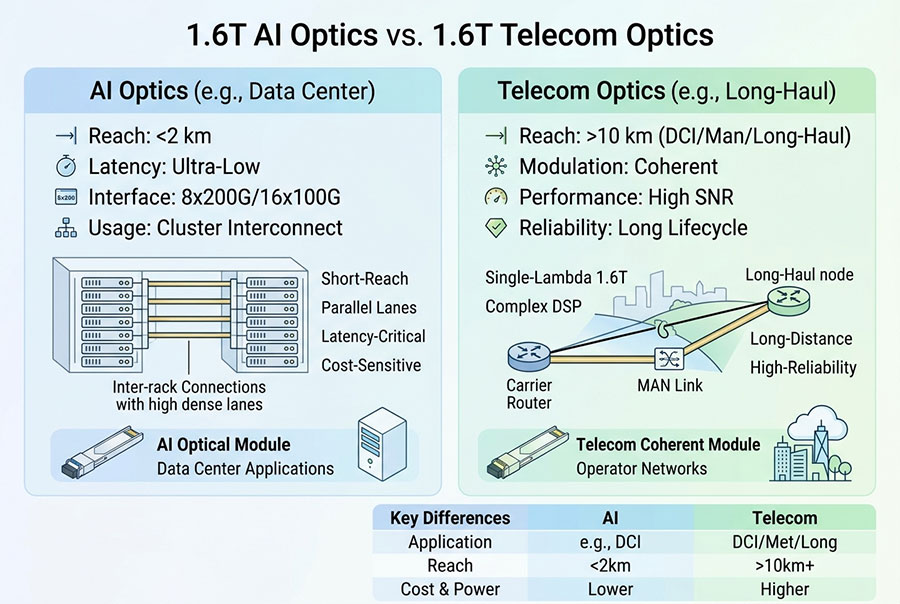
The ITU-T ION-2030 framework identifies several optical-network development directions for networks toward 2030 and beyond. These include 100GE-class fronthaul interfaces, 100GE access and 400GE aggregation interfaces for backhaul, 800GE to 1.6TE core interfaces, and 1.6 Tb/s-class coherent optical transceivers among the enabling technologies.
| Network Segment | Emerging Interface Direction | Optical Engineering Consideration |
|---|---|---|
| Fronthaul | 100GE-class interfaces and higher-rate options under consideration in future network planning | Balance bandwidth, latency, synchronization, optical reach, module cost, and power. |
| Access backhaul | 100GE or higher, depending on the planned architecture | Support increased site traffic while maintaining suitable fiber utilization and upgrade paths. |
| Aggregation backhaul | 400GE-class interface direction in the ION-2030 framework | Provide sufficient aggregate capacity and reliable transport between access and core layers. |
| Core transport | 800GE to 1.6TE interface direction in the ION-2030 framework | Meet high-capacity transmission requirements through compatible host interfaces, optical line systems, and reach planning. |
| High-capacity coherent links | 1.6 Tb/s-class coherent optical transceivers are identified as an enabling technology. | Assess modulation, spectral efficiency, optical reach, line-system compatibility, power, and thermal limits. |
These figures describe future network interface directions, not a requirement that every optical module support the listed rate. A 400GE interface can be implemented using different optical architectures, including multiple optical lanes or a line-side optical system. Likewise, a 1.6 Tb/s coherent transceiver is relevant to suitable high-capacity transport links, not automatically to every 6G fronthaul connection.
As 6G specifications evolve, module selection will depend on finalized interface definitions, form-factor standards, host electrical requirements, optical reach, and interoperability agreements. Product labels alone will not be sufficient to establish compatibility.
4. WDM vs Gray Optics in 5G and 6G-Oriented Networks
Gray optics and wavelength-division multiplexing serve different fiber-planning needs. Gray optics generally use a dedicated optical channel for a point-to-point connection, while WDM combines multiple optical wavelengths over a shared fiber. Both approaches can be relevant to existing 5G networks and future 6G transport infrastructure.
| Feature | Gray Optics | WDM Optics |
|---|---|---|
| Optical channel | Typically uses a dedicated wavelength for each connection. | Uses defined wavelengths that can be combined over the same fiber. |
| Fiber utilization | Separate fibers may be required for multiple links unless another multiplexing method is used. | Can increase the number of independent channels carried over limited fiber resources. |
| Channel planning | Primarily focuses on link compatibility, rate, distance, and optical budget. | Also requires wavelength allocation, filter compatibility, channel spacing, and isolation checks. |
| Typical mobile use | Suitable for point-to-point links where fiber resources are sufficient. | Useful for fronthaul or aggregation routes where multiple connections share available fiber. |
| Future network role | Remains suitable for straightforward links that meet capacity and reach requirements. | Can support higher fiber utilization and multi-wavelength expansion where economically justified. |
WDM is not automatically more economical for every link. Passive multiplexers add insertion loss, while active WDM systems add powered equipment and operational complexity. The decision should consider the number of channels, fiber availability, optical budget, remote-site power, monitoring, and future capacity demand.
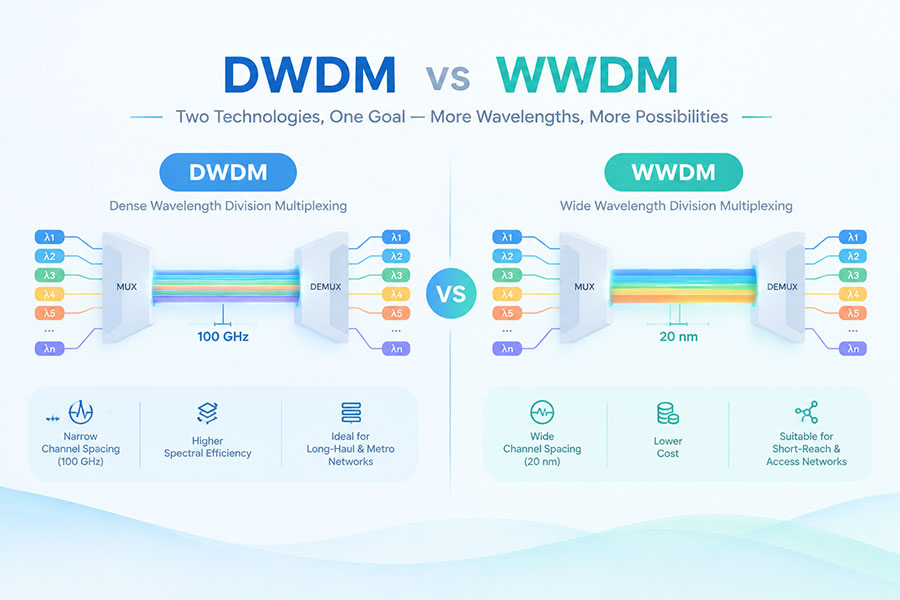
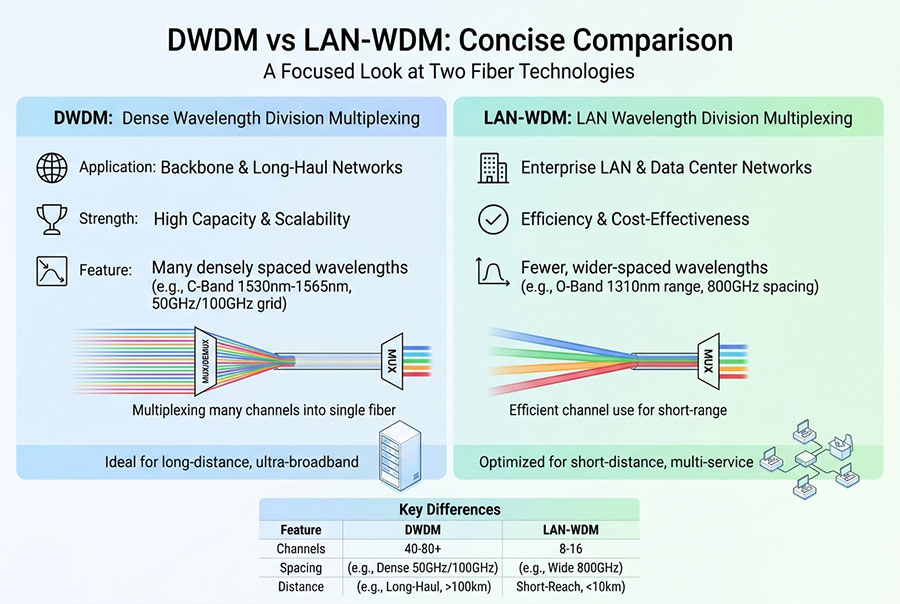
CWDM and DWDM also have different channel-spacing characteristics. CWDM generally suits simpler or lower-channel-count arrangements, while DWDM can support denser wavelength plans when the transceivers, filters, and optical line system are compatible. A future 6G network may use a mixture of gray optics, CWDM, DWDM, and coherent transport at different points.
5. Transmission Reach, Latency and Optical Budget
A higher data rate does not automatically mean that an optical module can transmit farther. Optical reach depends on the transmitter, receiver, fiber type, wavelength, dispersion tolerance, optical power budget, and whether the system uses direct detection or coherent technology.
| Parameter | 5G Module Selection | 6G-Oriented Module Planning |
|---|---|---|
| Transmission distance | Matched to the actual fronthaul, backhaul, or transport link. | Must be assessed by network segment; higher capacity does not guarantee longer reach. |
| Optical power budget | Based on transmitter power, receiver sensitivity, and total path loss. | Requires the same end-to-end validation, including any new WDM filters or optical routing components. |
| Dispersion and signal quality | Must remain within the selected module's supported transmission limits. | Higher-capacity and coherent designs require suitable signal-quality and line-system engineering. |
| Latency | Depends on fiber distance, electronics, processing, switching, and network architecture. | Must meet the service and interface budgets established for the actual deployment. |
| Synchronization | Supports the timing accuracy required by the deployed radio architecture. | Must preserve required timing quality as radio, transport, and computing functions evolve. |
| Reliability | Uses appropriate monitoring, fault handling, and protection where required. | May demand more coordinated monitoring and recovery across optical and packet layers. |
In a WDM system, the total link budget must include the loss of multiplexers, demultiplexers, connectors, splices, and other optical components. A module that works over a direct fiber connection may not meet the required margin after additional filters are inserted.
Low transport latency also cannot be inferred from the module's data rate alone. Fiber propagation, equipment processing, queueing, and switching all contribute to end-to-end delay. Module specifications must therefore be evaluated alongside the full transport design.
6. Form Factor, Power Consumption and Optical Integration
Optical-module form factors are determined by the host equipment, required electrical interface, optical performance, and thermal envelope. SFP-family and QSFP-family modules are already used in mobile and data transport systems, while high-capacity coherent pluggables serve appropriate metro and backbone applications.
Future 6G-oriented systems may use higher-rate pluggable modules and more integrated optical approaches where they offer a practical advantage. Co-packaged optics (CPO), linear-drive pluggable optics (LPO), and related architectures appear in broader optical-network roadmaps, but none should be assumed to be mandatory for every 6G optical connection.
| Technology or Form Factor | Engineering Role | Design Consideration |
|---|---|---|
| SFP / SFP28 / SFP56 | Compact pluggable interfaces used for compatible access and mobile transport applications. | Verify host support, lane rate, wavelength, reach, and power limits. |
| QSFP28 and higher-capacity QSFP-family modules | Support higher-capacity electrical and optical interfaces where the host equipment is designed for them. | Check the exact generation, electrical interface, thermal envelope, and optical specification. |
| Coherent pluggables | Provide high-capacity optical transmission for appropriate metro, regional, and backbone links. | Consider line-system compatibility, modulation, optical reach, spectral efficiency, and system power. |
| Linear-drive pluggable optics | Can reduce some electrical processing requirements in supported architectures. | Host signal integrity, reach, interoperability, and link performance must be validated. |
| Co-packaged optics | Integrates optical engines closer to switching or processing silicon in systems designed for that architecture. | Evaluate serviceability, packaging, thermal design, system integration, and the specific use case. |
Energy efficiency must be evaluated at both module and system levels. A lower-power module can be beneficial, but the overall result also depends on the number of transceivers, optical reach, external line equipment, cooling, and the amount of traffic actually carried.
For mobile access and fronthaul, a compact module with the required reach and wavelength may be more economical than a more complex coherent design. For a heavily aggregated transport route, a higher-capacity coherent solution may reduce the number of wavelengths or equipment ports needed. The correct choice is application-specific.
7. Compatibility and Interoperability Requirements
Compatibility is one of the most important differences between selecting an existing 5G module and planning optics for future network interfaces. Even if two modules have the same nominal data rate and form factor, they may use different wavelengths, fiber types, optical budgets, modulation formats, electrical interfaces, or management capabilities.
| Compatibility Item | What to Verify |
|---|---|
| Host interface | Supported electrical lane rate, encoding, connector cage, and equipment compatibility. |
| Wavelength | Transmit wavelength, channel assignment, tuning range, and compatibility with installed filters. |
| Fiber type | Single-mode or multimode requirements, connector type, and supported link length. |
| Optical budget | Transmit power, receiver sensitivity, insertion loss, and required engineering margin. |
| Signal format | Supported modulation, lane arrangement, and any required host or line-side processing. |
| Power and thermal limits | Module power consumption, host cooling capability, and operating temperature range. |
| Management | Diagnostic monitoring, configuration support, and compliance with the host's management interface. |
| Standards status | Confirm whether the required interface is finalized and interoperable or remains a developing 6G-oriented design. |
For future deployments, operators should avoid assuming that a product marketed as a “6G optical module” will work with all 6G equipment. Compatibility must be established against the actual system specifications and the relevant optical and electrical standards.
8. Practical Deployment Strategy: 5G Optical Modules to Future 6G Optics
Network upgrades can often be implemented in stages. Existing fiber infrastructure and optical modules may remain useful where they meet the link requirements, while high-traffic or fiber-constrained segments receive higher-rate interfaces or updated WDM systems.
| Planning Stage | Recommended Action | Expected Value |
|---|---|---|
| Existing 5G deployment | Document module rates, wavelengths, reaches, optical budgets, and host compatibility. | Establishes a reliable baseline for capacity and upgrade planning. |
| Capacity growth | Identify bottlenecks and assess faster modules, WDM expansion, or additional fiber strands. | Improves capacity without automatically rebuilding every route. |
| Fronthaul evolution | Review radio functional splits, interface bandwidth, timing, and reach before selecting optics. | Prevents a mismatch between radio requirements and optical transport capabilities. |
| Metro and backbone upgrade | Assess higher-rate transceivers, coherent optics, optical line systems, and route diversity. | Provides capacity and reach options for aggregated traffic. |
| 6G readiness | Track finalized interfaces and standards, then validate product compatibility before deployment. | Reduces procurement risk and avoids relying on unfinalized product assumptions. |
Existing 5G modules should not be replaced simply because a network is preparing for 6G. If a module still satisfies the interface, capacity, optical-budget, and operational requirements, retaining it may be the most efficient option. Upgrades should focus on demonstrable bottlenecks and confirmed compatibility requirements.
C-LIGHT offers 5G fronthaul WDM solutions and DWDM optical transceivers in 100G, 40G, and 25G classes for applicable transport architectures. Each deployment should be checked against the target equipment, wavelength plan, link budget, and network design.
9. Conclusion
5G optical modules already cover multiple data rates, wavelengths, form factors, and transmission distances. Their role is to satisfy the specific requirements of radio fronthaul, midhaul, backhaul, and other transport links. Future 6G-oriented optical modules are expected to support higher-capacity interfaces in selected network segments, improved optical resource management, and stronger attention to energy efficiency and network automation.
The transition is not defined by one universal 6G module or a single required data rate. The ITU-T ION-2030 framework identifies 100GE-class fronthaul, higher-capacity backhaul interfaces, and 1.6 Tb/s-class coherent optics among the future network directions, but these figures apply to different levels and segments of the optical system. They should not be treated as a specification for every module used in a 6G network.
For network operators and equipment planners, the priority is to match optical modules to the actual interface, reach, fiber plant, optical budget, power envelope, and interoperability requirements. Established 5G optical technologies can remain valuable in future deployments wherever they meet those requirements.
Planning optical connectivity for mobile transport networks?
Discuss fronthaul WDM, DWDM transceivers, link budgets, and interface compatibility with C-LIGHT.
Contact C-LIGHT >

 >
 >
 >
 >
 >
 >
 >