TEL:+86 132 6656 7067




5G fronthaul and midhaul are transport segments used to connect different processing functions within a mobile radio access network (RAN). Although both support communication between distributed network components, they carry traffic across different functional boundaries. Fronthaul typically connects the radio unit (RU) to the distributed unit (DU), while midhaul typically connects the DU to the centralized unit (CU) in a disaggregated RAN architecture.
These distinctions affect how operators design transport capacity, latency budgets, synchronization, Ethernet interfaces, and optical connectivity. Fronthaul can require substantial bandwidth and particularly tight timing and latency performance because it carries information across a radio-processing split. Midhaul generally carries packet traffic between higher-layer RAN functions and has different transport characteristics.
Understanding the difference is important when planning centralized RAN (C-RAN), cloud RAN, and Open RAN deployments. The appropriate solution depends on the functional split, radio configuration, equipment requirements, transport topology, and service objectives.
1. What Is 5G Fronthaul?
5G fronthaul is the transport connection between a radio unit and distributed baseband processing functions. In an Open RAN architecture, this connection commonly links the O-RU and O-DU across a lower-layer functional split. Instead of keeping all radio processing in one physical location, the network separates selected radio-frequency and physical-layer functions across different devices.
The RU handles radio-facing functions, including radio-frequency transmission and reception. Depending on the architecture, some lower physical-layer processing is performed within the RU, while other functions remain in the DU. Fronthaul carries the information required between these processing locations.
How Fronthaul Works
Fronthaul behavior depends on the functional split and interface protocol. Traditional CPRI transports digitized radio samples using a constant-rate interface. Ethernet-based eCPRI supports packet-oriented transport for suitable radio architectures and can allow statistical multiplexing when the complete implementation supports it.
In an Open RAN lower-layer split, the boundary between the high physical layer in the DU and the low physical layer in the RU determines what information must cross the fronthaul. The split influences transport bandwidth, latency, synchronization, and processing requirements.
Because the connected components cooperate to perform radio processing, fronthaul design must consider the complete link. Optical propagation, switching, queuing, packet delay variation, synchronization accuracy, and loss behavior can all affect whether the transport path meets the radio system's requirements.
Common Fronthaul Applications
Connecting remote radio units to distributed baseband processing.
Supporting centralized or cloud-based RAN deployments.
Connecting O-RUs and O-DUs in compatible Open RAN architectures.
Aggregating radio traffic over suitable Ethernet and optical transport infrastructure.
2. What Is 5G Midhaul?
5G midhaul is the transport segment between the distributed unit and the centralized unit in a disaggregated RAN. It is commonly associated with the higher-layer functional split, where the DU handles lower-layer protocol processing and the CU handles higher-layer functions.
In a typical 5G NR architecture, the DU performs functions such as the Radio Link Control (RLC), Medium Access Control (MAC), and high physical layer processing. The CU handles higher-layer functions, including the Radio Resource Control (RRC) and Packet Data Convergence Protocol (PDCP). The precise allocation depends on the selected architecture and implementation.
The Role of the F1 Interface
The DU and CU communicate through the F1 interface defined for the 5G RAN architecture. In a common deployment, F1 carries control-plane and user-plane information between the relevant CU and DU functions. The midhaul transport network provides the connectivity required for this communication.
Because midhaul generally carries packet traffic rather than the same type of lower-layer radio samples associated with certain fronthaul implementations, its bandwidth profile can be closer to that of conventional mobile transport. However, it still needs to meet the delay, capacity, reliability, and synchronization requirements of the RAN design.
Midhaul can also help operators place CU functions at aggregation sites or centralized locations instead of deploying all processing at each cell site. This supports flexible resource allocation, centralized management, and the deployment of virtualized RAN functions.
Common Midhaul Applications
Connecting DUs to centralized or virtualized CU functions.
Supporting distributed RAN processing across multiple physical locations.
Transporting F1-related control-plane and user-plane traffic.
Connecting radio access infrastructure to centralized RAN compute or edge locations.
3. 5G Fronthaul vs Midhaul: Key Technical Differences
| Comparison Item | 5G Fronthaul | 5G Midhaul |
|---|---|---|
| Primary role | Connects radio units with distributed radio processing | Connects distributed units with centralized units |
| Typical endpoints | RU to DU | DU to CU |
| Functional split | Typically a lower-layer split involving radio and physical-layer processing | Typically a higher-layer split between distributed and centralized RAN functions |
| Common interface | CPRI in legacy implementations; eCPRI and Ethernet-based Open Fronthaul in appropriate architectures | F1 interface in a common 5G DU-CU architecture |
| Traffic characteristics | Radio-related data across the selected functional split; some designs carry substantial continuous traffic | Packet-based control-plane and user-plane traffic between DU and CU functions |
| Bandwidth planning | Strongly influenced by functional split, antenna streams, radio configuration, and transport protocol | Influenced by aggregated radio traffic, protocol overhead, capacity growth, and redundancy |
| Latency requirements | Often tighter due to the direct relationship with radio processing | Must satisfy the DU-CU interface and service requirements, including applicable round-trip-time limits |
| Synchronization | Critical where required by the radio interface and processing architecture | May also require precise network timing depending on the overall RAN design |
| Transport technology | Dedicated fiber, optical transport, Ethernet-based fronthaul, or supported WDM solutions | IP/Ethernet transport, routed or switched packet networks, and optical infrastructure |
| Primary design focus | Radio-interface performance, latency, jitter, synchronization, and predictable transport behavior | Packet transport, throughput, round-trip time, service quality, and flexible CU placement |
The distinction is architectural, not simply geographical. A fronthaul link does not become midhaul because it spans a longer distance, and midhaul is not defined by being physically closer to the core. The terms describe which RAN functions are connected across a particular interface.
Fronthaul often has more demanding transport requirements, particularly in low-layer split implementations. Nevertheless, exact bandwidth and latency figures cannot be assigned universally to either segment. The applicable interface specifications, functional split, radio configuration, and vendor requirements determine the actual targets.
4. Bandwidth and Latency Requirements
Why Fronthaul Can Require More Bandwidth
Fronthaul bandwidth depends heavily on the amount and type of radio-related information transported between the RU and DU. In lower-layer split architectures, the transport network may carry digitized or packetized information associated with multiple antenna streams and radio channels. This can require substantially more capacity than the user traffic alone would suggest.
Traditional CPRI uses a configured constant-rate transport structure. Its required line rate is influenced by radio configuration and interface parameters rather than simply tracking the current amount of user data. Ethernet-based eCPRI can support more flexible packet transport and resource sharing in suitable implementations, but it does not eliminate the need to engineer capacity for the specified radio workload.
Fronthaul planning should therefore begin with the interface and functional split selected for the RAN. The number of radios, frequency bands, antenna streams, and radio settings must be included in the capacity calculation. Using only expected subscriber throughput can underestimate fronthaul demand in some architectures.
Latency and Jitter on Fronthaul Links
Fronthaul connects radio-processing functions that operate in coordination. Excessive delay, packet delay variation, packet loss, or synchronization errors can reduce system performance or cause the transport link to fall outside its supported operating conditions.
The transport delay budget depends on the functional split and radio implementation. It may need to account for fiber propagation, optical equipment, Ethernet switching, queueing, traffic contention, and any intermediate transport nodes. A short nominal propagation time does not guarantee that the complete network meets the required latency and jitter targets.
Midhaul Bandwidth and Round-Trip Time
Midhaul typically transports packet traffic between DU and CU functions. Its bandwidth requirements are often closer to aggregated RAN traffic than to those of a lower-layer fronthaul link, although the actual requirement depends on the deployed architecture and traffic load.
Midhaul still has performance constraints. The F1 interface and associated RAN functions must operate within the timing and transport limits of the implementation. Round-trip time, packet loss, congestion, redundancy mechanisms, and the location of centralized processing can all affect service behavior.
Centralizing the CU may improve resource utilization and simplify management, but it can also increase transport distance. Operators must balance centralization benefits against the midhaul latency and capacity budget.
5. CPRI, eCPRI, and the F1 Interface
The protocols and interfaces used on fronthaul and midhaul reflect the type of information exchanged across each functional boundary.
| Interface or Protocol | Typical Role | Key Characteristics |
|---|---|---|
| CPRI | Traditional radio-to-baseband fronthaul | Transports digitized radio samples using a configured constant-rate interface |
| eCPRI | Packet-based fronthaul in compatible architectures | Supports Ethernet-oriented transport and can enable statistical multiplexing where supported by the system design |
| O-RAN Open Fronthaul | Standardized open interface between O-RU and O-DU | Defines interoperable fronthaul functions and transport requirements for compatible multi-vendor deployments |
| F1 | DU-CU communication across midhaul | Carries the relevant control-plane and user-plane traffic between distributed and centralized RAN functions |
CPRI, eCPRI, Open Fronthaul, and F1 should not be treated as interchangeable labels. CPRI and eCPRI describe different approaches to fronthaul transport. Open Fronthaul defines an interface framework between the O-RU and O-DU in Open RAN, including relevant protocol and transport requirements. F1 supports communication between the DU and CU across the higher-layer split.
These distinctions matter when selecting equipment. Radio units, distributed units, centralized units, transport switches, and optical interfaces must support the appropriate protocols and implementation profiles. A network cannot assume that any Ethernet switch or optical transceiver will satisfy all fronthaul or midhaul requirements merely because the nominal link rate is sufficient.
6. Fiber Optic Connectivity for Fronthaul and Midhaul
Fiber for Fronthaul
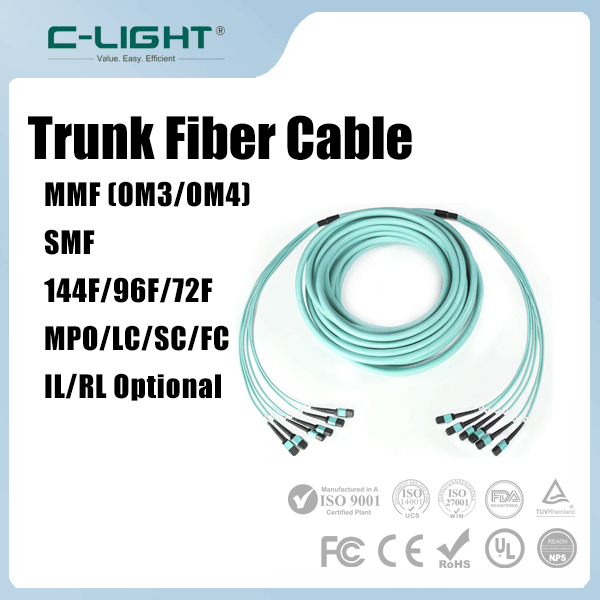
Fiber optic cable is widely used for fronthaul because it supports high-capacity transmission and its optical transmission medium is immune to electromagnetic interference. Depending on the topology and optical interfaces, the connection may use dedicated fiber, point-to-point optical links, or wavelength-division multiplexing (WDM).
Dedicated fiber can provide a straightforward physical path between radio equipment and processing locations, but fiber availability and strand consumption can become significant in dense urban deployments. WDM can carry multiple optical channels over a suitable fiber strand and improve fiber utilization when the optical system supports the required wavelengths, channel plan, and service performance.
For packet-based fronthaul, the physical fiber is only one part of the design. The complete transport solution must also meet bandwidth, latency, jitter, synchronization, packet delivery, and redundancy requirements. Equipment interoperability should be verified against the exact radio and transport configuration.
Fiber for Midhaul
Midhaul commonly uses Ethernet/IP transport over optical infrastructure to connect distributed units with centralized units. Compared with some low-layer fronthaul implementations, packet transport can allow more flexible aggregation and routing, provided that the design preserves the required performance for the DU-CU interface.
Operators may deploy midhaul over dedicated fiber, optical transport networks, or shared packet infrastructure with suitable quality-of-service and capacity controls. The choice depends on deployment distance, traffic volume, network topology, latency targets, and resilience requirements.
Because the CU may serve multiple DUs, midhaul aggregation points can become important capacity-planning locations. Operators should account for the total traffic from connected DUs, peak utilization, growth forecasts, and protection capacity rather than sizing each physical port in isolation.
Optical Module and Link Planning
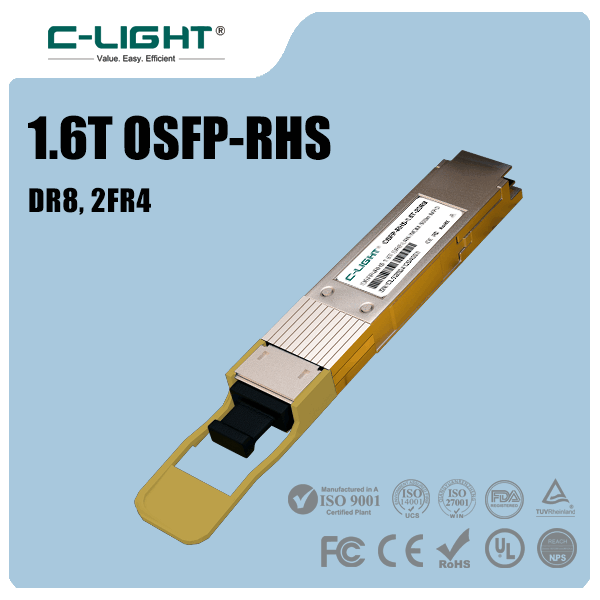
When optical transceivers are used, selection should account for the actual interface standard, data rate, fiber type, connector configuration, wavelength, reach, and optical loss budget. Fronthaul equipment may also impose specific latency and interoperability constraints beyond basic optical connectivity.
For both segments, installation quality matters. Connector cleanliness, fiber polarity, bend radius, insertion loss, and link monitoring help maintain reliability. Before deployment, validate the optical budget and the complete interface specification rather than relying only on a transceiver's advertised reach.
7. Network Synchronization and Reliability
Synchronization is a key consideration in 5G transport because radio nodes may need precise timing relationships for transmission, reception, and coordinated radio operation. The synchronization design must cover the network components and transport paths that participate in the relevant timing chain.
Precision Time Protocol (PTP), specified by IEEE 1588, and Synchronous Ethernet (SyncE) may be used where supported by the network architecture and equipment. They address different aspects of timing distribution and can be combined in suitable designs. The required accuracy and transport behavior depend on the radio deployment and timing profile.
Fronthaul Reliability Requirements
Fronthaul reliability planning should consider transport availability, latency variation, packet loss, synchronization performance, and the effect of link failure on the connected radio functions. Protection or alternate paths may be appropriate, but switching behavior must also be compatible with the timing and service requirements.
Midhaul Reliability Requirements
Midhaul networks must maintain stable communication between DU and CU functions, including the associated control-plane and user-plane traffic. Capacity bottlenecks, congestion, packet loss, and failure recovery can affect radio services even when the optical signal itself remains healthy.
Operators should evaluate path diversity, equipment redundancy, routing convergence, quality of service, monitoring, and operational recovery procedures. A shared transport network may serve both fronthaul and midhaul, but the service design must prevent one traffic class from compromising the performance of another.
8. How to Choose the Right Transport Solution
When Planning Fronthaul
Define the functional split: Confirm the RU-DU interface and the processing functions assigned to each endpoint.
Calculate capacity: Use the specified radio configuration, antenna streams, protocol, and traffic assumptions.
Set performance limits: Validate transport latency, jitter, packet loss, synchronization, and availability against the interface requirements.
Select the optical design: Evaluate dedicated fiber, WDM, optical modules, fiber availability, and link loss.
Confirm interoperability: Check that radio equipment and transport devices support the required interface and implementation profile.
When Planning Midhaul
Define the DU-CU architecture: Confirm the F1 interface implementation and the planned CU location.
Estimate aggregated traffic: Include peak traffic from connected DUs, protocol overhead, future growth, and protection capacity.
Check round-trip time: Account for the transport path, switching and routing, and any service-specific timing requirements.
Design aggregation: Ensure uplinks and intermediate nodes can handle simultaneous traffic from the connected radio sites.
Plan for resiliency: Consider alternate paths, redundancy, congestion control, monitoring, and recovery behavior.
The most suitable transport solution follows from the RAN architecture rather than a simple preference for one cable or protocol. Fronthaul focuses on the transport requirements created by a radio-processing split; midhaul focuses on moving packet traffic between distributed and centralized RAN functions within the DU-CU performance budget.
9. Conclusion
5G fronthaul and midhaul connect different functional parts of a disaggregated radio access network. Fronthaul typically links RU and DU functions across a lower-layer split, while midhaul typically links DU and CU functions across a higher-layer split through the F1 interface.
Fronthaul often requires high bandwidth and tight latency, jitter, and synchronization performance because it supports radio processing. Midhaul generally transports packet-based control-plane and user-plane traffic, with capacity and timing requirements influenced by traffic aggregation, CU placement, and the RAN implementation.
Fiber optic infrastructure can support both segments, but choosing the right solution requires more than checking optical reach or port speed. Operators should validate the functional split, interface compatibility, bandwidth, latency budget, synchronization, optical loss, and resilience of the complete transport path. This approach helps create a 5G RAN that is flexible, scalable, and reliable.
 >
>

 >
>
 >
>
 >
>
 >
>
 >
>
 >
>
 >
>