TEL:+86 132 6656 7067





A 5G edge network brings connectivity, selected network functions, and computing resources closer to users, devices, and application environments. A cloud data center provides a centralized or regional pool of computing, storage, and networking resources that can serve applications across a much broader geographic area.
These are complementary infrastructure layers rather than competing technologies. Edge deployments can run applications inside small data centers, enterprise facilities, or operator network sites, while cloud data centers provide large-scale processing and storage. The main design decision is where each workload should run and how the network should connect it to users, data sources, and other computing resources.
1. 5G Edge Network vs Cloud Data Center: Key Differences
The difference between a 5G edge network and a cloud data center is primarily related to architecture, workload location, and service delivery. The edge network connects devices and applications to nearby processing resources, while a cloud data center pools resources for scalable, centralized or regional services.
| Technical Dimension | 5G Edge Network | Cloud Data Center |
|---|---|---|
| Primary role | Connects users and devices to nearby network and computing resources. | Provides shared computing, storage, networking, and application services at scale. |
| Processing location | At or near the access network, enterprise site, radio aggregation point, or local edge facility. | Usually in centralized or regional data center facilities, although cloud services can also be distributed. |
| Latency strategy | Reduces avoidable transport distance by placing suitable workloads closer to users or data sources. | Provides large-scale resources, with response time depending on the distance and network path to the application. |
| Computing capacity | Often limited by the size, power, and cooling capacity of each edge site. | Can pool larger server, storage, and accelerator resources across a facility or cloud region. |
| Data processing | Useful for local analytics, traffic processing, industrial applications, and selected real-time workloads. | Suitable for large-scale data processing, persistent storage, centralized applications, and long-running workloads. |
| Transport network | Depends on radio access, fiber fronthaul or backhaul, aggregation, and local connectivity. | Depends on high-capacity data center fabrics and external connections to users, enterprises, and other facilities. |
| Scalability | Can scale across multiple edge locations, but each site has physical resource constraints. | Can pool and expand resources within a large facility or cloud region, subject to available capacity. |
| Operational model | May require managing many geographically distributed sites. | Centralized operations can simplify resource pooling, although large data centers still require complex management. |
| Typical cost consideration | Balances local response time and reduced backhaul traffic against distributed-site operating costs. | Benefits from resource pooling and scale but may require more network transport for distant workloads. |
These distinctions are not absolute. A regional cloud data center can be close enough to users to support latency-sensitive applications, while an edge site may host substantial computing resources. The location and network architecture matter more than the labels alone.
2. How a 5G Edge Network Works
A 5G edge network combines mobile connectivity with strategically placed computing and network resources. Depending on the deployment, radio sites connect through fronthaul, midhaul, or backhaul transport to processing systems, aggregation nodes, and edge applications.
Multi-access Edge Computing (MEC), defined through ETSI's work, provides an environment for running applications and cloud-computing capabilities at the network edge. It can also expose supported network information to authorized applications. The specific edge placement may be on-premises, near the radio access network, or within a broader operator network.
| Network Component | Function | Engineering Requirement |
|---|---|---|
| 5G radio access network | Provides wireless connectivity between user equipment and the mobile network. | Requires supported radio interfaces and transport connections with appropriate capacity and timing. |
| Fronthaul and backhaul | Carry traffic between radio equipment, processing resources, aggregation sites, and the core. | Must meet the selected architecture's bandwidth, reach, latency, and synchronization requirements. |
| Local edge platform | Runs selected applications, analytics, and services near users or devices. | Needs suitable compute, storage, power, cooling, and local network connectivity. |
| Local user-plane function | Can provide local traffic breakout when supported by the 5G core design and routing policies. | Requires compatible core configuration and appropriate routes to the local application. |
| Regional aggregation | Connects multiple access sites and edge locations to broader network resources. | Requires sufficient aggregate bandwidth and a transport design that supports service growth. |
A 5G edge network does not mean that all application data remains local. Traffic can be processed at the edge when the workload and network policies permit it, while other requests continue to regional or centralized cloud services.
This hybrid arrangement allows operators to place latency-sensitive services near the user without replicating every database, application, or computing workload at every edge site.
3. How a Cloud Data Center Works
A cloud data center houses servers, storage systems, network equipment, power infrastructure, cooling systems, and management software. Cloud services abstract these resources into computing environments that can be provisioned and scaled across a shared resource pool.
Compared with a small edge facility, a large cloud data center can usually provide more concentrated computing capacity, storage density, specialized accelerators, and operational resources. Cloud architecture can also distribute services across multiple regions to improve availability and geographic coverage.
| Cloud Data Center Layer | Primary Function | Network Consideration |
|---|---|---|
| Compute infrastructure | Runs virtual machines, containers, databases, applications, and processing workloads. | Needs scalable server connectivity, bandwidth, and appropriate isolation between workloads. |
| Storage infrastructure | Provides persistent data storage, backups, and application data services. | Requires sufficient storage-network bandwidth, availability, and data-protection mechanisms. |
| Data center fabric | Connects servers, storage, and switches within the facility. | Must handle east-west traffic, maintain suitable capacity, and control congestion. |
| External connectivity | Connects the facility to the internet, mobile networks, enterprises, and other data centers. | Requires suitable routing, optical transport, capacity planning, and resilience. |
| Cloud orchestration | Allocates and manages compute, storage, and networking resources. | Coordinates access, resource availability, workload placement, and service monitoring. |
Cloud computing is not defined only by the physical building. It is a service model that enables shared, on-demand access to configurable computing resources. A cloud data center may serve mobile-network functions, enterprise applications, AI workloads, and edge platforms simultaneously.
For large workloads, centralized facilities can improve resource utilization by sharing infrastructure across multiple customers or services. However, applications that continually exchange data with distant users may incur additional transport delay and network traffic compared with suitable local processing.
4. Latency, Bandwidth and Data Locality
Latency is one of the most common reasons for deploying edge computing, but the location of compute resources is only one factor. End-to-end response time also depends on radio scheduling, route distance, network congestion, switching, application processing, and the return path.
| Performance Factor | 5G Edge Network | Cloud Data Center |
|---|---|---|
| Round-trip delay | Can reduce transport delay when applications are hosted near users and the route remains local. | Depends on the distance and routing path between the user and the cloud region. |
| Data locality | Processes selected data close to its source, reducing the need to transfer every raw data stream upstream. | Centralizes data and services where broad access, shared processing, and persistent storage are required. |
| Bandwidth utilization | Local filtering and analysis can reduce traffic sent to regional or central facilities. | Can handle large aggregate traffic volumes but may require more transport for distant data sources. |
| Processing capacity | Limited by local compute resources and site constraints. | Can provide larger shared pools of processors, accelerators, and storage. |
| Service availability | Depends on local power, compute, access connectivity, and site resilience. | Can use large-scale redundancy and multiple regions, depending on the service design. |
| Workload flexibility | Suitable for workloads that benefit from local execution but may have limited resources. | Suitable for resource-intensive processing and workloads that can tolerate transport to a central or regional location. |
As a physical planning estimate, fiber propagation contributes roughly 5 microseconds of one-way delay per kilometer. A 20 km route therefore contributes approximately 100 microseconds of one-way propagation delay before switching, processing, queuing, and other delays are included.
Edge computing can reduce the distance to the application, but it does not eliminate radio-access delay or guarantee a specific end-to-end latency. A lightly loaded regional cloud can outperform an overloaded edge server, so workload placement must consider computing capacity and network conditions together.
5. Optical Fiber and WDM Connectivity for Edge and Cloud Networks
Both edge networks and cloud data centers depend on optical connectivity, although the distances, topologies, and traffic patterns may differ. Edge infrastructure uses fiber to connect access and aggregation sites to nearby processing resources, while cloud facilities use optical links inside the data center and between geographically separated sites.
| Optical Technology | Role in a 5G Edge Network | Role in a Cloud Data Center |
|---|---|---|
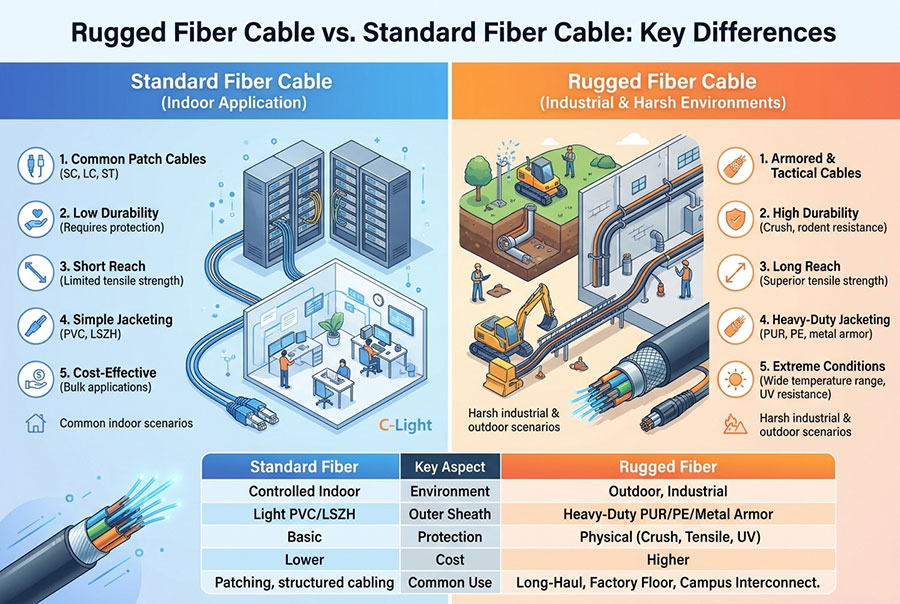
| Single-mode fiber | Connects radio sites, aggregation points, edge facilities, and regional transport. | Supports inter-building, campus, metro, and longer-distance data center connections. |
| Gray optical transceivers | Provide dedicated optical channels for suitable point-to-point connections. | Connect servers, switches, and transport equipment at supported rates and distances. |
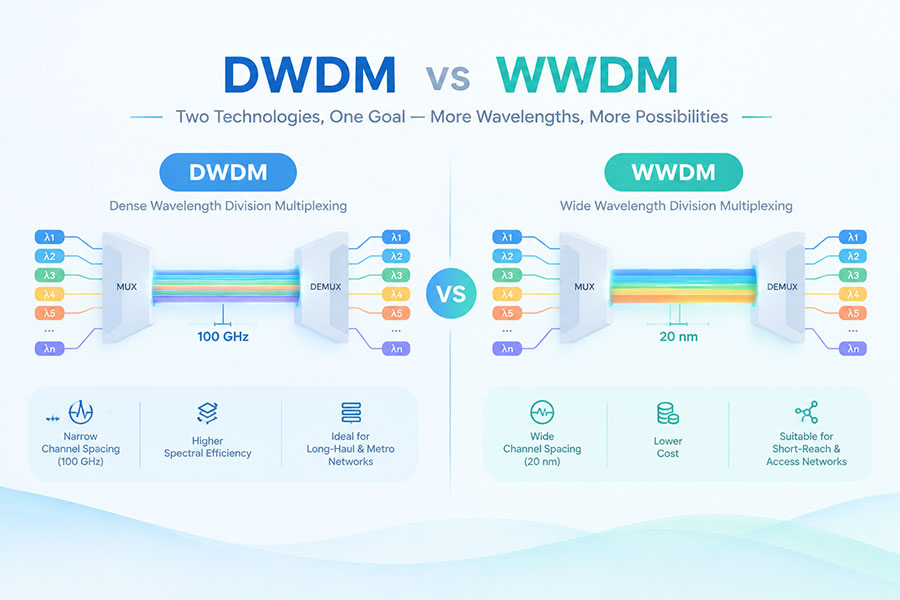
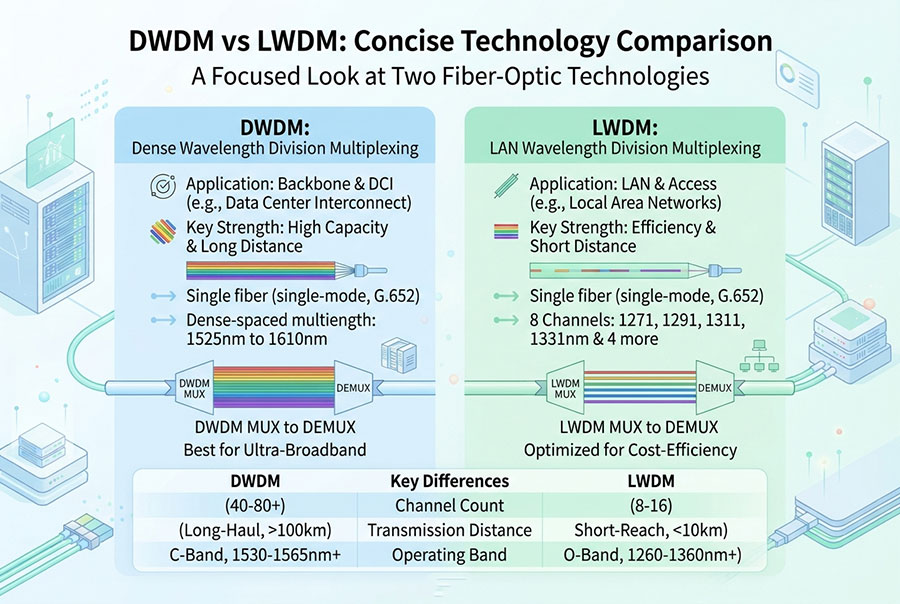
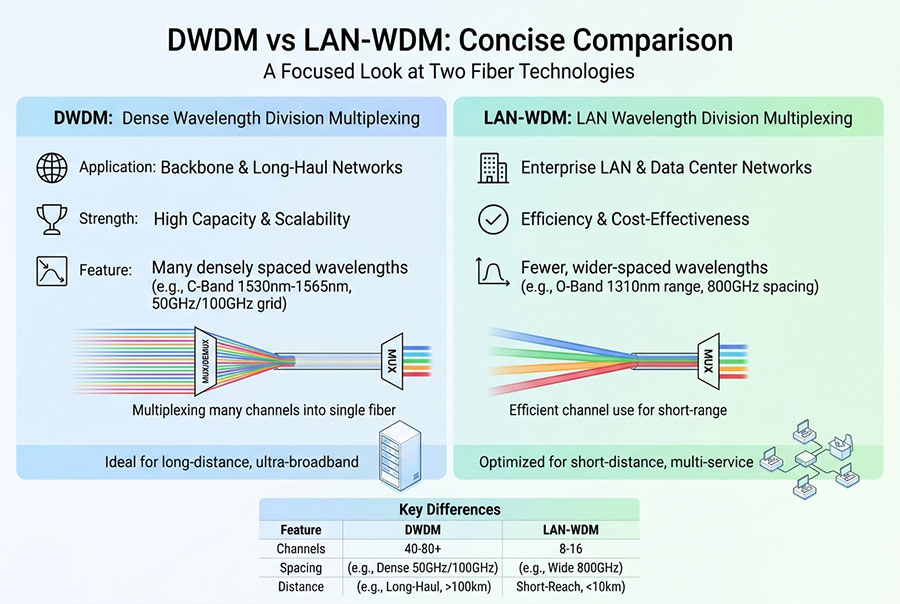
| CWDM | Allows multiple wavelengths to share fiber where channel count and optical budget permit. | Can be used for suitable multi-channel links, depending on the deployment. |
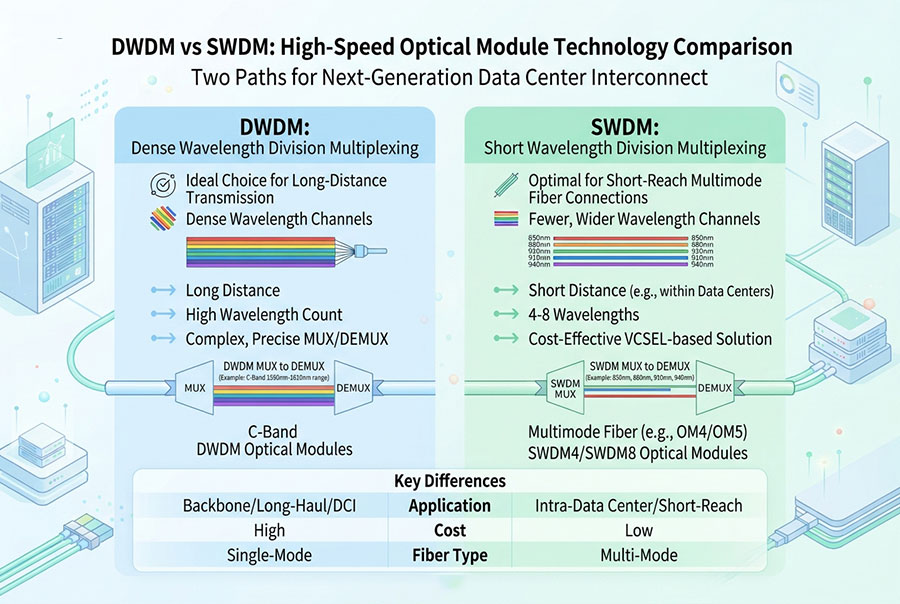
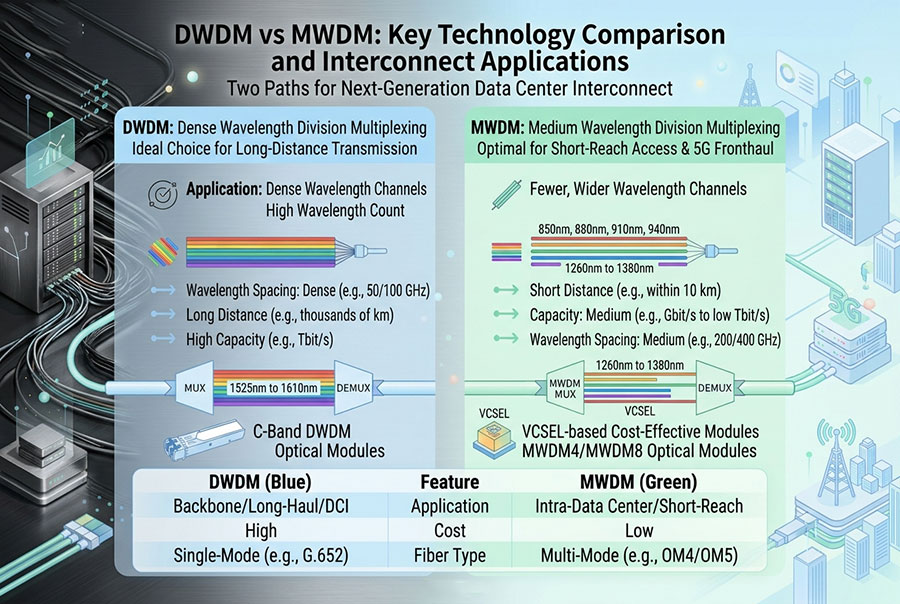
| DWDM | Provides denser wavelength multiplexing for fiber-constrained aggregation and transport routes. | Supports higher-capacity optical transport and data center interconnect where appropriate. |
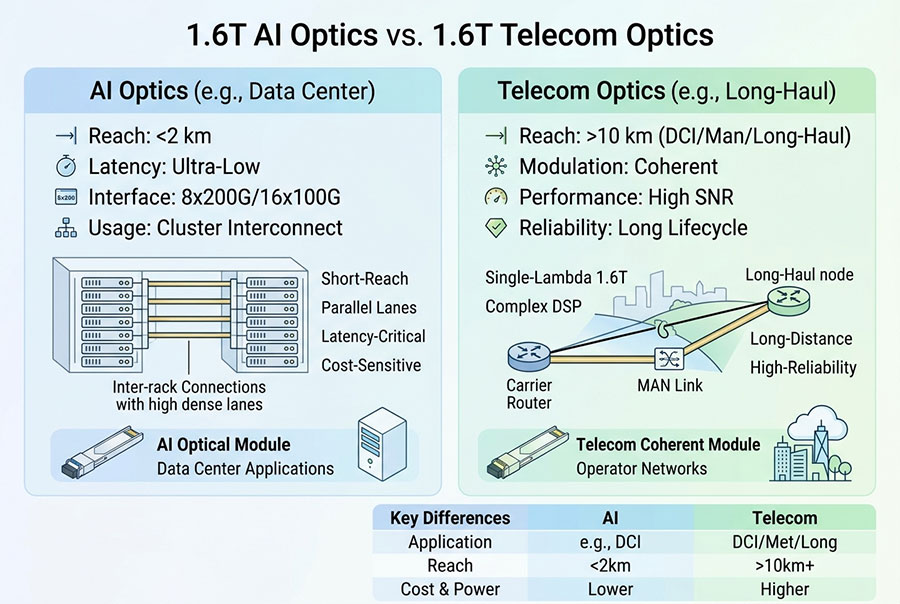
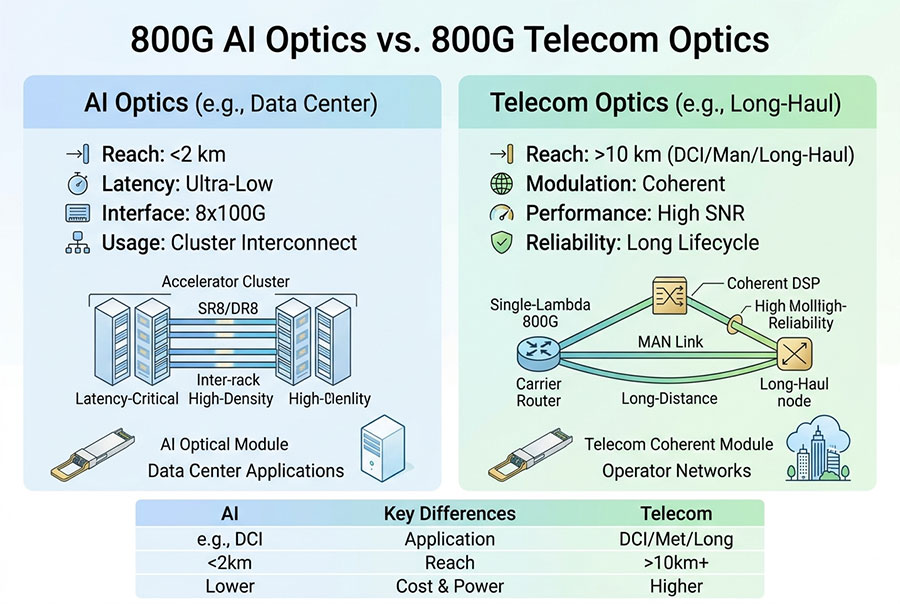
| High-speed pluggable optics | Support links between network switches, transport equipment, and edge computing platforms. | Provide high-bandwidth server-to-switch and switch-to-switch connectivity. |
| Active optical cables | Can simplify selected short-reach connections when supported by the equipment. | Provide integrated optical connectivity for suitable rack-to-rack or equipment connections. |
| Data center interconnect optics | Connect edge facilities to regional or centralized computing resources. | Interconnect separate data centers over campus, metro, regional, or longer-distance routes. |
WDM allows multiple optical channels to share fiber, but it introduces additional design considerations such as filter insertion loss, wavelength compatibility, channel isolation, and optical power margin. The preferred arrangement depends on fiber availability, route distance, required channel count, equipment compatibility, and cost.
For current mobile transport applications, C-LIGHT provides 5G fronthaul WDM solutions and 100G, 40G, and 25G DWDM optical transceivers. Module selection should be based on the intended interface, wavelength plan, optical budget, and compatibility with the host and transport equipment.
6. Application Requirements: Which Architecture Fits Which Workload?
Edge networks and cloud data centers are most effective when each workload is placed according to its processing, transport, and operational requirements. Many real deployments combine both architectures rather than choosing one exclusively.
| Application | Suitable Processing Location | Primary Engineering Reason |
|---|---|---|
| Industrial control | Local edge or on-premises infrastructure where supported by the control design | Can reduce dependence on long-distance network paths and support locally managed operations. |
| Video analytics | Edge for initial analysis; cloud for fleet-wide analytics and long-term storage | Reduces upstream raw-data transfer while preserving centralized insight. |
| Content delivery | Edge cache for popular local content; cloud for origin and content management | Balances local delivery efficiency with centralized content control. |
| Mobile core services | Regional or central data centers, with selected functions deployed closer to users as architecture permits | Supports shared infrastructure while allowing local traffic handling where needed. |
| Large-scale AI training | Typically a suitably provisioned AI or cloud data center | Benefits from large compute pools, accelerators, storage, and high-capacity internal fabrics. |
| Local AI inference | Edge when the model and workload fit the available resources and service requirements | Can reduce transport dependency and support local response requirements. |
| Centralized enterprise applications | Cloud or regional data center | Benefits from shared resource pools, centralized administration, and broad service access. |
| Data aggregation and historical analytics | Cloud or central data center, with optional edge filtering | Large-scale storage and batch processing can be more economical in shared facilities. |
Application requirements can change over time. A workload may initially run in the cloud and later move closer to users as traffic increases or response-time requirements become more demanding. Conversely, some edge workloads can be consolidated into regional facilities when local processing no longer provides enough benefit to justify the operational cost.
7. Deployment Costs, Scaling and Operational Complexity
Neither edge infrastructure nor cloud data centers are universally cheaper. Edge deployments can reduce transport volume and improve locality, but distributing computing resources across many locations increases the number of sites that must be powered, cooled, monitored, secured, and maintained.
| Cost Factor | 5G Edge Network | Cloud Data Center |
|---|---|---|
| Initial deployment | May require equipment at many sites, including network, compute, power, and cooling resources. | Concentrates infrastructure in larger facilities, which may require significant capacity planning and facility investment. |
| Compute utilization | Small isolated workloads can leave capacity underused at individual sites. | Shared pools can improve resource utilization across multiple workloads. |
| Network transport | Local processing can reduce some backhaul and long-distance data-transfer requirements. | Centralized processing may increase transport traffic for workloads generated far from the facility. |
| Operations | Distributed site maintenance and fault handling can increase operational complexity. | Centralized management can simplify some tasks, although large facilities have complex infrastructure and operations. |
| Capacity expansion | Often requires upgrades at specific edge locations according to local demand. | Can expand shared resource pools when power, cooling, space, and network capacity are available. |
| Resilience | May require local redundancy and connectivity to a regional site. | Can support redundant systems and multiple regions, depending on architecture and budget. |
A practical cost model should include computing hardware, optical modules, fiber connectivity, transport charges, site power, cooling, software, maintenance, and service-recovery costs. Reduced network traffic does not automatically offset the cost of running many small edge facilities.
8. Security, Data Management and Reliability
Both architectures require security controls, but their operational boundaries differ. A cloud data center typically centralizes large resource pools and management systems, while a 5G edge network may distribute applications and data across many locations closer to users and devices.
Data governance: Decide which information should be processed locally, stored centrally, or transferred between sites.
Access control: Apply consistent identity, authentication, authorization, and network segmentation across edge and cloud platforms.
Transport protection: Evaluate the security requirements of fiber links and network interfaces between facilities.
Fault isolation: Monitor the radio network, optical transport, local computing platform, and application layer so that failures can be diagnosed efficiently.
Service recovery: Define what should happen if an edge site loses power, computing capacity, or connectivity to the cloud.
Data consistency: For applications replicated across locations, define update, synchronization, and conflict-resolution behavior.
Processing data at the edge can reduce the amount transferred to a central facility, but it does not automatically guarantee privacy or security. The deployment still needs a defined data lifecycle, secure software, appropriate retention policies, and controlled access to local and remote resources.
9. Practical Selection Checklist
Before deciding whether to place a workload at the 5G edge or in a cloud data center, assess the following:
Application latency: Define the actual end-to-end response-time requirement rather than assuming that edge placement alone guarantees it.
Data volume: Estimate how much information must move between the source, edge, and cloud.
Compute requirements: Check processor, accelerator, memory, storage, and software dependencies.
Network connectivity: Verify fiber routes, interface rates, reach, optical budgets, and transport resilience.
Workload location: Determine whether processing must remain local or can be hosted regionally or centrally.
Resource utilization: Compare local capacity costs with the benefits of shared cloud resources.
Power and cooling: Confirm that each proposed edge site or cloud facility can support the required equipment.
Security and governance: Define data access, storage, transfer, and retention requirements.
Resilience: Plan for fiber cuts, equipment failures, power loss, and recovery of critical applications.
Growth strategy: Allow capacity to expand through appropriate compute upgrades, faster transceivers, WDM channels, or additional fiber where needed.
10. Conclusion
A 5G edge network and a cloud data center serve different but complementary roles. The edge network brings connectivity and selected computing capabilities closer to users, which can reduce transport delay and unnecessary backhaul traffic. Cloud data centers provide larger shared resource pools for scalable processing, persistent storage, centralized services, and workloads that benefit from aggregation.
The most effective architecture often combines local edge processing with regional and central cloud services. Workloads should be placed according to latency, data volume, computing demand, security, reliability, and operating cost rather than choosing one infrastructure model for every application.
Optical fiber, WDM, and compatible optical transceivers connect these distributed resources. Proper transport planning is essential to maintain capacity, reach, and resilience between radio sites, edge locations, and cloud facilities.
Planning optical connectivity for 5G edge and cloud infrastructure?
Discuss fronthaul WDM, DWDM transceivers, fiber connectivity, and optical transport requirements with C-LIGHT.
Contact C-LIGHT >

 >
 >
 >
 >
 >
 >
 >