TEL:+86 132 6656 7067





5G and 6G data center infrastructure connects mobile-network functions, distributed computing resources, edge applications, and core services. As mobile networks evolve, data centers must accommodate increasing traffic, more demanding computing workloads, and closer coordination between communication and processing resources.
A 5G data center and a 6G data center are not separate standardized facility categories. The distinction describes how data center infrastructure supports different generations of mobile networks and their associated services. Existing 5G environments commonly host mobile core functions, network virtualization, and edge applications. Future 6G-oriented infrastructure is expected to place greater emphasis on AI-native services, distributed computing, integrated sensing, flexible optical connectivity, and energy-efficient resource allocation.
1. 5G Data Center vs 6G Data Center: Key Differences
The primary difference is the evolution of network and computing requirements rather than a mandatory change in the physical data center building. Both generations can use conventional server racks, high-speed Ethernet, optical transceivers, fiber infrastructure, and centralized or distributed computing architectures.
| Infrastructure Dimension | 5G Data Center | 6G-Oriented Data Center |
|---|---|---|
| Deployment status | Supports deployed mobile core, virtualized network functions, edge applications, and service platforms. | Architecture and capability requirements are evolving alongside IMT-2030 and related standardization. |
| Primary workload | Mobile core processing, session management, user-plane traffic, network functions, and edge services. | Expected to support these workloads alongside more integrated AI, computing, sensing, and advanced communication services. |
| Computing architecture | Centralized cloud, private cloud, edge computing, and distributed network functions. | Greater emphasis is expected on distributed computing, AI-assisted resource coordination, and adaptable edge-to-cloud placement. |
| Internal data center network | Ethernet and other suitable fabrics, with high-speed optical links according to workload and rack design. | May require greater east-west capacity, lower communication overhead, and more adaptable fabrics for AI and distributed workloads. |
| Data center interconnect (DCI) | Connects regional data centers, mobile core sites, cloud facilities, and edge locations. | May need more capacity and flexible scheduling as computing and services are distributed across more locations. |
| Latency strategy | Places processing near users where required by mobile services and latency budgets. | May increase the need for workload placement that coordinates radio, compute, and transport performance. |
| AI integration | Supports selected AI applications and analytics workloads within mobile and cloud environments. | AI and communication are important IMT-2030 usage scenarios, potentially increasing demand for AI computing and model distribution. |
| Energy efficiency | Balances server utilization, cooling, network capacity, and operational cost. | Greater attention is expected on energy per computation, energy per bit, and coordination between compute and optical-network resources. |
These are development directions, not universal design requirements. Some 5G data centers already operate large AI clusters and high-capacity optical fabrics. A future 6G deployment may also reuse existing facilities where computing density, power delivery, cooling, network capacity, and resilience remain sufficient.
2. The Role of Data Centers in 5G Networks
5G networks rely on data centers to host software-based network functions, process user traffic, manage sessions, and provide services close to users. Depending on the deployment, these functions may operate in centralized facilities, regional sites, or distributed edge locations.
| Data Center Layer | Typical Workloads | Network Requirement |
|---|---|---|
| Centralized mobile core | Core control functions, subscriber and session management, policy functions, and centralized user-plane processing. | Reliable connectivity to aggregation networks, sufficient throughput, and operational resilience. |
| Regional data center | Regional user-plane functions, service platforms, traffic aggregation, and application hosting. | High-capacity links to access networks, central facilities, and neighboring regions. |
| Edge data center | Low-latency applications, local content delivery, industrial services, and selected user-plane functions. | Short network paths, local processing capacity, dependable timing where required, and suitable access connectivity. |
| Private enterprise data center | Enterprise applications, industrial computing, private 5G integration, and local data processing. | Predictable performance, segmentation, security, and interoperability with enterprise and radio equipment. |
| Cloud infrastructure | Virtual machines, containers, orchestration platforms, analytics, and application services. | Scalable server connectivity and appropriate links to mobile-network functions and cloud resources. |
Not every 5G network uses every layer. A centralized deployment can consolidate many functions in a limited number of data centers, while a distributed deployment places some processing closer to access sites. The chosen architecture determines how much traffic crosses the internal network and the links between facilities.
For this reason, 5G data center planning is closely related to optical transport planning. Fiber and high-speed optical transceivers connect data center switches, regional aggregation equipment, mobile core sites, and edge facilities. Where traffic grows, operators can consider faster optical interfaces, additional fiber strands, WDM expansion, or revised workload placement.
3. How 6G-Oriented Data Center Architecture May Evolve
IMT-2030 expands the mobile-network vision to include immersive communication, hyper-reliable low-latency communication, massive communication, ubiquitous connectivity, AI and communication, and integrated sensing and communication. These usage scenarios can influence how computing resources are distributed and interconnected.
Future 6G-oriented data center infrastructure is likely to support closer interaction between communications and computing rather than simply increasing server capacity at centralized locations.
Distributed AI processing: AI training, inference, and model distribution may span centralized data centers, regional facilities, and edge locations.
More adaptable edge placement: Workloads may move between locations according to latency, capacity, energy availability, and application requirements.
Greater network-compute coordination: Resource management may consider radio conditions, optical connectivity, compute availability, and service requirements together.
Integrated sensing services: Supported architectures may generate additional data and require transport between sensing endpoints and processing facilities.
AI-assisted network operations: Automation may help allocate computing resources, monitor infrastructure, predict faults, and manage service performance.
Higher resilience: Critical applications may require redundant computing resources and diverse transport paths across multiple locations.
These directions do not imply that every 6G service requires a dedicated data center or AI cluster. Workload placement will depend on application needs, data governance, economics, service-level objectives, and the eventual network architecture.
4. Internal Data Center Networks: Ethernet, AI Fabrics and Optical Connectivity
The internal data center network connects servers, accelerators, storage, and switching equipment. Its design is often determined more by the workload than by the mobile generation. A facility primarily running mobile core software may have different traffic patterns from an AI data center performing distributed model training.
| Network Technology | Function | Relevance to 5G and 6G-Oriented Facilities |
|---|---|---|
| Ethernet leaf-spine fabric | Connects servers and racks through scalable switching layers. | Supports mobile cloud workloads, service platforms, and Ethernet-based AI clusters. |
| InfiniBand | Provides a high-performance fabric for supported computing and AI workloads. | May serve AI clusters colocated with future mobile-service infrastructure; it is not required by every 6G data center. |
| RoCE-based Ethernet | Supports remote direct memory access over compatible Ethernet infrastructure. | Can support distributed AI and computing workloads where the network is engineered for congestion control and low-loss operation. |
| High-speed optical transceivers | Convert electrical data to and from optical signals for rack, leaf-spine, and inter-facility links. | Support increasing port bandwidth and distance across suitable 100G, 400G, 800G, and emerging higher-rate interfaces. |
| Active optical cable (AOC) | Provides an integrated optical cable assembly for supported short-reach connections. | Can simplify selected rack-to-rack or equipment connections where its reach and interface match the design. |
| Optical circuit switching (OCS) | Establishes optical paths between supported endpoints without forwarding every packet through a conventional electrical switching fabric. | May help selected AI data centers adapt connectivity to changing large-scale workloads. |
Higher-rate optical modules do not automatically improve application performance. The switch architecture, congestion management, host interface, lane mapping, cabling, and application communication pattern all contribute to system performance.
In AI-oriented facilities, bandwidth-intensive east-west traffic between accelerators can make the internal fabric a major design constraint. This differs from many mobile core workloads, which may place greater emphasis on predictable network-function performance, control-plane reliability, and service traffic aggregation.
Ethernet, RoCE, and InfiniBand are not mutually exclusive across an entire facility. Different fabrics may be deployed for separate workloads, provided that their operational requirements and interconnections are planned appropriately.
5. Data Center Interconnect: 5G Deployment vs 6G-Oriented Expansion
Data center interconnect (DCI) links separate data centers across campus, metropolitan, regional, or longer distances. For mobile networks, DCI can connect centralized and regional core facilities, cloud platforms, edge sites, and other service locations.
As computing becomes more distributed, the amount of traffic exchanged between facilities may increase. AI training and inference can require substantial data movement between sites, while mobile-network functions need dependable connectivity between access, edge, and centralized resources.
| DCI Requirement | 5G Data Center Environment | 6G-Oriented Environment |
|---|---|---|
| Inter-site bandwidth | Selected according to mobile traffic, application demand, redundancy, and regional aggregation. | May increase as more computing and AI workloads operate across distributed locations. |
| Optical technology | Uses suitable gray optics, DWDM, coherent transport, or leased optical services. | May use higher-capacity interfaces, flexible optical routing, and advanced DCI architectures where required. |
| Latency | Considered when placing user-plane functions, applications, and regional processing. | May require closer coordination of workload placement and optical-path selection for specific services. |
| Capacity scaling | Achieved through higher-rate links, additional wavelengths, or new fiber routes. | Can combine those methods with more dynamic optical resource allocation as systems mature. |
| Resilience | Uses appropriate redundant links and recovery procedures for critical services. | May require stronger coordination of computing failover and transport-path restoration. |
| AI workload traffic | Present where existing facilities already support AI and analytics. | May become a more prominent driver of DCI capacity, scheduling, and optical-resource efficiency. |
The ITU-T ION-2030 framework discusses high-capacity optical interconnection for distributed AI data centers, flexible optical bandwidth provisioning, and coordination between data center networks and DCI. It identifies 400G/800G-class and higher per-wavelength transmission as development directions for demanding data center interconnection scenarios. These trends should not be interpreted as mandatory rates for every mobile-network DCI link.
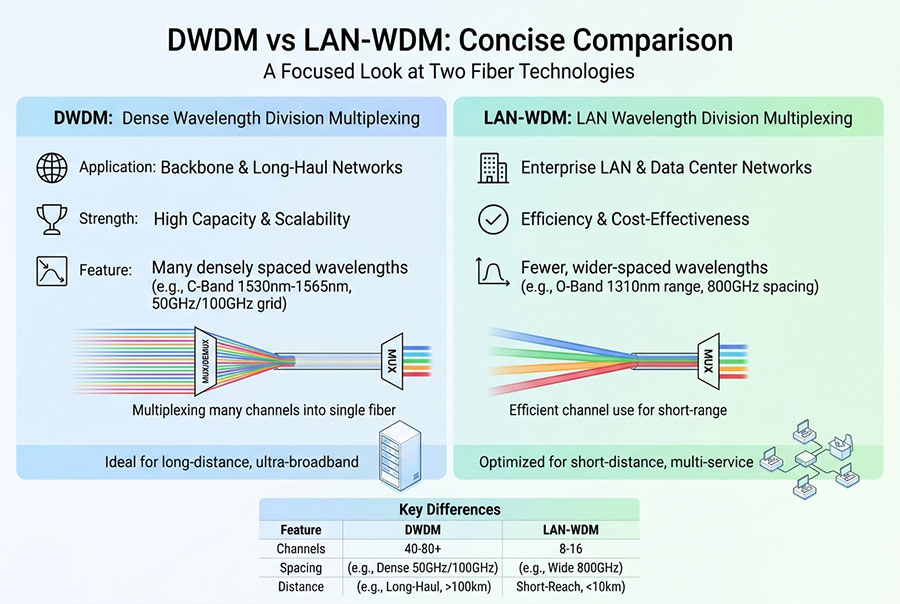
For suitable metro and regional links, DWDM can carry multiple optical channels over limited fiber resources. Coherent optical transceivers may be appropriate for higher-capacity or longer-reach connections, depending on the optical line system, route loss, modulation, and required reach.
C-LIGHT provides 100G, 40G, and 25G DWDM optical transceivers for supported optical transport applications, as well as a range of optical transceivers. Higher-capacity DCI designs should be specified against the target line rate, reach, wavelength plan, and equipment compatibility.
6. Optical Bandwidth: 400G, 800G and 1.6T Data Center Interconnects
As data centers scale their computing and networking capacity, higher-rate optical interfaces can reduce the number of physical ports needed for a given aggregate bandwidth. Their deployment, however, depends on whether the switch, server, optical module, cable, and thermal design support the intended interface.
| Interface Class | Typical Engineering Role | Selection Considerations |
|---|---|---|
| 100G | Established server, switching, and transport connections in suitable networks. | Port density, host compatibility, reach, and whether the connection is intra-data-center or DCI. |
| 400G | High-capacity leaf-spine links, aggregation, and suitable data center interconnect applications. | Electrical lane architecture, optical reach, fiber type, connector, and host support. |
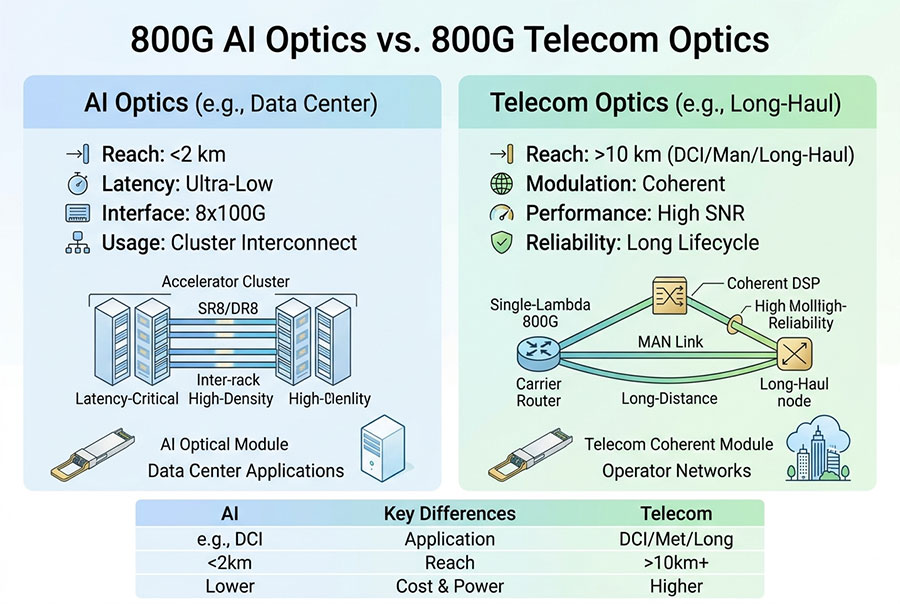
| 800G | High-density switching and bandwidth-intensive AI or cloud infrastructure. | Module power and cooling, port capability, optical architecture, fiber plant, and link budget. |
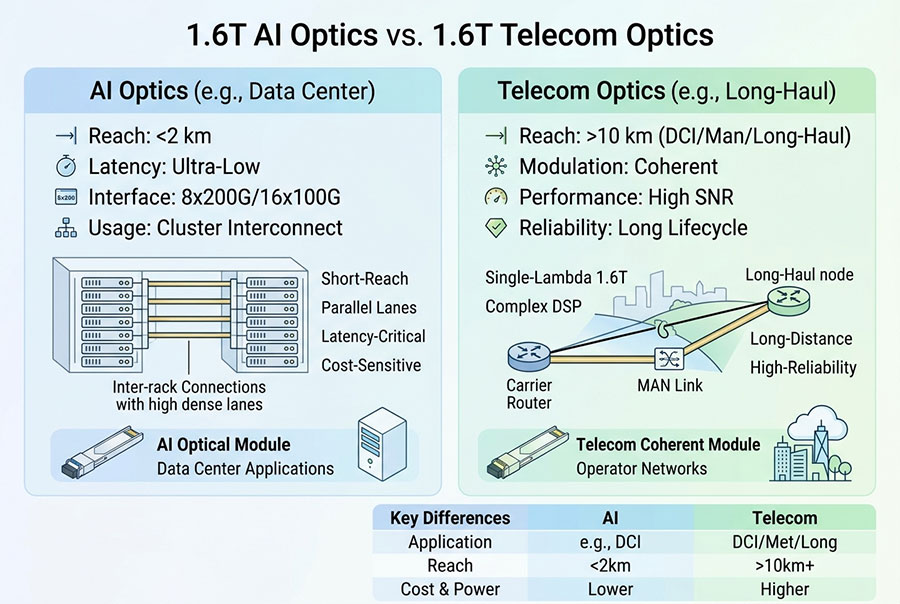
| 1.6T | Emerging higher-capacity interfaces for suitable next-generation switching and optical-network systems. | Availability of compatible host platforms, standardized interfaces, optical implementation, power envelope, and reach. |
| 400G/800G-class or higher per wavelength | Potential high-capacity line-side transmission in advanced DCI and optical transport architectures. | Distinguish the optical line rate per wavelength from the aggregate data rate of the complete system. |
These interface classes are not exclusive to a particular mobile generation. A 5G-supporting data center may already use 400G or 800G networking for AI, cloud, and aggregation workloads. Likewise, a 6G-oriented facility may continue to use 100G or 400G for links whose traffic demands do not justify a higher rate.
It is also important to distinguish a pluggable client-side interface from a coherent line-side wavelength. A DCI system may aggregate client traffic into a higher-capacity optical channel. The client-port rate and the line-side wavelength rate are related but do not have to be identical.
Before choosing an interface, verify the required optical reach, fiber type, connector configuration, module power, host electrical specification, wavelength, and interoperability requirements. The highest nominal data rate is not necessarily the most cost-effective solution for every link.
7. Power, Cooling and Energy Efficiency
Power availability and cooling capacity can limit data center expansion even when additional network bandwidth is technically possible. AI-heavy facilities may have much higher computing density than general-purpose network-function facilities, affecting rack power, cooling design, and the supporting electrical infrastructure.
| Design Area | 5G Data Center Consideration | 6G-Oriented Planning Consideration |
|---|---|---|
| Server power | Matched to mobile core, cloud, edge, and network-function workloads. | May need to accommodate additional AI computing and more variable distributed workloads. |
| Rack density | Varies by facility design and the mix of network and application servers. | AI-heavy deployments may require higher-density racks and revised power distribution. |
| Cooling | Designed around server and networking loads, including optical equipment. | May require advanced air or liquid cooling where computing density makes it appropriate. |
| Optical power | Module consumption is balanced against reach, data rate, and link requirements. | More attention to energy per bit and system-level optical efficiency as port rates increase. |
| Network utilization | Capacity planned around typical and peak mobile traffic patterns. | Potentially more dynamic resource allocation for variable AI and computing workloads. |
| Operational resilience | Power redundancy and recovery support the required availability of network services. | Coordinated computing and network recovery may be important for selected critical workloads. |
Optical transmission can support efficient high-capacity communication, but it does not eliminate energy use. Transceivers, switches, optical line systems, cooling, and conversion stages all consume power. A meaningful comparison should consider total system energy per delivered bit or completed workload rather than a module's power consumption alone.
Similarly, liquid cooling is not a defining feature of a 6G data center. It is a cooling option for suitable high-density computing environments and should be selected according to actual thermal loads, facility constraints, maintenance requirements, and lifecycle cost.
8. Data Center Security, Reliability and Service Continuity
Mobile network functions and AI services may have different workload characteristics, but both require suitable security, reliability, and fault management. As computing resources become more distributed, infrastructure design must account for failures at the server, rack, data center, fiber route, and transport-network levels.
Network segmentation: Separate traffic and control domains according to service, tenant, security, and operational requirements.
Route diversity: Use physically diverse fiber paths where a single cable cut or conduit failure would create an unacceptable outage.
Transport protection: Select appropriate protection and restoration mechanisms for critical inter-site connections.
Compute resilience: Design application and network-function placement so that supported services can recover from facility or equipment failures.
Operational monitoring: Correlate optical alarms, interface errors, packet loss, server metrics, and application-level performance where the management systems support it.
Redundancy should be engineered against a defined service objective. Two optical links that share the same physical route do not provide protection against every fiber or infrastructure failure, and redundant compute instances do not guarantee seamless service recovery without compatible application and network architecture.
9. Migration Strategy: From 5G Data Centers Toward 6G Readiness
Preparing existing facilities for future network requirements begins with a capacity and compatibility assessment. Wholesale replacement is rarely the only option; different links and computing domains can be upgraded at different times according to their actual constraints.
| Assessment Area | What to Verify | Possible Upgrade Path |
|---|---|---|
| Computing capacity | CPU and accelerator utilization, workload growth, memory, and storage bottlenecks. | Upgrade server platforms or redistribute workloads where required. |
| Internal network | Switch port rates, oversubscription, congestion, transceiver compatibility, and rack connectivity. | Adopt higher-rate links, revise the fabric, or add capacity at bottleneck points. |
| DCI capacity | Current utilization, growth forecasts, route diversity, optical reach, and line-system limits. | Upgrade client or line-side rates, expand WDM channels, or deploy additional routes. |
| Power and cooling | Available electrical capacity, rack power limits, heat removal, and redundancy. | Expand facility infrastructure before deploying higher-density workloads. |
| Edge architecture | Workload placement, latency constraints, local compute demand, and transport availability. | Add edge capacity or adjust the distribution of functions between central and regional facilities. |
| Operations | Telemetry quality, automation, fault isolation, and interoperability between network and compute management. | Improve monitoring and orchestration where supported by the systems involved. |
| Standards and compatibility | Confirmed equipment interfaces, supported transceivers, interoperability, and evolving 6G specifications. | Adopt products against validated requirements rather than unfinalized assumptions. |
A staged approach can preserve existing investments while directing new spending toward actual bottlenecks. Some routes may need only a transceiver or switching upgrade. Other sites may require new fiber, additional power, revised cooling, higher-density racks, or changes in computing placement.
As of October 2026, 6G standardization is still progressing. The 3GPP Release 21 schedule targets the first normative 6G specifications for a December 2028 functional freeze. Data center operators should therefore distinguish confirmed infrastructure requirements from anticipated capabilities and leave room for standards-based upgrades as specifications and interoperable products mature.
10. Conclusion
5G data centers primarily support mobile core functions, virtualized network services, edge applications, and the transport infrastructure that connects them. 6G-oriented data centers are expected to extend this foundation with greater integration of AI, distributed computing, sensing-related applications, and more adaptable optical connectivity.
The key infrastructure changes will depend on workload and network architecture rather than the mobile-generation label alone. Higher-rate optical modules, 400G and 800G networking, emerging 1.6T interfaces, DWDM, coherent DCI, and optical circuit switching can each serve particular requirements, but none is mandatory for every 6G data center.
For practical planning, operators should assess internal network bandwidth, DCI reach, fiber availability, optical budgets, power, cooling, resilience, and equipment compatibility. This creates an upgrade path that supports current 5G services while preparing facilities for confirmed future requirements.
Planning high-speed optical connectivity for telecom or AI data centers?
Discuss optical transceivers, DWDM transport, DCI requirements, and network compatibility with C-LIGHT.
Contact C-LIGHT >

 >
 >
 >
 >
 >
 >
 >