TEL:+86 132 6656 7067




1310 nm and 1550 nm are two wavelength windows used in single-mode fiber communications. 1310 nm is the zero-dispersion window of standard single-mode fiber, where chromatic dispersion is near zero. 1550 nm is the minimum-attenuation window, where fiber loss is approximately 0.2 dB/km. These two properties—zero dispersion versus minimum attenuation—drive the different roles each wavelength plays in optical networks.
1310 nm is used for short-reach and medium-reach single-mode links, typically up to 10 to 40 kilometers. It is the standard wavelength for PON upstream, 10GBASE-LR, 100GBASE-LR4, and many data center interconnect links. 1550 nm is used for long-reach transmission, DWDM, and coherent optics. It is the standard wavelength for 10GBASE-ER, 100GBASE-ER4, 400ZR, 800ZR, and long-haul telecom systems.
The choice between them depends on reach, fiber type, dispersion tolerance, DWDM requirements, laser technology, and cost. Neither wavelength is universally better; each serves the segment of the network where its properties are most advantageous.
1. Wavelength Fundamentals
1310 nm and 1550 nm are both in the near-infrared region used for fiber optic communications. 1310 nm is in the O-band, near the zero-dispersion wavelength of standard single-mode fiber. 1550 nm is in the C-band, the central band of the low-loss window.
| Parameter | 1310 nm | 1550 nm |
|---|---|---|
| Band | O-band | C-band |
| Fiber Type | Single-mode (G.652) | Single-mode (G.652) |
| Attenuation | ~0.35 dB/km | ~0.2 dB/km |
| Chromatic Dispersion | Near zero | ~17 ps/nm/km |
| Primary Light Source | DFB, DML, EML | DFB, EML, tunable laser |
| Primary Application | Short and medium reach | Long reach, DWDM, coherent |
2. Attenuation and Dispersion
Attenuation and dispersion determine the reach and the usable bandwidth of each wavelength window.
2.1 Attenuation
Standard single-mode fiber has an attenuation minimum at 1550 nm, approximately 0.2 dB/km. At 1310 nm, attenuation is approximately 0.35 dB/km. The difference means that 1550 nm can span longer distances with the same optical power budget. For a 40 km link, the fiber loss at 1310 nm is approximately 14 dB, while at 1550 nm it is approximately 8 dB. The 6 dB difference is significant for link budget planning.
2.2 Chromatic Dispersion
Chromatic dispersion in standard single-mode fiber is near zero at 1310 nm. At 1550 nm, it is approximately 17 ps/nm/km. The higher dispersion at 1550 nm causes pulse spreading, which limits the reach of direct-detect systems unless dispersion compensation is used. Coherent systems compensate for dispersion digitally in the DSP, which is one reason coherent transmission operates at 1550 nm.
| Parameter | 1310 nm | 1550 nm |
|---|---|---|
| Attenuation | ~0.35 dB/km | ~0.2 dB/km |
| Chromatic Dispersion | Near zero | ~17 ps/nm/km |
| Dispersion Compensation | Not required for most reaches | Required for direct-detect beyond 40 km |
| Reach Limiting Factor | Attenuation | Dispersion and OSNR |
3. Laser Sources and Modulation
Both wavelengths use DFB and EML lasers for direct-detect transmission. The difference is in the availability of tunable lasers and coherent modulation at 1550 nm.
3.1 1310 nm Laser Sources
1310 nm uses DFB lasers, directly modulated lasers (DMLs), and electro-absorption modulated lasers (EMLs). These are uncooled or lightly cooled and are inexpensive. 1310 nm does not support tunable lasers or coherent modulation in mainstream deployments.
3.2 1550 nm Laser Sources
1550 nm uses DFB lasers, EMLs, and tunable lasers. Tunable lasers in the C-band are essential for DWDM and coherent systems, allowing any channel on the ITU grid to be selected in software. Coherent modulation with DP-QPSK, DP-16QAM, and DP-64QAM operates at 1550 nm and delivers 100G to 800G per wavelength.
| Parameter | 1310 nm | 1550 nm |
|---|---|---|
| Laser Types | DFB, DML, EML | DFB, EML, tunable laser |
| Cooling | Uncooled or lightly cooled | Temperature-controlled |
| Tunable Lasers | Not typical | Yes (C-band) |
| Coherent Modulation | Not used | DP-QPSK, DP-16QAM, DP-64QAM |
4. Reach and Power Budget
Reach is determined by the optical power budget and the impairments in the fiber. The two wavelengths have different reach characteristics.
4.1 1310 nm Reach
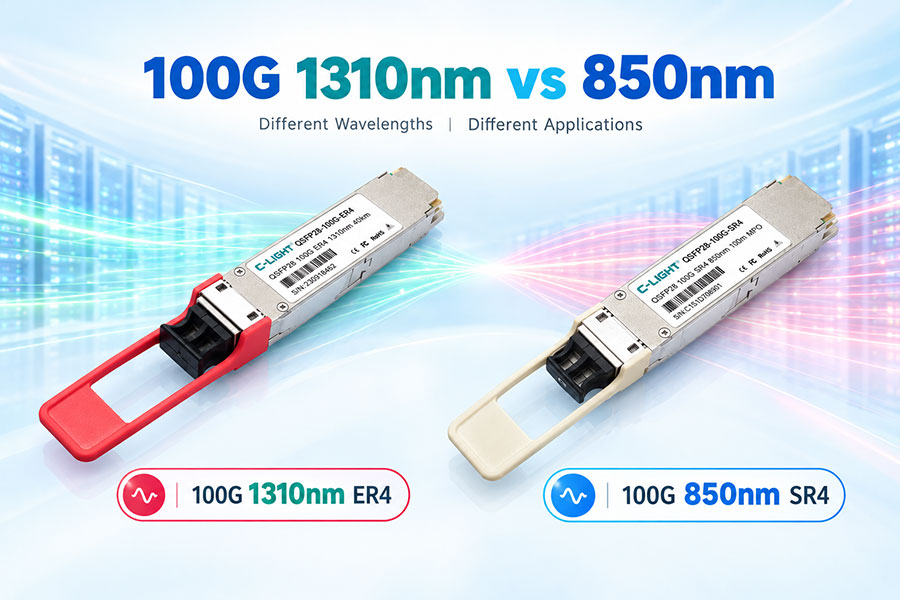
1310 nm supports reaches up to 10 km with 10GBASE-LR, up to 10 km with 100GBASE-LR4, and up to 40 km with 100GBASE-ER4. The reach is limited by attenuation and, for higher rates, by dispersion at longer distances. 1310 nm is the standard for PON upstream and for many data center and campus links.
4.2 1550 nm Reach
1550 nm supports reaches up to 40 km with 10GBASE-ER, up to 40 km with 100GBASE-ER4, up to 80 km with 400ZR and 800ZR coherent modules, and hundreds of kilometers with amplification and coherent detection. The reach is limited by chromatic dispersion, optical signal-to-noise ratio, and nonlinear effects.
| Application | 1310 nm Reach | 1550 nm Reach |
|---|---|---|
| 10G | 10 km (LR) | 40 km (ER), 80 km (ZR) |
| 100G | 10 km (LR4), 40 km (ER4) | 40 km (ER4), 80 km (ZR) |
| 400G | 10 km (LR4) | 80 km (400ZR) |
| 800G | 10 km (LR4) | 80–120 km (800ZR) |
5. WDM and Coherent Support
1550 nm is the standard window for wavelength division multiplexing and coherent transmission. 1310 nm supports CWDM and LAN-WDM but does not support DWDM or coherent transmission in mainstream deployments.
5.1 1310 nm WDM
1310 nm supports CWDM with 20 nm spacing across the O-band and LAN-WDM with 4.5 nm spacing used by 100GBASE-LR4 and 400GBASE-LR4. These are course or local-area WDM schemes with limited channel counts. 1310 nm does not support DWDM.
5.2 1550 nm WDM
1550 nm is the standard window for DWDM. The ITU-T G.694.1 grid defines 100 GHz, 50 GHz, and 25 GHz spacing, supporting 40, 80, or 160 channels on a single fiber pair. DWDM is the foundation of long-haul and metro transport. 1550 nm also supports coherent transmission, which combines DWDM with higher-order modulation to achieve multi-terabit capacity per fiber.
| Parameter | 1310 nm | 1550 nm |
|---|---|---|
| CWDM | Supported (O-band) | Supported |
| LAN-WDM | Supported (LR4) | Not typical |
| DWDM | Not supported | Supported (C-band) |
| Coherent | Not supported | Supported |
| Channel Count | Up to 8 (CWDM) | 40–160 (DWDM) |
6. PON and Access Networks
In passive optical networks, 1310 nm and 1550 nm serve different directions and functions.
6.1 1310 nm in PON
1310 nm is used for upstream transmission in GPON, XG-PON, and XGS-PON. The ONT transmits at 1310 nm, and the OLT receives at 1310 nm. The wavelength is chosen for its low dispersion and the availability of low-cost uncooled DFB lasers.
6.2 1550 nm in PON
1550 nm is used for downstream video overlay in GPON. The RF video signal is modulated onto a 1550 nm wavelength and combined with the 1490 nm data downstream. 1550 nm is also used for XGS-PON downstream (1577 nm) and upstream (1270 nm).
| PON Direction | 1310 nm | 1550 nm |
|---|---|---|
| GPON Upstream | Primary | Not used |
| GPON Downstream Data | Not used | 1490 nm |
| GPON Video Overlay | Not used | 1550 nm |
| XGS-PON Upstream | 1270 nm | Not used |
| XGS-PON Downstream | Not used | 1577 nm |
7. Data Center and Telecom Applications
1310 nm and 1550 nm serve different segments of data center and telecom networks.
7.1 1310 nm Applications
10GBASE-LR: 10 km reach over single-mode fiber.
100GBASE-LR4: 10 km reach with four LAN-WDM wavelengths.
400GBASE-LR4: 10 km reach with four wavelengths.
PON upstream: GPON, XG-PON, XGS-PON.
Data center interconnect: Short and medium reach.
Campus networks: Building-to-building links under 10 km.
7.2 1550 nm Applications
10GBASE-ER: 40 km reach over single-mode fiber.
100GBASE-ER4: 40 km reach with four LAN-WDM wavelengths.
400ZR / 800ZR: 80 km coherent DCI.
DWDM: Metro, regional, and long-haul transport.
Coherent long-haul: 100G to 800G per wavelength.
PON video overlay: 1550 nm RF video.
| Application | 1310 nm | 1550 nm |
|---|---|---|
| Data Center Intra | Short reach | Not typical |
| Data Center Interconnect | Up to 10 km | 80–120 km |
| Telecom Metro | Limited | Primary |
| Telecom Long-Haul | Not used | Primary |
| PON | Upstream | Downstream and video |
8. Cost and Power Consumption
Cost and power consumption differ between the two wavelengths. 1310 nm uses uncooled or lightly cooled lasers and simpler optics, resulting in lower module cost and lower power consumption. 1550 nm uses temperature-controlled lasers and, for coherent systems, complex DSP, resulting in higher cost and higher power.
| Parameter | 1310 nm | 1550 nm |
|---|---|---|
| Laser Cooling | Uncooled or lightly cooled | Temperature-controlled |
| Typical Module Power | 1–4 W | 3–15 W (coherent higher) |
| Module Cost | Lower | Higher |
| Cost per Gbps | Low for short reach | Low for long reach |
9. Comparison Summary
| Dimension | 1310 nm | 1550 nm |
|---|---|---|
| Attenuation | ~0.35 dB/km | ~0.2 dB/km |
| Chromatic Dispersion | Near zero | ~17 ps/nm/km |
| Typical Reach | 10–40 km | 40–1000+ km |
| Laser Type | DFB, DML, EML | DFB, EML, tunable |
| Cooling | Uncooled or lightly cooled | Temperature-controlled |
| DWDM Support | No | Yes |
| Coherent Support | No | Yes |
| Module Power | 1–4 W | 3–15 W |
| Module Cost | Lower | Higher |
| Primary Application | Short/medium reach, PON upstream | Long reach, DWDM, coherent, PON downstream |
10. Selection Framework
| Evaluation Factor | Recommendation |
|---|---|
| Reach under 10 km | 1310 nm |
| Reach 10–40 km | 1310 nm or 1550 nm |
| Reach over 40 km | 1550 nm |
| DWDM required | 1550 nm |
| Coherent transmission | 1550 nm |
| Cost-sensitive | 1310 nm |
| Power-constrained | 1310 nm |
| PON upstream | 1310 nm |
| PON downstream | 1550 nm (1490/1577 nm) |
| Long-haul telecom | 1550 nm |
11. Emerging Trends
11.1 1310 nm at Higher Speeds
1310 nm is used for 400GBASE-LR4 and 800GBASE-LR4, delivering 400G and 800G over 10 km with four LAN-WDM wavelengths. These modules use 1310 nm for its low dispersion and the availability of low-cost DFB and EML lasers.
11.2 1550 nm Coherent Pluggables
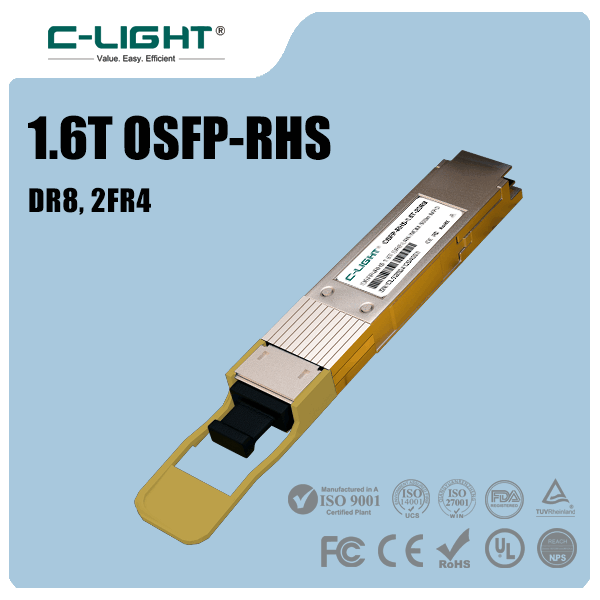
Coherent pluggable modules at 400ZR, 800ZR, and 1.6T operate at 1550 nm in the C-band. They use tunable lasers and coherent DSP to deliver 400G to 1.6T per wavelength over 80 to 120 kilometers. These modules are driving the adoption of 1550 nm in data center interconnect.
11.3 1310 nm for Co-Packaged Optics
1310 nm is a candidate for co-packaged optics in data centers, where short-reach single-mode links are used to interconnect switch ASICs. The low dispersion and low-cost lasers make 1310 nm attractive for these applications.
11.4 1550 nm for 50G-PON
50G-PON uses 1550 nm for downstream and 1310 nm for upstream, continuing the wavelength plan of previous PON generations. The higher speed requires more powerful lasers and receivers, but the wavelength plan remains compatible with the installed fiber plant.
12. Summary
1310 nm and 1550 nm are two single-mode fiber windows with different properties. 1310 nm offers near-zero chromatic dispersion and moderate attenuation, making it the standard for short and medium reach links up to 40 kilometers. 1550 nm offers the lowest attenuation and supports DWDM and coherent transmission, making it the standard for long reach, metro, regional, and long-haul networks.
1310 nm uses uncooled or lightly cooled DFB, DML, and EML lasers, resulting in lower module cost and lower power consumption. 1550 nm uses temperature-controlled DFB, EML, and tunable lasers, resulting in higher cost and higher power, but enabling DWDM and coherent transmission.
In PON, 1310 nm carries upstream traffic, while 1550 nm carries downstream data and RF video overlay. In data centers, 1310 nm serves short and medium reach links, while 1550 nm serves long-reach DCI and coherent interconnect. In telecom, 1310 nm is used for short metro links, while 1550 nm is used for metro, regional, and long-haul transport.
The choice between 1310 nm and 1550 nm depends on reach, dispersion tolerance, DWDM requirements, coherent requirements, cost, and power. 1310 nm is the default for short and medium reach single-mode links. 1550 nm is the default for long reach, DWDM, and coherent systems.
 >
>

 >
>
 >
>
 >
>
 >
>
 >
>
 >
>
 >
>