TEL:+86 132 6656 7067




1. Introduction
10G SFP+ remains an important connectivity technology in data center networks, enterprise infrastructure, storage, access networks, and network upgrades. Although 25G, 100G, 400G, and higher-speed interfaces are increasingly common in new AI and hyperscale deployments, 10G SFP+ continues to provide a practical balance between bandwidth, port density, reach, power consumption, and infrastructure compatibility.
2. What Is 10G SFP+?
10G SFP+ is a compact pluggable transceiver form factor designed for 10 Gigabit Ethernet and related communication applications. A fiber SFP+ module converts electrical signals from the host device into optical signals and converts incoming optical signals back into electrical data.
3. Why 10G SFP+ Is Still Used
Many data centers still contain 10G servers, switches, storage devices, management networks, and legacy uplinks. SFP+ also provides a flexible upgrade path because different optical modules can be selected for different fiber types and transmission distances.
4. 10G SFP+ in Data Center Networks
10G SFP+ can be used in server access, switch uplinks, storage networks, management networks, aggregation links, and selected inter-rack connections. The actual role depends on the network generation and required bandwidth.
5. 10G Data Center Architecture
A conventional 10G connection can follow a simple structure:
Server / NIC → SFP+ Port → 10G SFP+ → Fiber → 10G SFP+ → Switch
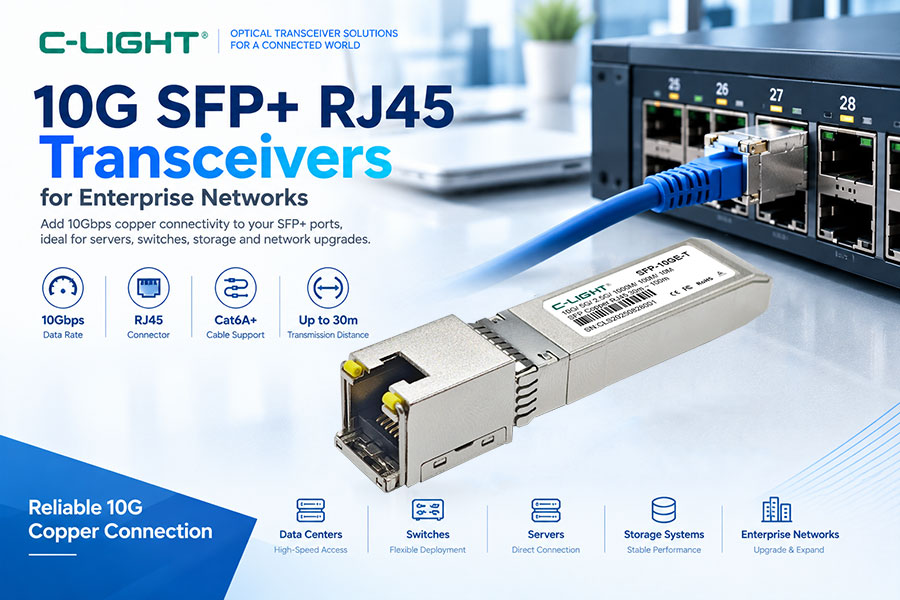
For copper-based deployments, a 10GBASE-T SFP+ can instead provide an RJ45 interface for twisted-pair Ethernet cabling.
6. 10G SFP+ Standards
10G SFP+ optical modules are commonly associated with IEEE 802.3ae for 10GbE and industry specifications such as SFF-8431 and SFF-8432. SFP+ MSA defines the broader mechanical and electrical framework for the form factor.
7. Main 10G SFP+ Types
| Type | Fiber | Typical Wavelength | Typical Reach | Application |
|---|---|---|---|---|
| 10G SR | MMF | 850nm | Short reach | Data center |
| 10G LRM | MMF / SMF | 1310nm | Medium reach | Structured links |
| 10G LR | SMF | 1310nm | 10km | Aggregation / backbone |
| 10G ER | SMF | 1550nm | 40km | Extended links |
| 10G ZR | SMF | 1550nm | 80km class | Long-distance links |
8. 10G SR SFP+
10GBASE-SR is designed for short-reach multimode fiber connections and commonly operates around 850nm. It is widely used for links between servers, switches, and nearby racks.
9. 10G LRM SFP+
10GBASE-LRM extends 10G connectivity beyond some conventional SR applications and can support both multimode and single-mode fiber in specific implementations. It is useful when the installed fiber type or distance falls between common SR and LR applications.
10. 10G LR SFP+
10GBASE-LR normally uses 1310nm single-mode fiber and supports 10km-class transmission. It is commonly used for aggregation, core, campus, and longer data center links.
11. 10G ER SFP+
10GBASE-ER uses 1550nm-class optics and is designed for extended-reach single-mode fiber transmission. It can support approximately 40km in suitable implementations.
12. 10G ZR SFP+
10G ZR extends the reach of conventional 10G pluggable optics toward the 80km class in appropriate system designs. These modules are more relevant to long-distance backbone, metro, and transport applications than ordinary intra-rack data center links.
13. 10G Copper SFP+
A 10GBASE-T Copper SFP+ provides an RJ45 interface and uses twisted-pair copper cabling. It is useful when existing Ethernet infrastructure is based on Cat6A or similar cabling. Its reach and power characteristics differ from those of fiber-based SFP+ modules.
14. Fiber SFP+ vs Copper SFP+
| Parameter | Fiber SFP+ | Copper SFP+ |
|---|---|---|
| Medium | Optical fiber | Twisted-pair copper |
| Connector | LC or other optical connector | RJ45 |
| Reach | Short to long | Usually shorter |
| EMI Sensitivity | Very low | Higher |
| Existing Cabling | Fiber infrastructure | Cat6A/Cat7 infrastructure |
| Typical Power | Lower for many optical modules | Higher for many 10GBASE-T modules |
15. Transmission Distance
One of the main strengths of the SFP+ ecosystem is its range of distance options. C-LIGHT's 10G SFP+ product family includes solutions ranging from short-distance applications through approximately 2km, 10km, 20km, 40km, 70km, 80km, 100km, and 120km according to the specific optical implementation.
16. Choosing Reach by Network Layer
Short server and rack connections can use SR-class optics, while aggregation and backbone connections often use LR or longer-reach modules. ER and ZR solutions are more appropriate when the fiber path extends well beyond typical data center distances.
17. Fiber Type
Multimode fiber is commonly used for short-reach 850nm SFP+ modules, while single-mode fiber is used for longer-reach 1310nm, 1550nm, and WDM-based solutions. Matching the transceiver with the installed fiber is essential.
18. OM3 and OM4
OM3 and OM4 are common multimode fiber grades for 10G data center links. The actual supported distance depends on the transceiver, fiber bandwidth, connector loss, and the complete optical link.
19. Single-Mode Fiber
Single-mode fiber is the standard choice for longer 10G links. It provides the optical transmission characteristics required by LR, ER, ZR, and other extended-reach architectures.
20. LC Connectivity
Duplex LC connectors are widely used with 10G SFP+ optical modules. One fiber carries the transmit signal and the other carries the receive signal, creating a straightforward point-to-point optical connection.
21. Wavelength Selection
The wavelength should match both the transceiver and the fiber architecture. 850nm is commonly associated with short multimode links, while 1310nm and 1550nm are widely used for longer single-mode transmission.
22. Optical Link Budget
A reliable 10G optical link requires sufficient optical margin. The link budget should account for transmitter output power, receiver sensitivity, fiber attenuation, connector loss, splice loss, and other passive components.
23. Connector Loss
Connector loss becomes increasingly important as transmission distance increases. Clean optical connectors and properly terminated patch cords help maintain the available optical margin.
24. Receiver Sensitivity
Receiver sensitivity defines the minimum optical power required to maintain the specified link performance. Long-reach SFP+ modules generally require stronger optical budgets or more sensitive receiver architectures than short-reach modules.
25. Digital Optical Monitoring
Many SFP+ modules provide digital diagnostic information such as temperature, supply voltage, laser bias, transmit power, and receive power. These values can help network operators identify optical or thermal problems before a complete link failure occurs.
26. Power Consumption
Power consumption varies significantly between SFP+ types. Short-reach optical modules can have relatively low power requirements, while copper 10GBASE-T and extended-reach designs may require more power because of their electrical PHY or optical architecture.
27. Thermal Management
Even at 10G, thermal management matters in densely populated switches. High module counts can produce a significant cumulative heat load, especially when higher-power copper or extended-reach optics are installed across many ports.
28. Port Density
SFP+ provides a compact interface that allows switches and other equipment to achieve high port density. This remains useful for network designs that require many 10G connections without occupying the space of larger form factors.
29. Server Connectivity
10G SFP+ is commonly used for server-to-switch connections. Fiber SFP+ can provide high-speed optical connectivity, while copper SFP+ can connect equipment to existing RJ45-based infrastructure where supported.
30. Storage Connectivity
10G connectivity remains relevant to storage networking and data movement. SFP+ can be used in Ethernet-based storage environments and selected storage-network architectures where the required throughput is within the platform's capabilities.
31. Switch Uplinks
10G SFP+ uplinks can connect access switches to aggregation or distribution layers. LR and other single-mode modules provide longer reach when switches are separated by larger distances.
32. Data Center Interconnect
Although modern DCI networks increasingly use 100G, 400G, and higher speeds, 10G optics remain useful for lower-capacity links, legacy systems, management traffic, and specific network segments. Long-reach SFP+ variants can support selected extended-distance connections.
33. Enterprise Networks
Enterprise networks often contain a mixture of copper and fiber infrastructure. 10G SFP+ allows network designers to select the appropriate optical or copper interface while keeping the familiar SFP+ host form factor.
34. Campus Networks
10G SFP+ can be used for campus aggregation, building-to-building links, and network backbones. LR-class optics can support 10km-scale single-mode connections, while longer variants can address larger geographic coverage.
35. Wireless and Telecom Applications
10G SFP+ modules can also be used in wireless and telecom equipment, including selected access, transport, and aggregation applications. The appropriate optical type depends on the required distance, protocol, and environmental conditions.
36. 10G SFP+ for Network Upgrades
For networks moving from 1G to 10G, SFP+ can provide a straightforward bandwidth upgrade where the host switch, NIC, and cabling infrastructure are compatible. Existing fiber can often be reused when the selected wavelength and optical type match the installed plant.
37. Multi-Rate SFP+ Options
Some SFP+ modules support multiple data rates or related protocols. C-LIGHT's product family includes multirate options covering specific operating ranges and applications. The actual supported rates should be confirmed from the product datasheet.
38. Compatibility
Physical insertion into an SFP+ slot does not guarantee interoperability. The host device must support the module's optical characteristics, data rate, coding, power level, management functions, and operating temperature.
39. Vendor Coding and EEPROM
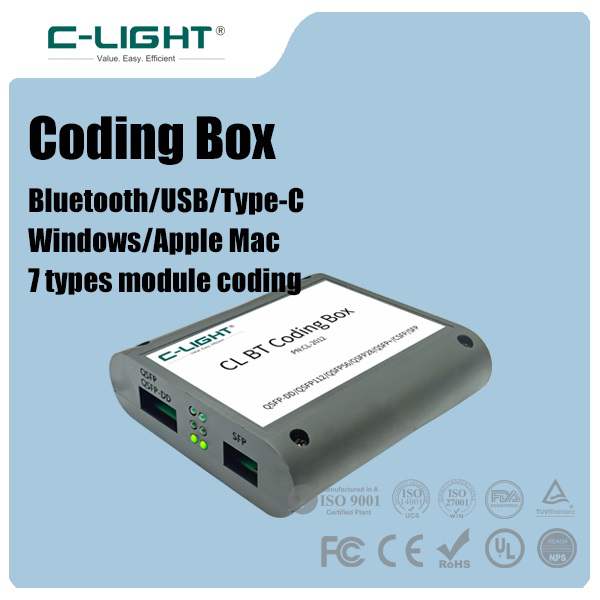
Networking equipment can read module identification data through the management interface. Vendor coding and EEPROM information can affect whether a transceiver is accepted by a particular switch, router, or NIC.
40. Interoperability Testing
When deploying third-party 10G SFP+ modules, test the complete link with the intended host devices. Check module recognition, optical levels, link stability, error counters, temperature, and long-duration traffic performance.
41. Troubleshooting 10G SFP+ Links
When a 10G link fails, first check the host port and module recognition. Then verify fiber type, connector cleanliness, polarity, wavelength, optical power, cable condition, FEC or port configuration, and the remote endpoint. DOM/DDM data can help isolate thermal or optical issues.
42. Common Deployment Mistakes
Common mistakes include using the wrong fiber type, mixing incompatible wavelengths, exceeding the specified reach, ignoring optical connector loss, installing unsupported vendor-coded modules, or assuming that all SFP+ modules have the same power and distance characteristics.
43. 10G SFP+ Selection Guide
| Requirement | Typical SFP+ Choice |
|---|---|
| Short data center link | 10G SR |
| Medium multimode/SMF link | 10G LRM |
| Up to 10km | 10G LR |
| Up to 40km | 10G ER |
| Up to 80km class | 10G ZR |
| Existing copper infrastructure | 10GBASE-T SFP+ |
44. 10G SFP+ vs Higher-Speed Modules
10G SFP+ has lower bandwidth than 25G, 100G, 400G, and 800G interfaces, but it can remain economical for applications that do not require higher throughput. Using the appropriate bandwidth level can avoid unnecessary equipment and optical infrastructure costs.
45. Migration from 10G to 25G
Many modern data centers use 25G for server connectivity while retaining 10G for legacy equipment and selected network functions. A mixed-speed environment can therefore remain common during network migration.
46. Migration from 10G to 100G
Aggregation and backbone networks increasingly use 100G and higher speeds. In such environments, 10G SFP+ can continue serving edge, management, legacy, and specialized network segments while higher-speed interfaces handle larger traffic volumes.
47. Future Role of 10G SFP+
10G SFP+ is unlikely to disappear from existing infrastructure immediately. Its compact form factor, mature ecosystem, broad reach options, and compatibility with established Ethernet architectures allow it to remain useful in many networks alongside newer optical generations.
48. Frequently Asked Questions
Q1. What is 10G SFP+ used for?
Q2. What is the difference between 10G SR and LR?
Q3. What fiber does 10G SFP+ use?
Q4. Can 10G SFP+ be used for server-to-switch connections?
Q5. Can 10G SFP+ use copper cables?
Q6. How far can a 10G SFP+ module transmit?
Q7. Does 10G SFP+ support single-mode fiber?
Q8. Is 10G SFP+ still suitable for data centers?
Q9. Does a longer-reach 10G SFP+ always consume more power?
Q10. How should I choose a 10G SFP+ module?
49. Summary
10G SFP+ remains a practical optical connectivity solution for data center, enterprise, telecom, wireless, storage, and legacy network applications. Its main advantage is flexibility: SR supports short multimode links, LRM addresses selected medium-reach applications, LR provides 10km-class single-mode connectivity, ER extends toward 40km, and ZR can reach the 80km class in suitable implementations. Copper 10GBASE-T SFP+ also provides an option for existing RJ45 infrastructure. When selecting 10G SFP+, the most important factors are host compatibility, transmission distance, fiber type, wavelength, connector, optical budget, power consumption, thermal conditions, and network role. As higher-speed interfaces continue to expand, 10G SFP+ will remain relevant where mature, flexible, and cost-conscious 10GbE connectivity is still required.
 >
>

 >
>
 >
>
 >
>
 >
>
 >
>
 >
>
 >
>