TEL:+86 132 6656 7067





10G SFP+ and 10G XFP are two optical transceiver form factors designed for 10 Gigabit network applications. Both support 10G-class optical transmission, but they differ in physical dimensions, electrical interface architecture, power consumption, thermal characteristics and host equipment requirements.
SFP+ is a smaller, more power-efficient interface widely used in modern Ethernet switches, routers and network equipment. XFP is an earlier 10G form factor with a larger housing and a different electrical interface architecture. Although both can support similar optical standards and transmission distances, they are not physically or electrically interchangeable.
1. SFP+ and XFP: Two Different 10G Transceiver Architectures
A compact Small Form-factor Pluggable Plus module designed for 10G serial electrical interfaces. Much of the high-speed signal processing is handled by the host equipment rather than the optical module.
Common in Ethernet switches, routers, storage networks and high-density access platforms.
A larger 10G pluggable transceiver based on an architecture with more signal-processing functionality inside the module. It uses a different electrical interface from SFP+.
Historically used in 10G Ethernet, telecommunications and optical transport equipment.
The most important architectural distinction is the location of the SerDes and signal-conditioning functions. SFP+ generally relies on the host's high-speed electrical interface, while XFP incorporates more of the transmission and reception signal-processing functions within the module.
2. Main Differences Between 10G SFP+ and XFP
| Parameter | 10G SFP+ | 10G XFP |
|---|---|---|
| Form Factor | Small Form-factor Pluggable Plus | 10 Gigabit Small Form Factor Pluggable |
| Physical Size | Smaller and more compact | Larger module housing |
| Data Rate | 10G-class serial interface; commonly 10GbE | 10G-class serial interface; commonly 10GbE and other 10G transport applications |
| Electrical Interface | Typically 10G serial host interface | Typically XFI serial interface |
| Signal Processing | More signal processing is handled by the host | More functionality is integrated into the module |
| Power Consumption | Generally lower | Generally higher |
| Thermal Design | Designed for compact, high-density port deployment | Requires thermal consideration for the larger module architecture |
| Port Density | Higher potential port density | Lower potential port density due to larger dimensions |
| Management | Digital diagnostics commonly supported through SFF-8472 implementations | Digital diagnostics supported through XFP management specifications |
| Interchangeability | Not mechanically or electrically interchangeable with XFP | Not mechanically or electrically interchangeable with SFP+ |
Actual power consumption, diagnostic features and supported optical specifications depend on the individual transceiver design. The table describes the general differences between the two form-factor architectures.
3. Physical Dimensions and Port Density
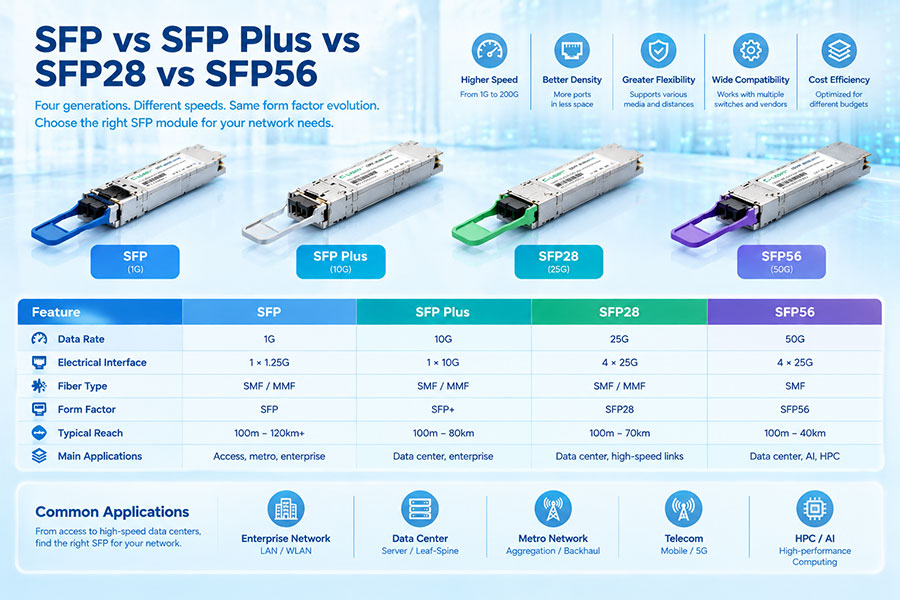
One of the most visible differences between SFP+ and XFP is their physical size. SFP+ was developed as a compact 10G interface, allowing network equipment manufacturers to integrate more optical ports into a limited front-panel area.
XFP has a larger housing and requires a different host cage and connector arrangement. This affects chassis layout, port spacing and the number of interfaces that can be installed in a given equipment footprint.
For switches and routers requiring high port density, SFP+ generally provides a more efficient physical design. XFP remains relevant in equipment originally designed around its form factor, particularly in certain legacy transport and telecom platforms.
Important compatibility point: An SFP+ module cannot be inserted into an XFP port, and an XFP module cannot be installed in an SFP+ cage. Their mechanical dimensions, electrical interfaces and host requirements are different.
4. Electrical Interface and Signal Processing
The electrical interface is a major technical difference between the two transceiver types.
SFP+ typically uses a 10G serial electrical interface between the host device and the module. The host SerDes handles much of the high-speed signal processing, while the transceiver performs the required optical-to-electrical and electrical-to-optical conversion.
XFP uses the XFI electrical interface architecture. Its design places more transmission and reception signal-conditioning functionality inside the module, reducing the amount of high-speed signal processing required from the host compared with a typical SFP+ implementation.
| Technical Aspect | SFP+ | XFP |
|---|---|---|
| Host Electrical Interface | SFI-style interface in common implementations | XFI |
| Host SerDes Role | Typically provides the high-speed serial interface and associated signal processing | Connects to the module's XFI interface |
| Module Architecture | Designed for a compact module with a relatively simple electrical interface | Includes more integrated signal-conditioning functions |
| System Design | Places greater emphasis on host electrical performance | Uses a different distribution of signal-processing functions |
These differences explain why identical optical specifications do not make the two modules interchangeable. The host interface must be designed for the corresponding electrical architecture.
5. Power Consumption and Thermal Performance
Power consumption is another important consideration when comparing 10G SFP+ and XFP transceivers. SFP+ generally offers lower module power consumption because of its compact architecture and reduced integration of high-speed signal-processing functions inside the module.
XFP modules generally consume more power because more signal-conditioning functionality is integrated into the transceiver. The actual difference varies by optical type, transmitter technology, receiver design and module generation.
Thermal performance also affects system reliability. High-density switches using multiple optical modules must maintain suitable airflow and operating temperatures across the front panel. Module power and temperature limits should be checked against the host equipment's specifications.
| Consideration | SFP+ | XFP |
|---|---|---|
| Typical Power Profile | Lower power in many common implementations | Generally higher than comparable SFP+ implementations |
| Thermal Requirements | Suitable for compact, high-density port designs | Requires thermal validation for the host cage and module |
| Chassis Design | Supports high port density and efficient front-panel layouts | Uses a larger module footprint |
| Deployment Priority | Power efficiency and port density | Compatibility with existing XFP-based platforms |
6. Optical Types and Transmission Distance
SFP+ and XFP modules can support several optical transmission types. The form factor does not determine the optical reach by itself. Wavelength, transmitter design, receiver sensitivity, fiber type and link budget determine the supported transmission distance.
| Optical Type | Common Wavelength | Typical Reach Category | Fiber Type | Application |
|---|---|---|---|---|
| 10G SR | 850nm | Up to 300m on specified OM3 configurations | Multimode | Data center and enterprise LAN |
| 10G LR | 1310nm | Up to 10km | Single-mode | Campus and metro access |
| 10G ER | 1550nm | Up to 40km | Single-mode | Extended-reach transport |
| 10G ZR | 1550nm | Commonly associated with 80km-class implementations | Single-mode | Longer-distance optical transport |
These are common optical reach categories, not a guarantee that every SFP+ or XFP implementation supports all four types. Actual availability depends on the product specification and applicable interface standard.
For example, a 10G SFP+ LR module and a 10G XFP LR module may both support 1310nm transmission over a specified single-mode fiber distance. However, they still require different host ports and cannot be substituted for one another.
7. Application Scenarios: Where SFP+ and XFP Are Used
SFP+ is widely adopted in modern Ethernet environments because of its compact size, power efficiency and broad availability across network equipment.
Common SFP+ applications include:
10 Gigabit Ethernet switch-to-switch connections.
Server and storage network uplinks.
Enterprise campus fiber connections.
Data center access and aggregation networks.
10G optical links using SR, LR, ER and other supported variants.
XFP is more commonly encountered in legacy 10G platforms and selected telecommunications or optical transport systems.
Common XFP applications include:
Legacy 10G Ethernet switches and routers.
Telecom transport equipment.
10G SONET/SDH and related optical transport interfaces.
Existing DWDM and long-distance optical platforms designed for XFP modules.
Network upgrades where retaining the original XFP host equipment is required.
8. Can SFP+ and XFP Transceivers Be Used in the Same Network?
Yes. SFP+ and XFP transceivers can operate within the same network if each is installed in a compatible host port and the optical interfaces at both ends are matched correctly.
For example, a network may use an SFP+ LR module in one switch and an XFP LR module in a legacy transport device. If both modules support compatible optical transmission specifications, wavelength, fiber type and link budget, the optical connection can work normally.
Example connection:
Endpoint A: 10G SFP+ LR, 1310nm, duplex LC.
Endpoint B: 10G XFP LR, 1310nm, duplex LC.
Fiber: Single-mode duplex fiber.
Host devices: Each endpoint uses its own compatible SFP+ or XFP port.
This is a possible cross-form-factor optical connection when both modules use compatible optical specifications. The modules are not interchangeable within the equipment itself.
Before deployment, verify the following:
Both endpoints support the same Ethernet or transport protocol.
Wavelengths and optical transmission specifications are compatible.
Both modules use the correct fiber type and connector arrangement.
Transmitter output and receiver sensitivity provide sufficient link margin.
Host devices support the installed transceiver and its identification data.
Operating temperature and power requirements meet equipment limits.
9. How to Choose Between 10G SFP+ and XFP
The choice should be based primarily on the host equipment, network architecture and long-term deployment requirements.
| Selection Requirement | Recommended Direction | Reason |
|---|---|---|
| New 10G Ethernet deployment | SFP+ | Compact size, lower power profile and broad platform adoption |
| High-density switch ports | SFP+ | Smaller physical footprint supports more ports |
| Existing XFP equipment | XFP | Maintains compatibility with the installed host platform |
| Legacy telecom transport | Check the original equipment specification | Some transport platforms are designed specifically for XFP interfaces |
| Optical link upgrade | Evaluate both host and optical interface requirements | Reach and wavelength compatibility do not eliminate form-factor constraints |
For a new 10G Ethernet network, SFP+ is generally the more practical choice. XFP remains a valid option when the network infrastructure already uses XFP-based equipment or when a specific transport platform requires it.
10. C-LIGHT 10G Optical Transceiver Solutions
C-LIGHT provides optical transceiver solutions for Ethernet, enterprise networking, data centers and optical transport applications. Selection can be based on data rate, transmission distance, wavelength, fiber type, connector and host equipment compatibility.
10G SFP+ Optical Transceivers
10G SFP+ modules are suitable for a range of single-mode and multimode fiber applications, including short-reach data center connections and longer-reach enterprise or transport links. Common optical categories include SR, LR, ER and other distance-specific configurations.
When selecting a replacement module, provide the host equipment model, required optical type, wavelength, fiber type and transmission distance. These details help verify both hardware compatibility and optical link requirements.
11. Conclusion
10G SFP+ and 10G XFP transceivers provide similar 10G-class optical connectivity but use different physical and electrical architectures. SFP+ offers a smaller form factor, a generally lower power profile and higher port-density potential, making it widely used in modern Ethernet equipment. XFP has a larger housing and integrates more signal-processing functionality within the module, making it relevant to legacy 10G platforms and selected optical transport systems.
The two formats are not interchangeable, even when their optical specifications are similar. Successful deployment requires matching the module to the host port and verifying the optical wavelength, fiber type, reach and link budget at both endpoints.
Looking for Compatible 10G Optical Transceivers?
Contact C-LIGHT for SFP+, XFP and other optical transceiver options based on your equipment model and network requirements.
Contact C-LIGHT >

 >
 >
 >
 >
 >
 >
 >