TEL:+86 132 6656 7067




10GE asymmetry:
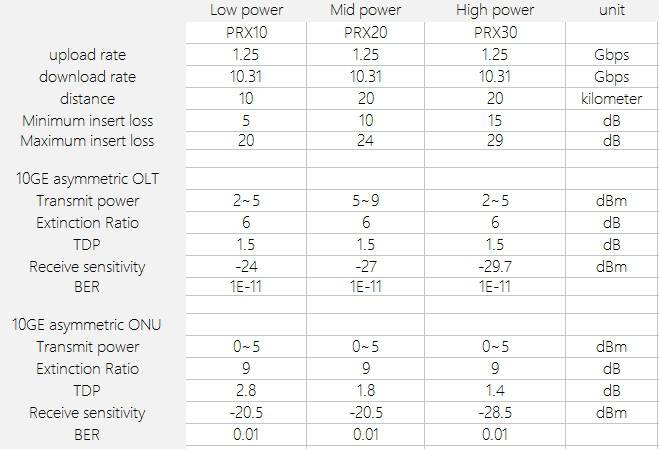
10GE symmetry
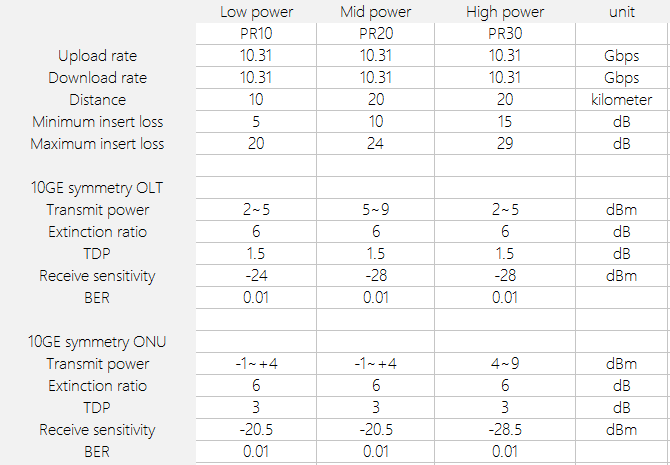
10G EPON Standard Parameters FAQ
Q1: What is 10G EPON technology?
Answer: 10G EPON (10 Gigabit Ethernet Passive Optical Network) is a next-generation passive optical network technology designed to provide higher bandwidth than traditional EPON systems.
Based on the IEEE 802.3av standard, 10G EPON extends Ethernet-based fiber access networks with:
Higher transmission capacity
Improved bandwidth efficiency
Better support for high-speed broadband services
10G EPON is widely used in:
FTTH networks
Enterprise broadband access
Telecom access networks
High-density fiber deployments
It provides a scalable upgrade path from traditional EPON infrastructure.
Q2: What are the standard parameters of 10G EPON?
Answer: The main parameters of 10G EPON include transmission rate, wavelength allocation, fiber interface, and network architecture.
Typical 10G EPON specifications include:
Downstream rate: 10Gbps
Upstream rate: 10Gbps or 1Gbps depending on configuration
Optical fiber type: Single-mode fiber (SMF)
Network structure: Point-to-multipoint passive optical network
10G EPON supports both:
Symmetric 10G/10G operation
Asymmetric 10G/1G operation
These configurations allow operators to select suitable bandwidth according to different service requirements.
Q3: What is the difference between symmetric and asymmetric 10G EPON?
Answer: 10G EPON supports two main operating modes depending on upstream bandwidth requirements.
| Feature | Symmetric 10G EPON | Asymmetric 10G EPON |
|---|---|---|
| Downstream Speed | 10Gbps | 10Gbps |
| Upstream Speed | 10Gbps | 1Gbps |
| Application | High-bandwidth services | General broadband access |
| Target Users | Enterprise / advanced users | Residential users |
Symmetric 10G EPON provides equal upstream and downstream bandwidth, making it suitable for applications requiring high upload capacity.
Asymmetric 10G EPON reduces cost while still providing high-speed download performance.
Q4: What wavelengths are used in 10G EPON networks?
Answer: 10G EPON uses different optical wavelengths for upstream and downstream transmission to support efficient fiber communication.
Typical wavelength allocation includes:
Downstream Transmission
Around 1577nm
Upstream Transmission
Around 1270nm
Using separate wavelengths allows 10G EPON systems to coexist with existing EPON networks on the same fiber infrastructure.
This coexistence capability helps operators upgrade network capacity without replacing all existing fiber resources.
Q5: What are the main components of a 10G EPON network?
Answer: A 10G EPON network mainly consists of three parts:
OLT (Optical Line Terminal)
Located at the service provider side, managing optical communication and user connections.
ODN (Optical Distribution Network)
Includes:
Optical fiber cables
Passive splitters
Distribution equipment
ONU (Optical Network Unit)
Located at the customer side and converts optical signals into electrical data.
Together, these components create a point-to-multipoint fiber access network architecture.
Q6: What are the applications of 10G EPON optical modules?
Answer: 10G EPON optical modules are used in OLT and ONU equipment to enable high-speed fiber access services.
Common applications include:
Residential Broadband
FTTH deployment
Multi-gigabit internet access
Enterprise Networks
Business broadband
Campus networks
Telecom Infrastructure
Access network upgrades
High-density user connections
C-LIGHT 10G EPON OLT/ONU optical modules support different transmission distances and are designed for broadband access and FTTx applications.
Q7: What is the difference between EPON and 10G EPON?
Answer: The main difference between EPON and 10G EPON is transmission capacity.
| Feature | EPON | 10G EPON |
|---|---|---|
| Standard | IEEE 802.3ah | IEEE 802.3av |
| Bandwidth | 1Gbps class | 10Gbps class |
| Application | Traditional broadband | High-speed access |
| Scalability | Limited | Higher |
10G EPON provides significantly higher bandwidth and supports future network requirements such as:
Cloud applications
4K/8K video
Enterprise services
Smart city networks
Q8: Why is 10G EPON important for future fiber access networks?
Answer: The demand for higher bandwidth continues increasing due to:
Cloud computing
Video streaming
Remote work
5G services
Enterprise digital transformation
10G EPON provides operators with:
Higher network capacity
Better fiber utilization
Flexible upgrade options
Long-term scalability
As fiber access networks continue evolving, 10G EPON will remain an important technology for next-generation broadband infrastructure.
 >
>

 >
>
 >
>
 >
>
 >
>
 >
>
 >
>
 >
>