TEL:+86 132 6656 7067




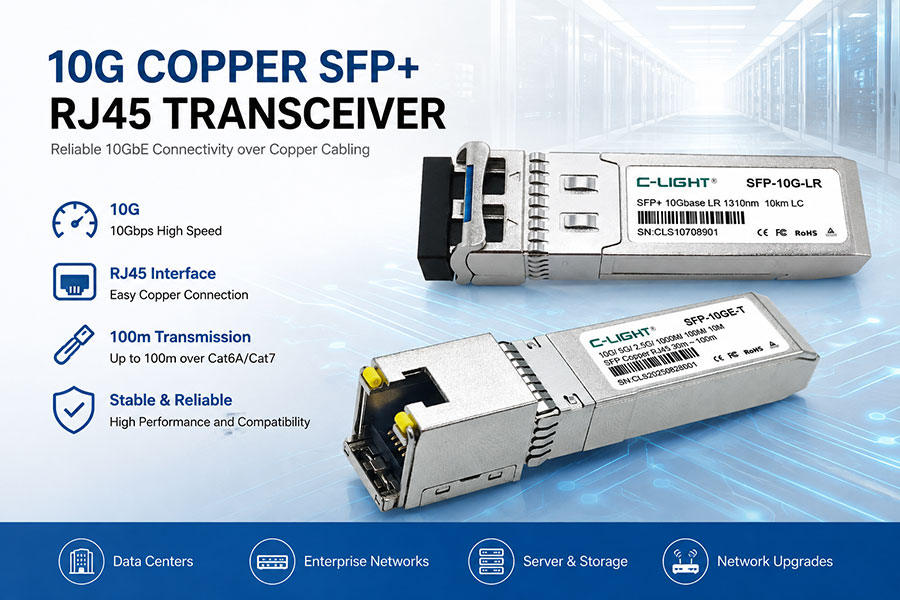
When choosing a 10G transceiver, the terms 10G Copper SFP and 10G SFP+ are sometimes used interchangeably. However, they do not represent exactly the same thing. A 10G Copper SFP is generally a copper-based SFP+ transceiver with an RJ45 interface, while 10G SFP+ refers to the broader SFP+ transceiver category that can use either optical fiber or copper as the transmission medium.
Understanding this difference is important when selecting transceivers for switches, servers, network interface cards, and data center networks. This article explains the relationship between 10G Copper SFP and 10G SFP+, including interfaces, transmission media, distance, power consumption, applications, and compatibility.
1.What Is a 10G Copper SFP?
A 10G Copper SFP is a copper-based transceiver designed to provide 10 Gigabit Ethernet connectivity through a standard RJ45 Ethernet interface. It is commonly implemented as a 10GBASE-T SFP+ module and uses twisted-pair copper cabling rather than optical fiber.
Typical 10G Copper SFP+ modules support up to 10Gbps transmission over Cat6A or higher-grade copper cabling, with many models supporting distances of up to 100 meters. They are designed to plug into an SFP+ port while providing an RJ45 copper connection. :contentReference[oaicite:1]{index=1}
This makes 10G Copper SFP+ particularly useful when an existing network already uses structured copper cabling and users want to upgrade network equipment without replacing the entire cabling infrastructure.
2.What Is a 10G SFP+?
10G SFP+ is a broader term describing the Small Form-factor Pluggable Plus transceiver family used for 10 Gigabit networking. The term SFP+ mainly describes the module form factor and electrical interface rather than specifying whether the transmission medium is copper or fiber.
10G SFP+ transceivers can therefore include different types of modules, such as:
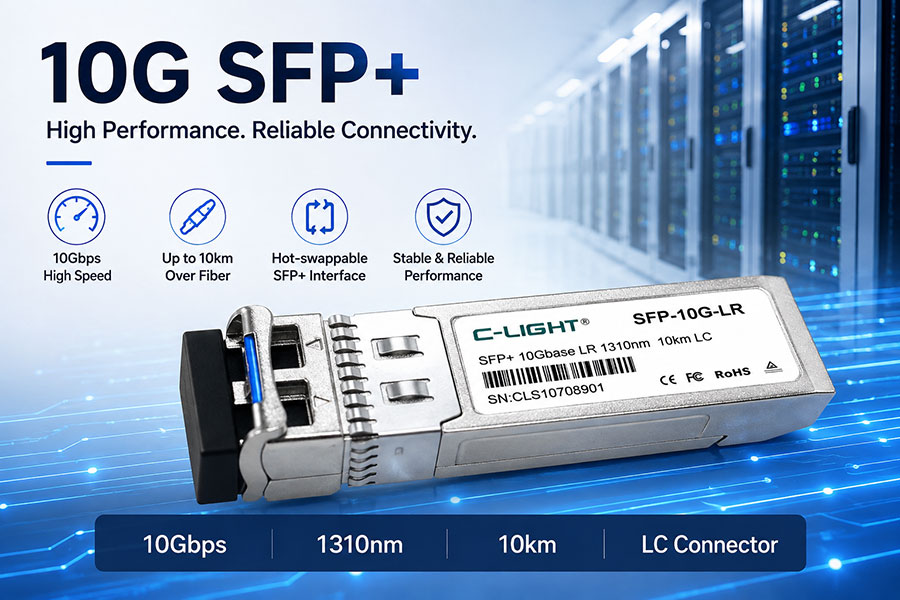
10G SR SFP+ for short-distance multimode fiber
10G LR SFP+ for long-distance single-mode fiber
10G ER SFP+ for extended-reach fiber links
10G Copper SFP+ with an RJ45 interface
As a result, a 10G Copper SFP+ can be considered a type of 10G SFP+, but not every 10G SFP+ is a copper module.
3.10G Copper SFP vs 10G SFP+: Are They the Same?
No, they are not exactly the same. The easiest way to understand the relationship is that 10G SFP+ is the larger category, while 10G Copper SFP+ is one specific type within that category.
| Feature | 10G Copper SFP+ | 10G SFP+ |
|---|---|---|
| Category | Copper-based SFP+ transceiver | 10G SFP+ transceiver family |
| Transmission Medium | Copper | Copper or optical fiber |
| Typical Interface | RJ45 | LC, RJ45, or other supported interfaces |
| Typical Cable | Cat6A/Cat7 | Fiber or copper |
| Typical 10G Reach | Up to 100m | Depends on transceiver type |
| Optical Wavelength | Not applicable | Applicable to optical versions |
| Typical Application | Copper Ethernet connectivity | Data center and enterprise 10G networking |
For example, a 10GBASE-T SFP+ with an RJ45 connector is a 10G SFP+ module, but an optical 10G SR SFP+ with an LC connector is also a 10G SFP+ module. The two modules share the SFP+ form factor but use different transmission technologies.
4.Key Difference: Copper vs Optical Transmission
The biggest difference is the physical transmission medium.
10G Copper SFP+ uses electrical signaling over twisted-pair copper cable. The module normally provides an RJ45 interface and can connect directly to conventional Ethernet copper infrastructure. Typical 10GBASE-T implementations support up to 100 meters over Cat6A or Cat7 cabling. :contentReference[oaicite:2]{index=2}
Optical 10G SFP+ converts electrical signals into optical signals and transmits data through fiber. Depending on the optical type, transmission distances can range from short data center links to much longer single-mode fiber connections.
This means that choosing between copper and optical SFP+ should be based on the existing cabling system, required distance, power budget, port compatibility, and network architecture.
5.10G Copper SFP+ vs Optical SFP+: Distance
Distance is another important consideration.
A typical 10G Copper SFP+ can provide up to 100m over Cat6A/Cat7 copper cable. This makes it suitable for many server-to-switch and switch-to-switch connections within the same data center or enterprise environment. :contentReference[oaicite:3]{index=3}
Optical SFP+ modules can provide different transmission distances depending on the optical standard. Short-reach multimode modules are commonly used for data center connections, while single-mode modules can support significantly longer links.
Therefore, copper is attractive for short and medium-distance Ethernet connections, while optical SFP+ provides greater flexibility for longer-distance networking.
6.Power Consumption Considerations
Power consumption can be an important factor when deploying large numbers of 10G transceivers.
10GBASE-T copper modules contain an active PHY to process electrical Ethernet signals, so their power consumption can be higher than some passive copper solutions and certain optical transceivers. Actual power consumption varies by module design and operating mode.
For example, commercially available 10GBASE-T SFP+ modules can have power consumption around 1.8W to 2.5W depending on the design and operating conditions. :contentReference[oaicite:4]{index=4}
For high-density deployments, it is therefore important to check the actual power specification of the selected transceiver rather than assuming all SFP+ modules have the same power requirements.
7.When Should You Use a 10G Copper SFP+?
A 10G Copper SFP+ is a practical option when the network already has copper infrastructure and an RJ45 connection is preferred.
Enterprise Ethernet networks
Server-to-switch connections
Switch-to-switch connections within 100m
Campus and office networks
Network upgrades using existing Cat6A/Cat7 cabling
Switches with available SFP+ ports
One major advantage is that the module can provide an RJ45 copper connection through an SFP+ slot, allowing network operators to reuse compatible structured copper cabling instead of immediately migrating to fiber.
8.When Should You Use an Optical 10G SFP+?
Optical 10G SFP+ modules are generally more appropriate when fiber infrastructure is already available or when longer transmission distances, lower cable weight, or higher port density are important.
Data center fiber networks
Longer-distance switch interconnection
Single-mode or multimode fiber infrastructure
High-density network deployments
Connections between different network rooms
Enterprise backbone networks
9.Compatibility Is More Important Than the Name
One common mistake is assuming that any device with an SFP+ slot can automatically use every 10G SFP+ module.
The physical SFP+ form factor does not guarantee complete compatibility. The host switch, router, server, or NIC must support the electrical characteristics, Ethernet standard, module coding, and specific transceiver type.
For a 10G Copper SFP+, compatibility with 10GBASE-T, supported speeds, host platform requirements, cable category, and maximum transmission distance should all be checked before deployment.
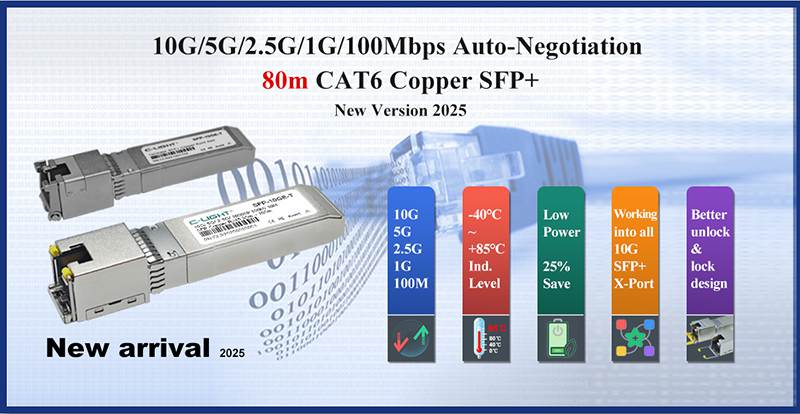
Some multi-rate copper modules can also support 1GbE, 2.5GbE, 5GbE, and 10GbE, but this capability depends on the specific module and host device. :contentReference[oaicite:5]{index=5}
10.How to Choose Between 10G Copper SFP+ and Optical SFP+
The selection can be simplified by considering several practical factors:
Existing cabling: Choose copper when Cat6A/Cat7 infrastructure is already available; choose optical when fiber infrastructure is preferred.
Distance: Copper 10GBASE-T SFP+ is typically suited to links up to 100m, while optical SFP+ options cover a wider range of distances.
Interface: Choose RJ45 for copper Ethernet and the appropriate optical connector for fiber-based SFP+ modules.
Power: Compare the actual module power specifications, especially in high-density deployments.
Compatibility: Verify the switch, router, server, or NIC compatibility before installation.
Network upgrade strategy: Copper can be attractive when existing structured cabling needs to be preserved, while optical provides greater flexibility for fiber-based network expansion.
11.10G Copper SFP+ from C-LIGHT
C-LIGHT provides 10G Copper SFP+ transceivers designed for high-speed Ethernet connectivity over copper cabling. The RJ45-based design allows an SFP+ port to connect with standard copper Ethernet infrastructure.
For applications requiring 10GbE connectivity over existing copper cabling, a 10GBASE-T SFP+ can provide a practical alternative to deploying a new optical infrastructure. Depending on the selected model, features can include multi-rate Ethernet support, hot-pluggable operation, commercial-temperature operation, and compatibility with Cat6A/Cat7 cabling.
For a specific deployment, users should confirm the required transmission distance, supported Ethernet speeds, host compatibility, cable category, and power consumption before selecting the module.
12.Conclusion
10G Copper SFP and 10G SFP+ are related, but they are not exactly the same term. 10G SFP+ describes a broad transceiver category, while a 10G Copper SFP+ is a specific SFP+ module that uses copper transmission and typically provides an RJ45 interface.
In simple terms, 10G Copper SFP+ is a type of 10G SFP+. If your network uses Cat6A/Cat7 copper cabling and requires 10GbE connectivity over distances of up to around 100m, a 10GBASE-T Copper SFP+ can be a practical choice. If you need longer distances or already operate a fiber infrastructure, an optical 10G SFP+ may be more appropriate
13. 10G Copper SFP vs 10G SFP+ Q&A
Q1. Are 10G Copper SFP and 10G SFP+ the same?
Answer: Not exactly. 10G SFP+ is the broader transceiver category, while 10G Copper SFP+ is a specific type that uses copper cabling and typically provides an RJ45 interface.
Q2. Is a 10G Copper SFP+ an optical module?
Answer: No. A 10G Copper SFP+ uses electrical signaling over copper Ethernet cabling rather than optical transmission over fiber.
Q3. How far can a 10G Copper SFP+ transmit?
Answer: Many 10GBASE-T Copper SFP+ modules support up to 100 meters over Cat6A or Cat7 copper cabling. The actual distance depends on the module and cable specifications.
Q4. Can a 10G Copper SFP+ be inserted into an SFP+ port?
Answer: Yes, it is designed for an SFP+ host port, but the switch, router, server, or NIC must support the specific 10GBASE-T copper module. Physical fit alone does not guarantee compatibility.
Q5. Does 10G SFP+ always mean fiber?
Answer: No. SFP+ is a form-factor and transceiver category. It can include optical fiber modules as well as copper-based modules such as 10GBASE-T RJ45 SFP+.
Q6. Which is better, 10G Copper SFP+ or optical 10G SFP+?
Answer: Neither is universally better. Copper SFP+ is convenient for existing Cat6A/Cat7 infrastructure and short-distance Ethernet connections, while optical SFP+ is generally more suitable for fiber networks and longer transmission distances.
 >
>

 >
>
 >
>
 >
>
 >
>
 >
>
 >
>
 >
>