TEL:+86 132 6656 7067




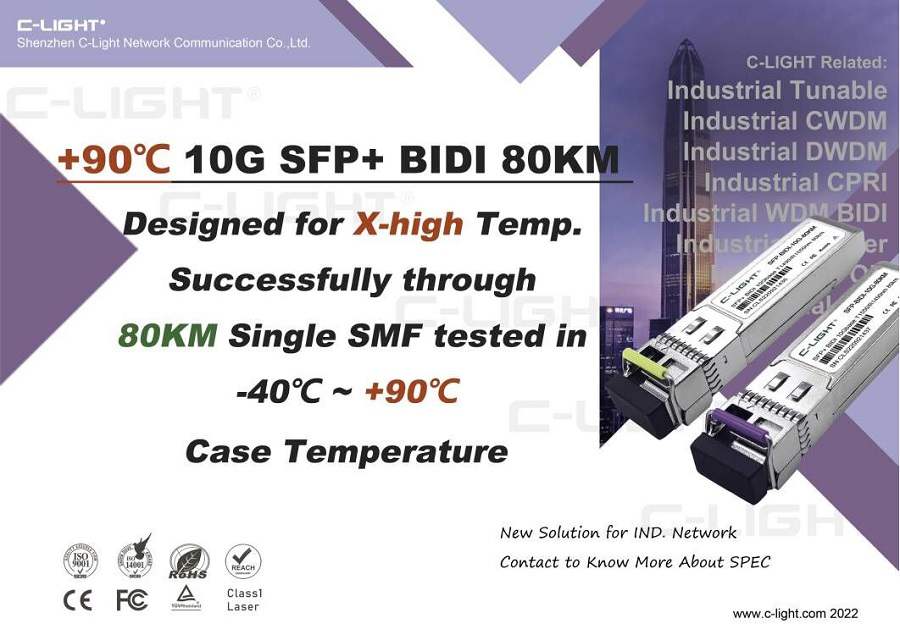
10G BiDi SFP+ 80km Optical Transceiver FAQ
Q1: What is a 10G BiDi SFP+ 80km optical transceiver?
Answer: A 10G BiDi SFP+ 80km optical transceiver is a long-distance optical module designed for 10Gbps data transmission over a single strand of single-mode fiber.
Unlike traditional duplex optical modules that require two fibers for transmitting and receiving data, BiDi optical modules use different wavelengths to achieve bidirectional communication through one fiber.
Key features include:
SFP+ compact form factor
10Gbps transmission rate
Single-fiber bidirectional transmission
80km long-distance reach
LC simplex optical connector
10G BiDi SFP+ 80km optical transceivers are widely used in:
Metropolitan Area Networks (MAN)
Long-distance enterprise networks
Telecom infrastructure
Data Center Interconnect (DCI)
By reducing fiber requirements, BiDi technology provides an efficient solution for long-distance optical communication where fiber resources are limited.
Q2: How does a 10G BiDi optical module work?
Answer: A 10G BiDi optical module uses different optical wavelengths for transmitting and receiving signals through the same single-mode fiber.
The working principle includes:
The transmitter sends optical signals using one wavelength.
The receiver receives signals using another wavelength.
Both transmission directions share a single optical fiber.
The optical module converts between electrical and optical signals.
For example, a typical BiDi pair may use:
| Module | Transmit (TX) | Receive (RX) |
|---|---|---|
| Module A | 1490nm | 1550nm |
| Module B | 1550nm | 1490nm |
This wavelength separation enables two-way communication through a single fiber link.
Q3: What are the advantages of 10G BiDi SFP+ 80km optical modules?
Answer: 10G BiDi SFP+ 80km optical modules provide several advantages for long-distance optical networks.
1. Fiber Saving
Requires only one fiber strand
Improves fiber resource utilization
Reduces additional fiber deployment requirements
2. Long Distance Transmission
Supports transmission distances up to 80km over single-mode fiber
Suitable for metro and backbone optical networks
3. Cost Reduction
Reduces fiber infrastructure costs
Lowers network expansion and maintenance expenses
4. Simple Deployment
Uses standard SFP+ interfaces
Compatible with many switches, routers, and optical transport systems
5. High Network Flexibility
Ideal for areas where fiber resources are limited
These advantages make BiDi technology valuable for telecom operators, enterprises, and data center operators managing long-distance optical networks.
Q4: What is the difference between 10G BiDi SFP+ and traditional 10G SFP+ modules?
Answer: The main difference between 10G BiDi SFP+ and traditional 10G SFP+ modules is the fiber requirement and transmission method.
| Feature | 10G BiDi SFP+ | Traditional 10G SFP+ |
|---|---|---|
| Fiber Usage | Single Fiber | Dual Fiber |
| Transmission Method | Bidirectional wavelength transmission | Separate TX/RX fibers |
| Connector | LC Simplex | LC Duplex |
| Fiber Cost | Lower | Higher |
| Application | Fiber-saving networks | Standard optical links |
BiDi modules are especially useful when available fiber resources are limited or deploying additional fiber cables is expensive.
Q5: Why are 80km BiDi optical modules important for telecom and DCI networks?
Answer: Long-distance optical connections require efficient fiber utilization, reliable transmission performance, and cost-effective network expansion.
80km BiDi optical modules help network operators build:
Metro Networks
Connect multiple network locations across cities
Support high-bandwidth metropolitan communication
Telecom Networks
Extend optical access and aggregation links
Improve fiber utilization efficiency
Data Center Interconnect (DCI)
Connect distributed data centers
Support long-distance data transmission
Enterprise Backbone Networks
Provide reliable high-speed communication between locations
By using one fiber instead of two, BiDi technology helps maximize existing fiber infrastructure investment.
Q6: What applications use 10G BiDi SFP+ 80km optical transceivers?
Answer: 10G BiDi SFP+ 80km modules are commonly deployed in applications requiring long-distance and bandwidth-efficient optical connectivity.
Typical applications include:
Telecom Networks
Carrier optical access
Metro aggregation networks
Enterprise Networks
Campus backbone connections
Remote office connectivity
Data Center Networks
Long-distance data center links
Optical infrastructure expansion
Video and Monitoring Systems
High-bandwidth signal transmission
The combination of long reach and single-fiber transmission makes BiDi suitable for distributed network environments.
Q7: How do you choose the right 10G BiDi optical module?
Answer: Selecting the right 10G BiDi optical module requires considering transmission distance, wavelength compatibility, fiber type, and equipment requirements.
1. Transmission Distance
Select according to link requirements:
10km
20km
40km
80km
2. Wavelength Matching
BiDi modules must be deployed as matched pairs.
TX/RX wavelengths must be opposite between two modules.
3. Fiber Type
Confirm compatibility with Single-mode Fiber (SMF).
4. Equipment Compatibility
Check compatibility with:
Switches
Routers
Optical transport equipment
Proper selection ensures stable and reliable long-distance optical communication.
Q8: What is the future development trend of 10G BiDi optical modules?
Answer: As fiber resources become increasingly valuable, single-fiber optical solutions will continue to play an important role in modern communication networks.
Future trends include:
Higher-speed BiDi optical solutions
25G/50G/100G BiDi development
More efficient fiber utilization
Expanded metro and access network applications
Although higher-speed optical technologies such as 400G and 800G are rapidly expanding in AI data centers, 10G BiDi remains an effective solution for existing telecom, enterprise, and long-distance optical networks requiring cost-efficient fiber deployment.
 >
>

 >
>
 >
>
 >
>
 >
>
 >
>
 >
>
 >
>