TEL:+86 132 6656 7067




1. Introduction
1.6T OSFP optical transceivers are becoming an important optical interconnect option for next-generation AI data centers, high-performance computing, and high-density Ethernet networks. By supporting up to 1.6Tbps of aggregate bandwidth in a pluggable form factor, they provide a path toward higher switch port capacity and faster GPU-to-network connectivity.
2. What Is a 1.6T OSFP Optical Transceiver?
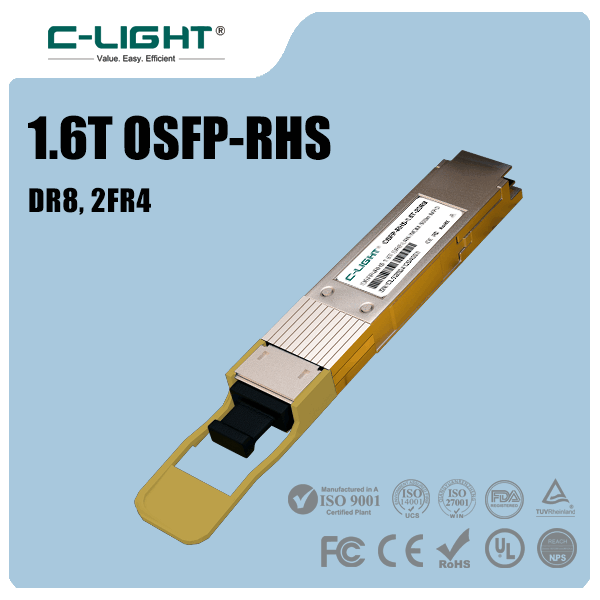
A 1.6T OSFP optical transceiver is a pluggable optical module designed to provide up to 1.6Tbps of aggregate data transmission. It converts high-speed electrical signals from a host device into optical signals and converts received optical signals back into electrical signals.
3. What Does OSFP Mean?
OSFP stands for Octal Small Form Factor Pluggable. The OSFP architecture provides eight high-speed electrical lanes and has evolved from 400G and 800G networking toward 1.6T operation.
4. What Does 1.6T Mean?
1.6T represents an aggregate data rate of approximately 1.6 terabits per second. A common implementation uses eight 200G-class lanes, providing approximately 200Gbps of capacity per lane.
5. Why 1.6T Matters for AI Data Centers
AI clusters create large amounts of traffic between GPUs, NICs, switches, and storage systems. Increasing bandwidth per optical port can help scale network capacity while reducing the number of physical ports required for a given aggregate bandwidth.
6. 1.6T vs 800G
| Parameter | 800G OSFP | 1.6T OSFP |
|---|---|---|
| Aggregate Data Rate | 800Gbps | 1.6Tbps |
| Typical Lane Rate | 100G-class or higher | 200G-class |
| Electrical Lanes | 8-class architecture | 8 × 200G-class |
| Signaling | PAM4 | PAM4 |
| Thermal Requirement | High | Higher |
7. 200G Per Lane
The move to 200G-class lanes is the key technology change behind 1.6T pluggable optics. Eight 200G-class lanes can provide the aggregate bandwidth required by a 1.6T interface.
8. PAM4 Signaling
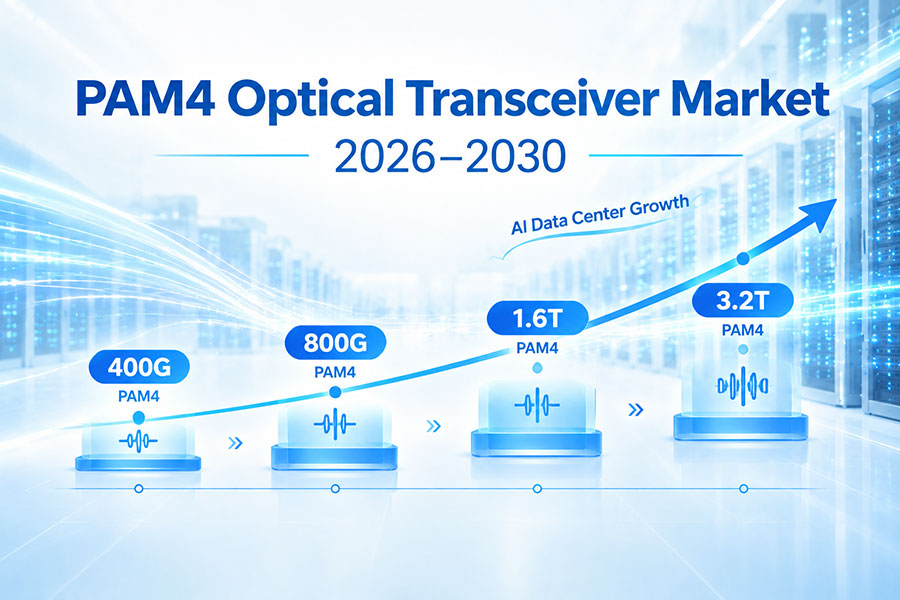
PAM4 uses four signal levels and carries two bits per symbol. It enables higher data rates without requiring a proportional increase in symbol rate, but it also creates tighter requirements for signal integrity, noise, equalization, and error performance.
9. 1.6T Electrical Interface
The electrical interface connects the optical module to the host switch ASIC or NIC. Current 1.6T architectures can use eight 200G-class electrical lanes, with the exact host interface depending on the system generation and implementation.
10. 1.6T Optical Interface
On the optical side, the eight high-speed electrical lanes are converted into optical channels. Depending on the application, the module can use parallel optics or wavelength-division multiplexing to achieve the required bandwidth and reach.
11. OSFP1600
The OSFP MSA defines an OSFP1600 variant supporting 200G per electrical lane. This provides the mechanical and electrical foundation for 1.6T pluggable optical modules.
12. OSFP-RHS
OSFP-RHS is a reduced-height OSFP architecture intended for different thermal and mechanical system designs. OSFP-RHS and standard OSFP use different cages and are not directly interchangeable, even though their electrical and management specifications can be aligned within the OSFP family.
13. Thermal Design
Higher lane rates increase thermal pressure on the optical module. Laser drivers, DSPs, TIAs, optical engines, and other components can generate significant heat, making heat spreading and host airflow increasingly important.
14. Heat Sink
Standard OSFP modules can use an integrated heat sink, while other OSFP architectures can use different host-side cooling arrangements. The exact thermal implementation depends on the module and switch design.
15. Air Cooling
Air cooling remains practical for many high-speed optical systems. Its effectiveness depends on module power, switch density, inlet temperature, heat-sink performance, fan capacity, and airflow design.
16. Liquid Cooling
Liquid cooling is increasingly relevant to high-density AI infrastructure. Direct-to-chip and immersion cooling are different approaches, and an optical module must be specifically designed or qualified for the selected cooling environment.
17. Optical Technology
1.6T optical modules can use several optical technologies. Silicon photonics, advanced EML, VCSEL, and hybrid optical architectures are all relevant depending on reach, wavelength, power, and module design.
18. Silicon Photonics
Silicon photonics integrates multiple optical functions into a photonic integrated circuit. It can combine waveguides, modulators, wavelength routing, and photodetectors into a compact optical engine, making it attractive for high-density multi-channel designs.
19. EML Technology
EML combines a laser source with an electro-absorption modulator and remains important for high-speed single-mode transmission. Advanced EML technologies can support 200G-class optical lanes for selected 1.6T architectures.
20. VCSEL Technology
VCSELs are widely used in short-reach multimode optical networking. Higher-speed VCSEL development provides a potential path for short-reach 1.6T applications where multimode fiber is appropriate.
21. 1.6T SR8
A 1.6T SR8 architecture can use eight optical lanes for short-reach connectivity. This approach is relevant to short-distance AI and data center links and may use multimode fiber depending on the implementation.
22. 1.6T DR8
1.6T DR8 uses eight parallel optical lanes and is designed for single-mode fiber applications. Current implementations can target approximately 500m-class reach, although actual distance depends on the specific product.
23. 1.6T 2DR4
2DR4 combines two DR4 optical groups. This approach can provide 1.6T connectivity while dividing the optical interface into two four-channel groups and can target approximately 500m-class single-mode links in specific implementations.
24. 1.6T 2×FR4
2×FR4 combines two four-channel WDM groups and can provide longer reach than short parallel optics. Certain implementations target approximately 2km over single-mode fiber.
25. Reach Options
| Architecture | Typical Fiber | Example Reach |
|---|---|---|
| SR8 | MMF | Short reach |
| DR8 | SMF | 500m-class in selected implementations |
| 2DR4 | SMF | 500m-class in selected implementations |
| 2×FR4 | SMF | 2km-class in selected implementations |
26. MPO Connectivity
Parallel 1.6T architectures commonly use high-density multi-fiber connectors. MPO-based interfaces can accommodate multiple optical lanes in a compact connection, but connector type, fiber count, lane mapping, and polarity must match the module.
27. Dual MPO-12
Some 1.6T DR8 and 2DR4 implementations use dual MPO-12 interfaces. This divides the optical connectivity into two high-density connections and requires correct polarity and lane mapping across both interfaces.
28. LC Connectivity
WDM-based architectures can use duplex LC interfaces when multiple optical channels are multiplexed onto a smaller number of fibers. This can simplify connections to existing single-mode fiber infrastructure.
29. Optical Link Budget
The link budget depends on transmitter output, receiver sensitivity, fiber attenuation, connector loss, splice loss, and other passive losses. A 1.6T module must provide sufficient margin for the intended transmission distance and operating conditions.
30. Signal Integrity
At 200G per lane, electrical signal integrity becomes a major engineering challenge. PCB loss, connector discontinuities, crosstalk, reflections, package design, and equalization all affect the available link margin.
31. DSP and 1.6T OSFP
DSP architecture strongly affects power, latency, and signal conditioning. Fully retimed modules can provide greater signal processing inside the transceiver, while lower-power architectures can move more of the signal-processing responsibility toward the host.
32. LPO and 1.6T
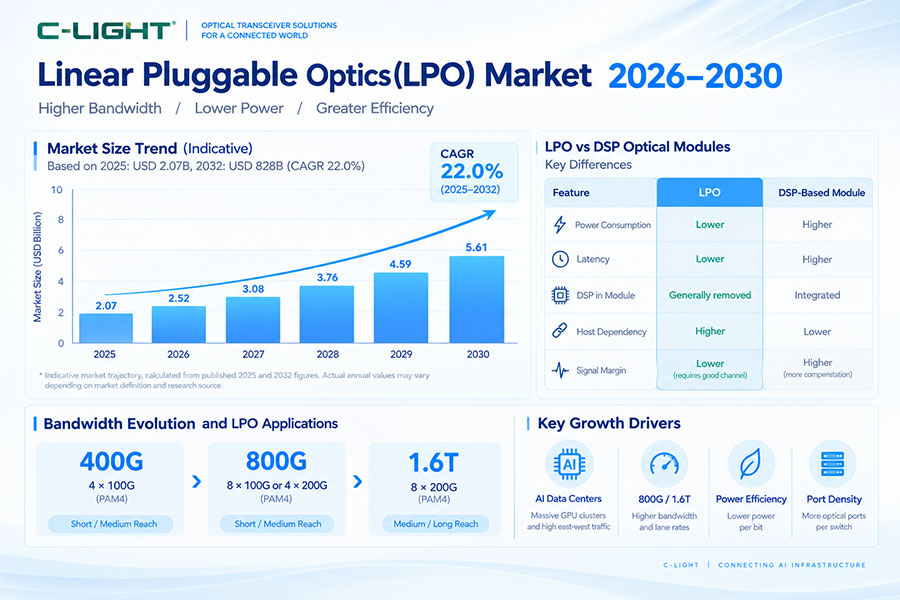
LPO reduces or bypasses certain module-level DSP functions and relies more heavily on the host SerDes and linear optical components. This can reduce module power, but the electrical channel becomes more sensitive to loss and signal-integrity limitations.
33. LRO and Hybrid Architectures
Linear receive or hybrid architectures can retain selected signal-processing functions while reducing others. These approaches provide additional options for balancing power, latency, and link margin in next-generation optical modules.
34. Power Consumption
1.6T modules generally face higher power requirements than previous generations because of higher lane speeds and more advanced processing. Total power depends on the DSP, laser, driver, TIA, optical engine, management functions, and thermal architecture.
35. Power per Bit
Power per bit is useful when comparing optical generations. A 1.6T module may consume more absolute power than an 800G module while still providing improved energy efficiency per transmitted bit.
36. AI Cluster Networking
AI training and inference clusters depend on high-bandwidth communication between GPUs, NICs, switches, and storage. 1.6T optical links can increase the capacity of these connections and support larger cluster architectures.
37. Switch-to-NIC Connectivity
1.6T optical interfaces can be used for high-capacity switch-to-NIC connections in AI scale-out systems. The host switch, NIC, and transceiver must support the same lane architecture and operating mode.
38. Switch-to-Switch Connectivity
High-capacity leaf-to-spine and spine-to-spine connections can use 1.6T optics where supported. Longer distances may require single-mode WDM architectures rather than short-reach parallel optics.
39. Port Density
Higher bandwidth per port allows switches to provide greater aggregate capacity without increasing port count at the same rate. However, higher port bandwidth also increases electrical, optical, and thermal requirements.
40. Compatibility
1.6T OSFP compatibility must be evaluated at the mechanical, electrical, optical, and management levels. The host cage, electrical lane rate, optical architecture, power class, firmware, coding, and management interface all matter.
41. OSFP and OSFP-RHS Compatibility
OSFP and OSFP-RHS are different mechanical implementations. They are not directly compatible at the cage level, so the host platform must be checked before selecting a 1.6T module.
42. CMIS and Diagnostics
Modern pluggable modules can provide management and diagnostic information through standardized interfaces. Parameters can include module temperature, supply voltage, optical power, laser bias, alarms, and module identification, depending on the implementation.
43. FEC
FEC is an important part of high-speed link design. The location and configuration of FEC depend on the host and transceiver architecture. Link qualification should consider BER and FEC performance together.
44. Testing Requirements
1.6T transceiver testing can include optical power, wavelength, receiver sensitivity, eye quality, TDECQ, BER, temperature, electrical signal integrity, and management functions. Testing should cover both module-level and complete-link performance.
45. Reliability
Higher-speed modules require careful reliability validation because optical alignment, high-speed electrical connections, thermal interfaces, laser operation, and packaging are all exposed to tighter operating conditions.
46. Manufacturing Challenges
1.6T production requires precise optical coupling, electrical assembly, thermal design, packaging, and testing. Manufacturing yield becomes increasingly important as the number of high-speed optical and electrical components increases.
47. Common Deployment Mistakes
Common mistakes include selecting a 1.6T OSFP module only by its data rate, ignoring the host cage, using an incompatible fiber type, exceeding the optical reach, overlooking MPO polarity, mixing unsupported electrical architectures, and failing to verify vendor coding.
48. How to Select a 1.6T OSFP Optical Transceiver
Start with the host platform and confirm the supported OSFP variant and electrical lane rate. Then select the optical architecture according to the required distance, fiber type, connector, power budget, thermal environment, management requirements, and interoperability.
49. 1.6T OSFP Selection by Reach
For short links, SR8 or similar parallel architectures can be considered. For approximately 500m-class single-mode connectivity, DR8 or 2DR4 architectures can be suitable in specified implementations. For longer links around 2km, WDM-based 2×FR4 designs may be appropriate.
50. 1.6T OSFP Selection by Cooling
Air-cooled and liquid-cooled platforms have different thermal requirements. The selected module should match the host switch's cooling design, module power limit, airflow, and operating temperature range.
51. 1.6T OSFP vs Traditional Optical Modules
| Parameter | 1.6T OSFP | Earlier High-Speed Modules |
|---|---|---|
| Bandwidth | 1.6Tbps | Lower aggregate capacity |
| Lane Rate | 200G-class | Typically lower |
| Signal Integrity | Very demanding | Less demanding |
| Thermal Load | Higher | Lower in many cases |
| Optical Integration | High | Varies by generation |
| AI Application | Next-generation AI fabrics | Existing network generations |
52. 1.6T OSFP for Future AI Networks
1.6T OSFP provides an important bandwidth step for AI scale-out networks. Its value is not limited to raw throughput; higher capacity per port can also affect switch architecture, rack design, cabling density, power distribution, and cooling requirements.
53. Future Optical Evolution
The transition to 1.6T is part of a broader movement toward higher lane rates, greater optical integration, lower power per bit, and closer optical-electrical integration. Technologies such as silicon photonics, advanced EML, LPO, CPO, and liquid cooling can all contribute to future optical systems.
54. Frequently Asked Questions
Q1. What is a 1.6T OSFP optical transceiver?
Q2. What is OSFP1600?
Q3. Does 1.6T OSFP use PAM4?
Q4. How many lanes does a 1.6T OSFP module use?
Q5. What fiber does a 1.6T OSFP use?
Q6. What is the typical reach of 1.6T DR8?
Q7. What is the difference between 1.6T DR8 and 2DR4?
Q8. What is the difference between OSFP and OSFP-RHS?
Q9. Is 1.6T OSFP suitable for AI data centers?
Q10. What are the main challenges of 1.6T OSFP?
55. Summary
1.6T OSFP optical transceivers provide a major increase in bandwidth density for AI data centers, HPC systems, and next-generation Ethernet networks. The current OSFP1600 architecture supports 200G per electrical lane, with eight 200G-class lanes providing a common path to 1.6Tbps. Different optical architectures, including SR8, DR8, 2DR4, and 2×FR4, can address different reach and fiber requirements. At the same time, 1.6T raises the importance of PAM4 signal integrity, DSP architecture, optical integration, thermal management, power per bit, host compatibility, and testing. For deployment, the correct 1.6T OSFP module should be selected according to the complete host, optical, electrical, thermal, and cabling architecture rather than bandwidth alone.
 >
>

 >
>
 >
>
 >
>
 >
>
 >
>
 >
>
 >
>