TEL:+86 132 6656 7067





AI infrastructure is pushing optical connectivity beyond the bandwidth limits of today's 800G and 1.6T generations. Larger accelerator clusters, higher switch capacity, and increasingly demanding scale-up networks are creating pressure not only for faster transceivers, but also for shorter electrical paths, denser optical integration, and more efficient fiber utilization. The next stage of optical interconnect development will therefore involve several parallel changes: higher per-lane signaling rates, 3.2T-class interfaces, near-package and co-packaged optics, optical I/O, and new fiber architectures.
These technologies will not arrive as one universal replacement for pluggable transceivers. Their adoption will depend on link distance, system architecture, power budgets, serviceability, manufacturing maturity, and interoperability requirements.
1. Why Optical Interconnects Must Move Beyond 1.6T
The growth of AI training and inference increases the amount of data exchanged between accelerators, switches, memory systems, and storage infrastructure. As clusters become larger, interconnect bandwidth can become a major constraint on overall system performance.
Traditional pluggable optical modules have supported successive speed generations by increasing lane rates, improving modulation technology, and using more parallel optical lanes. However, each increase creates new engineering challenges:
Electrical signal integrity: Higher signaling rates make PCB traces, connectors, package transitions, and electrical channel losses more difficult to manage.
Power consumption: High-speed SerDes, DSPs, and signal-conditioning circuits consume an increasing share of the system power budget.
Thermal density: More bandwidth in the same switch or accelerator footprint increases cooling requirements.
Front-panel density: More optical ports require space for cages, connectors, fiber routing, and service access.
Fiber management: Large AI clusters need scalable fiber routing and reliable optical connections across racks and buildings.
These constraints explain why the industry is investigating ways to move optical conversion closer to switching and computing silicon. Increasing the nominal data rate alone cannot solve every system-level bottleneck.
2. From 1.6T to 3.2T and Beyond
The next major bandwidth milestone for pluggable optical connectivity is 3.2T. The development path depends on advances in electrical interfaces, optical modulation, photonic integration, packaging, and thermal management.
At the electrical interface level, the industry is investigating signaling rates beyond today's 200G-per-lane generation. IEEE 802.3's future Ethernet assessment has identified 400 Gb/s electrical and optical signaling as an important development direction and a building block for future 3.2T Ethernet and higher-capacity systems.
| Generation or direction | Bandwidth level | Technology focus | Development context |
|---|---|---|---|
| 800G | 800 Gb/s | 100G-class electrical and optical lanes in common architectures | Established deployment generation |
| 1.6T | 1.6 Tb/s | 200G-class lane technology, advanced DSP and silicon photonics | Current deployment and ramp-up generation |
| 3.2T | 3.2 Tb/s | Higher-speed electrical and optical interfaces, advanced photonic integration | Next-generation development direction |
| 6.4T and above | 6.4 Tb/s and higher | Integrated optical engines, higher-density interfaces, and advanced packaging | Longer-term system and module development |
The figures represent aggregate interface bandwidth, not a guarantee that every generation will use the same number of lanes, modulation format, wavelength arrangement, or module form factor. A 3.2T implementation could take different physical forms depending on the electrical interface and optical architecture selected by the system designer.
It is also important to distinguish a technology roadmap from a standardized, interoperable product. A higher-speed demonstration or engineering sample does not automatically mean that a complete multi-vendor ecosystem is ready for broad deployment.
3. 400G-per-Lane Signaling and the Next Electrical Bottleneck
Higher aggregate bandwidth requires faster individual lanes, more lanes, or a combination of both. Moving toward 400G-per-lane signaling is therefore an important research and development direction for future Ethernet and optical interconnect systems.
However, increasing the lane rate is not simply a matter of doubling the clock speed. Designers must address insertion loss, crosstalk, equalization, jitter, modulation performance, receiver sensitivity, and error correction. Electrical and optical components must work together to maintain acceptable bit error rates over the intended channel.
At these rates, the choice of modulation format and signal-processing architecture becomes especially important. PAM4 has supported major recent bandwidth increases, while higher-order modulation formats and other signaling approaches are being investigated for future generations. The final choices depend on channel conditions, implementation complexity, power, and achievable signal quality.
4. Silicon Photonics Will Become More Important
Silicon photonics integrates optical functions onto photonic integrated circuits, enabling components such as waveguides, modulators, couplers, multiplexers, and photodetectors to be fabricated and connected through advanced semiconductor processes.
Its importance grows as optical systems move toward higher bandwidth density. Rather than assembling every optical function from separate discrete components, silicon photonics can support more compact and repeatable optical architectures.
Several developments are particularly relevant:
Higher-speed modulators: New device designs and material platforms are being investigated to support faster optical signaling while controlling insertion loss and drive requirements.
Improved laser integration: External, hybrid-integrated, and integrated laser approaches offer different trade-offs in reliability, thermal management, and serviceability.
Advanced photonic packaging: Fiber coupling, alignment accuracy, packaging yield, and thermal behavior become increasingly important as optical engines become more integrated.
Manufacturing scalability: Repeatable fabrication and test processes are essential for moving from laboratory demonstrations to high-volume systems.
Silicon photonics is not a replacement for every optical material or component. Indium phosphide and other material systems remain important for specific laser and photonic functions. Future products may combine multiple technologies within one optical engine.
5. NPO and CPO Will Move Optics Closer to the ASIC
One of the most significant changes beyond 1.6T is the movement of optical engines closer to the switch ASIC or accelerator package. This reduces the distance that high-speed electrical signals must travel before being converted into optical signals.
Three integration approaches are receiving particular attention:
| Architecture | Optical placement | Potential advantages | Main engineering considerations |
|---|---|---|---|
| Pluggable optics | Removable module in the front panel | Serviceability, modular replacement, and established multi-vendor ecosystems | Longer electrical paths between ASIC and optical module |
| NPO | Optical engine near the ASIC or package | Shorter electrical connections and greater integration flexibility | Board-level thermal design, optical access, and serviceability |
| CPO | Optical engines integrated with or very close to the switch package | Potentially shorter electrical paths and higher bandwidth density | Packaging complexity, laser supply, cooling, repair, and manufacturing yield |
Near-Packaged Optics (NPO) places optical engines close to the main processing or switching device while retaining a degree of separation from the package itself. This can shorten electrical paths without requiring every optical component to be integrated into the same package.
Co-Packaged Optics (CPO) brings optical engines into the switch package or a closely integrated package assembly. This approach can reduce high-speed electrical interconnect distance and support high aggregate bandwidth, but it introduces demanding packaging, thermal, optical coupling, and maintenance requirements.
Neither approach automatically makes pluggable optics obsolete. Pluggable modules remain attractive where field replacement, flexible port configuration, and established interoperability are priorities. Different architectures are likely to coexist across scale-out, scale-up, and other network segments.
6. Optical I/O Will Extend Connectivity Toward AI Processors
Optical I/O represents a further step in the integration of photonic communication with computing systems. Instead of relying exclusively on conventional electrical I/O across longer package or board-level channels, optical I/O architectures aim to provide optical communication closer to the processor or accelerator.
An optical I/O implementation may use a photonic chiplet or integrated optical engine connected to electronic circuitry. The photonic subsystem performs electrical-to-optical and optical-to-electrical conversion, while the surrounding system manages data movement and protocol functions.
Potential application areas include:
High-bandwidth communication between AI accelerator packages.
Optical links between processor trays or racks in large-scale systems.
Shorter-reach, high-density connections within advanced compute platforms.
Future disaggregated computing architectures requiring flexible high-bandwidth connectivity.
Optical I/O is not simply another name for a conventional pluggable transceiver. It describes a broader system-level approach to bringing optical communication into or closer to computing packages. Its commercial adoption will depend on packaging maturity, power efficiency, software and protocol integration, reliability, and manufacturing cost.
7. Multi-Wavelength and Multi-Core Fiber Can Increase Fiber Capacity
Higher data rates also place pressure on fiber infrastructure. Increasing the bandwidth of each optical lane is one solution, but future systems can also improve fiber utilization through wavelength and spatial multiplexing.
Wavelength Division Multiplexing (WDM) combines multiple optical wavelengths over a fiber. Each wavelength carries an independent data channel, allowing aggregate capacity to increase without requiring a separate fiber for every channel.
Space Division Multiplexing (SDM) uses multiple spatial paths to carry independent data streams. Multi-core fiber is one example: several optical cores are incorporated into a single fiber structure, potentially increasing capacity while reducing the number of separate fiber cables required.
These approaches introduce their own engineering requirements, including optical crosstalk control, connector design, fiber management, manufacturing consistency, and testing. Their suitability depends on the required distance, capacity, and deployment environment.
8. Optical Interconnects Will Expand Across Scale-Up, Scale-Out, and DCI
Future optical networks will not be limited to connections between conventional data center switches. AI infrastructure is creating demand for optical connectivity at multiple levels of the system.
Scale-up: Connects accelerators and compute resources within tightly coupled systems. Short electrical paths and high bandwidth density are major priorities, making NPO, CPO, and optical I/O relevant development areas.
Scale-out: Connects servers, racks, and network switches across larger clusters. Pluggable optical transceivers, AOCs, and other fiber-based links will remain important.
Scale-across and campus connectivity: Extends networking across multiple data center buildings or larger infrastructure sites. Fiber reach, optical amplification, and coherent transmission can become more important.
Data Center Interconnect (DCI): Connects geographically separated data center facilities. Coherent optical technologies and high-capacity wavelength systems support longer-reach transmission.
For longer-reach links, coherent optics will continue to play an important role. Higher-capacity coherent interfaces, optimized modulation, and improved optical line systems can support more efficient data transport across data center campuses and metropolitan networks.
The appropriate solution depends on the distance and network design. A short-reach accelerator connection, a rack-to-rack link, and a campus DCI connection have different requirements and should not be treated as interchangeable applications.
9. Power, Cooling, and Reliability Will Determine Commercial Adoption
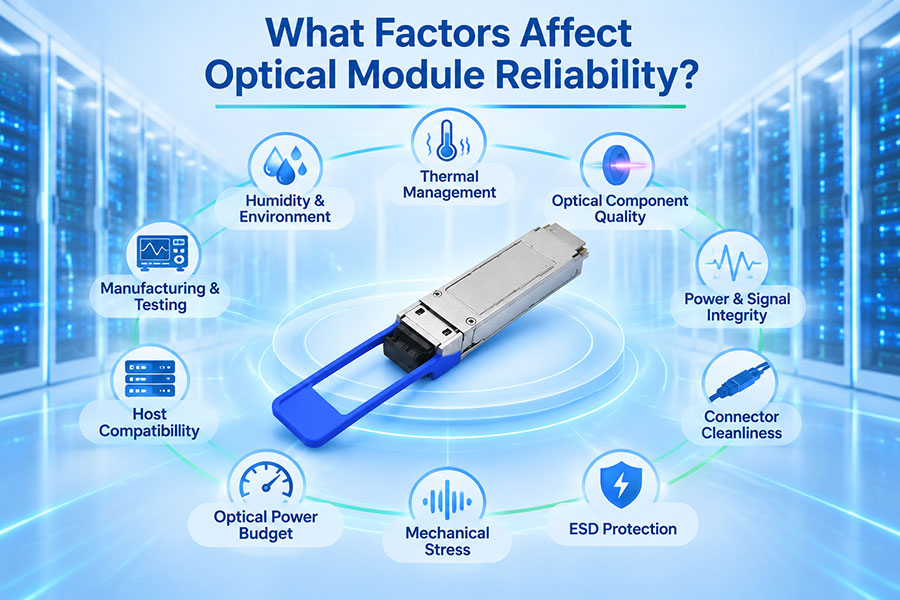
Higher bandwidth is useful only when the complete system can operate within its power, thermal, and reliability limits. As optical engines move closer to high-power ASICs, thermal management becomes a central part of optical architecture design.
Future systems will need to address several factors:
Power per bit: Energy consumption should be evaluated against delivered bandwidth, reach, and link quality rather than module speed alone.
Thermal isolation: Lasers, modulators, and photodetectors must operate within their specified temperature ranges.
Laser reliability: Laser lifetime, redundancy, monitoring, and replacement strategies become important in highly integrated systems.
Optical coupling: Fiber attachment and alignment must remain stable through manufacturing, operation, and maintenance.
Manufacturing yield: Advanced photonic packaging must achieve consistent performance at commercially viable production volumes.
Field maintenance: System operators need practical methods for identifying faults and replacing failed components.
Integrated optics may reduce some electrical power losses, but it does not guarantee lower total system power in every application. A meaningful evaluation must include the ASIC, SerDes, DSP, optical engine, laser source, cooling system, and supporting infrastructure.
10. The Role of 800G and 1.6T Products During the Transition
Although the industry is working toward 3.2T and more highly integrated optical architectures, 800G and 1.6T connectivity remains important for current data center expansion. These generations provide practical building blocks for network upgrades while future interfaces and packaging technologies mature.
C-LIGHT's current product portfolio includes several relevant high-speed connectivity options:
800G OSFP Optical Transceivers for high-bandwidth switch and data center connectivity.
800G QSFP-DD Optical Transceivers for supported QSFP-DD800 platforms and network designs.
400G OSFP Optical Transceivers for 400G network infrastructure.
400G QSFP-DD Optical Transceivers for supported 400G switch and router platforms.
1.6T OSFP-RHS for next-generation high-bandwidth system designs where the host platform supports the corresponding interface and thermal requirements.
800G AOC and 800G AEC for suitable short-reach interconnect applications.
These products address existing 400G, 800G, and 1.6T connectivity requirements. They should not be interpreted as 3.2T or CPO/NPO optical I/O products. The transition to future architectures will require new host interfaces, mechanical designs, thermal specifications, optical engines, and system-level qualification.
For network planners, a practical migration strategy is to deploy currently supported speeds where they meet bandwidth and latency requirements, while selecting switch platforms, cabling infrastructure, and rack designs that can accommodate future optical integration.
11. What Will Shape the Optical Interconnect Roadmap?
The future of optical interconnects will be determined by the combined progress of semiconductor interfaces, photonic devices, fiber infrastructure, and system architecture. Several developments are likely to shape the next generations:
400G-class electrical and optical signaling research as a foundation for higher aggregate bandwidth.
3.2T-class interfaces and increasingly dense optical modules.
Broader use of silicon photonics and advanced photonic packaging.
NPO and CPO adoption in systems where electrical reach and power constraints justify deeper integration.
Optical I/O for high-bandwidth communication closer to processors and accelerators.
Multi-wavelength and multi-core fiber technologies for greater fiber capacity.
Improved coherent optics for high-capacity campus and DCI networks.
Stronger interoperability, management, reliability, and thermal standards.
The timing of these developments will vary by application. A technology may appear in a demonstration, enter sampling, and still require several stages of qualification before becoming a widely deployed product. Commercial readiness should be evaluated through verified specifications, multi-vendor interoperability, reliability data, and actual system availability.
12. Conclusion
Optical interconnects beyond 1.6T will evolve through more than higher transceiver data rates. The next generation will combine faster electrical signaling, advanced silicon photonics, NPO and CPO architectures, optical I/O, and improved fiber utilization. These developments will support the growing bandwidth requirements of AI clusters, high-performance computing, and large-scale data center networks.
Pluggable optics will remain relevant during this transition, while integrated optical architectures expand into applications where bandwidth density, electrical reach, and power efficiency justify the additional complexity. The long-term direction is toward closer integration between computing silicon and photonic communication, supported by reliable packaging, scalable manufacturing, and interoperable system designs.
For optical network operators and equipment designers, preparing for this evolution means balancing current 400G, 800G, and 1.6T deployment needs with a flexible infrastructure strategy for future 3.2T and integrated optical systems. For product and technical requirements,
Email:
sales@c-light.com
WhatsApp:
+86 132 6656 7067
For any questions, please contact us by email or WhatsApp.
 >

 >
 >
 >
 >
 >
 >
 >