TEL:+86 132 6656 7067





Artificial intelligence infrastructure is changing the economics of data center networking. Large-scale training and inference systems connect thousands of accelerators, high-performance switches, storage systems, and computing nodes. As these systems grow, network bandwidth, electrical signal integrity, power consumption, and cooling capacity increasingly influence overall cluster performance.
Optical connectivity is evolving to address these constraints at multiple levels. Higher-speed pluggable transceivers, silicon photonics, linear-drive optics, near-packaged optics, co-packaged optics, and optical circuit switching are developing as complementary approaches. Rather than replacing every existing connection with one new technology, next-generation AI networks will use different optical architectures according to link distance, bandwidth, latency, serviceability, and system power requirements.
1. Why AI Networks Need a New Optical Connectivity Architecture
Modern AI clusters generate substantial east-west traffic as accelerators exchange model parameters, gradients, activations, and distributed training data. Network performance depends not only on the capacity of individual links but also on the efficiency of the complete fabric.
As accelerator performance increases, conventional electrical interconnects face several constraints:
Bandwidth limitations: Higher traffic volumes require faster connections between accelerators, switches, and network tiers.
Signal integrity: High-speed electrical channels become more difficult to maintain as signaling rates increase and channel losses accumulate.
Power consumption: SerDes, retimers, DSPs, and other signal-processing components contribute to the power budget of network equipment.
Thermal density: High-speed switching and optical components generate heat within increasingly compact systems.
Interconnect scalability: Larger clusters require more network links, higher-radix switches, and efficient cabling architectures.
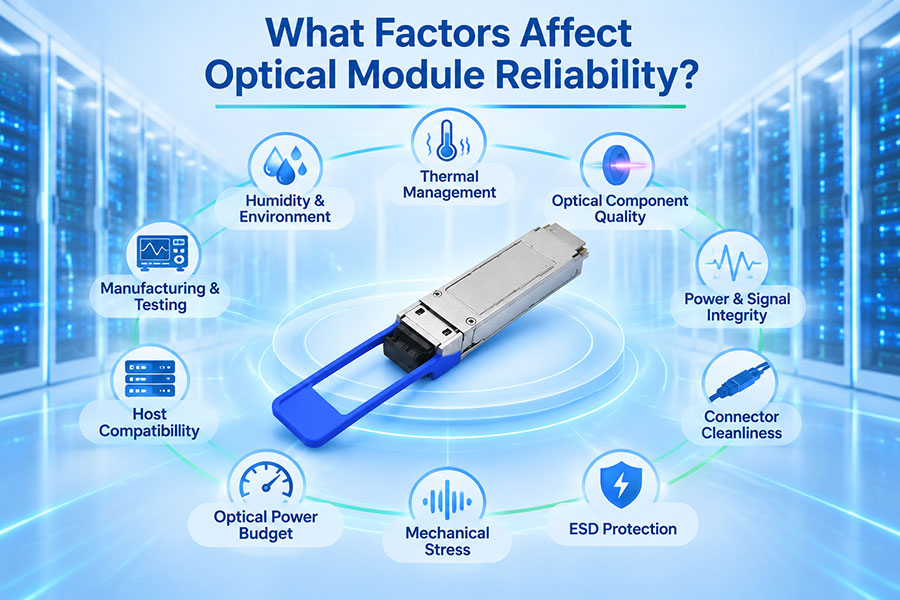
Optical transmission helps address distance-related electrical losses and supports high-bandwidth connectivity over fiber. However, optics also introduce their own power, thermal, manufacturing, and maintenance requirements. The next generation of AI networking therefore focuses on improving the entire electrical-to-optical signal path, not simply increasing transceiver data rates.
2. Optical Connectivity Across AI Scale-Up, Scale-Out, and Scale-Across Networks
AI network architecture is commonly divided into scale-up, scale-out, and scale-across domains. Each has different connectivity requirements, and optical technology will enter these domains at different rates.
| Network Architecture | Primary Connectivity | Key Requirements | Optical Development Direction |
|---|---|---|---|
| Scale-Up | Connections among accelerators within a tightly integrated computing system | High bandwidth, low latency, efficient short-reach interconnects | High-speed copper, optical I/O, onboard optics, and emerging co-packaged approaches |
| Scale-Out | Connections between servers, accelerator trays, and network switches | High-radix switching, bandwidth, predictable latency, and fabric scalability | 400G, 800G, 1.6T pluggable optics, AOCs, LPO, and CPO |
| Scale-Across | Connections between clusters, data center buildings, or geographically distributed facilities | Longer reach, optical amplification, capacity, and link reliability | DWDM, coherent optics, DCI systems, and high-capacity optical transport |
Optical connectivity will not necessarily replace copper at every point in an AI cluster. Short electrical connections can remain attractive where distance is limited and the power, cost, and integration trade-offs are favorable. Optical links become increasingly important as bandwidth and reach requirements exceed the practical capabilities of electrical connections.
3. From 800G to 1.6T and 3.2T Optical Transceivers
Higher per-port bandwidth is one of the most visible changes in AI optical connectivity. 400G and 800G technologies have enabled higher-capacity data center fabrics, while 1.6T pluggable designs extend the same direction using faster electrical and optical interfaces.
A common 1.6T pluggable architecture uses eight electrical lanes operating at 200G per lane. This doubles the aggregate bandwidth of an eight-lane 800G architecture based on 100G-class lanes. The transition requires advances in SerDes, modulation, optical components, DSP technology, packaging, and thermal management.
| Generation | Representative Lane Architecture | Aggregate Data Rate | Network Role |
|---|---|---|---|
| 400G | 8 × 50G or 4 × 100G electrical lanes, depending on implementation | 400 Gbps | High-speed data center switching and aggregation |
| 800G | 8 × 100G-class or 4 × 200G-class lanes, depending on implementation | 800 Gbps | AI scale-out fabrics and high-capacity switching |
| 1.6T | 8 × 200G-class electrical lanes | 1.6 Tbps | Next-generation AI switches and accelerator networking |
| 3.2T | Future lane architecture and optical implementation | 3.2 Tbps | Future high-radix switching and optical interconnect systems |
The industry is also working toward 3.2T optical connectivity. Achieving this capacity will require continued improvements in electrical signaling, optical modulation, photonic integration, packaging, and heat removal. The exact lane count, form factor, and optical implementation will depend on the standards and multi-source agreements adopted for each product generation.
4. Silicon Photonics Will Become More Important
Silicon photonics integrates optical functions onto photonic integrated circuits using semiconductor manufacturing techniques. It can combine modulators, waveguides, multiplexers, and other optical components into a compact platform, supporting higher integration and scalable optical engine designs.
As optical lane rates increase, silicon photonics is becoming an important technology for 800G and 1.6T transceivers and future higher-capacity optical systems. It offers a path toward integrating multiple optical functions while addressing module size, manufacturing scalability, and energy efficiency.
Its development also involves heterogeneous integration. Silicon is not equally suited to every optical function, particularly light generation. III-V semiconductor lasers and other materials can be integrated or coupled with silicon photonic platforms to provide the required optical sources and performance.
Important development areas include:
Higher-bandwidth silicon photonic modulators for 200G-class and future optical lanes.
Low-loss optical waveguides and improved coupling efficiency.
Integration of lasers, photodetectors, drivers, and transimpedance amplifiers.
Improved thermal stability and optical performance across operating conditions.
Manufacturing processes that support reliable, high-volume photonic integration.
Silicon photonics is not a single transceiver form factor. It is an integration technology that can be used in pluggable modules, onboard optical engines, and co-packaged optical systems.
5. LPO and NPO: Reducing the Distance Between Electronics and Optics
Traditional pluggable optical transceivers commonly use DSPs to compensate for signal impairments and maintain reliable high-speed transmission. As data rates increase, the power and latency associated with signal processing become important system-level considerations.
Linear-drive optics and near-packaged optics are two approaches intended to improve the electrical-to-optical signal path.
Linear Pluggable Optics (LPO) reduces or removes the DSP-based retiming stage in the optical module. The host switch and module use a more direct linear electrical interface, potentially lowering power consumption and latency. However, the host SerDes, channel quality, and link design must provide sufficient signal integrity. LPO is therefore more sensitive to system-level electrical performance than conventional DSP-based pluggables.
Near-Packaged Optics (NPO) places optical engines closer to the switch ASIC than conventional front-panel pluggable modules. Shorter electrical connections can reduce channel loss and may improve power efficiency at high data rates, while retaining more separation between the optical engine and the main switch package than CPO.
| Technology | Integration Position | Potential Advantages | Key Engineering Considerations |
|---|---|---|---|
| DSP-based Pluggable | Front-panel module | Signal conditioning, replaceability, established deployment model | Module power, DSP heat, electrical channel requirements |
| LPO | Front-panel pluggable module | Potentially lower power and latency through a simpler signal path | Host SerDes performance, channel loss, signal integrity, interoperability |
| NPO | Near the switch ASIC, typically on the system board | Shorter electrical paths and closer integration | Serviceability, optical routing, thermal design, system packaging |
| CPO | Optical engines integrated with the switch ASIC package | Very short electrical paths and high integration density | Packaging, external laser architecture, reliability, repair strategy |
These technologies are not interchangeable. Each represents a different balance between integration, signal processing, power, serviceability, and system complexity. Their adoption will depend on the network's performance targets and the equipment manufacturer's architecture.
6. Co-Packaged Optics Will Change Switch Architecture
Co-Packaged Optics (CPO) moves optical engines close to, or within the same package as, a switch ASIC. This reduces the length of high-speed electrical connections between the switch silicon and optical conversion components.
In conventional pluggable architectures, electrical signals travel from the switch ASIC across the board to front-panel transceiver cages. At very high signaling rates, these electrical paths require significant signal conditioning. CPO shortens this path by placing optical engines alongside the switch package.
The potential benefits include:
Reduced electrical channel length between the switch ASIC and optical engines.
Potential improvements in energy efficiency at high aggregate bandwidth.
Higher optical bandwidth density around advanced switching silicon.
More flexible optical connectivity for large-scale AI fabrics.
However, CPO introduces challenges that are less prominent in traditional pluggable systems. Optical engines are more closely integrated with expensive switch hardware, making replacement and maintenance more complicated. External laser sources, optical fiber routing, connector reliability, packaging yield, and thermal isolation must be addressed at the system level.
For these reasons, CPO is not expected to replace all pluggable transceivers at once. Pluggable optics retain advantages in field replacement, independent module qualification, and multi-vendor deployment. The two architectures are likely to coexist for different network roles.
7. Optical Circuit Switching for Large AI Fabrics
Optical Circuit Switching (OCS) is another technology gaining attention in large-scale AI network design. Unlike conventional packet switches that process individual packets electronically, an optical circuit switch establishes optical paths between selected input and output ports.
OCS can be used to reconfigure connections between groups of servers, accelerator systems, or network domains. In suitable architectures, it can reduce the need for repeated optical-to-electrical-to-optical conversion across certain paths and provide flexible connectivity for large traffic flows.
Potential applications include:
Reconfigurable connections between AI compute groups.
Dynamic allocation of network capacity for large training jobs.
Optical fabric architectures that complement packet-switched networks.
Interconnection of high-bandwidth network domains.
OCS is not a direct replacement for packet switching. It operates at the optical circuit level and is generally suited to traffic patterns and network designs where establishing longer-lived optical paths is beneficial. Control-plane coordination, path setup time, topology management, and traffic behavior remain important design factors.
8. Optical Connectivity Will Extend Across More Network Distances
Future AI infrastructure will use optical connectivity across multiple distances, from short connections inside computing systems to longer links between data centers. Different optical technologies will serve these applications according to reach, capacity, fiber infrastructure, and cost.
| Connection Environment | Representative Technologies | Primary Design Priorities |
|---|---|---|
| Inside a server or accelerator system | High-speed copper, optical I/O, and emerging integrated optics | Short reach, low latency, power efficiency, integration |
| Server-to-switch connections | DAC, AEC, AOC, and pluggable optical transceivers | Port speed, cable distance, power, and installation density |
| Switch-to-switch connections | 400G, 800G, 1.6T pluggable optics and optical engines | Bandwidth, fiber count, optical reach, and network topology |
| Data center interconnection | Coherent optics, DWDM, and optical transport systems | Reach, wavelength capacity, amplification, and link budget |
| Distributed data center infrastructure | Coherent optical systems and high-capacity DWDM networks | Long-distance transmission, scalability, and operational reliability |
As AI infrastructure becomes geographically distributed, coherent optical technologies will remain important for high-capacity data center interconnection. Within individual facilities, short-reach parallel optics, duplex single-mode links, AOCs, and emerging integrated optical architectures will serve different connectivity requirements.
9. Power Efficiency and Thermal Management Will Shape Optical Design
Power consumption is becoming a major constraint in AI data centers. The energy used by optical modules, switch ASICs, retimers, signal-processing components, and cooling infrastructure must be considered together.
Improving optical connectivity efficiency requires more than reducing the power consumption of one transceiver. Engineers must evaluate the complete link, including electrical signaling, optical conversion, DSP processing, fiber coupling, and host-system cooling.
Important development priorities include:
Lower power per bit: Improve the energy efficiency of optical transmitters, receivers, and signal-processing circuits.
Reduced electrical reach: Place optical conversion closer to switching silicon where the system architecture supports it.
Advanced photonic integration: Combine optical functions to reduce component count and improve integration.
Improved thermal interfaces: Coordinate module heat sinks, host airflow, cold plates, and system-level cooling.
Efficient network utilization: Improve topology and traffic management so installed bandwidth is used effectively.
Liquid cooling may become increasingly relevant for high-power switching platforms and advanced optical integration. However, liquid cooling is a host-system solution rather than an inherent feature of every optical transceiver. Module mechanical design, thermal contact, operating temperature, and equipment qualification must all be considered.
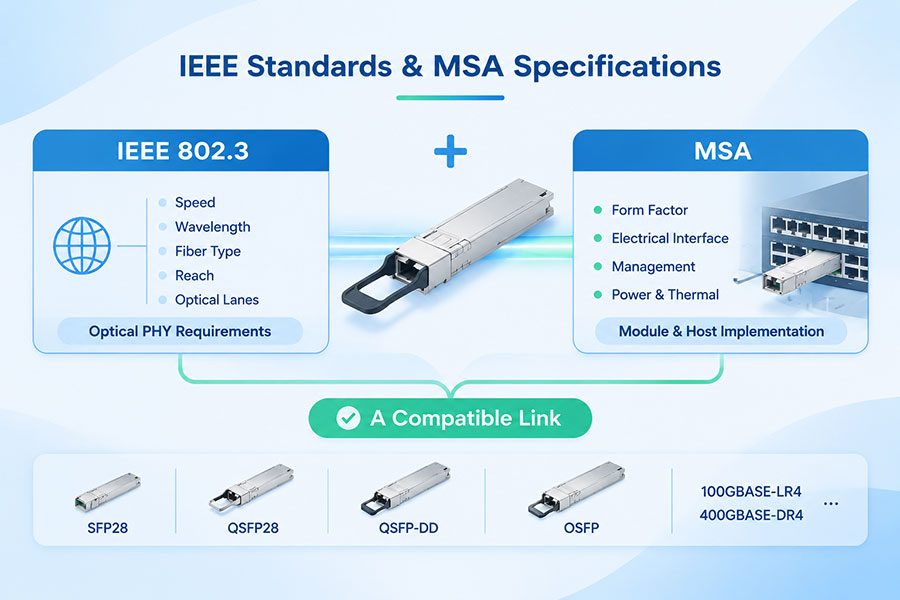
10. Interoperability and Standards Will Remain Essential
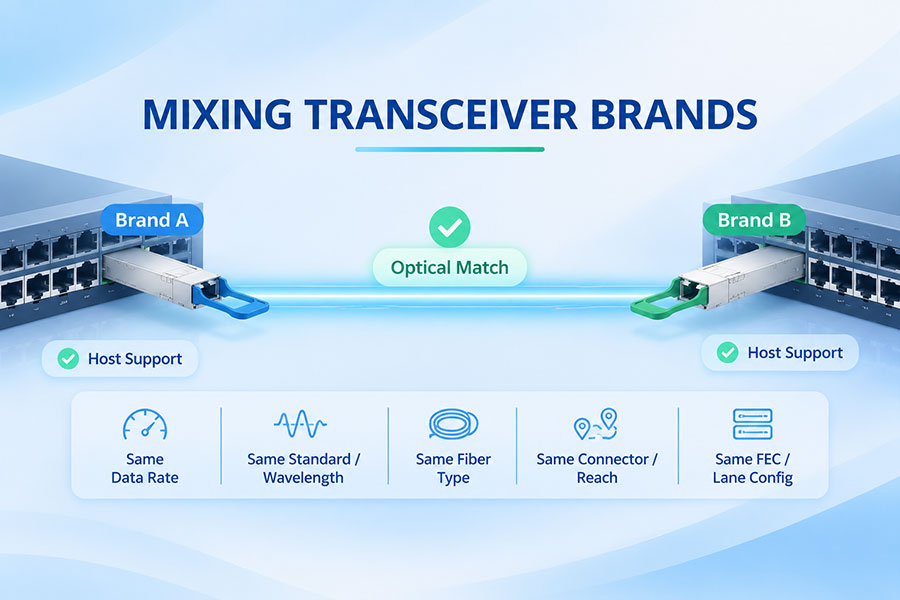
Higher bandwidth and closer optical integration increase the importance of interoperability. A module may use a recognized form factor and optical interface but still require specific host support, firmware, electrical signaling, management behavior, and power capability.
Several industry organizations contribute to the development of high-speed optical connectivity:
IEEE 802.3: Defines Ethernet physical-layer specifications, electrical interfaces, optical interfaces, and related management parameters.
OIF: Develops implementation agreements for electrical interfaces, coherent optics, co-packaging, and other interoperable network technologies.
OSFP MSA and QSFP-DD MSA: Define mechanical, electrical, and management requirements for their respective pluggable form-factor families.
CMIS: Provides a common management interface framework for supported optical modules and related devices.
For AI network operators, interoperability testing should cover more than optical signal compatibility. Electrical lane mapping, FEC configuration, module power, thermal performance, firmware, diagnostics, and link behavior all influence deployment success.
11. C-LIGHT Optical Connectivity for Next-Generation AI Networks
As AI data center networks move toward higher port speeds and denser switching architectures, optical connectivity must support different link distances, host platforms, and system requirements. C-LIGHT offers optical transceiver and active cable product families covering established high-speed deployments and emerging network generations.
400G Optical Transceivers
400G modules support high-bandwidth data center links and provide connectivity options for switch, router, and network infrastructure upgrades.
800G Optical Transceivers
800G modules address higher-capacity AI fabrics and next-generation data center switching platforms. Selection depends on the host form factor, optical reach, lane architecture, and cooling requirements.
1.6T OSFP-RHS Optical Connectivity
1.6T OSFP-RHS is designed for compatible high-bandwidth host platforms using a riding heat-sink thermal architecture. Mechanical compatibility and thermal qualification must be verified with the host equipment.
800G Active Optical and Electrical Cables
Active cable solutions support short-reach connections between servers, switches, and other data center equipment. AOC and AEC use different transmission approaches and should be selected according to link distance, power, and host-interface requirements.
For each deployment, the optical interface should be matched to the target equipment, fiber infrastructure, transmission distance, power budget, and thermal environment. Product qualification and interoperability testing are important when integrating modules into multi-vendor AI networking systems.
12. Conclusion: A More Integrated and Flexible Optical Network
Optical connectivity in next-generation AI networks will evolve through several parallel technology paths. Higher-speed 800G and 1.6T pluggable transceivers will continue to increase network bandwidth, while silicon photonics improves optical integration. LPO and NPO address power and electrical channel constraints, and CPO brings optical engines closer to switching silicon. Optical circuit switching adds another option for reconfigurable high-capacity fabrics.
These technologies will not advance at the same pace or replace one another in every application. Pluggable optics will remain important where serviceability, flexibility, and established interoperability are priorities. More integrated optical architectures will become attractive where bandwidth density, electrical reach, and system power impose tighter constraints.
The long-term direction is clear: AI networks will require optical connectivity that scales in bandwidth while improving energy efficiency, thermal performance, and system-level integration. C-LIGHT supports high-speed optical connectivity requirements across 400G, 800G, and 1.6T product generations. For product selection and application support, Contact C-LIGHT.
 >

 >
 >
 >
 >
 >
 >
 >