TEL:+86 132 6656 7067





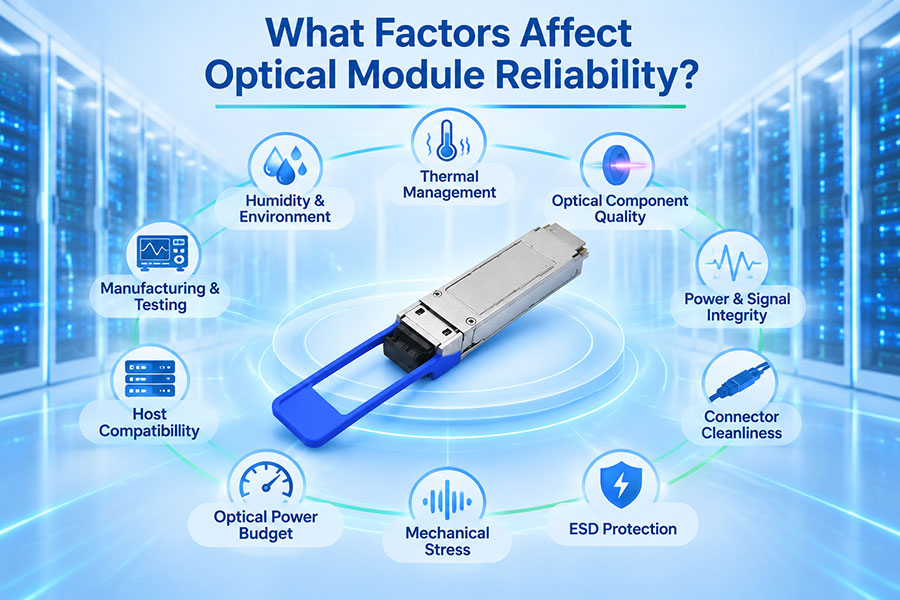
Optical transceivers operate in environments where temperature, airflow, dust, and moisture can influence long-term reliability. Although the optical signal itself is not directly affected by ordinary changes in ambient relative humidity, moisture can gradually affect the electronic, optical, and mechanical components inside a module. The risks become more significant when high humidity is combined with elevated temperatures, airborne contaminants, or repeated temperature changes that cause condensation.
For data centers, telecommunications facilities, industrial networks, and outdoor communication systems, humidity management is therefore an important part of equipment protection and optical module reliability. Understanding the difference between non-condensing humidity exposure and actual moisture condensation helps engineers select suitable transceivers and establish appropriate environmental testing procedures.
1. Does Humidity Directly Affect Optical Signal Transmission?
In a properly constructed optical transceiver, ambient humidity does not normally cause an immediate change in the optical signal simply because the surrounding air contains more water vapor. The transmitter converts electrical signals into optical signals, while the receiver converts incoming light back into electrical signals. These processes are primarily determined by the optical and electrical characteristics of the components.
However, humidity can affect the materials and interfaces that support these functions. Moisture may penetrate non-hermetic packaging, accumulate on exposed surfaces, or contribute to corrosion and contamination. Over time, these effects can influence electrical stability, optical alignment, connector condition, and the reliability of internal components.
| Environmental condition | Direct optical impact | Potential reliability concern |
|---|---|---|
| Moderate, non-condensing humidity | Usually limited for a properly qualified module | Long-term material exposure depends on module construction |
| Prolonged high humidity | Not necessarily an immediate optical change | Moisture absorption, corrosion, and material degradation |
| Condensation | May affect exposed optical interfaces | Electrical leakage, corrosion, contamination, and connection instability |
| High humidity with elevated temperature | Indirect rather than necessarily immediate | Accelerated moisture-related aging and corrosion |
The key distinction is that humidity is an environmental stress factor. It does not automatically mean that an optical transceiver will experience higher insertion loss, lower transmit power, or reduced receiver sensitivity. Those changes depend on the actual failure mechanism and the module's exposure conditions.
2. How High Humidity Affects Optical Transceiver Components
Moisture can influence several parts of an optical module. The severity depends on its packaging, sealing design, material selection, manufacturing cleanliness, and operating environment.
Electronic components and circuit boards: Moisture on circuit-board surfaces can reduce insulation resistance and create conditions for leakage currents. When conductive residues or contaminants are present, humidity can increase the risk of corrosion and electrical degradation. These effects may eventually contribute to unstable operation or component failure.
Laser and photodetector assemblies: Optical semiconductor devices rely on carefully controlled material interfaces and protective structures. Moisture penetration can contribute to degradation of susceptible materials, coatings, bonding interfaces, or package structures. Non-hermetic devices require particular attention to moisture-related qualification and protection.
Electrical contacts and solder joints: High humidity can accelerate corrosion when moisture interacts with exposed metals, manufacturing residues, or dissimilar-metal interfaces. Contact degradation may increase electrical resistance or cause intermittent connections.
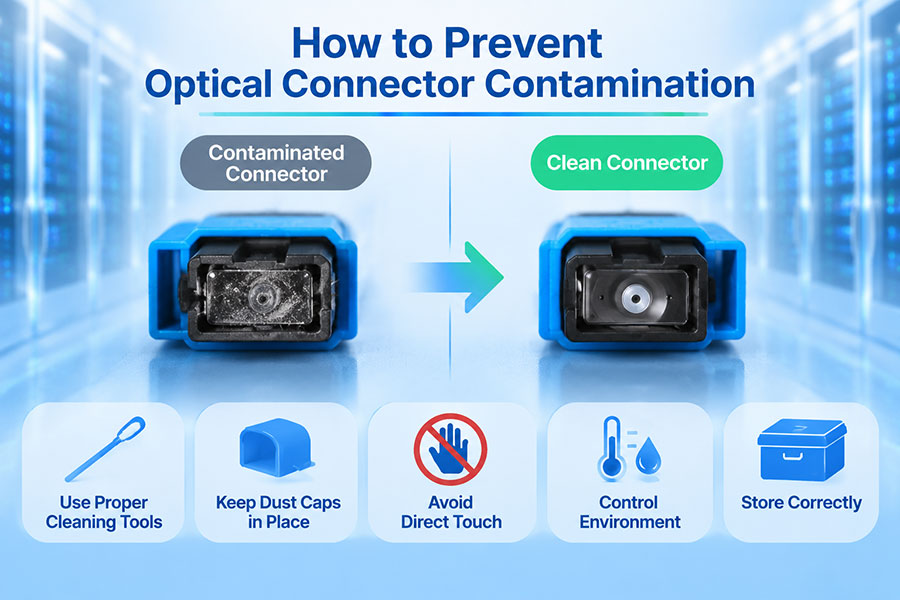
Optical interfaces: Moisture, condensation, and residue on exposed connector end faces can interfere with light coupling. Contamination at the interface may increase insertion loss or return loss. This is one reason connector inspection and cleaning remain important even when the transceiver itself has passed environmental qualification.
Encapsulation and packaging materials: Some polymers and insulating materials absorb moisture over time. Absorption and diffusion can change physical or electrical properties, while repeated moisture exposure may affect mechanical integrity and protective performance.
3. Condensation Is More Dangerous Than High Humidity Alone
Relative humidity and condensation are related but different environmental conditions. Relative humidity describes how close the air is to saturation at a particular temperature. Condensation occurs when a surface temperature falls below the dew point of the surrounding air.
This distinction matters because a transceiver may operate in a high-humidity environment without visible condensation, provided its temperature remains sufficiently above the dew point. Conversely, a module moved from a cold storage area into warm, humid air may develop condensation even if the surrounding environment is otherwise within its rated temperature range.
Condensation can create several problems:
Optical contamination: Moisture can collect on exposed optical interfaces and interact with dust or other residues, affecting the quality of the optical connection.
Electrical leakage: Moisture on insulating surfaces can reduce surface resistance and increase leakage-current risk.
Corrosion: Water in contact with metallic surfaces and manufacturing residues can accelerate corrosion.
Mechanical degradation: Moisture absorption and repeated environmental changes can affect certain packaging and insulating materials.
For this reason, preventing condensation is a central consideration in optical equipment storage, transportation, installation, and environmental qualification. A module's specified operating temperature and humidity conditions should always be considered together rather than evaluated independently.
4. The Relationship Between Temperature and Humidity
Temperature changes can make moisture exposure more complicated. Relative humidity varies with temperature even when the amount of water vapor in the air remains approximately constant. When a cold optical module enters a warmer and more humid environment, its surfaces may remain below the surrounding air's dew point until the module reaches thermal equilibrium.
High temperature can also accelerate moisture-related chemical reactions and corrosion processes. Consequently, prolonged exposure to high temperature and high humidity may create greater reliability stress than either condition alone.
| Environmental scenario | Possible effect on the module | Engineering consideration |
|---|---|---|
| Stable temperature, moderate humidity | Generally lower moisture-related stress | Maintain operation within the manufacturer's environmental specifications |
| High temperature and high humidity | Greater potential for moisture absorption and corrosion | Evaluate damp-heat qualification and material protection |
| Rapid temperature decrease | Surface temperature may fall below the dew point | Allow appropriate environmental acclimatization before operation |
| Repeated temperature and humidity cycles | Repeated moisture absorption and condensation exposure | Consider cyclic moisture testing where the application requires it |
| Cold storage followed by warm, humid installation | Temporary condensation may occur | Follow supplier handling and installation guidance |
Temperature and humidity monitoring is particularly important in facilities with substantial daily temperature changes, outdoor cabinets, industrial enclosures, and equipment rooms with inconsistent environmental control.
5. How Humidity Can Affect Optical Performance Parameters
Humidity-related damage does not necessarily appear as an immediate optical power failure. In many cases, it first affects the electrical or mechanical condition of the module and only later contributes to measurable changes in optical performance.
| Performance parameter | Possible humidity-related influence | What engineers should monitor |
|---|---|---|
| Transmit optical power | Potential degradation if moisture damages the laser assembly or associated circuitry | Tx power stability over time |
| Receiver sensitivity | Possible deterioration if the photodetector or receiver circuitry is affected | Rx sensitivity and receiver performance |
| Bit error rate (BER) | May increase if moisture-related degradation causes signal quality or electrical stability problems | BER under defined test conditions |
| Insertion loss | May increase when moisture or residue contaminates an optical connection | Connector cleanliness and link loss |
| Return loss | May be affected by contamination or changes at an optical interface | Connector end-face condition and reflection performance |
| DDM/DOM readings | May reveal secondary changes in monitored operating parameters | Temperature, voltage, Tx bias current, Tx power, and Rx power |
Digital Diagnostic Monitoring (DDM), also known as Digital Optical Monitoring (DOM), can help engineers observe changes in operating parameters. However, DDM does not directly measure relative humidity, detect every form of corrosion, or confirm that a module has no internal moisture damage.
For reliable diagnosis, DDM readings should be combined with optical power measurements, BER testing, connector inspection, host-device logs, and environmental records. A change in optical power or BER should not automatically be attributed to humidity without checking other possible causes, including fiber contamination, connector damage, temperature, laser aging, and host compatibility.
6. Humidity Testing for Optical Transceiver Reliability
Environmental qualification helps determine whether an optical transceiver can withstand the humidity conditions expected during transportation, storage, and operation. Testing should reflect the module's construction and intended application rather than relying on a single universal humidity limit.
Several environmental test approaches are relevant to moisture-related reliability:
Damp heat, steady state: This test exposes components to elevated temperature and humidity for a specified duration without intentional condensation. IEC 60068-2-78 defines a steady-state damp-heat test method for evaluating the effects of high humidity at constant temperature.
Cyclic damp heat: Temperature and humidity change during the test cycle. Depending on the selected conditions, condensation may occur. This approach is useful when equipment is expected to experience changing environmental conditions during normal use, storage, or transportation.
Temperature cycling: Repeated temperature changes stress materials, interfaces, and mechanical structures. It is not a substitute for humidity testing, but it can help identify weaknesses that become more important when temperature changes occur in moisture-containing environments.
Powered damp-heat testing: Operating the device during controlled environmental exposure can help assess whether electrical and optical performance remains stable under the selected conditions. The test profile must be appropriate for the module design and applicable qualification requirements.
| Test method | Primary purpose | Typical evaluation focus |
|---|---|---|
| IEC 60068-2-78 | Steady-state damp-heat exposure without condensation | Effects of sustained high humidity at constant temperature |
| IEC 60068-2-30 | Cyclic damp-heat exposure | Effects of temperature and humidity cycling, including condensation under applicable conditions |
| IEC 61300-2-46 | Cyclic damp-heat testing for fiber-optic interconnecting devices and passive components | Moisture and temperature-cycle resistance of applicable optical components |
| Telcordia GR-468-CORE | Reliability assurance for optoelectronic devices used in telecommunications equipment | Environmental and reliability qualification requirements for applicable devices |
The IPEC Reliability Agreement V1.0, published in 2025, includes damp-heat and cyclic-moisture test items among its reliability assessment categories. Its listed examples include 85°C/85% RH damp-heat exposure for specified test durations. These are qualification test conditions, not general operating limits for every commercial optical transceiver.
Test duration, temperature, humidity, powered state, sample size, and acceptance criteria must be selected according to the applicable standard, product construction, and customer requirements. Passing one damp-heat test does not establish immunity to every form of moisture exposure or guarantee a particular field lifetime.
7. How to Reduce Humidity-Related Risks in Optical Networks
Effective moisture management combines equipment selection, environmental control, correct handling, and ongoing maintenance. The following practices help reduce unnecessary humidity-related stress.
Select modules for the intended environment: Check the manufacturer's specified operating and storage temperature ranges and any stated humidity or condensation restrictions. Industrial and outdoor applications may require different environmental qualifications from controlled data-center deployments.
Control room and enclosure conditions: Maintain suitable temperature and humidity levels in server rooms, telecom cabinets, and industrial enclosures. Avoid conditions that allow condensation to form on equipment.
Allow temperature acclimatization: When modules are transferred between environments with significantly different temperatures, follow the manufacturer's handling instructions before installation or operation.
Protect unused optical ports: Keep dust caps on unused optical interfaces. Store spare transceivers in suitable protective packaging and avoid exposing connector end faces to moisture or contaminants.
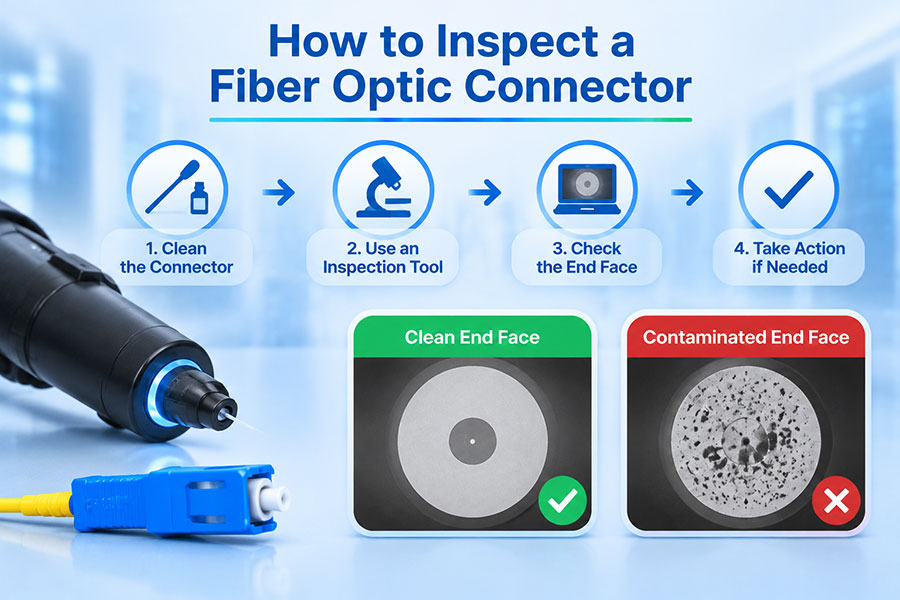
Maintain connector cleanliness: Inspect and clean optical connectors using appropriate procedures and materials. Moisture combined with dust or residue can make interface contamination more difficult to manage.
Monitor operating conditions: Track equipment-room temperature and humidity. Review DDM/DOM readings and link-performance records to identify abnormal changes that may require investigation.
Use suitable environmental qualification: For demanding applications, review damp-heat, cyclic-moisture, and other relevant reliability test evidence before selecting a transceiver.
For network deployments using different data rates and form factors, environmental suitability should be evaluated alongside optical specifications and host compatibility. C-LIGHT provides a range of optical transceivers for different network applications. Selection should be based on the required data rate, transmission distance, wavelength, fiber type, host platform, and specified environmental conditions.
8. Data Center and Industrial Application Considerations
Humidity risks vary considerably across deployment environments. A controlled data center, an outdoor telecommunications cabinet, and an industrial production facility may expose optical modules to very different moisture conditions.
Data centers: Server rooms generally use environmental control systems to maintain stable operating conditions. Even so, condensation can become a concern during cooling-system faults, maintenance activities, or the transfer of cold equipment into warmer, humid areas. Proper airflow and environmental monitoring help reduce these risks.
Telecommunications cabinets: Outdoor cabinets may experience changing temperatures, seasonal humidity, and limited ventilation. Moisture management should consider enclosure design, sealing, drainage, and condensation prevention in addition to the transceiver's own environmental specifications.
Industrial networks: Industrial environments may contain temperature fluctuations, dust, chemical contaminants, and moisture. These factors can combine to increase corrosion and material-degradation risks. Transceivers and network equipment should be selected according to the actual environmental conditions and required reliability level.
High-speed optical links: 400G, 800G, and 1.6T systems have demanding electrical, thermal, and optical requirements. High humidity does not inherently reduce their data rates, but moisture-related degradation in components or optical interfaces can eventually affect link stability. Environmental qualification remains important as data rates and module integration density increase.
9. Conclusion: Humidity Management Supports Long-Term Optical Reliability
Humidity does not normally change optical transmission performance directly under controlled, non-condensing operating conditions. Its main risks are associated with moisture absorption, condensation, corrosion, contamination, and changes in the electrical or mechanical properties of materials. These effects can develop gradually and may eventually contribute to unstable optical power, receiver performance, BER, or link availability.
For reliable optical network operation, engineers should consider humidity together with temperature, dew point, packaging design, connector cleanliness, and application-specific environmental requirements. Appropriate damp-heat and cyclic-moisture testing, combined with sound storage and installation practices, helps reduce moisture-related risks throughout the service life of optical equipment.
For optical transceiver selection or application requirements, Contact C-LIGHT.
 >

 >
 >
 >
 >
 >
 >
 >