1. Introduction
As artificial intelligence (AI), large language models (LLMs), high-performance computing (HPC), and hyperscale data centers continue to evolve, rack power density is reaching unprecedented levels. Modern GPU servers equipped with hundreds or even thousands of AI accelerators generate significantly more heat than traditional computing platforms, making efficient thermal management one of the biggest challenges facing next-generation AI infrastructure.
Conventional air-cooling technologies are no longer sufficient for many high-density deployments. As a result, Cold Plate Liquid Cooling and Immersion Liquid Cooling are rapidly becoming the preferred cooling solutions for AI data centers, GPU clusters, cloud computing platforms, and supercomputing environments.
However, liquid cooling introduces new challenges for network infrastructure.
High-speed interconnects are no longer required only to deliver ultra-high bandwidth, low latency, and low bit error rates (BER). They must also withstand long-term exposure to moisture, cooling fluids, temperature cycling, and chemically demanding environments without compromising reliability.
For this reason, the long-term performance of a Liquid Cooling Active Optical Cable (Liquid Cooling AOC) depends on much more than its optical engine. The cable jacket materials and sealing potting compounds play an equally critical role in ensuring durability, environmental resistance, and operational stability throughout the product's lifecycle.
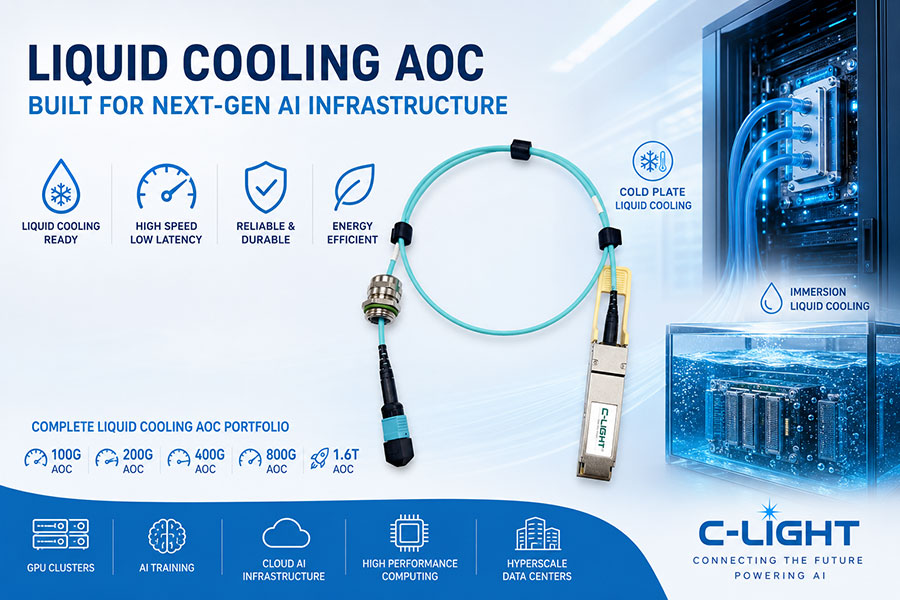
As a leading provider of high-speed optical interconnect solutions, C-LIGHT has developed a comprehensive portfolio of Liquid Cooling AOC products designed specifically for AI data centers and liquid-cooled GPU servers. The product family includes 100G, 200G, 400G, 800G, and next-generation 1.6T Liquid Cooling AOC solutions, supporting a wide range of deployment scenarios, including:
Cold Plate Liquid Cooling systems
Immersion Cooling data centers
High-density GPU clusters
AI training platforms
High-performance computing (HPC) environments
Cloud AI infrastructure
Designed with advanced cable materials, optimized sealing technologies, and rigorous reliability testing, C-LIGHT's Liquid Cooling AOC solutions provide stable, low-latency, and energy-efficient optical connectivity for next-generation AI infrastructure.
Liquid Immersion Transceiver for AI Data Centers | 400G/800G/1.6T Optical Solutions丨C-LIGHT
2. What Environmental Challenges Does Liquid Cooling AOC Face?

Compared with conventional enterprise data centers, liquid-cooled environments impose much stricter reliability requirements on high-speed optical interconnects.
Besides maintaining excellent optical transmission performance, Liquid Cooling AOCs must continue operating reliably under challenging environmental conditions throughout years of continuous service.
Typical challenges include:
Long-term exposure to high humidity
Cooling liquid splashes or temporary immersion
Continuous thermal cycling caused by repeated heating and cooling
Chemical compatibility with various cooling fluids
Higher sealing reliability requirements
Extended product service life
Reduced maintenance frequency in mission-critical AI infrastructure
Unlike standard Active Optical Cables designed primarily for climate-controlled server rooms, Liquid Cooling AOCs must resist environmental degradation while preserving both optical and mechanical integrity.
This means that product design extends beyond optical performance.
Material engineering—including cable jacket selection, sealing technology, and encapsulation materials—has become a critical factor influencing overall product reliability.
For AI data centers operating around the clock, even minor material degradation can eventually result in moisture ingress, signal instability, connector failure, or costly maintenance.
Therefore, environmental durability has become just as important as bandwidth performance.
3. Why Waterproof Fiber Jackets Matter

The outer fiber jacket is the first line of defense protecting an Active Optical Cable from external environmental hazards.
In Liquid Cooling AOC systems, the cable jacket must do far more than provide mechanical protection. It must effectively prevent moisture, cooling fluids, and contaminants from reaching the optical fibers and internal electronic components.
An ideal waterproof cable jacket should provide:
Excellent water resistance
Extremely low water absorption
Superior abrasion resistance
Outstanding flexibility
High bending durability
Long-term aging resistance
These characteristics help preserve both the mechanical strength and optical performance of the cable throughout years of operation in demanding liquid-cooled environments.
Common Jacket Materials Used in Liquid Cooling AOC
Thermoplastic Polyurethane (TPU)
TPU is one of the most widely used materials for premium Liquid Cooling AOCs.
Its advantages include:
Excellent abrasion resistance
High flexibility
Outstanding hydrolysis resistance
Superior impact resistance
Excellent durability under repeated bending
Because of these properties, TPU is particularly suitable for high-density AI servers where cables are frequently routed through confined spaces or repeatedly repositioned during installation and maintenance.
Modified Polyethylene (PE)
Modified polyethylene offers another effective solution for waterproof cable protection.
Its benefits include:
Very low water absorption
Excellent chemical resistance
Stable electrical insulation
Good mechanical strength
Cost-effective long-term durability
PE-based materials perform especially well in liquid-cooled environments where long-term exposure to cooling fluids is expected.
Specialty Polyolefin Materials
Advanced polyolefin compounds combine several desirable characteristics into a single cable jacket material.
Typical advantages include:
High flexibility
Wide operating temperature range
Excellent weather resistance
Long-term aging stability
Improved resistance to chemicals and moisture
These materials are increasingly used in next-generation AI networking products requiring higher reliability over extended operational lifetimes.
How Waterproof Jackets Improve Long-Term Reliability
A high-performance waterproof jacket helps prevent cooling liquids from penetrating the cable structure, protecting both optical fibers and internal electronic components from environmental damage.
The result is:
Improved mechanical durability
Stable optical transmission
Lower failure rates
Longer service life
Reduced maintenance costs
C-LIGHT Liquid Cooling AOC products utilize hydrolysis-resistant, high-flexibility cable jacket materials combined with reinforced sealing technologies to ensure outstanding mechanical and optical stability, even after prolonged exposure to high-humidity and liquid-cooled operating environments.
This optimized material design enables reliable high-speed optical connectivity for demanding AI data centers, GPU clusters, and next-generation liquid-cooled computing platforms.
4. Why Are UV-Resistant Fiber Jackets Necessary?

Although most liquid-cooled AI data centers are deployed indoors, many modern computing facilities are increasingly installed in semi-outdoor or fully outdoor environments. As AI infrastructure expands toward edge computing and distributed computing architectures, cable materials must withstand not only moisture and cooling liquids but also prolonged ultraviolet (UV) exposure.
Typical deployment scenarios include:
Containerized AI data centers
Edge computing facilities
Outdoor AI computing centers
Renewable energy and energy storage sites
Telecommunications cabinets
Remote edge AI infrastructure
Under continuous UV radiation, conventional polymer jacket materials may gradually deteriorate, resulting in:
Even if optical performance initially remains unaffected, degraded cable jackets become increasingly susceptible to moisture ingress, mechanical damage, and sealing failure over time.
For long-term outdoor deployments, UV resistance has become a critical design consideration rather than an optional feature.
Common UV Protection Technologies
To improve environmental durability, Liquid Cooling AOC products typically incorporate one or more of the following UV-resistant technologies:
UV stabilizers
UV-resistant TPU compounds
UV-resistant polyethylene (PE)
Carbon black anti-aging formulations
Weather-resistant polymer additives
These materials significantly reduce polymer degradation caused by sunlight while maintaining excellent mechanical performance throughout years of outdoor operation.
Compared with conventional cable materials, UV-resistant jackets provide several important advantages:
Improved weather resistance
Better crack resistance
Enhanced flexibility retention
Greater impact resistance
Longer product lifespan
Lower maintenance frequency
For containerized AI data centers, edge computing nodes, renewable-energy computing facilities, and outdoor communication cabinets, selecting Liquid Cooling AOC products with UV-resistant cable jackets is strongly recommended to maximize long-term operational reliability.
At C-LIGHT, optional UV-resistant cable jacket materials are available for customers deploying high-speed optical interconnects in demanding outdoor or hybrid environments, ensuring stable performance throughout the product lifecycle.
5. Why Are Liquid Cooling Potting Compounds So Important?

If the cable jacket protects the outside of an Active Optical Cable, the potting compound protects its internal structure.
Liquid Cooling Potting Compound—also known as encapsulation adhesive or sealing resin—is widely applied inside optical modules, cable interfaces, connector assemblies, and optoelectronic conversion areas.
Its role extends far beyond simply securing components mechanically.
Instead, it creates a highly reliable sealing barrier that prevents moisture, cooling liquids, dust, and contaminants from entering sensitive electronic assemblies.
Without effective sealing, cooling fluids may penetrate into internal circuits, eventually causing corrosion, insulation degradation, electrical leakage, or even complete device failure.
As AI data centers increasingly adopt cold plate cooling and immersion cooling technologies, the reliability of sealing materials has become one of the key factors determining product longevity.
Primary Functions of Liquid Cooling Potting Compounds
High-performance potting materials provide multiple protective functions simultaneously:
Unlike conventional office networking environments, AI data centers operate continuously under high power loads, frequent thermal cycling, and increasingly complex cooling architectures.
As a result, sealing materials must maintain their mechanical integrity for many years without cracking, shrinking, or losing adhesion.
High-quality potting compounds therefore become essential for ensuring uninterrupted operation throughout the service life of high-speed optical interconnects.
C-LIGHT Liquid Cooling AOC products utilize high-reliability sealing and encapsulation technologies around optical modules, connector assemblies, and cable interfaces. These reinforced sealing processes significantly improve resistance to moisture, water ingress, thermal cycling, and coolant exposure, ensuring stable optical transmission in demanding liquid-cooled AI infrastructures.
6. What Material Properties Should Liquid Cooling Potting Compounds Have?

Choosing an appropriate potting compound requires balancing multiple performance characteristics rather than optimizing a single parameter.
An ideal encapsulation material should continue providing reliable protection throughout years of continuous operation under varying environmental conditions.
The following characteristics are considered essential.
6.1 Excellent Waterproof Performance
The primary purpose of a liquid cooling potting compound is to create a durable waterproof barrier.
Even after prolonged exposure to cooling fluids, the material should maintain excellent sealing performance without:
Cracking
Delamination
Shrinkage
Leakage
Loss of adhesion
Reliable waterproof sealing protects both optical and electrical components from moisture-related failures.
6.2 Excellent Chemical Compatibility
Modern liquid-cooled AI infrastructure utilizes various cooling media depending on system architecture.
Typical cooling fluids include:
A high-quality potting compound must remain chemically stable when exposed to these liquids.
It should resist:
Swelling
Softening
Corrosion
Chemical decomposition
Mechanical degradation
Excellent chemical compatibility ensures long-term reliability under continuous liquid exposure.
6.3 Wide Operating Temperature Range
Liquid Cooling AOCs frequently experience repeated heating and cooling cycles during daily operation.
The sealing material should therefore maintain stable physical properties across a broad temperature range.
Typical industrial requirements include:
Stable thermal performance minimizes the risk of seal degradation caused by expansion and contraction over thousands of thermal cycles.
6.4 High Elasticity and Stress Relief
Temperature fluctuations create continuous expansion and contraction among different materials inside an optical module.
Rigid sealing materials may eventually crack under repeated stress.
An ideal potting compound should possess sufficient elasticity to:
Absorb thermal stress
Reduce mechanical fatigue
Prevent cracking
Maintain sealing integrity
Protect delicate optical assemblies
Flexible encapsulation materials greatly improve long-term mechanical reliability.
6.5 Excellent Electrical Insulation
Because Active Optical Cables contain high-speed electronic circuits operating at extremely high data rates, electrical insulation is equally important.
Potting compounds should provide:
High dielectric strength
Excellent insulation resistance
Low electrical conductivity
Stable electrical performance under humid conditions
These characteristics help prevent current leakage, short circuits, and signal degradation throughout long-term operation.
6.6 Outstanding Long-Term Aging Resistance
AI data centers are designed to operate continuously for many years with minimal maintenance interruptions.
Accordingly, encapsulation materials must retain their mechanical and sealing performance throughout extended service lifecycles.
High-quality potting compounds should demonstrate excellent resistance to:
Maintaining stable material properties over time directly contributes to lower maintenance costs, higher network availability, and improved total cost of ownership (TCO).
To ensure long-term product reliability, all C-LIGHT Liquid Cooling high-speed interconnect solutions can be validated through comprehensive environmental reliability testing based on customer requirements, including:
High- and low-temperature cycling
Long-duration aging tests
Mechanical tensile testing
Connector insertion and extraction lifecycle testing
Liquid cooling compatibility verification
Humidity resistance evaluation
Through optimized material selection, advanced sealing technologies, and rigorous qualification testing, C-LIGHT delivers highly reliable Liquid Cooling AOC solutions for AI data centers, hyperscale GPU clusters, cloud computing platforms, and next-generation high-performance computing (HPC) environments.
7. Material Design Trends for Liquid Cooling AOC

As AI infrastructure rapidly evolves toward 800G, 1.6T, and future 3.2T optical interconnects, Liquid Cooling Active Optical Cables (AOCs) are no longer evaluated solely by transmission speed. Material engineering has become a critical factor in determining long-term product reliability, operational stability, and maintenance costs.
Future Liquid Cooling AOC development will focus on optimizing cable materials, sealing technologies, and environmental durability to meet the increasingly demanding requirements of AI data centers.
Key material innovation trends include:
Higher-performance waterproof sealing structures
More chemically resistant cable jacket materials
Lower water absorption fiber jackets
Higher-reliability liquid cooling potting compounds
Wider operating temperature ranges
Improved flexibility and bend resistance
Longer product service life
Lower material outgassing for enclosed liquid-cooled environments
Enhanced compatibility with immersion cooling fluids
More environmentally friendly and sustainable materials
These advancements help improve environmental adaptability while reducing maintenance frequency, minimizing downtime, and lowering the total cost of ownership (TCO) for hyperscale AI infrastructure.
As optical networking transitions from 400G to 800G and 1.6T, Liquid Cooling AOCs must achieve more than simply higher bandwidth. They must also support:
Lower power consumption
Smaller cable diameters
Higher cable density
Improved thermal management
Greater installation flexibility
Longer operational lifecycles
Material innovation will therefore remain one of the key drivers behind next-generation high-speed optical interconnect technologies.
8. Typical Application Scenarios

With the rapid deployment of AI computing infrastructure worldwide, Liquid Cooling AOCs have become an essential component of modern high-speed networking systems.
Their superior environmental resistance makes them particularly suitable for demanding liquid-cooled environments where conventional Active Optical Cables may not provide sufficient long-term reliability.
Typical deployment scenarios include:
AI Data Center GPU Clusters
High-Performance Computing (HPC)
Cold Plate Liquid Cooling Servers
Immersion Cooling Servers
Edge AI Computing Centers
Supercomputing Centers
Cloud Computing Data Centers
High-Density Switch-to-Switch Interconnects
GPU-to-GPU Interconnects
Spine-Leaf Network Architectures
AI Training Clusters
AI Inference Platforms
As GPU density continues to increase, Liquid Cooling AOCs enable stable, low-latency, and high-bandwidth optical communication between servers, switches, storage systems, and AI accelerators.
C-LIGHT Liquid Cooling AOC Portfolio
To address a wide range of deployment requirements, C-LIGHT offers a comprehensive portfolio of Liquid Cooling Active Optical Cable solutions, including:
100G QSFP28 Liquid Cooling AOC
200G QSFP56 Liquid Cooling AOC
400G QSFP-DD Liquid Cooling AOC
400G OSFP Liquid Cooling AOC
800G QSFP-DD Liquid Cooling AOC
800G OSFP Liquid Cooling AOC
These products are designed for compatibility with leading AI platforms and networking ecosystems, including:
Supporting industry-standard protocols and switch platforms, C-LIGHT Liquid Cooling AOCs provide reliable high-speed optical connectivity for:
By combining advanced optical transmission technology with optimized waterproof cable materials and high-reliability sealing processes, C-LIGHT helps customers build scalable, energy-efficient, and future-ready AI networking infrastructures.
9. Future Development Trends
As AI models continue to grow in size and computational complexity, the performance requirements for optical interconnects will become increasingly demanding.
Future Liquid Cooling AOCs will focus not only on higher transmission speeds but also on enhanced material performance and overall system reliability.
Several major trends are expected to shape the next generation of Liquid Cooling AOC technology.
More Environmentally Friendly Materials
Sustainability is becoming an important consideration in data center construction.
Future cable materials will increasingly adopt:
These improvements help reduce environmental impact while complying with increasingly stringent global regulations.
Higher-Performance Sealing Materials
Future potting compounds will provide:
These properties will further improve long-term reliability under continuous exposure to cooling liquids.
Lower Outgassing Materials
Certain liquid-cooled environments require materials with extremely low volatile emissions.
Future cable jackets and encapsulation materials will continue reducing:
This is especially important for enclosed AI computing environments and immersion cooling systems.
Higher Temperature Resistance
Next-generation GPU systems continue pushing thermal limits.
Future materials must support:
Wider industrial operating temperatures
Improved thermal aging resistance
Better dimensional stability under continuous heat exposure
These characteristics will contribute to more reliable operation in high-power AI servers.
Improved Cooling Fluid Compatibility
As immersion cooling technologies diversify, future Liquid Cooling AOCs must remain compatible with a wider range of dielectric fluids and advanced cooling media.
Enhanced chemical resistance will become increasingly important for long-term deployment in hyperscale AI facilities.
Higher Protection Ratings
Future products are expected to achieve even higher environmental protection levels, including:
These upgrades will provide greater protection against moisture, dust, and coolant ingress.
Longer Service Life
Hyperscale AI infrastructure is designed for continuous operation over many years.
Future Liquid Cooling AOCs will prioritize:
Lower maintenance requirements
Longer operational lifetimes
Improved reliability under continuous workloads
Reduced total cost of ownership (TCO)
Advances in cable jacket materials, sealing technologies, and environmental qualification testing will play a central role in achieving these goals.
The Future of Liquid Cooling AOC
Looking ahead, Liquid Cooling AOCs will integrate multiple technological innovations beyond advanced materials.
Future products are expected to incorporate:
Lower-power DSP architectures
Optimized thermal management designs
Next-generation waterproof cable jackets
Advanced encapsulation technologies
Smaller cable diameters
Higher cable density
AI-optimized optical interconnect architectures
As AI infrastructure evolves toward 800G, 1.6T, and eventually 3.2T optical networking, material performance will become just as critical as transmission bandwidth.
Manufacturers capable of combining high-speed optical technology with advanced material engineering will be best positioned to support the next generation of AI data centers, hyperscale GPU clusters, cloud computing platforms, and high-performance computing (HPC) environments.
With continuous innovation in optical interconnect technology, C-LIGHT remains committed to developing reliable, high-performance Liquid Cooling AOC solutions that meet the evolving demands of AI infrastructure while delivering superior durability, lower power consumption, and long-term operational stability.
10. Conclusion
Liquid Cooling Active Optical Cables (AOCs) are far more than high-speed optical interconnect products—they represent a comprehensive integration of optical engineering, material science, mechanical design, and environmental reliability.
While transmission bandwidth remains a primary performance indicator, the long-term stability of a Liquid Cooling AOC depends equally on the quality of its cable jacket materials and sealing technologies.
A high-performance waterproof fiber jacket protects optical fibers and internal components from moisture, coolant exposure, mechanical abrasion, and long-term environmental aging. At the same time, UV-resistant jacket materials help maintain mechanical strength and flexibility in outdoor deployments such as containerized AI data centers, edge computing facilities, and telecommunications cabinets.
Equally important, liquid cooling potting compounds serve as the first line of defense for protecting optoelectronic assemblies inside the cable. High-quality encapsulation materials provide reliable waterproof sealing, electrical insulation, vibration damping, stress relief, and chemical resistance, ensuring stable operation even under prolonged exposure to thermal cycling and liquid cooling media.
As AI infrastructure continues to scale, data centers are rapidly transitioning toward higher rack power densities, larger GPU clusters, and increasingly sophisticated liquid cooling architectures. These trends are driving demand for optical interconnect solutions that combine ultra-high bandwidth with exceptional environmental durability.
Consequently, the performance of cable jacket materials and potting compounds will play an increasingly significant role in determining:
Looking ahead, future Liquid Cooling AOCs will continue evolving alongside AI networking technologies, emphasizing:
Higher bandwidth
Lower power consumption
Smaller cable form factors
Improved sealing performance
Enhanced chemical compatibility
Wider operating temperature ranges
Greater environmental sustainability
Longer operational lifecycles
As one of the industry's leading providers of high-speed optical interconnect solutions, C-LIGHT continues expanding its Liquid Cooling product portfolio to support the growing demands of AI infrastructure.
Today, C-LIGHT offers comprehensive 100G, 200G, 400G, and 800G Liquid Cooling AOC solutions while actively developing next-generation 1.6T Liquid Cooling AOC products for future AI data centers.
By combining advanced optical technologies with hydrolysis-resistant cable jacket materials, optimized sealing structures, and rigorous environmental qualification testing, C-LIGHT delivers reliable, energy-efficient, and future-ready optical interconnect solutions for:
AI Data Centers
Hyperscale GPU Clusters
High-Performance Computing (HPC)
Cloud Computing Platforms
AI Training Networks
AI Inference Infrastructure
Liquid-Cooled Server Systems
As AI networking continues to evolve toward the era of 800G, 1.6T, and beyond, C-LIGHT remains committed to helping customers build scalable, high-performance, and highly reliable optical networks capable of supporting the next generation of intelligent computing.
11. Frequently Asked Questions (FAQ)
Q1. Why can't standard Active Optical Cables (AOCs) be used in liquid cooling environments?
Answer: Standard AOCs are primarily designed for conventional indoor data center environments where exposure to moisture, cooling fluids, and frequent thermal cycling is minimal. Their cable jackets and sealing materials are generally not optimized for prolonged contact with liquid coolants or high-humidity conditions. In liquid-cooled AI data centers, standard materials may experience water absorption, material aging, seal degradation, or mechanical failure over time. Liquid Cooling AOCs address these challenges through specialized waterproof cable jackets, enhanced sealing structures, and high-reliability potting compounds engineered for harsh operating environments.
Q2. Why do Liquid Cooling AOCs require UV-resistant cable jackets?
Answer: Although most liquid-cooled data centers are installed indoors, an increasing number of AI infrastructures are deployed in containerized facilities, edge computing sites, outdoor communication cabinets, and renewable energy campuses. Continuous exposure to ultraviolet (UV) radiation can cause conventional polymer jackets to crack, become brittle, and lose flexibility. UV-resistant cable materials help maintain long-term mechanical strength, improve weather resistance, and significantly extend cable service life in outdoor or semi-outdoor applications.
Q3. How do liquid cooling potting compounds differ from standard encapsulation materials?
Answer: Liquid cooling potting compounds are specifically formulated for demanding liquid-cooled environments. Compared with conventional encapsulation materials, they typically provide:
Superior waterproof sealing
Wider operating temperature ranges
Higher electrical insulation performance
Better resistance to thermal cycling
Improved mechanical flexibility
Excellent chemical compatibility with cooling fluids
These enhanced characteristics allow Liquid Cooling AOCs to operate reliably for many years in AI data centers and immersion cooling systems.
Q4. What cable jacket materials are commonly used in Liquid Cooling AOCs?
Answer: Common cable jacket materials include:
Thermoplastic Polyurethane (TPU) for excellent flexibility, abrasion resistance, and hydrolysis resistance.
Modified Polyethylene (PE) for low water absorption and strong chemical resistance.
Specialty Polyolefin Compounds for enhanced environmental durability, long-term aging resistance, and wide operating temperature performance.
Material selection depends on the intended deployment environment, cooling technology, and required mechanical performance.
Q5. What are the future material development trends for Liquid Cooling AOCs?
Answer: As AI data centers continue transitioning toward 800G, 1.6T, and future 3.2T optical interconnects, material technologies will continue evolving in several key directions, including:
Higher waterproof protection ratings (IP67/IP68)
Greater chemical resistance to advanced cooling fluids
Lower water absorption cable materials
More environmentally friendly and low-outgassing polymers
Wider industrial operating temperature ranges
Improved flexibility and bend resistance
Longer service life
Higher reliability sealing materials
These innovations will enable next-generation Liquid Cooling AOCs to deliver higher bandwidth, lower power consumption, greater environmental durability, and reduced total cost of ownership for AI data centers, hyperscale GPU clusters, and high-performance computing (HPC) infrastructures.
 TEL:+86 132 6656 7067





 >

 >
 >
 >
 >
 >
 >
 >