TEL:+86 132 6656 7067





The optical communications market is undergoing a significant transition in 2026 as artificial intelligence infrastructure, cloud computing, and high-capacity data center networks increase demand for faster connectivity. Optical transceivers operating at 400G, 800G, and 1.6T are becoming increasingly important to network designs that must support larger workloads, greater bandwidth density, and efficient data movement between computing resources.
This growth extends beyond higher transmission rates. Network operators are evaluating power consumption, optical reach, port density, interoperability, and component availability when planning new deployments. Meanwhile, developments in silicon photonics, linear-drive optics, coherent pluggable modules, and advanced optical packaging are creating additional options for different network environments.
1. What Is Driving Optical Transceiver Demand in 2026?
AI training and inference require communication between accelerators, servers, storage systems, and network switches. As computing clusters expand, the volume of traffic moving through the network increases, placing greater demands on switching capacity and optical interconnects.
Cloud service providers are also expanding their infrastructure to support AI applications, enterprise workloads, data storage, and distributed computing. These investments increase the need for high-speed links within data centers and between geographically separated facilities.
AI infrastructure expansion: Large accelerator clusters require high-bandwidth connections between servers, racks, and switching layers.
Higher network traffic: Cloud applications and distributed workloads increase demand for aggregate bandwidth and predictable network performance.
Switching capacity upgrades: Higher-capacity switch platforms create demand for optical interfaces operating at 400G, 800G, and beyond.
Data center interconnect: Distributed computing environments require high-capacity links between facilities and network regions.
Bandwidth density: Higher-speed modules can increase the capacity supported by a given number of switch ports.
These drivers reinforce one another. More powerful computing infrastructure generates additional traffic, while higher-capacity networking helps prevent communication bottlenecks from limiting the performance of distributed systems.
2. The Shift Toward 800G and 1.6T Optical Transceivers
High-speed optical transceivers are progressing toward greater aggregate bandwidth per module. While 400G remains relevant across many deployments, 800G is an important capacity tier for AI and cloud networks, and 1.6T is advancing as next-generation switching platforms become available.
| Data Rate | Network Role | Key Considerations |
|---|---|---|
| 400G | High-capacity data center links, switching connections, and selected interconnect applications | Reach, fiber type, power consumption, and existing platform support |
| 800G | High-bandwidth AI clusters, cloud data centers, and high-capacity switching fabrics | Port density, thermal design, host interface, and optical architecture |
| 1.6T | Emerging next-generation switching systems and higher-density AI network deployments | 200G-class electrical lanes in representative designs, signal integrity, power, and qualification |
These data rates describe aggregate module capacity, not a universal optical interface. The number of lanes, signaling rate, modulation format, wavelength, and supported reach depend on the specific transceiver design.
For network operators, the migration from 400G to 800G or 1.6T requires more than selecting a faster module. Switch compatibility, port configuration, fiber infrastructure, cooling capacity, and the complete optical link budget must be verified before deployment.
3. AI Data Centers Are Changing Optical Network Design
Scale-Out Connectivity
Scale-out networks connect servers and accelerator nodes through high-performance switching fabrics. Distributed AI workloads can generate substantial east-west traffic as compute nodes exchange training data, gradients, model parameters, and intermediate results.
High-speed optical transceivers support connections across racks and network tiers where bandwidth requirements and physical distances make optical links suitable. As the cluster grows, aggregate switch capacity and the number of high-speed links become important factors in network design.
Scale-Up and High-Density Systems
Scale-up architectures connect processing resources within tightly integrated systems. Depending on the platform, these connections may use electrical links, active cables, optical interconnects, or emerging integrated photonic technologies.
Optical transceivers are particularly relevant where connections extend between separate systems or switching equipment. Their role depends on the platform architecture rather than on data rate alone.
Scale-Across and Distributed AI Infrastructure
Some AI deployments distribute computing resources across multiple data centers or locations. These architectures require high-capacity connectivity over longer distances, creating demand for data center interconnect solutions that can maintain performance across fiber links.
Coherent optical technologies, including selected 800G and emerging 1.6T ZR/ZR+ implementations, can support high-capacity transmission where the system design, reach, and optical budget are appropriate. These products address different requirements from short-reach multimode or single-mode transceivers used inside data center fabrics.
4. Optical Technologies Supporting Market Growth
Higher-speed transceivers depend on advances in photonic devices, electronic signal processing, packaging, and thermal management. Several technologies are shaping the available options for next-generation optical connectivity.
Silicon Photonics
Silicon photonics integrates optical functions on a photonic chip and can support compact, multi-channel designs. Manufacturing yield, laser integration, optical coupling, and packaging remain important factors in commercial deployment.
Digital Signal Processing
DSP-based transceivers use signal processing to compensate for channel impairments and support reliable high-speed transmission. DSP design also influences module power consumption, latency, and thermal performance.
Linear-Drive Optics
LPO and related linear-drive approaches can reduce some module-side signal-processing requirements in suitable systems. Their feasibility depends on host electrical-channel quality and system-level signal integrity.
Coherent Optics
Coherent transceivers enable high-capacity transmission over appropriate longer-reach links. They are particularly relevant to data center interconnect and optical transport applications with demanding reach and capacity requirements.
These technologies are not direct substitutes for one another in every application. Selection depends on transmission distance, network architecture, power targets, cost, host compatibility, and the required operational model.
5. Supply Constraints and Manufacturing Capacity
Rapid demand growth can place pressure on the optical component supply chain. High-speed transceivers depend on specialized laser chips, photodetectors, DSPs, drivers, photonic integrated circuits, precision packaging, and production testing.
Industry reports in 2026 identified limited availability of certain laser components, including EML and continuous-wave laser devices, alongside precision optical alignment and thermal-management challenges. These constraints can affect production throughput, lead times, and the pace at which new products reach customers.
| Supply-Chain Area | Potential Constraint | Impact on Deployment |
|---|---|---|
| Laser and photonic chips | Specialized fabrication capacity and component qualification | Can limit the number of optical engines available for module assembly |
| DSPs and electronic components | High-speed design complexity, process technology, and power requirements | May constrain production volumes or extend product qualification schedules |
| Optical packaging | Precision alignment, coupling efficiency, and assembly yield | Can affect throughput, unit cost, and consistency of optical performance |
| Testing and qualification | High-speed validation and reliability requirements | Can extend the time between initial production and customer deployment |
| Thermal management | Higher module power and dense switch configurations | May require additional system validation or cooling adjustments |
Manufacturers are responding through capacity expansion, supply-chain diversification, process optimization, and increased investment in advanced optical technologies. However, additional manufacturing capacity does not translate immediately into qualified, deliverable product volume.
6. Power Efficiency and Thermal Management
Higher bandwidth increases the importance of energy efficiency in data center networks. Optical transceivers operate within a limited power and thermal budget, particularly when switches support many high-speed ports in a compact enclosure.
System designers must evaluate the power consumed by the optical engine, DSP, driver circuitry, receiver electronics, and supporting components. The cooling requirements of the module must also align with the airflow and thermal limits of the host equipment.
Evaluate power consumption at the intended operating configuration.
Confirm that the switch supports the module's power and thermal requirements.
Check airflow direction and inlet temperature under expected rack conditions.
Assess the combined thermal load when deploying many high-speed modules in one system.
Compare energy efficiency at the network level rather than relying exclusively on per-module figures.
A higher data rate does not automatically result in lower power consumption per transmitted bit. The outcome depends on the transceiver architecture, switch design, port utilization, and the number of links required for the target network capacity.
7. Data Center Interconnect and Coherent Pluggable Optics
AI infrastructure is increasingly distributed across multiple buildings, campuses, and regions. This creates demand for optical links that can connect data centers while meeting requirements for capacity, reach, and efficient fiber utilization.
Coherent pluggable transceivers can combine high-capacity optical transmission with a pluggable form factor, allowing supported platforms to implement optical transport functions without relying exclusively on traditional dedicated transport equipment.
When evaluating a coherent module, network operators should consider:
Required transmission distance and optical link budget.
Supported wavelength plan and compatibility with the optical line system.
Host platform support and available power capacity.
FEC, modulation, and performance requirements.
Fiber infrastructure, amplification, and dispersion-related constraints where applicable.
ZR and ZR+ specifications may differ in supported reach, optical performance, and system requirements. Product selection should be based on the specific implementation and deployment environment rather than assuming all modules with similar labels are interchangeable.
8. Selecting Optical Transceivers for 2026 Deployments
Choosing the right optical transceiver requires a coordinated assessment of the network application, physical interface, optical link, and host system. A module with the correct nominal data rate may still be unsuitable if its reach, fiber type, form factor, or power requirements do not match the deployment.
| Selection Factor | What to Verify |
|---|---|
| Data rate | Supported aggregate bandwidth and lane configuration |
| Form factor | OSFP, QSFP-DD, or another interface supported by the host equipment |
| Optical reach | Specified distance, wavelength, optical power budget, and fiber characteristics |
| Connector and fiber | Connector type, single-mode or multimode fiber, and link polarity |
| Power and cooling | Module power class, airflow, operating temperature, and system thermal limits |
| Compatibility | Equipment support, module coding, firmware behavior, and diagnostic functions |
| Supply and lifecycle | Availability, lead time, qualification status, and long-term sourcing needs |
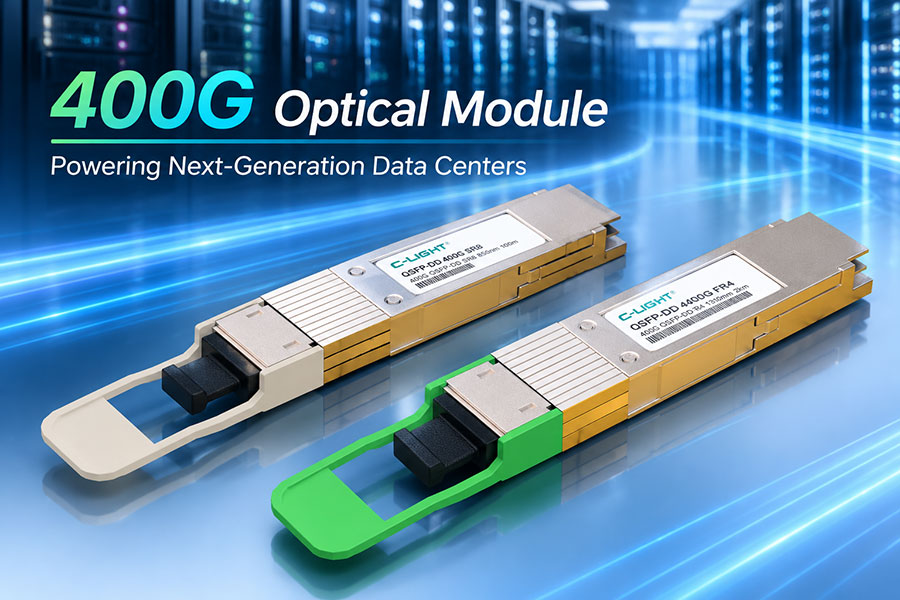
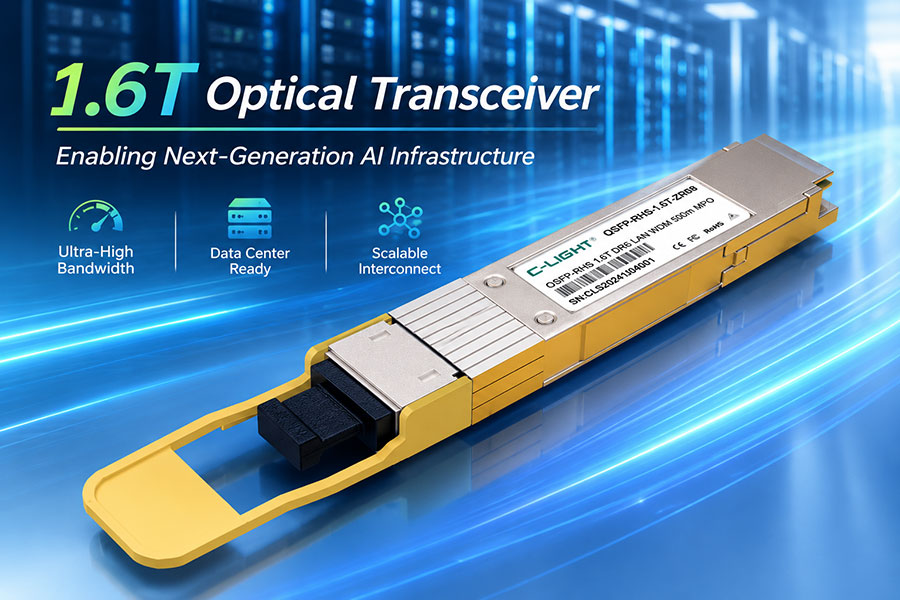
Relevant product families include 400G QSFP-DD optical transceivers, 800G OSFP optical transceivers, 800G QSFP-DD optical transceivers, and 1.6T OSFP-RHS optical transceivers. The exact specification and compatibility of each product should be confirmed against the intended host platform and link requirements.
9. Market Outlook and Industry Implications
In 2026, demand for high-speed optical transceivers is being shaped by three connected developments: expansion of AI infrastructure, migration toward higher-capacity network interfaces, and diversification into additional optical applications.
Market forecasts published during 2026 project substantial growth in AI-focused optical transceivers. One TrendForce forecast estimated that this market would rise from $16.5 billion in 2025 to $26 billion in 2026. This is a forecast for the AI-focused segment, not the entire global optical transceiver market.
The outlook also depends on factors beyond optical technology itself. Cloud infrastructure investment, accelerator availability, manufacturing capacity, component costs, and deployment schedules can all affect actual shipments and market growth.
For suppliers, the opportunity extends across high-speed modules, optical components, precision packaging, testing, and supporting fiber connectivity. For network operators, the priority is to balance bandwidth growth with reliable sourcing, power efficiency, and compatibility across successive equipment generations.
10. Frequently Asked Questions
Q1. Why is demand for high-speed optical transceivers growing in 2026?
Answer: AI data centers, cloud expansion, and higher-capacity switching systems are increasing demand for fast, reliable network connections. These deployments require more bandwidth between servers, racks, and data center facilities.
Q2. Which optical transceiver speeds are important in 2026?
Answer: 400G remains relevant across many deployments, while 800G is a key high-bandwidth option for AI and cloud infrastructure. 1.6T is emerging for next-generation platforms that support its electrical, optical, and thermal requirements.
Q3. What is the difference between 800G and 1.6T transceivers?
Answer: Their nominal aggregate data rates are 800 Gb/s and 1.6 Tb/s, respectively. Actual lane configuration, optical reach, power consumption, and form factor depend on the specific module design.
Q4. Will AI growth affect the supply of optical components?
Answer: Yes. Higher demand can place pressure on specialized lasers, photonic chips, DSPs, and precision packaging. Manufacturing expansion and component qualification take time, so supply constraints may affect lead times and deployment schedules.
Q5. Are coherent optical transceivers used inside AI data centers?
Answer: Coherent modules are particularly relevant to data center interconnect and other higher-capacity links over longer distances. Short-reach connections inside data center fabrics may use different optical architectures depending on the application.
Q6. What should buyers verify before purchasing high-speed optical transceivers?
Answer: Buyers should confirm data rate, form factor, optical reach, wavelength, fiber type, connector, power requirements, host compatibility, and product availability. Testing the complete link on the intended equipment helps reduce deployment risk.
11. Conclusion
The growing demand for high-speed optical transceivers in 2026 reflects the expanding bandwidth needs of AI computing, cloud services, and data center networking. 400G and 800G products continue to serve important connectivity requirements, while 1.6T modules are advancing to support higher-capacity platforms.
Continued market growth will depend on more than faster optical technology. Component availability, manufacturing yield, power efficiency, thermal design, interoperability, and supply-chain resilience will all influence deployment outcomes. Network operators that align transceiver selection with verified system requirements and realistic procurement plans will be better positioned to scale their infrastructure.
Planning a high-speed optical network upgrade?
Review transceiver data rates, optical reach, host compatibility, and supply requirements before selecting modules for your deployment.
Contact C-LIGHT >

 >
 >
 >
 >
 >
 >
 >