TEL:+86 132 6656 7067





AI training and inference depend on fast communication between accelerators, memory systems, switches and distributed compute nodes. As GPU clusters grow, network performance is increasingly influenced by link bandwidth, communication latency, congestion, power consumption and the number of optical connections required. Silicon photonics supports this growth by integrating optical functions onto compact photonic chips that can be used in high-speed transceivers and emerging optical-engine architectures.
Its role extends beyond replacing copper with fiber. Silicon photonics provides a platform for dense optical integration, while transceiver design, switching architecture and network topology determine how those optical links are deployed. Understanding the relationship between these layers is important when planning scalable AI infrastructure.
1. Why AI Networks Need Silicon Photonics
AI workloads create different communication patterns. Distributed training requires frequent exchanges of gradients, parameters or intermediate data, while inference systems may emphasize latency, throughput and efficient communication between accelerators and memory. Optical links provide the physical connectivity, but their value depends on how effectively the network uses available bandwidth.
2. Where Silicon Photonics Fits in an AI Network
A typical AI data center contains accelerator servers, leaf and spine switches, high-speed network adapters and optical connections between devices. Silicon photonics most commonly appears in optical transceivers or optical engines that convert electrical signals into optical signals and back again.
| Network Layer | Communication Role | Silicon Photonics Application |
|---|---|---|
| Accelerator scale-up | Connects accelerators within a tightly coupled compute system. | Potentially relevant to selected optical scale-up architectures, but many current scale-up links use electrical or proprietary interconnect technologies. |
| Scale-out fabric | Connects accelerator servers through Ethernet or InfiniBand switches. | Used in optical transceivers and may be used in optical engines for high-bandwidth switch connections. |
| Data center interconnect | Connects network equipment, clusters or facilities over longer fiber links. | Can support single-mode optical interfaces and wavelength-multiplexed designs, depending on reach and product architecture. |
| Emerging co-packaged systems | Places optical engines close to high-bandwidth switching or computing ASICs. | Can provide integrated optical functions while reducing the length of high-speed electrical paths. |
Silicon photonics is not itself a networking protocol. Ethernet and InfiniBand define network communication behavior, while the optical interface determines how signals are physically transmitted. The selected transceiver must match the host interface, optical standard, reach, fiber type and network design.
3. How Silicon Photonics Carries AI Traffic
Silicon photonic circuits integrate structures such as waveguides, modulators, splitters, combiners and wavelength filters. Depending on the design, photodetectors may be integrated using germanium or another compatible material system. Together with laser sources and electronic circuits, these devices form an optical transmitter or receiver.
Transmit Path
The host switch or network adapter generates electrical data. Driver electronics condition the signal and operate the optical modulator, which encodes data onto light supplied by a laser. The photonic circuit routes the optical signal to a fiber interface connected to the network.
Receive Path
Incoming light enters the photonic circuit and reaches a photodetector. The detector converts optical power into an electrical signal, which is amplified and processed by receiver electronics before reaching the host device.
The specific implementation depends on lane rate, modulation format, wavelength plan, optical reach and transceiver architecture. Silicon photonics is one part of the link; high-speed electronics, firmware, signal processing and optical packaging are also critical to reliable operation.
4. Optical Bandwidth: From 400G to 800G and 1.6T
AI network designs continue to increase the bandwidth available at switch ports and optical interfaces. Higher-capacity links can reduce the number of physical connections needed for a given aggregate bandwidth, but they also raise requirements for lane speed, signal integrity, thermal control and optical performance.
| Aggregate Link Class | Design Considerations | AI Networking Relevance |
|---|---|---|
| 400G | Established high-speed optical architectures use multiple electrical and optical lanes, with implementation varying by reach and interface type. | Suitable for many existing data center fabrics and high-bandwidth server or switch connections. |
| 800G | Requires higher aggregate lane capacity, careful electrical design and sufficient optical margin. | Supports increasing bandwidth demands in modern AI clusters and high-radix switching systems. |
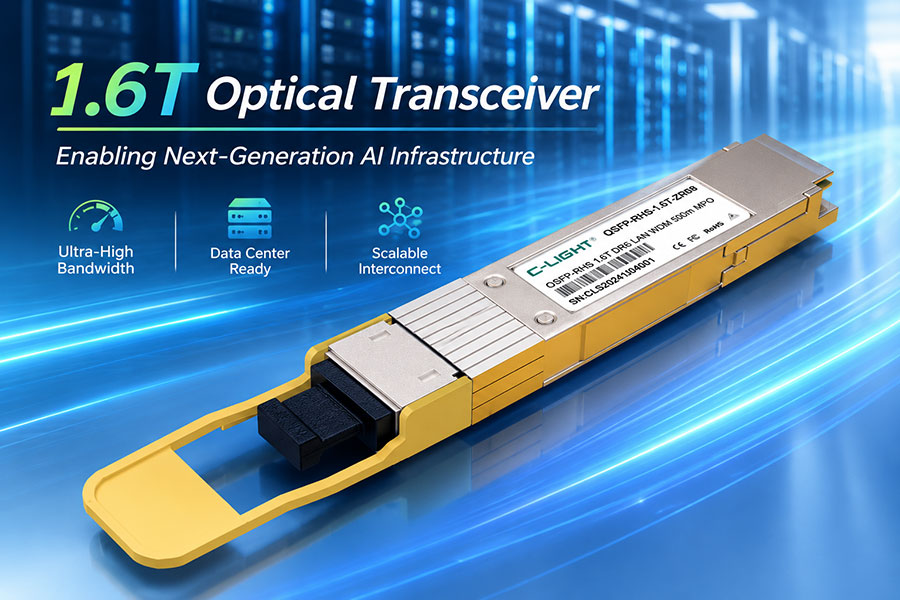
| 1.6T | Emerging architectures commonly target 200G-class electrical lanes, with optical lane arrangements depending on the implementation. | Provides a path toward higher-capacity switch connectivity as AI network bandwidth grows. |
Aggregate port rate is not the same as application throughput. Protocol overhead, congestion, routing, collective communication patterns and network utilization all affect the useful data rate delivered to an AI workload.
5. Silicon Photonics and InfiniBand or Ethernet
Silicon photonics can support optical physical interfaces used by both Ethernet and InfiniBand equipment, provided the transceiver and host interface are designed for the required standard. The choice between Ethernet and InfiniBand depends on network architecture, software ecosystem, congestion management, operational preferences and application requirements—not on the photonic material alone.
| Consideration | Ethernet AI Fabric | InfiniBand AI Fabric |
|---|---|---|
| Network approach | Uses Ethernet switching and associated transport and congestion-management mechanisms. | Uses InfiniBand switching and its fabric management and transport mechanisms. |
| Optical connectivity | Uses compatible Ethernet optical transceivers and fiber links. | Uses compatible InfiniBand optical interfaces and fiber links. |
| Silicon photonics role | Implements optical conversion in supported transceiver or optical-engine products. | Can implement optical conversion in products designed for compatible InfiniBand interfaces. |
| Compatibility requirement | Must match port rate, optical standard, reach and host specifications. | Must match InfiniBand generation, port specifications, optical interface and supported reach. |
Physical connector compatibility alone does not guarantee interoperability. Data rate, encoding, FEC behavior, wavelength, optical power budget, link training and host-device support must all be considered when selecting optical modules.
6. Scale-Up, Scale-Out and Optical Connectivity
AI networking is not a single flat fabric. Different layers have different requirements for latency, bandwidth, topology and physical reach.
Scale-Up
Scale-up interconnects connect accelerators within a closely coupled compute domain. Many implementations use specialized electrical links or proprietary interconnects. Optical scale-up is an area of development where bandwidth density and reach may justify optical conversion, but silicon photonics is not automatically required for every scale-up system.
Scale-Out
Scale-out networks connect accelerator servers through switches, often using Ethernet or InfiniBand. Optical transceivers are widely used where high port rates, cable reach, rack layout or cabling density make fiber a practical choice. Silicon photonics can provide the optical functions inside suitable transceivers.
Scale-Across
Scale-across architectures connect multiple clusters or data center domains. Depending on distance and topology, they may use high-speed single-mode optics, wavelength-division multiplexing or coherent optical technology. Not every scale-across link uses silicon photonics, since reach and performance requirements can favor different optical platforms.
7. Optical Power, Reach and Fiber Selection
The benefits of silicon photonics depend on the optical link budget and the fiber infrastructure. A module must provide enough transmitter power and receiver sensitivity to accommodate fiber attenuation, connector losses, splices and other optical penalties while retaining operating margin.
| Link Consideration | Engineering Impact |
|---|---|
| Fiber type | Single-mode fiber is common for longer data center links and many wavelength-multiplexed applications; multimode fiber may be suitable for specific short-reach interfaces. |
| Optical reach | Determines the required transmitter, receiver and optical interface specifications. |
| Insertion loss | Connector, fiber and internal coupling losses reduce the optical power available at the receiver. |
| Wavelength plan | Must match the transceiver architecture and any multiplexing or filtering components. |
| FEC and error performance | System-level error correction and performance targets depend on the interface specification and implementation. |
Silicon photonics does not automatically provide longer reach than other photonic platforms. Reach depends on the complete transmitter and receiver design, laser characteristics, modulation format, amplification where applicable, fiber plant and receiver performance.
8. Power Efficiency and Thermal Constraints
Power efficiency is a major consideration in AI data centers because large numbers of high-speed ports operate continuously. Silicon photonics can integrate optical functions compactly, but the total transceiver power also includes laser sources, drivers, TIAs, digital signal processors where used, control circuitry and power-delivery losses.
Thermal design becomes more difficult as modules and switches increase in density. Temperature can affect laser wavelength, photonic filter alignment and electronic performance. Optical engines placed close to switching ASICs introduce additional thermal interactions, making package design and cooling strategy particularly important in co-packaged systems.
Comparisons between optical technologies should use consistent system boundaries. Module-only power, optical-engine power and complete link power are different metrics, and savings in one part of the system may be offset by requirements elsewhere.
9. Silicon Photonics and Co-Packaged Optics
Pluggable transceivers place the optical engine inside a removable module connected to the host through an electrical interface. Co-packaged optics moves optical engines closer to the host ASIC, shortening the high-speed electrical path and potentially reducing electrical interconnect power.
| Factor | Pluggable Silicon Photonics | Silicon Photonics in CPO |
|---|---|---|
| Electrical path | Includes board routing and the module interface. | Can shorten the path between the ASIC and optical engine. |
| Maintenance | Usually supports independent transceiver replacement. | Requires a service strategy for optical engines, lasers and package-level connections. |
| Fiber connection | Uses accessible module ports. | Requires fiber routing and access integrated into the system design. |
| Thermal integration | Managed within the module and host airflow design. | Must coordinate with the ASIC package and cooling structure. |
| Deployment decision | Useful where modularity and field replacement are priorities. | Potentially attractive where bandwidth density and electrical power are major constraints. |
CPO and silicon photonics solve different parts of the system problem. Silicon photonics integrates optical functions; CPO changes where those functions are packaged. CPO can use silicon photonics, but it does not eliminate the need for fiber management, laser delivery, thermal control or reliable optical coupling.
10. Manufacturing and Deployment Challenges
High-volume AI networking requires optical links that perform consistently across production lots and operating environments. Silicon photonics manufacturing must control waveguide dimensions, modulator characteristics, detector performance and optical loss. Packaging adds fiber alignment, die attachment, laser integration and electrical interconnect requirements.
Optical coupling yield: Small alignment errors can increase insertion loss and reduce channel consistency.
High-speed signal integrity: Electrical parasitics and crosstalk can limit achievable lane rates.
Thermal stability: Temperature changes can affect optical wavelength and electrical performance.
Qualification: Final modules require optical, electrical, thermal and reliability testing.
Supply and compatibility: Products must match host equipment, protocol requirements and supported optical interfaces.
Operational complexity: Dense fiber plants require careful labeling, routing, cleaning and maintenance procedures.
These issues cannot be resolved through the photonic chip alone. The transceiver, host ASIC, package, cooling structure and fiber infrastructure must be evaluated as a complete interconnect system.
11. Selecting Silicon Photonics for an AI Deployment
Choosing an optical solution begins with the required link characteristics and the network's operating model. The photonic platform should follow the interface requirements rather than serve as the only selection criterion.
| Selection Factor | Questions to Resolve |
|---|---|
| Network protocol | Does the host use Ethernet, InfiniBand or another supported interface? |
| Port speed | Is the deployment based on 400G, 800G, 1.6T or a different interface generation? |
| Distance | What reach is required between servers, switches, racks or facilities? |
| Fiber infrastructure | Is single-mode or multimode fiber installed, and what connector types are available? |
| Power and cooling | What are the module power limits, airflow conditions and thermal constraints? |
| Host compatibility | Does the selected module match the port, firmware, interface specification and supported configuration? |
| Lifecycle requirements | How will modules be monitored, replaced and supported over the deployment lifecycle? |
For an existing AI cluster, validating compatibility with the actual switch or network adapter is especially important. Optical specifications, host coding requirements and firmware behavior should be confirmed before large-scale procurement.
12. Frequently Asked Questions
12.1 What role does silicon photonics play in AI networking?
It provides integrated optical functions for transmitting and receiving high-speed data. These functions can be used in optical transceivers and optical engines connecting accelerator servers, switches and other data center equipment.
12.2 Does silicon photonics make AI networking faster by itself?
Not necessarily. It enables optical connectivity, but overall network performance depends on port bandwidth, topology, congestion, protocol behavior, switching capacity and application communication patterns.
12.3 Is silicon photonics required for 800G or 1.6T transceivers?
No. These data rates can be implemented using different photonic platforms and optical architectures. The appropriate design depends on reach, power, cost, integration and product requirements.
12.4 Can silicon photonics support both Ethernet and InfiniBand?
Yes, when incorporated into optical products designed for the relevant interface. The complete module must meet the protocol's optical and electrical specifications and be compatible with the intended host equipment.
12.5 Will co-packaged optics replace pluggable modules in AI data centers?
Not universally. CPO may suit systems where electrical reach and bandwidth density are major constraints, while pluggable modules retain benefits in serviceability, flexibility and independent replacement.
13. Conclusion
Silicon photonics is an important technology for scaling optical connectivity in AI data centers. By integrating optical functions on compact photonic circuits, it supports high-bandwidth transceivers and emerging optical-engine architectures for Ethernet and InfiniBand fabrics.
Its practical value depends on the entire interconnect: photonic device performance, high-speed electronics, laser architecture, thermal management, optical reach and host compatibility. As 800G and 1.6T networks evolve, silicon photonics and co-packaged optics offer complementary approaches to increasing bandwidth density while addressing the power and integration challenges of large AI clusters.
Discuss optical transceiver specifications, fiber interfaces and host compatibility requirements with the C-LIGHT team.
Contact C-LIGHT >

 >
 >
 >
 >
 >
 >
 >