TEL:+86 132 6656 7067




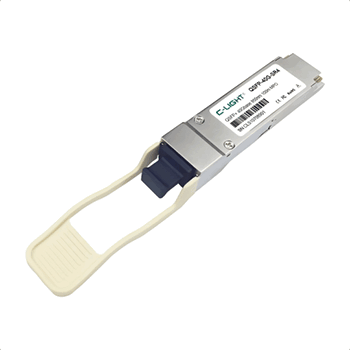
QSFP28 100G/OTU4 Dual-Rate SR4 100m Optical Transceiver delivers dual-protocol support for 100GbE and OTU4 (112Gbps) in a QSFP28 form factor. Utilizing 4× 850nm VCSEL lanes over OM3/OM4 multimode fiber (MMF) with MPO connectors, it achieves 100-meter reach for high-density, low-latency interconnects in data center racks, HPC clusters, and OTN edge networks.
| Product Features: |
●Supports 103.1Gb/s and OTU4 112Gb/s aggregate rate ●Maximum link length of 100m on OM3 Multimode Fiber (MMF)and 150m on OM4 MMF ●850nm VCSEL array laser and receiver ●MPO Connector ●Built-in digital diagnostic functions ●Hot-pluggable QSFP+ form factor ●Single 3. 3V power supply ●Operating temperature: 0℃ to 75℃ ●RoHS 6 compliant (lead free) ●Digital Diagnostic Monitor (DDM) ●Power Consumption < 1.5W |
| Applications |
| • Data Center Interconnects (DCI) • High-Performance Computing (HPC) Clusters • Telecom Metro Network Aggregation • Enterprise Core Network Backbones |
| Data Sheet |
| QSFP28-100G-OTU4-DUAL-RATE-SR4-100m.pdf |
100G QSFP28 SR4 100m Transceiver FAQ
Q1: What is a 100G QSFP28 SR4 100m transceiver?
A 100G QSFP28 SR4 100m transceiver is a high-speed multimode optical module designed for 100GbE transmission over OM3/OM4 multimode fiber. It uses 850nm VCSEL technology to provide reliable short-range connectivity within data centers.
Key features include:
100Gbps data rate
850nm VCSEL technology
Up to 100m over OM4 MMF
MPO/MTP connector
QSFP28 hot-pluggable form factor
It is ideal for AI data centers, cloud computing, HPC, and enterprise networks.
Q2: How does a 100G QSFP28 SR4 transceiver work?
The module converts electrical signals into 4×25G NRZ optical channels over multimode fiber. This parallel optical architecture delivers high bandwidth and low latency for switch-to-switch and server-to-switch connections.
Q3: What are the key features of the C-LIGHT 100G QSFP28 SR4 100m transceiver?
The C-LIGHT module is designed for high-density 100G optical networking.
Key features include:
100Gbps transmission
Up to 100m over OM4 MMF
4×25G NRZ channels
MPO/MTP optical interface
QSFP28 MSA compliant
Digital Diagnostic Monitoring (DDM)
Power consumption <2.5W
These features ensure reliable, energy-efficient data center connectivity.
Q4: What are the advantages of a 100G QSFP28 SR4 transceiver?
Compared with lower-speed optical modules, it offers:
Higher bandwidth
Ultra-low latency
High port density
Low power consumption
Cost-effective multimode deployment
It is an ideal solution for short-range 100G interconnects.
Q5: Where are 100G QSFP28 SR4 transceivers commonly used?
These modules are widely deployed in short-distance optical networks.
Typical applications include:
AI data centers
Cloud computing
High-performance computing (HPC)
Spine-Leaf architectures
Top-of-Rack (ToR) switching
Enterprise data centers
These applications require high bandwidth and low-latency connectivity within 100m.
Q6: Why choose a 100G QSFP28 SR4 instead of a 100G LR4 module?
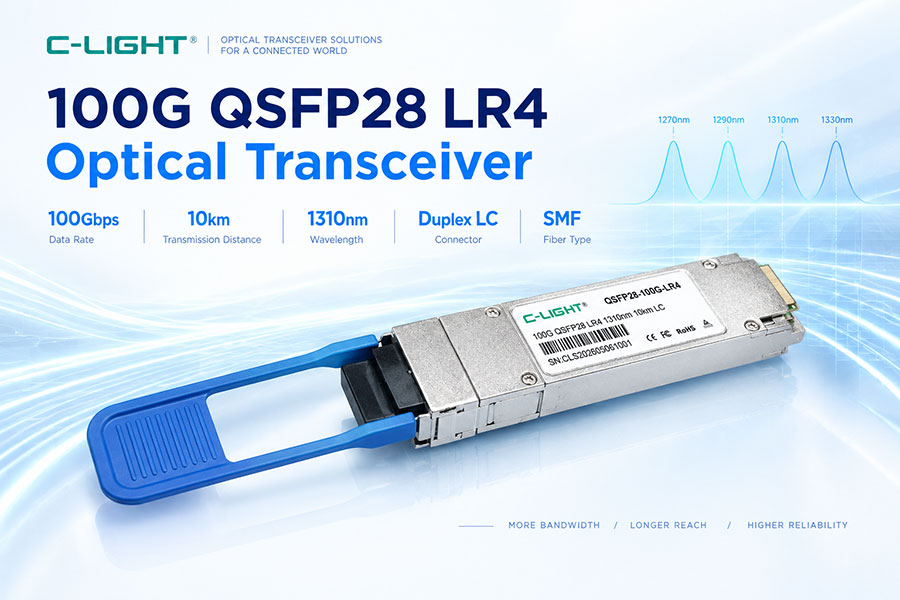
A 100G SR4 module is designed for multimode fiber and short-distance links, while 100G LR4 supports single-mode fiber transmission up to 10km.
Its advantages include:
Lower deployment cost
OM3/OM4 fiber support
Low latency
Easy installation
Excellent compatibility
It is ideal for in-rack and inter-rack data center connections.
Q7: How do you choose the right 100G QSFP28 SR4 transceiver?
When selecting a 100G SR4 module, consider:
Transmission distance
Fiber type (OM3/OM4)
Connector type
Switch compatibility
Power consumption
Operating temperature
Choosing the right module ensures reliable performance and long-term network scalability.
Q8: Why choose the C-LIGHT 100G QSFP28 SR4 100m transceiver?
The C-LIGHT 100G QSFP28 SR4 combines high bandwidth, low power consumption, and reliable 100m multimode transmission in a compact QSFP28 package.
It provides:
100Gbps bandwidth
Up to 100m over OM4
850nm VCSEL technology
Power consumption <2.5W
Broad platform compatibility
It is an ideal solution for AI data centers, cloud computing, HPC, and high-density Ethernet networks.
 >
>

 >
>
 >
>
 >
>
 >
>
 >
>
 >
>
 >
>