TEL:+86 132 6656 7067





An Optical Transport Network (OTN) is a transport technology standardized by ITU-T to carry, monitor and manage high-capacity client signals across optical networks. It combines digital signal framing, forward error correction, performance monitoring and transport switching with optical technologies such as DWDM to support reliable connectivity across metro, regional and long-haul infrastructure.
As traffic grows across data centers, telecom networks, enterprise infrastructure and AI computing environments, operators need transport systems that can aggregate different client services while maintaining visibility into signal quality and network performance. OTN provides a structured digital transport layer between client equipment and the underlying optical transmission system.
1. What Is an Optical Transport Network?
OTN is defined by a family of ITU-T recommendations, including the G.709 interface specification. It encapsulates client traffic into standardized transport frames, adds overhead for management and monitoring, and can apply forward error correction (FEC) to improve transmission robustness.
OTN is not the same as DWDM. OTN primarily provides digital transport framing, multiplexing, switching and monitoring, while DWDM carries multiple optical wavelengths over shared fiber. The two technologies are frequently deployed together in modern optical transport systems.
2. OTN Network Architecture
A typical OTN deployment connects routers, switches, storage platforms or other client equipment to transport nodes. The OTN layer adapts client traffic into transport containers, aggregates services where required and sends the resulting signals through an optical line system.
Routers, switches, storage
Client signal adaptation
Service routing and aggregation
Transport overhead and error correction
Electrical-to-optical conversion
Wavelength transport over fiber
The physical implementation varies by platform. Some systems integrate client mapping, OTN switching and optical interfaces into one chassis. Others use separate transponders, muxponders, switching shelves and line-system equipment.
3. OTN Framing and Hierarchy
OTN organizes traffic into standardized digital transport structures. The main signal categories include OPU, ODU and OTU, each serving a distinct function in the transport hierarchy.
| OTN Structure | Primary Function | Role in Transport |
|---|---|---|
| OPU (Optical Payload Unit) | Adapts and carries the client payload | Provides payload mapping and adaptation information |
| ODU (Optical Data Unit) | Provides digital path monitoring and switching structure | Supports end-to-end or subnetwork transport and multiplexing |
| OTU (Optical Transport Unit) | Adds transport overhead and associated FEC where specified | Supports transmission over the transport section |
Common OTN signal rates include OTU1, OTU2, OTU2e, OTU3 and OTU4, with higher-rate interfaces and newer flexible-rate transport specifications also available. The actual line rate includes overhead and may be higher than the nominal client payload rate.
OTN multiplexing allows lower-rate ODU signals to be carried within higher-capacity ODU containers when the relevant mapping and multiplexing combinations are supported. This enables service aggregation and more efficient use of transport capacity.
4. Forward Error Correction in OTN
Forward Error Correction (FEC) adds redundant information to a transmitted signal so the receiver can detect and correct a defined range of transmission errors. In OTN systems, FEC is an important mechanism for improving error performance across optical links affected by noise and other impairments.
FEC performance depends on the coding scheme, implementation and transmission conditions. Different optical interfaces may use different FEC approaches, and not every implementation has the same correction capability or overhead.
Error correction: Helps recover data affected by transmission errors within the correction capability of the code.
Improved link performance: Can support more demanding optical links when the complete system is engineered for the selected FEC scheme.
Performance monitoring: Pre-FEC and post-FEC error statistics can help operators assess signal quality and detect deteriorating links.
Latency and processing: FEC introduces implementation-dependent processing delay and requires compatible transmitter and receiver behavior.
FEC does not compensate for every optical fault. Excessive loss, poor OSNR, incorrect channel configuration or incompatible equipment may still prevent a link from operating correctly.
5. OTN Switching, Multiplexing and Service Aggregation
OTN switching enables transport nodes to direct ODU containers between ports and network paths. This differs from ordinary optical wavelength switching because the switching operation can occur at the digital transport layer rather than by manipulating optical wavelengths directly.
ODU Switching
ODU switching can allocate transport capacity to different services and route them through supported network paths. Depending on the platform, it may support grooming, protection switching and more efficient utilization of higher-rate transport interfaces.
Multiplexing and Grooming
Multiple lower-rate services can be mapped into higher-capacity transport containers when supported by the OTN equipment. Grooming helps aggregate traffic before it is transmitted across a high-capacity optical link.
Protection and Resilience
OTN platforms may support protection mechanisms that restore traffic following certain link or equipment failures. Protection behavior depends on the network design, supported protocols, switching configuration and available alternate paths.
6. OTN vs. DWDM vs. Ethernet Transport
OTN, DWDM and Ethernet serve different roles, although they can work together within the same network.
| Technology | Primary Role | Typical Functions |
|---|---|---|
| Ethernet | Client data networking | Packet forwarding, switching, VLANs and Ethernet service delivery |
| OTN | Digital transport | Client mapping, transport framing, multiplexing, switching, monitoring and FEC where specified |
| DWDM | Optical wavelength transport | Multiplexing multiple wavelengths over a shared fiber and supporting high-capacity optical transmission |
| Coherent optics | High-capacity optical transmission | Advanced modulation and digital signal processing for suitable high-speed and extended-reach links |
For example, an Ethernet service can be mapped into an OTN container and transmitted over a DWDM wavelength. In another architecture, a router may use a compatible coherent pluggable directly over an optical line system without a separate OTN switching layer.
7. OTN and Coherent Optical Transceivers
High-capacity OTN systems frequently use optical transponders or coherent interfaces to carry transport signals over fiber. Coherent optical technology uses phase and polarization information alongside digital signal processing to recover high-capacity optical signals.
Coherent pluggables can reduce the need for separate optical transport hardware in selected designs, while dedicated OTN equipment remains useful when digital grooming, transport-layer monitoring, client adaptation or protection functions are required.
100G and 200G: Used in appropriate metro and regional transport applications, depending on interface and reach.
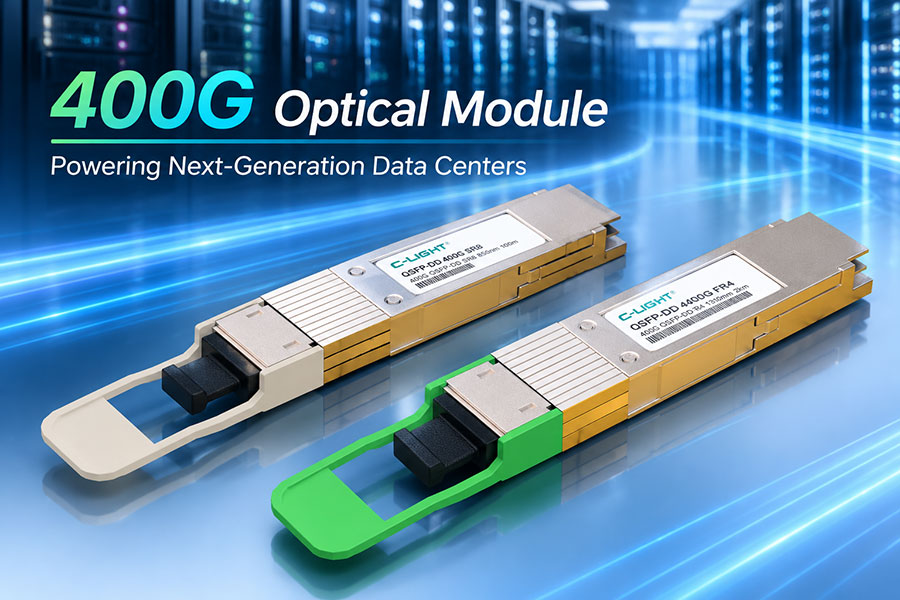
400G coherent optics: Supports higher-capacity transport and data center interconnect applications with compatible line systems.
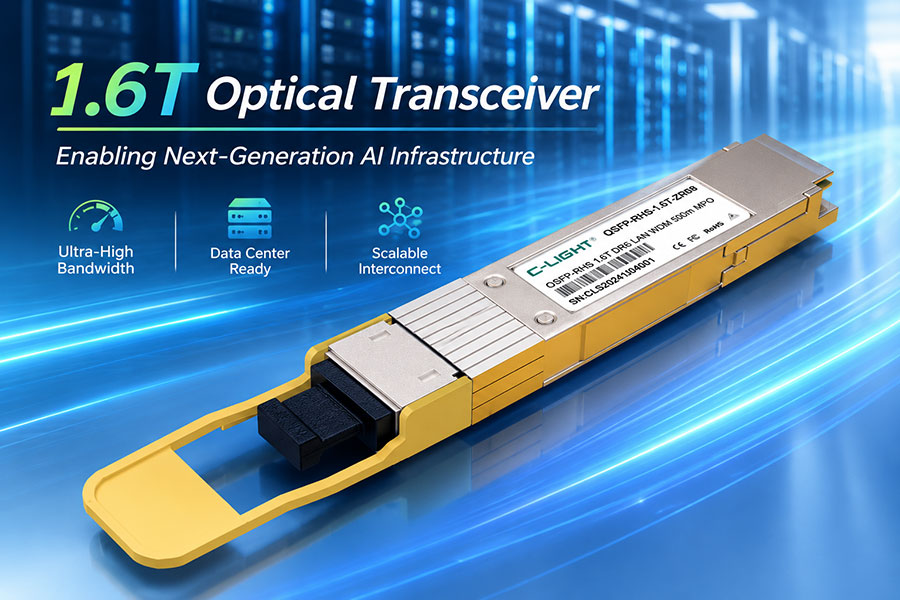
800G coherent optics: Targets high-capacity optical links, with reach and spectral performance dependent on the specific product and system design.
OTN transponders and muxponders: Adapt client interfaces to supported transport formats and may aggregate multiple services.
OTN equipment and coherent transceivers must be selected as a compatible system. Verify client interface rates, OTN mapping options, line-side mode, FEC requirements, optical power, supported reach and host-platform constraints.
8. C-LIGHT Optical Transport Products
C-LIGHT provides optical networking product categories relevant to OTN and DWDM deployments, including DWDM transceivers, coherent DCO modules and WDM/OTN-related transport equipment. The appropriate combination depends on whether a project needs digital transport switching, wavelength transmission, or both.
8.1 WDM OTN Transport Equipment
OTN transport equipment can provide client adaptation, OTN framing, service aggregation and switching functions, depending on the platform. In a DWDM environment, it can work alongside wavelength multiplexers and optical amplifiers to deliver multi-service transport over fiber infrastructure.
For deployment planning, confirm the supported client interfaces, OTN hierarchy, mapping and multiplexing capabilities, switching capacity, protection features and line-side interfaces of the proposed system.
8.2 DWDM 100G / 40G / 25G Optical Transceivers
C-LIGHT's DWDM 100G/40G/25G product family includes SFP28, QSFP+ and QSFP28 options, depending on the model. These products can be considered for optical uplinks and wavelength-based transport links where the data rate, wavelength, distance and host interface match the network design.
When used with OTN equipment, verify the client-side interface and whether the transceiver is intended for a client link or a DWDM line-side connection. A module's nominal data rate alone does not determine its compatibility with a specific OTN port.
8.3 DWDM 100G / 200G / 400G / 800G Coherent DCO Transceivers
C-LIGHT lists coherent DCO product categories spanning 100G, 200G, 400G and 800G. Depending on the specific model, these products can support high-capacity optical transport and data center interconnect architectures using compatible coherent interfaces and DWDM line systems.
For OTN deployments, verify whether the coherent module is used as a line-side interface, a router-hosted optical interface or part of a dedicated transport platform. Supported standards, FEC behavior, line rates and transmission reach vary by product.
8.4 Optical Line-System Components
Wavelength multiplexers, demultiplexers and EDFA amplifiers may be required to build the optical layer beneath an OTN system. These components support wavelength aggregation, channel separation and optical power management across suitable fiber routes.
Selection should account for channel spacing, insertion loss, amplifier gain, output power, OSNR and the number of active wavelengths. These parameters determine whether the optical line can support the intended transmission performance.
9. OTN Applications in Modern Networks
Telecom Backbone Networks
OTN provides structured transport for aggregating high-capacity services across backbone infrastructure. Monitoring and FEC capabilities help operators evaluate transport performance and manage transmission quality.
Metro Aggregation
Metro networks can aggregate multiple client services into higher-rate transport interfaces. OTN switching and grooming can help allocate capacity across interconnected sites while DWDM increases the utilization of available fiber.
Data Center Interconnects
Data centers require high-bandwidth connectivity for storage replication, cloud platforms and distributed computing. OTN and coherent optical technologies can support selected interconnect architectures, especially where service aggregation or transport-layer visibility is required.
Enterprise and Storage Networks
Enterprises with multiple locations may use optical transport to carry Ethernet, storage and other supported services over carrier or private optical infrastructure. The specific service mapping and protection options depend on the deployed platform.
AI and High-Performance Computing Infrastructure
AI clusters increase demand for high-capacity data center interconnects and scalable network infrastructure. OTN can be relevant in transport networks that aggregate traffic between sites, while the choice of client interface and optical line technology depends on the required bandwidth, distance and network architecture.
10. OTN Deployment and Troubleshooting
OTN faults can arise at the client interface, mapping layer, transport frame, optical line or management layer. Troubleshooting should isolate each layer rather than treating every error as a fiber problem.
Client interface: Verify port configuration, data rate, protocol and physical connectivity.
OTN mapping: Confirm the client-to-OPU/ODU mapping and supported signal rate.
Transport overhead: Review alarms and performance counters for defects affecting the ODU or OTU path.
FEC statistics: Check pre-FEC and post-FEC error measurements where available to assess transmission margin.
Optical power: Measure transmit and receive levels and compare them with module and line-system limits.
DWDM channel plan: Verify the wavelength, channel assignment and multiplexer/demultiplexer connections.
OSNR and line quality: Investigate optical noise, excessive span loss, amplifier settings and other transmission impairments when indicated.
Management and protection: Confirm alarms, configuration consistency and protection-switching behavior across the network.
Alarm names and diagnostic counters vary by vendor and platform. Use the relevant equipment documentation to interpret defects and performance measurements before making configuration changes.
11. Frequently Asked Questions
Q1. What is the main purpose of OTN?
OTN provides standardized digital transport framing, client mapping, multiplexing, monitoring and transport switching. It can also provide FEC to improve transmission robustness when supported by the interface.
Q2. Is OTN the same as DWDM?
No. OTN handles digital transport functions, while DWDM combines multiple optical wavelengths onto a shared fiber. They are often used together, with OTN handling service transport and DWDM providing the optical transmission layer.
Q3. What do OPU, ODU and OTU mean?
OPU provides client payload adaptation, ODU provides the digital path and monitoring structure, and OTU adds transport-section overhead and associated FEC where specified.
Q4. Does OTN always require FEC?
FEC is commonly used in OTN transport interfaces, but the supported scheme depends on the relevant interface and implementation. Verify the specified FEC mode and compatibility requirements for both ends of the link.
Q5. Can coherent pluggables replace OTN equipment?
Not in every application. Coherent pluggables can simplify optical transmission in compatible architectures, but they do not automatically provide all OTN functions, such as digital grooming, OTN-layer monitoring or transport switching.
Q6. Which C-LIGHT products are relevant to OTN networks?
Relevant categories include WDM/OTN transport equipment, DWDM transceivers across multiple data rates, coherent DCO modules and optical line-system components. The correct combination depends on the required transport functions, interfaces, optical reach and system architecture.
12. Conclusion
Optical Transport Networks provide a structured and manageable way to transport high-capacity services across modern fiber infrastructure. OTN framing, multiplexing, switching, performance monitoring and FEC support reliable digital transport, while DWDM and coherent optics increase the capacity and reach of the underlying optical layer.
For network upgrades, the key is to align client interfaces, OTN mapping, switching capabilities and optical transmission specifications. C-LIGHT's DWDM transceivers, coherent DCO products and WDM/OTN-related product categories provide options for evaluating optical transport architectures across telecom, metro and data center interconnect applications.
Build Your Optical Transport Solution
Review C-LIGHT optical products for DWDM transmission, coherent connectivity and optical transport applications. For product selection, provide your target data rate, interface type, distance, existing equipment and OTN or DWDM requirements.
Contact C-LIGHT >

 >
 >
 >
 >
 >
 >
 >