TEL:+86 132 6656 7067





The expansion of AI data centers is reshaping the optical transceiver supply chain, from semiconductor materials and photonic chips to high-speed electronics, precision assembly, testing, and global distribution. As 400G, 800G, and 1.6T connectivity becomes increasingly important, supply-chain performance depends on component availability, manufacturing yield, qualification capacity, and coordination across the entire production ecosystem.
1. The Optical Transceiver Supply Chain at a Glance
Optical transceivers convert electrical data into optical signals and incoming light back into electrical data. They are essential for connecting switches, servers, storage systems, and other network equipment across the distances and bandwidths required by modern data centers.
A finished transceiver is the result of several manufacturing stages. Semiconductor suppliers produce optical and electronic chips, component manufacturers provide lasers and other specialized devices, optical engine manufacturers integrate photonic and electronic components, and transceiver manufacturers assemble and validate the complete module. Network equipment providers and data center operators then qualify the module for deployment in their systems.
Each stage has different capacity requirements and technical constraints. A shortage of one qualified laser, driver IC, or photonic integrated circuit can limit finished-module production even when the remaining components are readily available.
| Supply Chain Stage | Main Activities | Key Deliverables |
|---|---|---|
| Raw materials and substrates | Material preparation, wafer production, and specialized semiconductor inputs | Qualified substrates and process materials |
| Optical and electronic chip production | Photonic fabrication, laser production, and high-speed electronic IC manufacturing | Laser chips, PICs, DSPs, drivers, TIAs, and control ICs |
| Component manufacturing | Production of optical connectors, fibers, lenses, filters, and other components | Optical and mechanical components |
| Optical engine integration | Chip bonding, optical coupling, fiber alignment, and electrical interconnection | Tested optical engines or subassemblies |
| Transceiver manufacturing | Module assembly, firmware or management configuration, and final testing | Qualified optical transceiver modules |
| System qualification | Host compatibility, link testing, and deployment validation | Approved transceiver configurations |
| Distribution and lifecycle support | Inventory management, delivery, traceability, and technical support | Available products and ongoing deployment support |
The supply chain is not simply a linear sequence. Component specifications, production feedback, customer qualification, and demand forecasts influence upstream manufacturing decisions. Effective coordination helps reduce mismatches between component production and finished-module requirements.
2. Upstream Suppliers: Optical Chips and Electronic Components
Upstream suppliers provide the semiconductor devices and specialized components that determine much of a transceiver's performance, power consumption, optical reach, and production cost. The required component mix varies according to data rate, modulation format, wavelength, reach, and optical architecture.
Optical semiconductor devices
Laser chips generate optical signals, while photodetectors convert incoming light into electrical current. Modulators control the optical signal according to the transmitted data, and photonic integrated circuits (PICs) combine selected optical functions on a chip.
Indium phosphide (InP) is widely used for active photonic devices, including lasers and electro-absorption modulated lasers (EMLs). Gallium arsenide (GaAs) is used in technologies such as vertical-cavity surface-emitting lasers (VCSELs), particularly in suitable short-reach applications. Silicon photonics integrates optical functions such as waveguides and modulators, while compatible laser sources are typically provided through a separate or integrated light-source arrangement.
High-speed electronic components
Optical transceivers also rely on electronic devices that drive optical transmitters, amplify receiver signals, and process high-speed data. Depending on the architecture, these include digital signal processors (DSPs), laser drivers, transimpedance amplifiers (TIAs), clocking circuits, and power-management components.
| Component | Function | Supply Chain Consideration |
|---|---|---|
| Laser chip | Generates the optical carrier | Wavelength, output power, device yield, and qualified capacity |
| EML | Combines a laser with electro-absorption modulation | High-speed performance, process complexity, and availability |
| VCSEL | Provides laser emission for supported short-reach optical links | Array quality, manufacturing yield, and application compatibility |
| Silicon-photonic PIC | Integrates selected optical functions | Fabrication yield, optical coupling, and laser integration |
| DSP | Performs supported signal processing and may integrate FEC functions | Interface support, power, qualification, and design availability |
| Laser driver | Provides the electrical drive for a laser or modulator | Bandwidth, signal integrity, and electrical compatibility |
| TIA | Converts photodetector current into a usable voltage signal | Noise, bandwidth, linearity, and receiver performance |
| Optical connectors and passive components | Provide fiber coupling, routing, and optical-path management | Precision, insertion loss, cleanliness, and production consistency |
These components are not interchangeable solely because they belong to the same category. A replacement laser, driver, or PIC may require design changes and requalification to ensure that the finished module meets its electrical and optical specifications.
3. Optical Engine Integration and Transceiver Manufacturing
Optical engine integration bridges semiconductor manufacturing and finished-module production. It requires precise alignment and stable electrical and optical connections between the laser source, photonic devices, receiver components, and fiber interface.
Manufacturing operations can include die attachment, wire bonding or other electrical interconnection, laser-to-PIC coupling, fiber attachment, optical alignment, thermal integration, and subassembly testing. The exact process depends on whether the transceiver uses discrete optical components, silicon photonics, or another architecture.
Precision assembly
Optical coupling efficiency is sensitive to alignment. Small variations in the relative position of a laser, waveguide, lens, or fiber can affect insertion loss and the optical power reaching the receiver. High-volume manufacturing therefore requires repeatable positioning, controlled assembly conditions, and effective inspection.
Manufacturing yield
Nominal assembly capacity does not equal the number of qualified modules available for delivery. Yield losses can arise from chip defects, optical coupling problems, electrical performance failures, contamination, mechanical tolerances, or final-test results outside the required limits.
Improving yield can increase usable output without a proportional expansion of factory footprint. However, yield improvement requires process data, root-cause analysis, and consistent control of components and assembly procedures.
Test capacity
High-speed transceivers require appropriate electrical and optical testing. Depending on the design, validation may include transmit power, wavelength, receiver sensitivity, lane performance, error statistics, power consumption, thermal behavior, and management-interface checks.
Testing can become a manufacturing bottleneck when measurements are time-consuming, specialized instruments are limited, or multiple test stages must be completed sequentially. Integrated test automation and parallel measurement can help increase throughput while maintaining the required test coverage.
4. Why AI Data Centers Are Reshaping Supply and Demand
AI training and inference workloads increase traffic between accelerators, switches, storage, and separate network tiers. Large clusters require high aggregate bandwidth, while growing port counts create additional demand for optical modules, fiber assemblies, and supporting connectivity products.
Demand is also changing the product mix. Higher-speed modules require different optical and electronic components, more demanding signal-integrity performance, and careful power and thermal management. As a result, a supplier with adequate capacity for one generation may not immediately have the qualified capacity needed for the next.
A TrendForce report published on April 20, 2026, projected that the global AI-focused optical transceiver market would grow from US$16.5 billion in 2025 to US$26 billion in 2026. The same report identified tight supplies of selected EML and continuous-wave laser components, along with precision optical assembly, as constraints on production expansion. These are market projections and identified bottlenecks, not evidence that every component or product is in shortage. Read the market analysis.
| Market Driver | Effect on Transceiver Demand | Supply Chain Implication |
|---|---|---|
| AI accelerator cluster expansion | More high-speed links between computing and networking equipment | Greater demand for qualified modules and fiber connectivity |
| 800G deployment | Higher bandwidth per port and increased use of advanced optical components | Need for qualified high-speed chips, assembly, and test capacity |
| 1.6T transition | Higher per-port bandwidth and demanding per-lane signaling requirements | Additional qualification and manufacturing challenges |
| Data center interconnect | Demand for longer-reach and coherent optical solutions | Different laser, DSP, optical line-system, and test requirements |
| Power and thermal constraints | Greater emphasis on module efficiency and system-level integration | More attention to optical architecture, packaging, and cooling |
| Geographic diversification | Manufacturers seek additional production and assembly locations | New logistics, quality-control, and supplier-qualification requirements |
The key planning challenge is matching demand forecasts to the actual component mix and qualified manufacturing capacity required by each product generation.
5. Supply Chain Bottlenecks and Their Impact
Optical transceiver production can be constrained at several points, and bottlenecks may shift as manufacturing capacity expands. Increasing final assembly capacity will have limited impact if an upstream optical chip or a specialized testing process remains the limiting factor.
Optical chip availability
Specialized laser and photonic devices require dedicated materials, fabrication processes, and process controls. Expanding production requires more than adding equipment; manufacturers must establish stable yield and demonstrate that devices meet the required performance and reliability specifications.
Electronic component constraints
DSPs, drivers, TIAs, and other high-speed electronics must support the relevant signaling rate and transceiver architecture. An alternative IC may not provide the same bandwidth, noise characteristics, power profile, or management behavior, so substitution may require redesign and testing.
Packaging and assembly capacity
Precision optical alignment, fiber attachment, and advanced packaging require specialized processes and equipment. When demand rises sharply, these stages may become constraints even if semiconductor supply is improving.
Qualification and interoperability
Customer qualification takes time. A newly sourced component or alternative module may require optical, electrical, thermal, reliability, and host-platform testing before it can be deployed at scale.
Logistics and geographic concentration
Manufacturing networks can span several countries and contract manufacturers. Transport disruptions, trade requirements, customs procedures, and concentration of specialized production can affect delivery schedules. Geographic diversification may improve resilience, but only when alternative facilities have qualified processes and adequate capacity.
6. How 400G, 800G, and 1.6T Change Manufacturing Requirements
Higher aggregate data rates change both the component mix and the manufacturing tolerances required for optical transceivers. The impact depends on the interface, number of optical lanes, signaling rate per lane, modulation format, and transmission distance.
| Generation | Manufacturing Focus | Key Qualification Areas |
|---|---|---|
| 400G | Established multi-lane optical architectures and high-speed electronic interfaces | Lane mapping, optical budget, host compatibility, and error performance |
| 800G | Higher bandwidth density and more demanding electrical and optical performance | Signal integrity, component consistency, power consumption, and thermal behavior |
| 1.6T | Higher per-port throughput and increasingly demanding per-lane signaling | Advanced chip integration, packaging, lane consistency, and production test coverage |
| 800G and 1.6T coherent | High-performance coherent optical processing for supported longer-reach applications | OSNR, modulation format, FEC, optical line-system compatibility, and reach validation |
The generation label alone does not define the optical architecture. Short-reach parallel optics, wavelength-multiplexed single-mode modules, and coherent transceivers can have very different bills of materials and manufacturing processes even at similar aggregate data rates.
Manufacturers should therefore plan capacity by product family and exact configuration, rather than assuming that equipment and components qualified for one generation will automatically support another.
7. Silicon Photonics, LPO, NPO, and CPO
New optical architectures are changing how components are integrated and where signal processing occurs. They may reduce some limitations of conventional electrical interconnects or improve bandwidth density, but each introduces distinct manufacturing and qualification requirements.
| Architecture | Supply Chain Characteristics | Manufacturing Considerations |
|---|---|---|
| DSP-based pluggable optics | Integrates optical and electronic components into a replaceable module | DSP availability, optical engine assembly, module testing, and thermal design |
| Silicon photonics | Uses a PIC to integrate selected optical functions | PIC fabrication, laser integration, coupling efficiency, and packaging yield |
| Linear pluggable optics (LPO) | Removes selected in-module retiming DSP functions and relies more heavily on host signal conditioning | Host-module electrical compatibility, analog performance, and system-level qualification |
| Near-packaged optics (NPO) | Places optical engines close to the host ASIC while retaining a separate assembly | Short electrical interconnects, optical access, thermal integration, and serviceability |
| Co-packaged optics (CPO) | Integrates optical engines close to or alongside the host ASIC within a shared or tightly integrated package | Optical coupling, package integration, laser delivery, cooling, and integrated testing |
Silicon photonics does not eliminate the need for light sources, and LPO does not remove the need for electrical signal integrity. NPO and CPO can shorten electrical paths but require close coordination between optical, semiconductor, packaging, and test teams.
In an October 13, 2026 report, TrendForce highlighted integrated optical-electrical testing as an important production issue for CPO. The report noted that optical coupling, instrument coordination, and test throughput affect the cost and scalability of manufacturing. Read the CPO testing analysis.
These architectures are not universal replacements for pluggable transceivers. Different solutions can coexist, with selection depending on reach, power, bandwidth density, cost, serviceability, and manufacturing maturity.
8. Quality Control and Interoperability Testing
Quality control connects component manufacturing to reliable network operation. A module can pass individual component tests but still fail to meet system requirements because of assembly variation, host incompatibility, firmware behavior, or optical link conditions.
A robust qualification process should include the following areas:
Optical performance: Verify transmitter power, wavelength, receiver sensitivity, insertion loss, and the supported reach for the intended interface.
Electrical performance: Check signaling compatibility, lane mapping, signal integrity, and relevant error statistics.
Thermal behavior: Validate power consumption, temperature limits, cooling requirements, and sustained operation.
Management compatibility: Confirm module identification, supported configuration, diagnostics, alarms, and host recognition.
Reliability: Evaluate manufacturing consistency and applicable environmental and reliability requirements.
System interoperability: Test the transceiver in the intended host platform and network configuration.
Traceability: Maintain records of part numbers, hardware revisions, component lots, test results, and approved configurations.
Production testing should distinguish component-level results from final module qualification and live-system validation. These stages answer different questions and should not be treated as interchangeable.
9. Procurement Strategies for Supply Continuity
Procurement decisions should consider technical qualification, delivery reliability, lifecycle support, and total deployment cost in addition to unit price. A lower-cost component may create additional engineering expense or delivery risk if it is not qualified for the target application.
Forecast demand by exact product configuration
Separate demand by data rate, reach, connector, wavelength, form factor, and host requirements. This improves visibility into the specific components needed for each transceiver family and reduces the risk of treating technically different products as interchangeable inventory.
Qualify alternative suppliers early
Where feasible, qualify alternative component or transceiver sources before a shortage becomes critical. Validation should establish the scope of any required redesign, testing, and customer approval.
Use realistic lead-time and capacity data
Distinguish forecast production from confirmed capacity and committed deliveries. Monitor component allocation, yield, packaging throughput, test capacity, and changes in supplier lead times.
Manage inventory according to risk
Inventory levels should reflect lead times, demand uncertainty, component lifecycle, storage requirements, and the operational impact of a supply interruption. Critical spare planning can improve continuity, but excessive inventory can become obsolete when specifications or platform requirements change.
Coordinate engineering and purchasing
Procurement teams should work with engineering to track approved bills of materials, component revisions, firmware requirements, and qualification status. This coordination helps prevent unapproved substitutions and makes it easier to respond to changes in component availability.
10. The Role of Transceiver Manufacturers in the Supply Chain
Transceiver manufacturers connect component suppliers with network equipment providers and data center customers. Their role extends beyond module assembly to include component selection, optical and electrical integration, firmware and management implementation, testing, traceability, and lifecycle support.
Manufacturers with effective supplier management and engineering processes can identify component risks earlier, coordinate alternatives, and improve production consistency. Their ability to provide complete technical documentation and reliable test results is also important when customers deploy modules across different switch platforms.
Key manufacturing capabilities include:
Access to qualified optical and electronic components.
Stable assembly processes and production-yield management.
Optical and electrical testing suitable for the product specification.
Compatibility validation across supported host platforms.
Clear part-number, revision, and production-lot traceability.
Demand planning and coordination with upstream suppliers.
Responsive technical support for integration and troubleshooting.
For high-speed products, a manufacturer's supply capability should be assessed together with its engineering and quality processes. A production commitment is most useful when supported by a clear configuration, validated performance, and a realistic delivery plan.
11. Frequently Asked Questions
11.1 What are the main stages of the optical transceiver supply chain?
The supply chain typically includes semiconductor materials, optical and electronic chip fabrication, component production, optical engine integration, transceiver assembly, testing, system qualification, distribution, and lifecycle support.
11.2 Why can optical transceiver production be constrained even when assembly capacity is available?
Finished-module output depends on the availability of all required components and production processes. A shortage of a qualified laser, DSP, PIC, connector, or precision packaging capacity can limit deliveries even when final assembly lines have unused capacity.
11.3 How does AI data center growth affect optical transceiver manufacturing?
AI clusters require high aggregate bandwidth and increasing numbers of high-speed connections. Demand for 800G and 1.6T modules adds pressure to specialized components, precision assembly, thermal design, and production testing.
11.4 Does silicon photonics remove the need for other optical components?
No. Silicon photonics integrates selected optical functions, but conventional implementations still require compatible light sources and supporting electronic and optical components. Packaging, fiber coupling, and testing remain important.
11.5 Why is second-source qualification important?
It can reduce dependence on a single supplier and improve supply flexibility. However, alternative components must meet the required specifications and may need additional engineering work, testing, and customer approval.
11.6 What should buyers check before placing a large transceiver order?
Buyers should verify the exact product configuration, optical and electrical specifications, host compatibility, qualified supply capacity, delivery commitments, testing documentation, lifecycle support, and the process for managing substitutions or revisions.
11.7 Will CPO replace all pluggable optical transceivers?
No single architecture is suitable for every deployment. CPO, NPO, LPO, and pluggable optics have different trade-offs in power, reach, integration, servicing, and manufacturing maturity. Multiple architectures are likely to coexist across different network applications.
12. Summary
The optical transceiver supply chain is becoming increasingly important to AI data center deployment. It spans semiconductor materials, lasers, photonic integrated circuits, high-speed electronics, optical engine assembly, module testing, and system-level qualification. Every stage contributes to the availability, performance, and reliability of the finished product.
Rising demand for 800G and 1.6T connectivity is increasing the importance of qualified component capacity, manufacturing yield, precision packaging, and integrated optical-electrical testing. New architectures such as silicon photonics, LPO, NPO, and CPO are changing the manufacturing ecosystem, but they also introduce new requirements for component integration and qualification.
A resilient supply strategy combines accurate demand forecasting, qualified alternative sources, traceable production, realistic lead-time planning, and thorough system-level testing. For data center operators and network equipment providers, evaluating the entire supply chain is essential to achieving reliable delivery and long-term network performance.
Planning 800G or 1.6T optical connectivity?
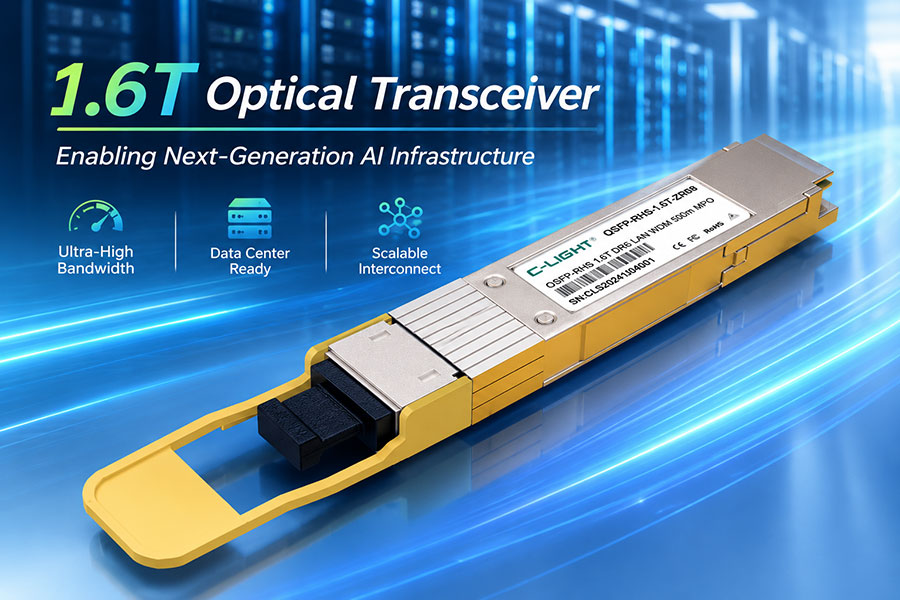
Review the 800G OSFP and 1.6T OSFP-RHS product portfolios when evaluating high-speed connectivity requirements, module configurations, and deployment compatibility.
Contact C-LIGHT >

 >
 >
 >
 >
 >
 >
 >