TEL:+86 132 6656 7067





AI data center scaling is increasingly shaped by the ability to move data between accelerators, switches, memory systems and distributed compute resources. As GPU clusters grow, aggregate network bandwidth rises, electrical channels become harder to extend, and power and cooling budgets become more restrictive. Optical interconnects address many of these challenges, but the optical layer is also becoming a critical system-level constraint that influences network topology, deployment cost and the pace of scaling.
The issue is not simply whether an optical transceiver can support 800G or 1.6T. Scaling depends on the combined performance of the host electrical interface, optical engine, fiber plant, switching architecture, packaging, thermal system and manufacturing supply chain. A bottleneck in any of these areas can limit the usable capacity of the complete AI fabric.
1. Why Optical Interconnect Is Becoming a Scaling Constraint
Large AI systems distribute computation across many accelerators. Training workloads exchange model parameters, gradients and intermediate data, while inference systems distribute requests and results across compute and storage resources. These transfers place substantial demand on the network fabric, particularly when many accelerators communicate concurrently.
At small scale, conventional electrical connections and established optical modules can provide sufficient capacity. As clusters expand, however, operators must increase switch radix, port bandwidth, cable density and the number of links between racks and facilities. Each upgrade introduces constraints in signal integrity, optical power, module cooling, fiber routing and system cost.
Optical interconnect becomes a binding constraint when its cost, power, availability or performance prevents the network from scaling at the rate required by compute deployment. This does not mean optics are always the primary bottleneck. GPU availability, memory bandwidth, switching capacity and software scheduling can also limit system performance. The dominant constraint depends on the workload and network design.
2. AI Cluster Scaling Increases Network Pressure
2.1 Scale-Out Networking
Scale-out networking connects servers and racks through Ethernet or InfiniBand switching fabrics. As the number of accelerators increases, the network must provide sufficient bandwidth between nodes while managing congestion and maintaining predictable communication performance.
Higher-speed optical transceivers increase capacity per port, but the network may still require a large number of links. The number of optical connections depends on switch radix, topology, oversubscription, link redundancy and the bandwidth assigned to each server. Consequently, optical module demand can grow through both higher data rates and larger port counts.
2.2 Scale-Up Interconnects
Scale-up architectures connect accelerators within tightly coupled systems. These links can require very high bandwidth, low latency and high bandwidth density. Short electrical connections may be practical within a server or closely integrated system, but longer electrical paths become increasingly difficult as lane rates rise.
Optical connectivity can extend high-bandwidth communication beyond the practical reach of some electrical implementations. The challenge is integrating optical conversion without introducing excessive power, cost, latency or service complexity. Different scale-up platforms therefore use different combinations of copper, electrical signaling and optical links.
2.3 Scale-Across and Distributed AI Infrastructure
Some AI deployments distribute resources across multiple buildings or data center sites. This introduces additional optical transport requirements beyond the local cluster fabric. Distance, fiber availability, wavelength planning and transmission technology become increasingly important, particularly when connecting separate facilities or regional edge sites.
Short-reach multimode links, single-mode parallel optics, wavelength-multiplexed links and coherent DCI systems address different distance and capacity ranges. Choosing the appropriate solution requires an end-to-end view of the network rather than a single data-rate specification.
3. The Transition from 400G to 800G and 1.6T
Higher-speed optical modules increase the bandwidth available through each physical port. The transition from 400G to 800G and then 1.6T helps network operators accommodate growing traffic without increasing port count at the same rate as aggregate bandwidth.
| Generation | Role in AI networks | Main engineering challenges |
|---|---|---|
| 400G | Established high-bandwidth connectivity in AI and cloud fabrics | Port density, power, reach and compatibility across host platforms |
| 800G | Higher capacity for large-scale AI clusters and high-radix switching | Thermal management, electrical channel quality, optical power and link qualification |
| 1.6T | Next-generation high-bandwidth connectivity for advanced switching systems | Higher lane rates, host electrical interface design, module cooling and manufacturing yield |
| Beyond 1.6T | Longer-term evolution toward greater bandwidth density | Optical integration, advanced packaging, optical I/O and system-level power optimization |
The speed transition is not a simple replacement cycle. Different generations may coexist within the same data center, depending on server interfaces, switch platforms, reach requirements and qualification schedules. A network upgrade must also consider cabling, connector density, breakout options, spare inventory and operational procedures.
3.1 Higher Port Speed Does Not Eliminate Congestion
Doubling the port rate can increase the capacity of a link, but it does not necessarily double application performance. If traffic patterns create congestion at a switch, oversubscription point or receiving endpoint, higher optical line rates may only move the bottleneck elsewhere.
Network topology, load balancing, congestion control and application communication patterns must therefore evolve alongside optical bandwidth. Effective scaling requires sufficient capacity across the entire path, including host interfaces, switch fabrics and uplinks.
4. Electrical Reach, Signal Integrity and Optical Conversion
At high data rates, electrical channels become more sensitive to insertion loss, reflections, crosstalk and equalization limits. PCB traces, connectors, backplanes and cable assemblies all contribute to the electrical channel budget. Maintaining signal quality over longer paths can require more complex equalization or retiming, increasing power and design effort.
Optical transmission converts electrical signals into light for transport over fiber. Fiber offers low attenuation over distance and immunity to electromagnetic interference, making it suitable for high-bandwidth connections across racks and facilities. However, the optical link still requires transmitters, receivers, coupling, fiber routing and appropriate signal conditioning.
| Interconnect type | Strengths | Constraints | Typical design role |
|---|---|---|---|
| Passive copper cable | Low cost and no active optical conversion | Reach and signal integrity become limiting at higher data rates | Short connections within racks or compatible systems |
| Active electrical cable | Can extend electrical reach with signal conditioning | Power consumption, thermal load and reach limitations | Selected short-reach high-speed connections |
| Active optical cable | Integrated optical conversion and convenient cable assembly | Fixed assembly, replacement model and supported reach | Short-reach rack and row connectivity |
| Pluggable optical transceiver | Flexible replacement and multiple reach options | Module power, front-panel density and host electrical interface | Switch-to-switch, server-to-switch and longer links |
| Co-packaged optics | Short electrical paths between switch silicon and optical engines | Packaging, repairability, manufacturing and system integration | Selected high-bandwidth-density switching platforms |
The correct transition point from copper to optics depends on the platform and the required reach. Optical connectivity is not automatically more economical for every short link, but it becomes increasingly attractive as bandwidth, distance and density requirements exceed the practical envelope of electrical interconnects.
5. Power per Bit and Thermal Constraints
Power consumption is a major consideration in large AI data centers. A small difference in the power of each optical port can become significant when multiplied across thousands or tens of thousands of links. Optical interconnect efficiency must therefore be evaluated at both the module level and the complete system level.
Module power is only one part of the total. The host ASIC, retimers, DSPs, optical engines, cooling infrastructure and conversion losses all contribute to the energy required to move data. A lower-power module does not necessarily reduce total system power if it requires additional components or introduces other inefficiencies.
5.1 DSP-Based Pluggable Modules
Many high-speed optical modules use digital signal processors to compensate for channel impairments and support robust transmission. DSP-based designs can provide useful signal-conditioning capabilities, but the processing adds power consumption and thermal load. At higher data rates, these costs become more important for switch-port density and cooling design.
5.2 Linear Pluggable Optics
Linear Pluggable Optics (LPO) reduces or removes conventional DSP processing inside the optical module, shifting more responsibility for signal quality to the host electrical interface and overall system design. This can reduce module power and latency in suitable implementations.
LPO also places tighter demands on the electrical channel, host transmitter and receiver behavior, optical engine characteristics and interoperability testing. It is best evaluated as a complete system architecture rather than as a universal drop-in replacement for DSP-based modules.
5.3 Thermal Design at High Port Density
High-speed modules generate heat in a limited volume around the switch faceplate. Dense deployments must manage airflow, module case temperature, heat transfer and the thermal interaction between adjacent ports. Thermal limits can affect achievable port density and long-term reliability.
Thermal qualification should reflect realistic operating conditions, including high ambient temperature, full port population and sustained traffic. Power specifications and cooling requirements should be evaluated for the exact module and host combination.
6. CPO and Optical I/O: Moving Optics Closer to Compute
Co-Packaged Optics (CPO) places optical engines close to switching silicon, shortening the high-speed electrical path between the ASIC and optical conversion stage. This can reduce electrical losses and support higher bandwidth density in selected switching systems.
Optical I/O extends the broader concept of integrating optical communication more closely with compute or switching devices. The goal is to move data with lower energy per bit and fewer electrical interconnect constraints as system bandwidth continues to rise.
| Architecture | Optical placement | Potential benefit | Key trade-off |
|---|---|---|---|
| Pluggable optics | At the front panel of the host | Modular replacement, mature service workflows and flexible reach choices | Electrical channel between ASIC and module; module power and thermal density |
| Near-Packaged Optics (NPO) | Near the main ASIC package | Shorter electrical paths while retaining some physical separation | Packaging complexity, interconnect design and service model |
| Co-Packaged Optics (CPO) | Integrated close to the switching ASIC package | Reduced electrical reach and potential improvement in bandwidth density and energy efficiency | Repairability, packaging yield, laser servicing and system qualification |
| Optical I/O | Integrated into or closely coupled with compute or switching systems | Potential scaling path for high-bandwidth chip-to-chip and system-level communication | Technology maturity, ecosystem support and integration complexity |
These architectures are not interchangeable labels for the same implementation. Their benefits depend on where electrical-to-optical conversion occurs, how the laser is supplied, how optical fibers connect to the system and how failed components are serviced. Pluggable optics are likely to remain important wherever flexibility and field replacement are priorities, while more integrated approaches target specific density and power challenges.
7. Fiber Plant and Optical Network Design
As AI fabrics expand, fiber management becomes a system-level concern. Higher port counts require more fiber connections, while multi-fiber transceivers and high-density connector systems introduce complexity in polarity, cleaning, routing and labeling. Cable congestion can increase installation time and complicate fault isolation.
Single-mode fiber supports a wide range of reach requirements and is central to many high-speed AI data center designs. Multimode fiber remains useful for selected short-reach applications where the module, distance and fiber category are compatible. The choice should reflect the intended transceiver type and the actual link requirements rather than a general assumption that one fiber type is always superior.
7.1 Parallel Optics and Wavelength Multiplexing
Parallel optical designs use multiple fiber lanes to achieve aggregate bandwidth. They can be appropriate for high-speed links, but they require careful control of fiber count, connector type and polarity. Wavelength-multiplexed designs use multiple optical wavelengths over fewer fibers, reducing fiber consumption in suitable architectures while adding MUX/DEMUX components and associated insertion loss.
For longer distances or inter-site links, coherent optics and DWDM can support high-capacity transport over engineered optical systems. These solutions address different requirements from short-reach parallel optics and should be selected according to reach, aggregate capacity and network architecture.
7.2 Fiber Infrastructure as an Operational Constraint
Even when transceivers meet their specifications, poor fiber documentation or contaminated connectors can cause intermittent errors and expensive troubleshooting. Large AI deployments benefit from standardized cleaning procedures, clear labeling, validated polarity and end-to-end optical loss records.
As new optical generations are introduced, fiber infrastructure should be reviewed for connector density, available paths, bend radius, patch-panel capacity and future maintenance access. The physical fiber plant is part of the scaling architecture, not simply a passive accessory.
8. Manufacturing Capacity and Optical Supply Chains
AI data center expansion creates demand for high-speed lasers, photonic integrated circuits, DSPs, optical subassemblies, precision packaging and test capacity. A module design may be technically ready yet difficult to deploy at scale if any critical component or manufacturing process is constrained.
Laser and photonic component supply: Availability, performance variation and qualification requirements can affect production volume.
Assembly and coupling: Precision optical alignment and packaging yield influence cost and throughput.
Testing: High-speed electrical and optical validation requires suitable equipment, test coverage and production time.
Thermal and reliability qualification: New module generations must perform within the specified operating envelope.
Customer qualification: Host-specific validation and interoperability requirements can delay volume deployment.
Product lifecycle: Suppliers must manage component changes, firmware compatibility and consistent delivery across repeat orders.
Supply-chain resilience matters because large AI deployments need consistent quantities of qualified modules, not merely access to a small number of engineering samples. Manufacturing yield, lead time and compatibility support can influence the practical scaling rate of a network.
9. Measuring Whether Optical Interconnect Is the Actual Bottleneck
Optical interconnect should be treated as the binding constraint only when measurements show that it limits the target system. Low application throughput may result from network congestion, switch configuration, server limitations, memory bandwidth or software behavior rather than from the optical link itself.
| Measurement area | Useful indicators | What they help identify |
|---|---|---|
| Optical link health | Received optical power, module alarms, error counters and link stability | Optical margin, faulty fiber paths or transceiver issues |
| Port utilization | Average and peak traffic, queue occupancy and congestion events | Insufficient capacity or uneven traffic distribution |
| Signal integrity | Host diagnostics, lane errors and supported physical-layer statistics | Electrical or optical channel problems |
| Application performance | Collective communication time, job scaling efficiency and throughput | Whether network behavior is limiting AI workload performance |
| Power and temperature | Module power, case temperature, host thermal conditions and cooling demand | Thermal or power limits affecting port density and reliability |
| Deployment readiness | Qualified module supply, production yield and installation lead time | Whether infrastructure availability is delaying cluster expansion |
Testing should reflect the intended traffic pattern and full deployment conditions. A link that performs well in an isolated test may behave differently when all ports are active, switch buffers are heavily loaded and cooling operates near its design limits.
10. Optical Interconnect Selection for AI Networks
The most suitable interconnect depends on the network layer, reach, port density and service model. A single AI data center may combine several technologies rather than using one type of optical connection throughout the facility.
| Connection scenario | Candidate technologies | Primary design checks |
|---|---|---|
| Very short in-rack connections | DAC, AEC or short-reach AOC, where supported | Reach, electrical or optical power, bend radius and host compatibility |
| Server-to-leaf or rack-to-rack links | 400G and 800G pluggable optical modules, or supported cable alternatives | Required reach, fiber type, connector and switching platform |
| High-density switch interconnects | 800G, 1.6T and emerging integrated optical architectures | Power per bit, thermal limits, port density and qualification |
| Campus or data center interconnect | Single-mode optics, wavelength multiplexing and coherent transport where required | Distance, optical budget, aggregate capacity and fiber availability |
| Future integrated systems | LPO, NPO, CPO and optical I/O, depending on platform maturity | System-level performance, serviceability and ecosystem support |
Before selecting a module, verify the host's supported form factor, data rate, electrical interface, power limits, coding requirements and firmware behavior. Optical reach must be matched to the fiber route and complete loss budget. For multi-vendor deployments, interoperability should be confirmed with the actual equipment and operating configuration.
11. C-LIGHT Optical Connectivity for AI Data Centers
C-LIGHT offers optical transceivers and related connectivity products for high-speed data center and network applications. For AI infrastructure, product selection should be aligned with the required link speed, reach, fiber type, host platform and thermal envelope.
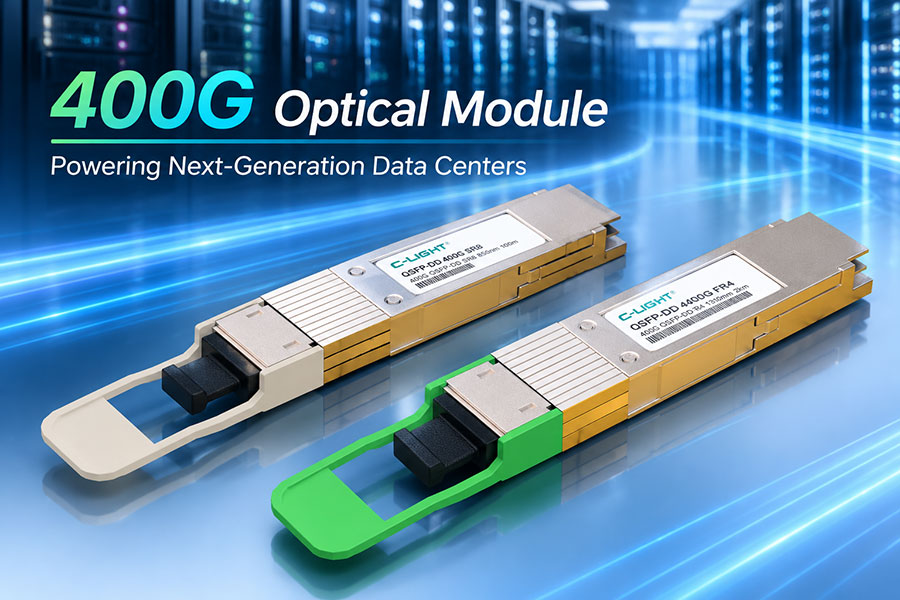
400G and 800G optical connectivity for high-bandwidth switching fabrics and data center links.
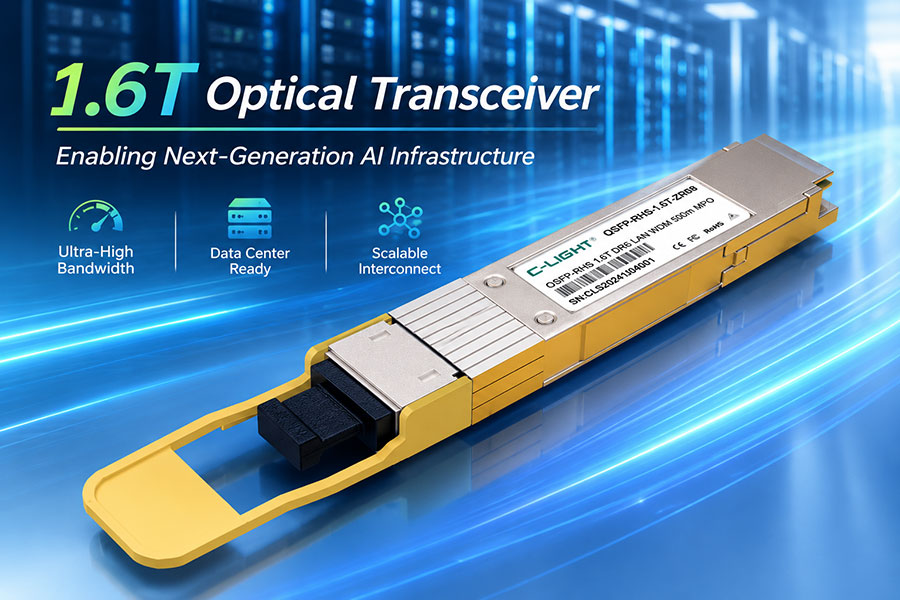
1.6T optical transceiver solutions for next-generation high-density network designs, subject to product configuration and host compatibility.
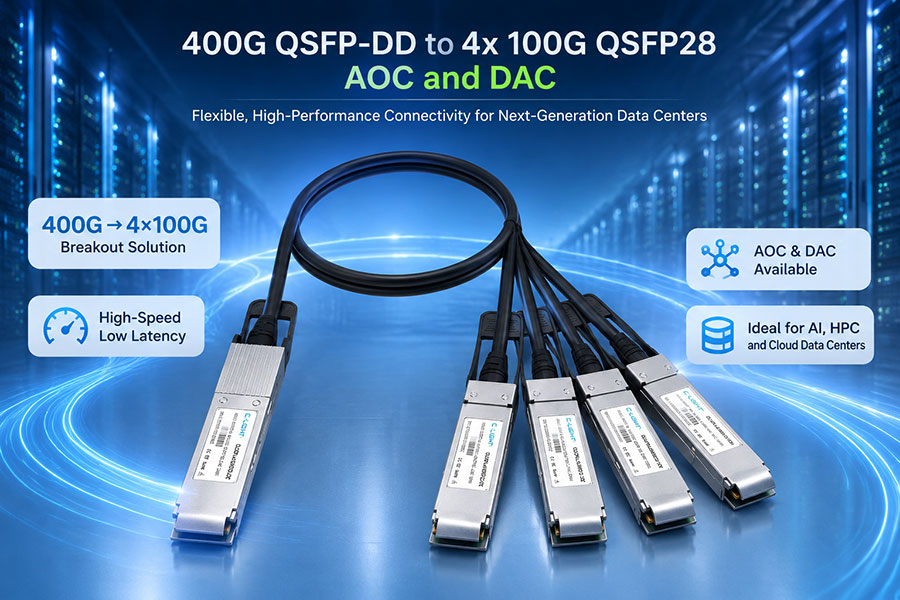
DAC, AEC and AOC products for short-reach connections where cable-based interconnects meet the deployment requirements.
CWDM, DWDM and DCI products for wavelength-based transport and inter-site connectivity.
Optical interconnect planning should start with a defined topology and link budget, followed by host compatibility checks, thermal evaluation and interoperability testing. These steps help ensure that higher-speed modules improve usable network capacity rather than shifting the bottleneck to another part of the system.
12. Frequently Asked Questions
12.1 Why is optical interconnect a constraint in AI data centers?
AI clusters require large amounts of data to move among accelerators, servers and switches. As aggregate bandwidth rises, optical port density, module power, thermal management, signal integrity, fiber infrastructure and component supply can constrain how quickly the network scales.
12.2 Will 800G and 1.6T solve AI networking bottlenecks?
They increase capacity per port but do not eliminate all bottlenecks. Network topology, congestion, host interfaces, switching capacity, software communication patterns and the availability of qualified modules also affect performance.
12.3 Why are LPO and CPO receiving attention?
Both address the power and electrical-reach challenges associated with high-bandwidth interconnects. LPO reduces in-module signal processing, while CPO places optical engines close to switching silicon. Each has different requirements for signal integrity, packaging, maintenance and interoperability.
12.4 Are optical modules always better than copper cables?
No. Copper cables can remain cost-effective for short links within their supported reach and signal-integrity limits. Optical links become more attractive when distance, bandwidth density, cable routing or electrical channel constraints justify optical conversion.
12.5 How can operators confirm that optics are limiting cluster performance?
Correlate optical diagnostics, link errors, port utilization, congestion metrics, application performance and thermal data. This helps distinguish a physical link problem from a switching, topology, compute or software bottleneck.
13. Conclusion
Optical interconnect is becoming a defining factor in AI data center scaling because network bandwidth, power consumption, electrical reach, fiber density and manufacturing capacity must all advance alongside compute performance. The transition to 800G and 1.6T increases port capacity, while LPO, CPO and optical I/O explore new approaches to improving power efficiency and bandwidth density.
The practical solution is not a single module or architecture. It is an end-to-end design that balances copper and optical links, pluggable and integrated optics, network topology, thermal limits, fiber infrastructure and supply-chain readiness. Measuring the actual bottleneck and validating the complete link path are essential to turning higher optical data rates into meaningful AI system performance.
Review the required bandwidth, reach, host platform, fiber configuration and power envelope before selecting an optical interconnect solution.
Contact C-LIGHT >

 >
 >
 >
 >
 >
 >
 >