TEL:+86 132 6656 7067





Optical Data Center Interconnect (Optical DCI) connects geographically separated data centers through high-capacity optical fiber links. It enables data replication, cloud service delivery, distributed computing, disaster recovery and AI infrastructure to operate across multiple facilities. By combining high-speed optical transceivers, DWDM and coherent transmission technologies, Optical DCI can scale bandwidth while making efficient use of available fiber resources.
As cloud platforms and AI workloads expand, data centers increasingly exchange large volumes of data between campuses and regions. Network designers must balance bandwidth, latency, reach, reliability, power consumption and cost. The appropriate DCI architecture depends on the distance between sites, the required capacity, existing fiber infrastructure and the capabilities of the connected switches, routers and optical transport systems.
1. What Is Optical DCI?
Optical DCI is a network architecture that uses optical fiber and optical transmission technologies to connect separate data center locations. The connection may be deployed across a campus, a metropolitan area, a regional network or a longer-distance route.
Depending on the application, DCI can carry Ethernet traffic directly over optical links or use dedicated transport equipment to aggregate and manage multiple services. Shorter links may use direct-detection transceivers, while longer and higher-capacity links commonly rely on DWDM and coherent optical technology.
2. Typical Optical DCI Architecture
A basic DCI link connects switches or routers in two data centers. Optical transceivers convert electrical data into optical signals, and the fiber link carries those signals to the remote facility. For higher capacity or longer distances, a DWDM line system can combine multiple wavelengths over the same fiber.
Switches and routers
Client-side interfaces
Fiber and optional DWDM
Switches and routers
Signal recovery
Remote fiber endpoint
In a simple point-to-point design, compatible optical interfaces can connect the two endpoints over a suitable fiber path. In a DWDM deployment, multiplexers, demultiplexers and potentially optical amplifiers are added to support multiple wavelength channels or longer transmission distances.
3. DCI Deployment Scenarios by Distance
Distance is one of the main factors determining the optical technology used for DCI. The ranges below are general planning categories rather than guaranteed reach specifications. Actual feasibility depends on the selected module, fiber loss, optical budget, dispersion, channel plan and line-system design.
| Deployment Type | Approximate Distance Category | Common Technologies | Typical Applications |
|---|---|---|---|
| Intra-campus DCI | Hundreds of meters to a few kilometers | 100G, 400G or 800G client optics; suitable single-mode fiber links | Campus data centers and nearby facilities |
| Metro DCI | Several to tens of kilometers | LR-class optics, DWDM and selected coherent solutions | Metro cloud regions and data center campuses |
| Extended metro DCI | Tens to around 100 km or more, depending on design | DWDM, coherent optics and potentially optical amplification | Regional data center connections |
| Regional or long-haul DCI | Hundreds of kilometers in engineered transport systems | Coherent transponders or pluggables, amplified DWDM line systems | Geographically distributed data centers and backbone transport |
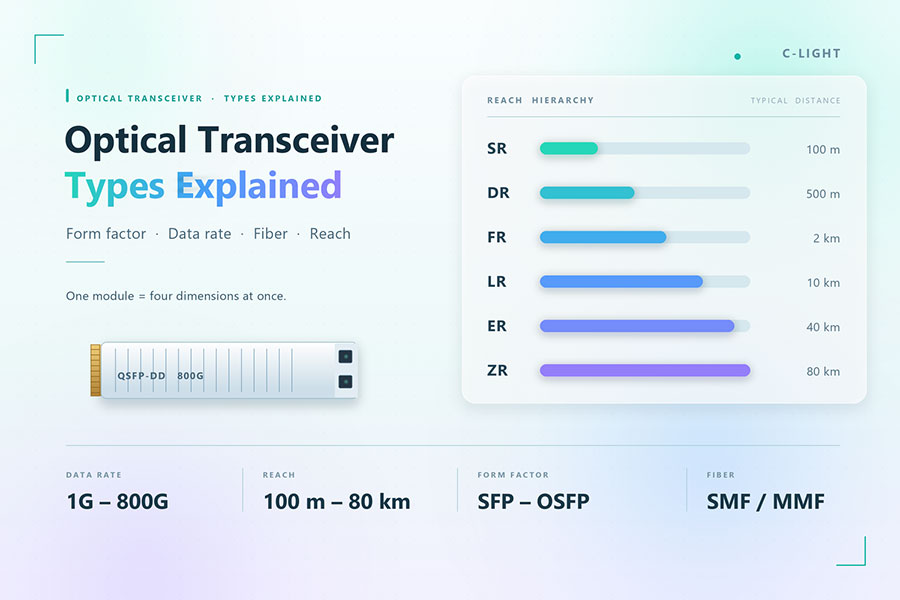
Distance labels such as LR, ER, ZR or ZR+ are associated with particular interface specifications or product implementations. Their meaning should not be treated as interchangeable across all data rates and technologies. Verify the actual reach specification and system conditions for each selected product.
4. Optical Technologies Used in DCI
Direct-Detection Optical Transceivers
Direct-detection transceivers are widely used for short- and medium-reach Ethernet links. They can provide a straightforward connection between data center switches or routers when the link distance and optical budget fall within the supported specifications.
DWDM Optical Transceivers
DWDM allows multiple wavelength channels to share the same fiber. Each channel carries a separate optical signal, increasing aggregate capacity without requiring a dedicated fiber pair for every connection. Channel planning, wavelength compatibility and line-system loss must be considered when building a multi-wavelength DCI network.
Coherent Optical Transceivers
Coherent optics uses advanced modulation and digital signal processing to recover high-capacity optical signals. It is particularly useful for applications where higher spectral efficiency or longer reach is required. Coherent solutions are available in different data-rate classes and pluggable form factors, but their supported modes and reach vary by product.
Optical Amplification
Optical amplifiers, including EDFAs where appropriate, compensate for signal loss along suitable fiber routes. They are part of the line system rather than a substitute for correct optical engineering. Amplifier gain, output power, noise figure and the number of active wavelength channels affect overall performance.
5. 100G, 400G and 800G DCI
DCI capacity requirements vary with the number of sites, storage replication demands, cloud traffic and distributed computing workloads. Higher-rate interfaces can reduce the number of physical links required to deliver a given aggregate bandwidth, but they may also impose tighter requirements on power, cooling, fiber infrastructure and optical transport.
| Interface Class | Potential DCI Role | Key Design Considerations |
|---|---|---|
| 100G | Established metro links, service aggregation and moderate-capacity interconnects | Reach, optical budget, wavelength plan and interface compatibility |
| 400G | Higher-capacity data center links and cloud-region interconnects | Client interface, lane architecture, power, fiber type and transport mode |
| 800G | High-density interconnects and large-scale data center infrastructure | Host support, thermal design, signal integrity and optical reach |
| Coherent 400G/800G-class transport | High-capacity DCI over compatible DWDM systems | Modulation, FEC, OSNR, channel spacing and line-system compatibility |
A 400G or 800G client interface does not automatically provide a particular DCI reach. A short-reach client optic and a coherent line-side transceiver may both be described by their nominal data rate, but they can serve different functions and require different network architectures.
6. C-LIGHT Optical Products for DCI
C-LIGHT's optical portfolio includes high-speed transceivers and DWDM coherent products relevant to different parts of a DCI architecture. The final choice depends on the required data rate, distance, host platform, fiber route and whether the deployment uses direct fiber connectivity or a DWDM line system.
6.1 C-LIGHT 100G QSFP28 Optical Transceivers
100G QSFP28 modules can be considered for DCI links that require 100G client connectivity and whose reach requirements match the selected optical interface. The QSFP28 family includes different optical variants for different fiber types and distances, so the exact model should be selected against the intended route.
Suitable for supported 100G host interfaces
Model-dependent reach, wavelength and connector options
Relevant to metro and campus connectivity where specifications align
6.2 C-LIGHT 400G QSFP-DD Optical Transceivers
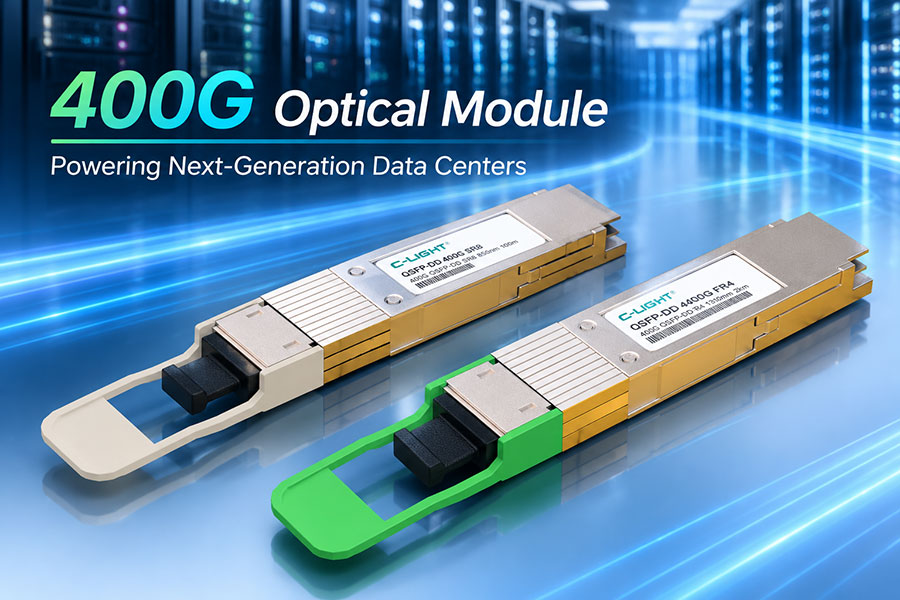
The 400G QSFP-DD product family targets high-bandwidth switching and routing platforms. Depending on the selected variant, a 400G module may serve a client-side link or a specific optical transmission application. Short-reach and extended-reach options must not be treated as interchangeable.
400G interface options for supported QSFP-DD host ports
Model-dependent optical reach and fiber requirements
Suitable for evaluating higher-capacity DCI architectures
6.3 C-LIGHT 800G OSFP and QSFP-DD Optical Transceivers
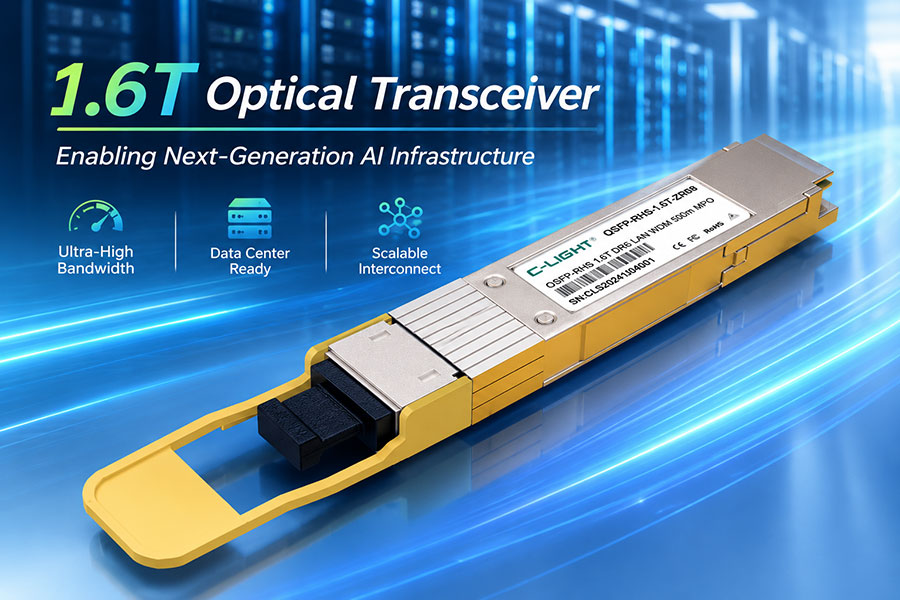
800G OSFP and QSFP-DD modules support high-density optical connectivity on compatible host platforms. They can be relevant to high-capacity data center infrastructure, but the correct module type depends on port support, optical reach, fiber architecture and whether the link is intended for intra-data-center or inter-data-center use.
High-bandwidth optical interfaces for supported 800G platforms
Different form factors to match host hardware designs
Model-specific optical interfaces, reach and power requirements
6.4 C-LIGHT DWDM Coherent DCO Transceivers
C-LIGHT's DWDM DCO product family covers 100G, 200G, 400G and 800G categories, with available form factors and operating modes depending on the specific model. Coherent DCO products are relevant to DCI designs that need to transport high-capacity signals over compatible DWDM line systems.
Before selection, verify the coherent standard or operating mode, supported host interface, tuning range, optical power, FEC requirements and target reach. A coherent module must be compatible with the intended line system and endpoint configuration.
7. Point-to-Point DCI vs. DWDM-Based DCI
A point-to-point DCI link connects two endpoints using compatible optical interfaces over a dedicated fiber path. A DWDM-based design combines multiple wavelength channels over shared fiber, allowing several high-capacity connections to use the same infrastructure.
| Factor | Point-to-Point Optical Link | DWDM-Based DCI |
|---|---|---|
| Architecture | Direct optical connection between endpoints | Multiple wavelength channels share an optical line system |
| Fiber utilization | May require separate fiber resources for each link | Can carry multiple channels over a shared fiber pair |
| Equipment | Compatible endpoint transceivers and fiber | May require MUX/DEMUX, amplification and channel management |
| Expansion | Often involves adding links or fiber resources | Can add channels within the supported optical spectrum and system capacity |
| Engineering effort | Usually simpler for suitable short links | Requires wavelength, power and optical performance planning |
DWDM is especially useful when fiber availability is constrained or aggregate bandwidth is high. For a short link with adequate fiber resources, direct optical connectivity may offer a simpler solution. The best design depends on lifecycle cost, capacity growth, operational requirements and the optical characteristics of the route.
8. Key Factors in Optical DCI Design
Transmission Distance and Fiber Loss
Calculate the total link loss using fiber attenuation, connectors, splices and passive components. Confirm that the received signal falls within the specified optical power range. For longer links, also evaluate dispersion, OSNR and the need for amplification or coherent transmission.
Latency
Optical propagation delay depends primarily on the physical route and the speed of light in fiber. Additional delay can arise from transponders, FEC processing, switching, buffering and other equipment. The shortest physical route is not always the route with the lowest end-to-end operational latency.
Bandwidth and Growth
Estimate current traffic and future capacity requirements before selecting the number and rate of optical channels. Higher-rate interfaces can reduce port count, while DWDM can increase aggregate capacity over existing fiber infrastructure.
Power and Thermal Limits
High-speed and coherent modules can have significant power and cooling requirements. Check the host platform's supported module power, airflow, operating temperature and port density, particularly when deploying many high-rate transceivers in a single chassis.
Interoperability
Verify the supported interface standards, host compatibility, firmware, wavelength or coherent mode, FEC behavior and optical operating limits at both ends. If a line system is involved, confirm its channel grid, filter characteristics and optical power requirements.
9. Optical DCI Deployment Checklist
Define the sites, physical route and required end-to-end bandwidth.
Identify the host switch or router models and supported optical interfaces.
Choose the optical technology based on distance, fiber type and required capacity.
Calculate the optical power budget and check receiver limits.
For DWDM, define channel spacing, wavelength assignment and line-system components.
For coherent links, verify the supported mode, FEC, OSNR and host compatibility.
Check module power consumption, airflow and thermal limits.
Plan monitoring, alarms, redundancy and recovery procedures.
Test the link under representative traffic and document the final configuration.
10. Frequently Asked Questions
Q1. What does Optical DCI mean?
Optical DCI stands for Optical Data Center Interconnect. It uses optical fiber and optical transmission technologies to connect separate data center locations for cloud services, replication, distributed computing and other data-intensive applications.
Q2. Does DCI always require DWDM?
No. Shorter links may use direct optical connections without a DWDM line system. DWDM becomes useful when multiple wavelength channels must share limited fiber resources or when the network requires a scalable wavelength-based transport architecture.
Q3. Which optical transceiver is best for DCI?
There is no universal choice. The appropriate module depends on the data rate, distance, fiber type, host platform, optical budget and whether the link uses direct detection or coherent transmission. The exact model specification should guide the selection.
Q4. Can 400G or 800G transceivers connect two data centers?
Yes, when the selected transceiver supports the required reach and the endpoint equipment and fiber link meet its specifications. Short-reach 400G or 800G modules should not be assumed to support metro or regional distances without a suitable optical architecture.
Q5. When should coherent optics be considered for DCI?
Coherent optics is worth evaluating when capacity and reach requirements exceed the practical limits of simpler direct-detection interfaces or when DWDM spectral efficiency is important. The decision should account for supported modes, line-system compatibility, power and total system cost.
Q6. Which C-LIGHT products are relevant to Optical DCI?
Relevant product categories include 100G QSFP28, 400G QSFP-DD, 800G OSFP/QSFP-DD and DWDM coherent DCO transceivers. The correct product depends on the DCI architecture and the specific reach, host and optical line-system requirements.
11. Conclusion
Optical DCI is a key building block for connecting distributed data centers as cloud, AI and enterprise workloads demand more bandwidth across multiple sites. Direct optical links can suit shorter routes, while DWDM and coherent technologies provide scalable options for higher-capacity and longer-distance transport.
C-LIGHT's 100G, 400G and 800G optical transceiver families, together with DWDM coherent DCO products, offer options for evaluating different DCI architectures. A reliable deployment begins with the actual route, bandwidth target, host platform and optical budget, followed by product-level compatibility checks and end-to-end validation.
Find Optical Products for Your DCI Project
Share your target distance, bandwidth, switch or router model, fiber type and existing DWDM infrastructure to identify suitable optical transceiver options for your data center interconnect.
Contact C-LIGHT >

 >
 >
 >
 >
 >
 >
 >