TEL:+86 132 6656 7067





The transition to 1.6T optical transceivers is increasing demand for high-performance lasers, photodetectors, digital signal processors, photonic integrated circuits, and precision optical packaging. As AI data centers expand their network capacity, component suppliers must meet more demanding performance requirements while scaling manufacturing output and maintaining consistent quality.
Unlike a simple increase in production volume, the move from 800G to 1.6T introduces new challenges across the entire optical supply chain. Higher lane rates tighten requirements for bandwidth, signal integrity, optical alignment, thermal performance, and manufacturing yield. The availability of qualified components can therefore influence product costs, delivery schedules, and the pace of network deployment.
1. Why 1.6T Is Reshaping the Optical Component Supply Chain
AI clusters require high-bandwidth connections between accelerators, servers, and switching systems. As the number of compute nodes increases, optical interconnect demand grows alongside requirements for higher capacity per port and greater network density.
The 1.6T generation is particularly demanding because many designs target eight 200G-class lanes. These implementations require electrical and optical components that maintain signal quality at higher data rates, with sufficient operating margin across temperature, manufacturing variation, and transmission conditions.
Supply pressure can emerge at several stages simultaneously:
Compound semiconductor production: High-performance laser and detector chips require specialized materials, epitaxy, fabrication, and testing.
Advanced electronic components: High-speed DSPs, drivers, and transimpedance amplifiers must meet stringent bandwidth and power requirements.
Photonic integration: Silicon photonics and other optical integration platforms require qualified fabrication and packaging processes.
Precision assembly: Fiber coupling, optical alignment, and thermal management can constrain production throughput.
Qualification and reliability testing: Components must demonstrate consistent performance before they can be deployed at scale.
2. Laser Availability and Compound Semiconductor Capacity
Laser components are among the most important supply-chain considerations for high-speed optical transceivers. Their performance directly affects optical output, modulation quality, transmission reach, and receiver performance across the link.
EML Laser Supply
Electro-absorption modulated lasers integrate a laser source with an electro-absorption modulator. They are used in high-speed optical applications where strong modulation performance and suitable transmission characteristics are required.
Manufacturing EMLs involves demanding epitaxial structures, device fabrication, high-speed characterization, and reliability qualification. As designs move toward 200G-class optical lanes, suppliers must meet tighter performance requirements while increasing qualified production capacity.
Capacity expansion is not immediate. Specialized manufacturing equipment, process optimization, yield improvement, and customer qualification can all extend the time required to bring additional output to market.
Continuous-Wave Lasers and External Modulation
Silicon photonics provides an alternative optical integration approach in which a continuous-wave laser supplies light to a photonic integrated circuit that performs modulation and other optical functions.
This architecture can expand design options and reduce dependence on particular integrated laser solutions. However, it does not eliminate the need for high-quality laser sources. Continuous-wave lasers must still meet requirements for optical power, wavelength stability, reliability, and coupling efficiency.
As silicon photonics adoption grows, laser supply pressure may shift between component categories rather than disappear entirely. External laser assemblies, optical coupling, and photonic packaging can become important capacity constraints in their own right.
3. Silicon Photonics and Photonic Integrated Circuit Capacity
Silicon photonics integrates optical functions on a photonic integrated circuit, potentially supporting compact architectures with multiple optical channels. It is increasingly relevant to high-density transceiver designs, including implementations intended for 800G and 1.6T networks.
Its supply chain includes photonic chip design, wafer fabrication, process control, laser integration, fiber coupling, and final module assembly. Each stage requires specialized equipment and process knowledge.
Fabrication Capacity
Foundry availability, process maturity, wafer utilization, and yield affect the number of qualified photonic chips available for module production.
Laser Integration
External light sources must be integrated with the photonic circuit while maintaining optical power, coupling efficiency, and operational stability.
Optical Coupling
Precise alignment between waveguides, fibers, and optical components is necessary to control coupling loss and maintain consistent performance.
Packaging and Testing
Integrated optical devices require packaging processes that preserve alignment, manage heat, and support reliable operation over the intended service life.
Silicon photonics can improve integration and offer attractive power or cost characteristics for suitable designs. Actual benefits depend on the optical architecture, production yield, laser implementation, and the maturity of the manufacturing ecosystem.
4. DSPs, Drivers, and High-Speed Electronic Components
Optical transceivers rely on electronic components to convert, process, and condition signals between the host interface and optical engine. As aggregate bandwidth increases, the electrical subsystem becomes a major factor in module performance, power consumption, and manufacturing cost.
| Component | Role in the Transceiver | Supply Challenge |
|---|---|---|
| Digital signal processor | Performs signal processing and compensation in DSP-based architectures | Advanced process technology, high-speed design complexity, power optimization, and limited qualified suppliers |
| Laser driver | Provides the electrical drive signals required by the optical transmitter | Bandwidth, linearity, signal integrity, and thermal performance at higher lane rates |
| Transimpedance amplifier | Converts photodetector current into a usable electrical signal | Receiver sensitivity, noise performance, bandwidth, and integration requirements |
| High-speed photodetector | Converts incoming optical signals into electrical signals | Responsivity, bandwidth, fabrication yield, and receiver performance consistency |
| Host electrical interface | Connects the transceiver to the switch or network device | High-speed channel loss, connector performance, equalization, and interoperability |
DSP availability can affect module production even when optical components are ready. Advanced process nodes and demanding power targets increase design complexity, while customer qualification and production ramp-up influence how quickly new devices become available in volume.
Linear-drive pluggable optics can reduce or eliminate some module-side DSP functions in suitable systems, but this changes the signal-processing responsibilities of the host platform. Such designs require careful validation of electrical channels, host capabilities, and interoperability rather than serving as a universal replacement for DSP-based modules.
5. Indium Phosphide Materials and Wafer Processing
Indium phosphide is an important semiconductor material for high-speed optical communication components, including many laser and photodetector technologies. Its compound semiconductor properties make it suitable for devices operating at optical wavelengths used in data center and telecommunications applications.
The InP supply chain extends from raw material production and crystal growth to wafer preparation, epitaxial growth, device fabrication, and testing. Capacity constraints at any of these stages can affect downstream component availability.
Key considerations include:
Raw material availability: Consistent access to suitable source materials is essential for wafer production.
Wafer quality: Crystal defects and material variation can influence device performance and manufacturing yield.
Epitaxial process control: Complex semiconductor layer structures require tightly controlled growth processes.
Wafer diameter and process maturity: Changes in wafer size can improve manufacturing economics but require investment, process development, and qualification.
Geographic concentration: Dependence on a limited number of material or fabrication sources increases exposure to logistics and regional disruptions.
Expanding wafer capacity is only one part of the solution. New production must achieve the required device performance and yield before it can provide a reliable source of qualified components for high-speed optical modules.
6. Precision Optical Packaging and Manufacturing Yield
Even when the required chips are available, manufacturing a complete 1.6T transceiver remains a precision-intensive process. Optical engines, laser sources, photodetectors, electrical components, fibers, and connectors must be integrated into a compact package with predictable optical and electrical performance.
Higher data rates reduce the margin for manufacturing variation. Small changes in optical alignment, coupling loss, electrical interconnects, or thermal behavior can affect performance and increase the proportion of units that fail testing.
Manufacturing Processes That Require Close Control
Active optical alignment: Positioning fibers and optical components to achieve the required coupling efficiency.
Die attachment and bonding: Maintaining mechanical stability and suitable thermal paths for sensitive components.
High-speed electrical interconnects: Controlling parasitic effects and signal degradation within the module.
Thermal interface design: Managing heat from DSPs, drivers, and optical devices within the permitted operating range.
Automated testing: Measuring optical power, wavelength, receiver sensitivity, error performance, and other specified parameters.
Manufacturing yield has a direct effect on effective supply. A production line may process a given number of units, but the number of modules that pass qualification and final acceptance determines the deliverable output.
7. Power and Thermal Constraints Across the Supply Chain
Power consumption becomes increasingly important as data centers deploy large numbers of high-speed transceivers. A module that delivers greater bandwidth per port must still operate within the power and thermal limits of the host equipment.
Thermal constraints can influence component selection, packaging design, module density, and production qualification. Higher operating temperatures may also affect laser characteristics, electronic performance, and long-term reliability.
| Design Area | Potential Constraint | Engineering Response |
|---|---|---|
| DSP and electronic components | Power consumption and heat generation | Optimize signal processing, component selection, and thermal paths |
| Laser source | Optical output stability and temperature sensitivity | Validate operating margins and thermal control across specified conditions |
| Optical engine | Coupling loss and packaging sensitivity | Improve alignment processes and mechanical stability |
| Module enclosure | Limited space and airflow | Verify form factor, heat dissipation, and host-system cooling capability |
| System integration | High port density and rack-level thermal load | Evaluate total power and cooling requirements at the network-system level |
Reducing power consumption per bit is an important objective, but it must be assessed against the complete design. Silicon photonics, optimized DSPs, linear-drive architectures, and improved packaging can offer different benefits depending on the application and host system.
8. Supply-Chain Risks and Procurement Strategies
Supply constraints can affect lead times, pricing, qualification schedules, and the ability to support large-scale network deployments. When several components depend on specialized production processes, a shortage in a single category can restrict the output of an otherwise well-supplied transceiver manufacturing line.
Procurement teams can reduce exposure by evaluating both the module supplier and its upstream supply chain.
Confirm component qualification: Establish whether proposed components have completed the required performance and reliability testing.
Review production capacity: Assess realistic output, lead times, allocation policies, and planned capacity expansion.
Evaluate multiple sourcing options: Where technically feasible, qualify alternative components or suppliers without assuming that nominally similar parts are interchangeable.
Plan demand forecasts: Share realistic volume projections early enough to support capacity planning and production scheduling.
Track engineering changes: Require notification and requalification where changes could affect optical, electrical, thermal, or mechanical performance.
Maintain appropriate inventory: Balance supply continuity against inventory costs, product lifecycle changes, and the risk of holding components that become obsolete.
Validate finished modules: Check compatibility, diagnostics, and link performance on the intended network equipment.
Long-term supply agreements can help suppliers plan investment and allocate capacity, but they do not remove manufacturing, quality, or logistics risks. Effective sourcing combines supply commitments with qualification discipline and transparent production planning.
9. What the Transition Means for 800G and 1.6T Deployments
The transition to 1.6T does not remove the need for 800G products. Both generations can remain relevant across different equipment platforms, network tiers, and deployment schedules.
For current installations, 800G may offer a practical way to expand bandwidth on supported switching platforms. For new platforms designed around 1.6T interfaces, higher-capacity modules can help reduce the number of ports needed for a target aggregate bandwidth, subject to the overall network architecture.
Supply planning should reflect the maturity of each product generation, not only its maximum data rate. A deployment plan needs to account for qualified module availability, switch compatibility, optical reach, thermal requirements, and the time needed to validate production units.
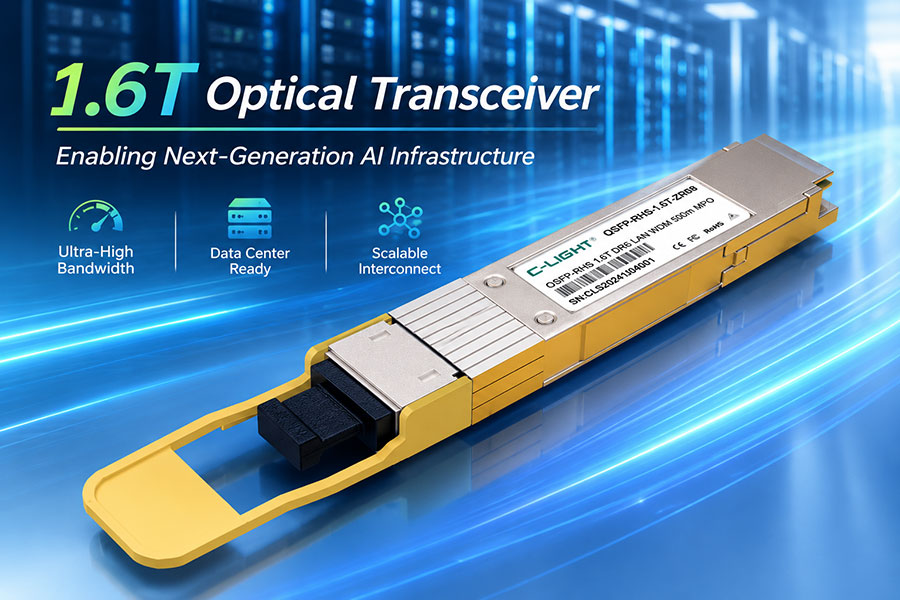
Relevant product families include 800G OSFP optical transceivers, 800G QSFP-DD optical transceivers, and 1.6T OSFP-RHS optical transceivers. Product-specific specifications and equipment support should be confirmed before a design or purchasing decision.
10. Frequently Asked Questions
Q1. Which components are most important to the 1.6T supply chain?
Answer: Key components include EML and continuous-wave lasers, photodetectors, optical DSPs, drivers, transimpedance amplifiers, photonic integrated circuits, and precision packaging materials. Their relative importance varies by transceiver architecture.
Q2. Why can laser shortages affect the supply of complete optical transceivers?
Answer: Lasers are essential to the optical transmitter. If qualified laser capacity cannot meet production requirements, module manufacturers may be unable to complete enough transceivers even when other components and assembly capacity are available.
Q3. Does silicon photonics eliminate dependence on compound semiconductor materials?
Answer: No. Silicon photonics can integrate modulation and other optical functions, but many implementations still require an external laser. The technology changes the component mix and integration approach rather than eliminating every upstream material constraint.
Q4. Why is manufacturing yield important for 1.6T modules?
Answer: Higher-speed modules require precise optical alignment, electrical performance, and thermal control. Lower yield means fewer units pass final testing, reducing effective supply and potentially increasing manufacturing costs.
Q5. Can alternative suppliers solve component shortages?
Answer: Alternative suppliers can improve resilience when their components meet the required specifications and complete qualification. Substitutions may require changes to electrical design, optical performance, firmware, packaging, or reliability testing.
Q6. How should buyers prepare for 1.6T procurement?
Answer: Buyers should establish realistic demand forecasts, verify host compatibility, confirm qualified component availability, review production lead times, and allow sufficient time for interoperability and reliability validation.
11. Conclusion
The 1.6T transition is increasing demand for specialized optical and electronic components while raising the difficulty of manufacturing high-speed transceivers at scale. Laser availability, InP material capacity, DSP production, silicon photonics integration, precision packaging, and manufacturing yield all influence the supply of qualified modules.
Addressing these challenges requires investment in upstream capacity, mature manufacturing processes, reliable component sourcing, and coordinated qualification across the supply chain. For network operators and procurement teams, early planning and product-specific validation are essential to maintaining deployment schedules as AI infrastructure moves toward higher-capacity optical connectivity.
Planning an 800G or 1.6T optical deployment?
Review your bandwidth, optical reach, host interface, and supply requirements to identify suitable transceiver options for your network.
Contact C-LIGHT >

 >
 >
 >
 >
 >
 >
 >