TEL:+86 132 6656 7067





AI data centers generate increasing volumes of traffic as accelerator clusters expand across racks, buildings, and geographically separated facilities. Dense Wavelength Division Multiplexing (DWDM) enables multiple optical channels to share a single fiber pair, increasing transmission capacity without requiring a separate fiber for every wavelength. It is particularly relevant to data center interconnect (DCI), where high bandwidth, fiber efficiency, and reliable long-distance connectivity are essential.
Why DWDM Matters for AI Infrastructure
AI training and inference depend on high-speed communication among GPUs, switches, storage systems, and distributed computing resources. Within a rack or server, electrical connections and short-reach optical links may be appropriate. As traffic extends between racks, buildings, campuses, or data centers, the network must balance capacity, reach, latency, and infrastructure cost.
DWDM addresses fiber capacity by transmitting multiple wavelengths through the same optical fiber. Each wavelength carries an independent optical channel, allowing operators to increase aggregate capacity through wavelength allocation and compatible transponder or muxponder technology.
How DWDM Works in AI Data Center Networks
A DWDM system uses optical transmitters operating at designated wavelengths. A multiplexer combines these channels onto a shared fiber, and a demultiplexer separates them at the receiving end. Depending on the required reach and system architecture, optical amplifiers, optical add-drop multiplexers, and coherent transponders may also be included.
Optical transmitters or transponders: Generate data-bearing optical signals at supported wavelengths.
DWDM multiplexer: Combines multiple wavelength channels onto a common fiber.
Transmission fiber: Carries the multiplexed optical signal between network locations.
Optical amplifiers: Compensate for transmission loss where required, subject to gain, noise, and power constraints.
DWDM demultiplexer: Separates wavelengths so that the corresponding receiving interfaces can process them.
The number of usable channels depends on the wavelength grid, channel spacing, equipment capabilities, optical performance requirements, and available spectrum. Aggregate capacity is determined by the capacity of each channel and the number of channels operating successfully, not simply by the number of wavelengths supported on paper.
DWDM Applications Across AI Data Center Architecture
| Network Layer | Typical Connectivity Need | Role of DWDM |
|---|---|---|
| Server and accelerator connections | High-bandwidth, low-latency connections within servers and racks | Usually not the primary solution for very short internal links; DAC, AEC, and optical transceivers are selected according to reach and interface requirements. |
| Data center fabric | Connections among switches, racks, and network domains | May transport aggregated traffic across fiber links where multiple wavelengths improve fiber utilization. |
| Campus interconnect | Connections between buildings or separate data center halls | Can increase capacity over existing fiber routes and support multiple high-speed services. |
| Data center interconnect | High-capacity links between geographically separated facilities | Supports multiple wavelength channels over single-mode fiber, with coherent optics and amplification where appropriate. |
| Regional AI infrastructure | Connectivity between distributed computing and storage sites | Can support high-capacity optical transport when distance, latency, and optical engineering requirements are satisfied. |
DWDM is generally more relevant to aggregated transport and inter-facility links than to every individual GPU connection. AI network architecture determines where wavelength multiplexing adds value, while the required reach and traffic pattern determine whether DWDM is preferable to simpler point-to-point optical links.
DWDM and High-Speed Optical Connectivity
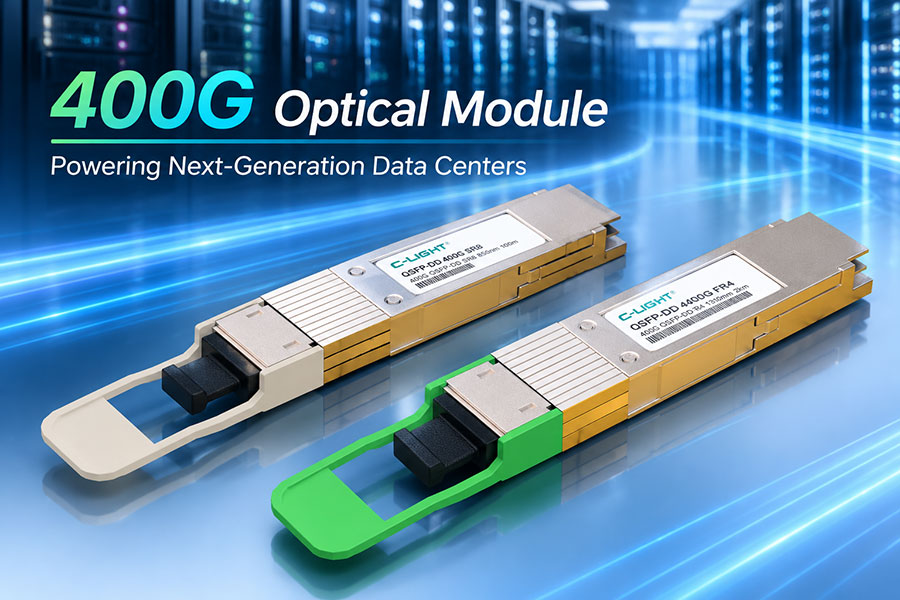
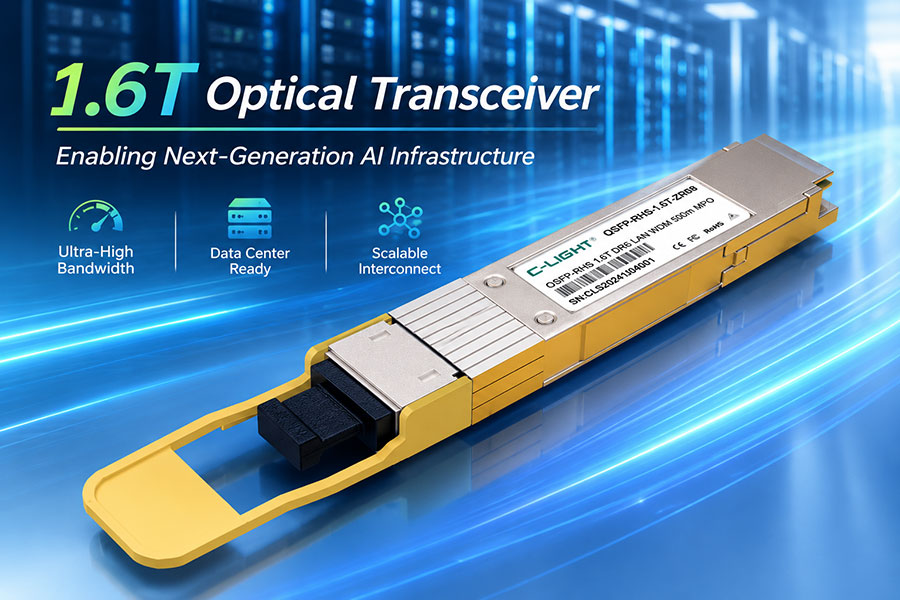
AI data center networks increasingly use 400G and 800G interfaces, while 1.6T technology is developing for next-generation high-bandwidth systems. DWDM can carry high-capacity client traffic through optical transport equipment, but the client interface rate and the line-side wavelength rate are not necessarily identical.
A transponder or muxponder may map one or more client signals onto a wavelength channel. Coherent optical technology can support high-capacity transmission over longer distances, with the achievable rate and reach depending on modulation, baud rate, forward error correction, optical signal quality, and the transmission system.
| Technology | Main Function | Typical Design Focus |
|---|---|---|
| 400G client optics | Connects compatible 400G equipment interfaces | Client reach, host compatibility, and electrical interface requirements |
| 800G client optics | Provides higher-bandwidth equipment connectivity | Port density, module power, and short- or medium-reach performance |
| Coherent DWDM optics | Transmits high-capacity signals over wavelength channels | Reach, modulation, OSNR, dispersion, and line-system compatibility |
| Optical muxponder | Aggregates multiple client signals onto optical transport channels | Client-to-line mapping, capacity utilization, and supported protocols |
| DWDM optical line system | Combines, transports, amplifies, and separates wavelengths | Channel plan, optical power, amplification, and system margin |
A 400G or 800G client interface does not automatically correspond to a particular DWDM wavelength capacity or reach. The client-side format, line-side technology, and optical line system must be evaluated as a complete design.
Fiber Efficiency and Capacity Expansion
Fiber availability can become a constraint when AI traffic grows faster than physical infrastructure. DWDM provides a way to increase capacity on qualified existing fiber routes, potentially delaying the need to install additional fiber. The benefit depends on how much spare optical capacity is available and whether the installed fiber and passive components support the intended wavelength plan.
For example, if a system carries 16 wavelength channels operating at a nominal 100G each, the aggregate nominal line capacity is 1.6 Tb/s before accounting for framing, protection, and service overhead. A system with 32 channels at the same nominal rate would provide 3.2 Tb/s of aggregate nominal capacity. These figures are illustrative; actual line rates, usable payload capacity, and channel counts depend on the equipment and configuration.
Capacity expansion also requires adequate optical signal quality. Channel spacing, filter passbands, fiber attenuation, connector losses, amplifier noise, and nonlinear effects can constrain the number of channels and their usable transmission distance.
Optical Amplification, OSNR, and Link Engineering
Longer DWDM links may require optical amplifiers to compensate for fiber and component losses. Amplification restores signal power but also introduces noise, so power alone is not a sufficient measure of transmission quality.
Optical power budget: Accounts for transmitter output, fiber attenuation, connector losses, mux/demux losses, and other passive components.
OSNR: Measures optical signal power relative to noise within a defined reference bandwidth and is important for amplified links.
Dispersion: Must remain within the capabilities of the selected transceiver and line system.
Nonlinear effects: Can become significant depending on launch power, channel loading, fiber characteristics, and transmission distance.
Channel power equalization: Helps manage wavelength-to-wavelength power differences across the optical path.
Engineering validation should cover both the optical power budget and the required signal quality at the receiver. A link can have adequate received power but still fail performance targets because of poor OSNR or other transmission impairments.
DWDM vs. Direct Optical Links
Not every AI data center connection requires DWDM. For short connections, a standard optical transceiver pair and fiber may provide the simplest solution. For longer or capacity-constrained routes, DWDM can consolidate multiple services onto a shared fiber infrastructure.
| Approach | Advantages | Considerations |
|---|---|---|
| Direct optical link | Simple point-to-point design and fewer line-system components | Each connection typically uses its own optical path or fiber allocation. |
| DWDM passive line system | Multiple wavelengths share a fiber pair without requiring amplification in every design | Insertion loss, channel plan, and reach limits must be validated. |
| Amplified DWDM system | Supports longer links and higher-capacity optical transport where engineered appropriately | Requires amplifier planning, OSNR analysis, power management, and more complex monitoring. |
The appropriate architecture depends on distance, number of services, available fiber, required capacity, and operational complexity. DWDM can improve fiber utilization, but it also introduces additional equipment and engineering requirements that may not be justified for a small number of short links.
Implementation Considerations for AI Operators
Before deploying DWDM for AI data center interconnects, network planners should establish the traffic model, required aggregate capacity, route distance, and expected growth. The optical design should then be validated against available fiber, channel spacing, transponder compatibility, power budget, OSNR, and protection requirements.
Confirm the required client interfaces and supported line-side data rates.
Determine the number of wavelength channels and the capacity required per channel.
Measure or verify fiber attenuation and passive component insertion loss.
Check whether optical amplification is needed and validate amplifier operating margins.
Plan monitoring for channel power, OSNR, alarms, and link performance.
Consider fiber diversity, protection paths, service restoration, and future capacity upgrades.
These steps help distinguish a DWDM design that works in a laboratory from one that can be operated reliably at scale across production AI infrastructure.
Conclusion
DWDM supports AI data center growth by carrying multiple wavelength channels over shared fiber infrastructure. Its strongest role is in high-capacity transport between network domains, campuses, and data centers, where fiber efficiency and scalable bandwidth are important.
Successful deployment depends on matching client interfaces with the appropriate line-side technology and validating optical power, OSNR, amplification, and fiber characteristics. As AI traffic continues to grow, DWDM provides one option for scaling interconnect capacity alongside high-speed pluggable optics, coherent transmission, and evolving optical integration architectures.
Review wavelength capacity, transmission distance, optical budgets, and equipment compatibility before selecting a DWDM solution.
Contact C-LIGHT >

 >
 >
 >
 >
 >
 >
 >