TEL:+86 158 1857 3751





The core technical advantages of the 400G Active Optical Cable (AOC) lie in its highly integrated design combining optoelectronic conversion modules with optical fiber, along with advanced packaging and signal processing technologies. This achieves an excellent balance across multiple key dimensions, including high bandwidth, low power consumption, long reach, immunity to electromagnetic interference, and ease of deployment.
Leveraging PAM4 modulation, the 400G AOC delivers ultra‑high bandwidth with extremely low latency and high reliability, meeting the demands of high‑performance scenarios such as AI clusters and HPC. Through advanced techniques like silicon photonics integration, its power consumption is significantly reduced compared to traditional solutions. The optical fiber medium enables transmission distances far exceeding those of copper cables, while providing complete immunity to electromagnetic interference. Furthermore, its lightweight, flexible design and highly integrated monolithic structure not only simplify deployment and maintenance but also lower the total cost of long‑term operations.
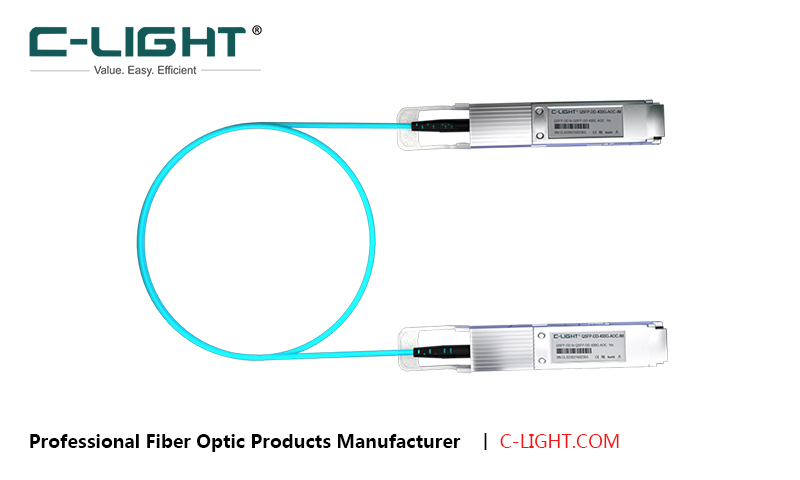
1、Significant Distance Extension
Compared to traditional 400G DAC (Direct Attach Copper Cable), which has a maximum transmission distance of only 3 meters, the 400G AOC uses optical fiber as the transmission medium, greatly extending the distance to up to 100 meters. This overcomes the physical limitations of copper cables at high data rates, making the AOC an ideal choice for inter‑rack and adjacent‑rack interconnections.
2、Excellent Immunity to Electromagnetic Interference
AOCs transmit optical signals, making them completely immune to electromagnetic interference (EMI) and radio‑frequency interference (RFI). In high‑density data center environments, electromagnetic crosstalk between devices poses a serious challenge for traditional copper cables. With the inherent insulation properties of optical fiber, AOCs achieve complete electrical isolation, offering far superior signal integrity and reliability compared to copper‑based solutions, with a bit error rate (BER) below 1e‑15.
3、Lightweight, Flexible, and Easy Routing
The 400G AOC offers significant physical advantages: compared to DAC copper cables, AOCs reduce volume by approximately 50% and weight by about 75%. The optical fiber is thinner and more flexible than copper cables with equivalent transmission capacity. In high‑density cabling scenarios, AOCs not only improve airflow within racks but also simplify cable management, making them particularly suitable for high‑port‑count network applications such as 200G, 400G, and 800G.
4、Plug‑and‑Play and Efficient Deployment
AOCs use a pre‑terminated design, with the optical engine permanently fixed to both ends of the cable, forming an integrated, all‑in‑one solution. While this design sacrifices field replaceability, it provides higher connection consistency and stability, avoids operational pain points such as optical port contamination and insertion‑loss variation, and saves approximately 70% of installation time.
5、Power Consumption and Heat Dissipation Advantages
AOCs typically consume less power than comparable pluggable optical module plus patch cord combinations. Moreover, because optical fiber replaces copper conductors, resistive heat generation is reduced, resulting in lower thermal management requirements. This helps lower data center cooling costs and PUE (Power Usage Effectiveness). Measured data shows that the typical power consumption of a 400G AOC is approximately 7.5W. At the same transmission distance, this represents energy savings of about 40% compared to traditional DAC copper cables and cost savings of approximately 35% compared to discrete transceiver‑based solutions.




 >
>

 >
>
 >
>
 >
>
 >
>
 >
>