TEL:+86 132 6656 7067




Driven by explosive growth in artificial intelligence, high-performance computing, and cloud computing, data center traffic is rising at an unprecedented rate. According to IDC forecasts, global data center traffic is expected to triple by 2025 compared to 2023, imposing stringent demands on high-speed interconnect technologies. At the critical juncture of the transition from 400G to 800G and onward to 1.6T, Active Optical Cables (AOC) have emerged as a core interconnect solution supporting AI clusters and hyperscale data centers, leveraging their unique technological advantages.
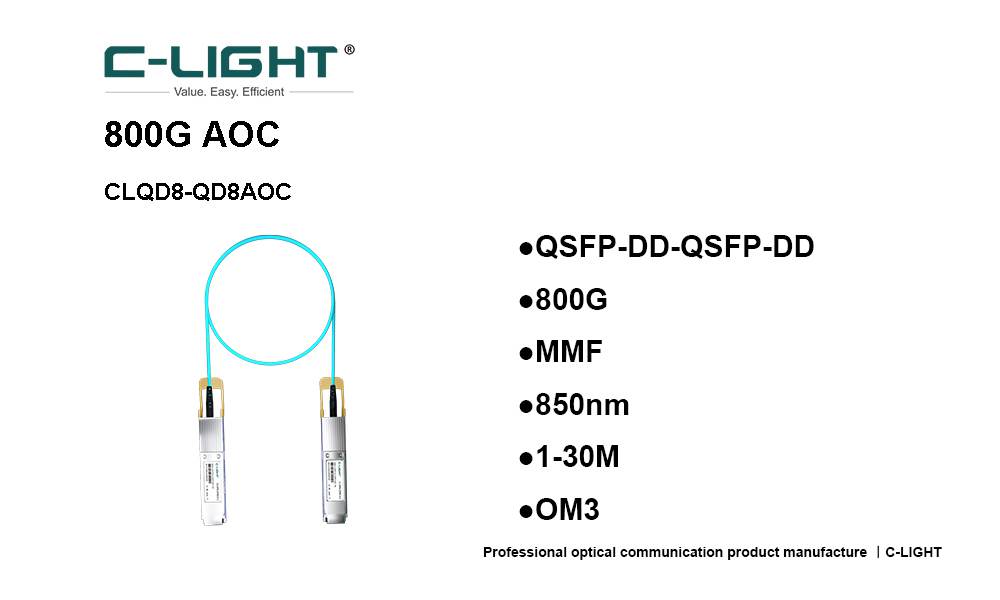
I. Core Architecture and Innovative Evolution of 800G AOC
1.1 Technical Principles and Basic Architecture of AOC
An Active Optical Cable is a high-speed transmission solution that integrates optoelectronic conversion functions within the connector. Its core operating principle can be summarized as an "electrical-to-optical-to-electrical" conversion process: at the transmitting end, a Vertical-Cavity Surface-Emitting Laser (VCSEL) converts electrical signals into optical signals for transmission over multimode fiber (OM3/OM4); at the receiving end, a PIN photodiode converts the optical signals back into electrical signals. This design enables AOC to combine the high bandwidth and electromagnetic interference (EMI) immunity of optical fiber transmission with the plug-and-play convenience of copper cabling.
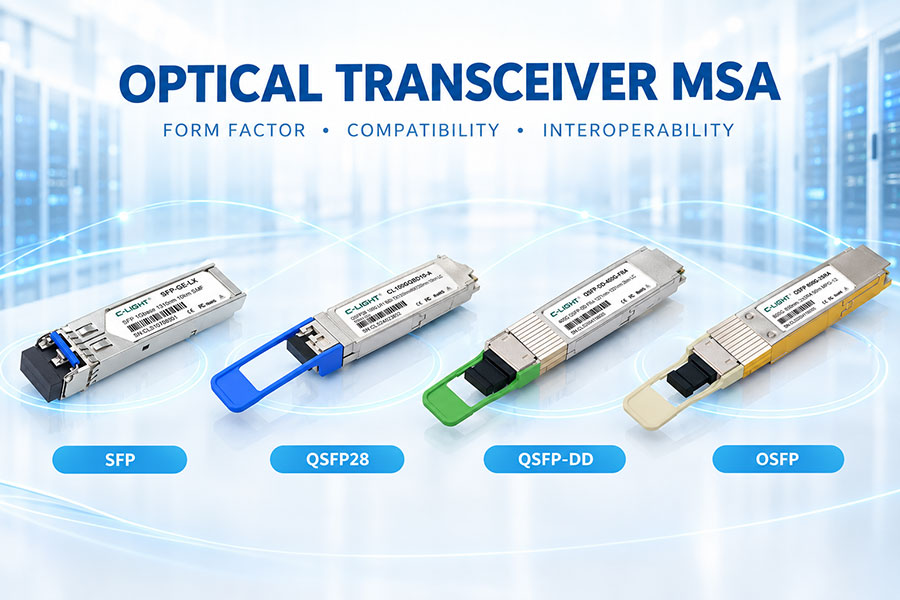
800G AOC typically employs an eight-channel parallel architecture, with each channel operating at a rate of 106.25 Gb/s, achieving an aggregate bandwidth of 800 Gbps through PAM4 modulation. Mainstream form factors include OSFP and QSFP-DD. The former supports higher power consumption with a larger heat dissipation surface area, while the latter offers advantages in upgrade scenarios due to its backward compatibility.
1.2 Performance Metrics and Technical Advantages
Compared to traditional Direct Attach Copper (DAC) cables and Active Electrical Cables (AEC), 800G AOC demonstrates distinct advantages across several key dimensions:
Transmission Distance: 800G AOC supports transmission distances of 30-100 meters (over multimode fiber), with single-mode versions extending beyond 10 kilometers. This significantly surpasses the 3-5 meter range of DAC and the 2-9 meter range of AEC, making AOC an ideal choice for inter-rack, inter-row, and even cross-connection applications.
Electromagnetic Interference (EMI) Immunity: The non-conductive nature of optical fiber provides AOC with excellent EMI immunity. In high-noise environments such as AI server clusters, AOC maintains an extremely low Bit Error Rate (BER).
Weight and Cabling: 800G AOC weighs approximately 25% of a comparable DAC. The flexibility of the fiber optic cable significantly improves cabling efficiency and airflow management in high-density scenarios.
Signal Integrity: Through optoelectronic conversion, AOC effectively avoids the signal attenuation and crosstalk issues associated with copper cables at high frequencies, ensuring signal quality over longer transmission distances.
II. Demand Drivers and Competitive Landscape
2.1 Market Size and Growth Drivers
The Ethernet optical module market surged by 93% in 2024. Meanwhile, despite adjustments in NVIDIA's product strategy, the AOC market still achieved 26% growth and is projected to accelerate to 53% in 2025. The global optical module market is expected to expand at a Compound Annual Growth Rate (CAGR) of 22% over the next five years. As a core component in data communication applications, AOC global shipments are projected to reach 10 million units by 2029.
Within the high-speed cable sector, AOC's market share is expected to increase from 30% in 2024 to 45% by 2029, positioning it as the fastest-growing subcategory. This growth trajectory is primarily driven by two factors:
AI Cluster Demands: Training generative AI models requires parallel computing across thousands, or even tens of thousands, of GPUs. High-speed interconnects between GPUs have become a critical bottleneck determining computing power utilization efficiency. With its transmission capability of 30-100 meters, 800G AOC is perfectly suited for inter-rack connectivity needs.
Data Center Architecture Upgrades: From leaf-spine architectures to the hyperscale networking of AI clusters, data center bandwidth demand doubles approximately every two years, accelerating the transition of interconnect technologies from 400G to 800G.
2.2 Application Scenarios and Selection Strategies
Based on technical characteristics, the application of 800G AOC in data centers exhibits a clear scenario-based stratification:
| Application | Distance | Solution | Note |
Intra-rack interconnection | < 3 meters | DAC | Ultimate low latency and low cost |
Interconnection between adjacent racks | 3-7 meters | AEC | Power consumption is 25-50% lower than that of AOC |
Inter-rack interconnection | 7-30 meters | AOC (multimodal) | Lightweight, anti-interference, and flexible wiring |
Inter-row connection | 30-100 meters | AOC (multimodal) | The only feasible medium-range high-speed solution |
Cross-building interconnection | >100 meters | AOC (single mode) | Supports transmission over 10 kilometers |
In AI cluster deployments, a hybrid strategy is often adopted: DAC is used intra-rack to ensure minimal latency, AOC is employed inter-rack to guarantee bandwidth and cabling density, while AEC provides a cost-performance balance for medium-distance scenarios.
As a critical infrastructure enabling the transition of data centers into the AI era, 800G AOC is currently experiencing a golden period of development driven by both technological advancement and market demand. For data center operators, understanding the technical boundaries between AOC, AEC, and DAC, and developing a refined selection strategy based on distance, power consumption, and cost, will be crucial to unlocking the full potential of AI computing power.
 >
>

 >
>
 >
>
 >
>
 >
>
 >
>
 >
>
 >
>