TEL:+86 132 6656 7067





The choice between coherent and direct-detect optics is fundamentally a choice about how much information the receiver extracts from an optical signal, how much signal processing is required to recover that information, and what the complete link must deliver. Direct-detect optics remain highly effective for many intra-data-center connections, while coherent technology enables higher spectral efficiency and stronger compensation of fiber impairments across demanding data center interconnect (DCI) routes. As network capacity grows, the distinction increasingly affects fiber utilization, transceiver power, optical-layer design and total cost of ownership.
1. Detection Architecture: Optical Intensity vs. Complex Field Recovery
Direct detection, commonly implemented as intensity modulation and direct detection (IM-DD), recovers information from changes in received optical power. The transmitter encodes data through optical intensity, and a photodiode converts the received light into an electrical signal. Modern high-speed implementations frequently use PAM4, in which four amplitude levels represent two bits per symbol.
The architecture is comparatively straightforward, but the receiver observes optical intensity rather than the full optical field. Phase information is not directly recovered. This limits the signal-processing techniques available for compensating channel impairments, particularly when transmission distance, symbol rate or wavelength-channel density increases.
Coherent detection takes a different approach. The incoming optical signal is mixed with a locally generated reference laser, known as the local oscillator (LO). An optical hybrid and balanced photodetectors produce electrical signals that preserve information about the received field. Analog-to-digital converters and a coherent digital signal processor (DSP) then recover the transmitted symbols.
Depending on the implementation, coherent systems can recover amplitude and phase across two polarization states. This supports modulation formats such as dual-polarization QPSK and 16-QAM, allowing more information to be carried per symbol and enabling sophisticated compensation for transmission impairments.
2. Modulation, DSP and Fiber-Impairment Compensation
The performance gap between the two approaches becomes clearer when modulation and signal processing are considered together. Direct-detect systems commonly use OOK or PAM4, depending on the generation and application. PAM4 increases the number of bits transmitted per symbol compared with binary signaling, but its four amplitude levels have smaller decision margins than a comparable two-level signal at the same amplitude range. This makes performance more sensitive to noise, distortion and implementation penalties.
High-speed IM-DD links therefore still require careful electrical and optical engineering. Transmit equalization, receiver equalization, clock recovery and forward error correction (FEC) may all be part of the link. Direct detection should not be interpreted as DSP-free by default; the exact processing requirements depend on the transceiver design and interface standard.
Coherent systems generally use a more extensive DSP chain. Depending on the implementation, it may perform chromatic-dispersion compensation, adaptive equalization, polarization demultiplexing, frequency-offset estimation, carrier-phase recovery and FEC decoding. These functions help maintain signal quality across longer or more complex optical paths.
| Engineering Factor | Direct-Detect Optics | Coherent Optics |
|---|---|---|
| Detected information | Optical intensity | Optical field information recovered relative to a local oscillator, including phase and, where implemented, polarization |
| Common modulation formats | OOK and PAM4 in many data center interfaces | DP-QPSK, DP-16QAM and other coherent formats, depending on application |
| DSP architecture | Often simpler, with processing determined by baud rate, reach and implementation | Typically more extensive, supporting field recovery and advanced channel compensation |
| Chromatic dispersion | Reach and baud-rate dependent; electronic compensation is possible but constrained by the architecture | Can be compensated digitally over a broad operating range, subject to DSP capability and link budget |
| Polarization handling | Generally does not use coherent polarization demultiplexing | Polarization-diverse reception and adaptive equalization are common in high-capacity implementations |
| Optical-layer flexibility | Best suited to defined channels and supported reach conditions | Can support flexible modulation, wavelength-channel operation and more demanding optical paths |
Neither architecture removes the need for a valid link budget. Coherent DSP can compensate for certain transmission impairments, but it cannot recover a signal when received optical power, optical signal-to-noise ratio (OSNR), nonlinear penalties or other impairments exceed the system's operating limits.
3. Transmission Reach and Data Center Interconnect Design
Reach is a major factor in transceiver selection, but distance alone is not sufficient to determine which architecture is appropriate. Fiber attenuation, chromatic dispersion, connector losses, optical filtering, amplifier noise, wavelength plan and required engineering margin all affect the feasible transmission distance.
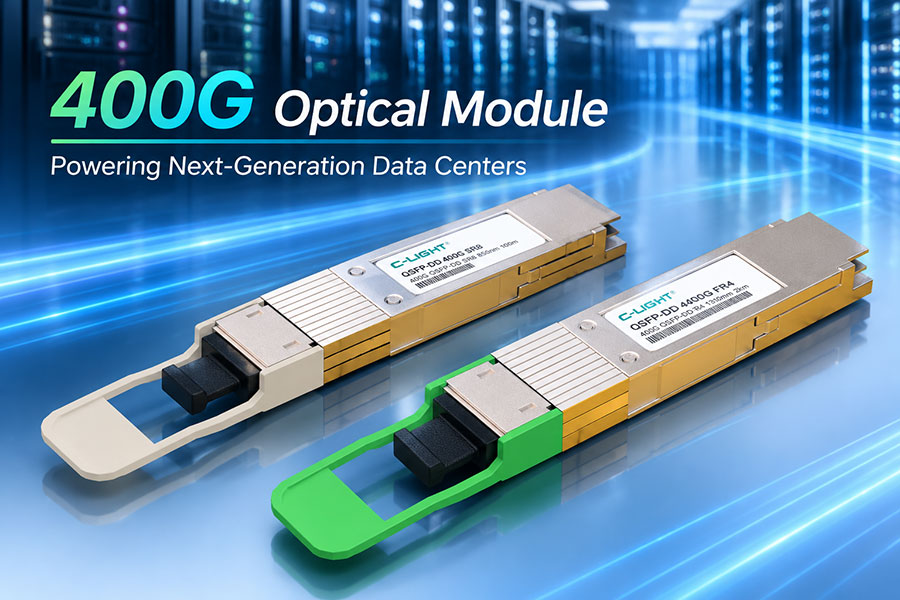
For short-reach connections within a data center, direct-detect optics often provide the most practical combination of port density, cost and power. Standardized interfaces such as 400GBASE-SR8, 400GBASE-DR4 and 400GBASE-FR4 illustrate how different direct-detect implementations address different fiber types and reach requirements. Their specifications are not interchangeable: multimode SR, single-mode DR and wavelength-multiplexed FR links have distinct optical interfaces and deployment conditions.
For DCI, the situation changes as fiber routes become longer or require wavelength multiplexing over a managed optical line system. Coherent transceivers can use advanced modulation and DSP to transmit high-capacity wavelengths through systems containing amplifiers and, where supported, reconfigurable optical add-drop multiplexers (ROADMs).
Standards-based 400ZR modules provide an important example of coherent technology moving into compact, pluggable form factors for DCI. OpenZR+ and other coherent implementations address additional operating modes and deployment requirements, but their capabilities vary by specification, mode and vendor. A coherent module should not be assumed to support every line system or reach simply because it carries a ZR or ZR+ label.
| Network Scenario | Architecture to Evaluate First | Primary Design Considerations |
|---|---|---|
| Within a rack or between nearby systems | Direct-detect optics or other short-reach electrical/optical interconnects | Port density, cabling, channel loss, power and physical reach |
| Data center leaf-spine fabric | Direct-detect optics for supported short-reach links | Aggregate bandwidth, fiber count, breakout topology and switch compatibility |
| Campus or short DCI route | Direct detection or coherent, depending on the actual route and capacity requirement | Fiber loss, dispersion, wavelength plan, module cost and available link margin |
| Metro DCI with DWDM | Coherent optics often warrant evaluation | OSNR, amplifier configuration, channel spacing, filtering and transceiver operating mode |
| Regional or longer-haul interconnect | Coherent transport architecture | Reach, span count, OSNR accumulation, optical-layer control and regeneration strategy |
These categories are screening guidance rather than fixed distance thresholds. Some direct-detect designs support extended reaches, while coherent modules also have defined operating limits. The decision should be made against the actual optical path and the exact supported PMD or coherent mode.
4. Power Consumption, Port Density and Total Cost
Direct-detect optics generally benefit from a simpler optical receiver and can avoid the full coherent DSP chain. For large data center fabrics with thousands of short-reach links, the per-port power difference can become a material factor in rack-level power budgets, cooling capacity and operating expenditure.
Coherent optics require additional components and processing, including a local oscillator, optical hybrid, high-speed conversion electronics and more complex DSP. These functions typically increase module power and implementation cost relative to a comparable short-reach direct-detect solution. However, a module-level comparison alone can be misleading when the two technologies solve different transmission problems.
On a DCI route, coherent optics may reduce the need for separate dispersion-compensation equipment, electrical regeneration or multiple intermediate conversion stages. Where these savings apply, the higher transceiver cost can be offset by a simpler transport architecture or more efficient use of installed fiber.
Power comparisons must also use equivalent system boundaries. Comparing the transceiver alone may omit external amplifiers, line cards, regeneration equipment, cooling and optical-layer components. The relevant metric is the energy and cost required to deliver the required capacity over the complete route.
| Cost or Power Factor | Direct-Detect Approach | Coherent Approach |
|---|---|---|
| Transceiver complexity | Generally lower for comparable short-reach applications | Generally higher due to coherent optical and electronic processing |
| Power per port | Often advantageous for short-reach links | Typically higher, though implementation and generation strongly affect the result |
| Fiber utilization | May require more fiber pairs for some parallel-optics designs | Wavelength multiplexing can carry high capacity over shared fiber infrastructure |
| External optical equipment | May need additional compensation or regeneration when the link exceeds its operating envelope | May simplify some long-distance systems, but amplifiers and line-system equipment can still be required |
| Maintenance and operations | Often straightforward for defined point-to-point links | May involve coherent-mode configuration, OSNR monitoring and optical-line-system management |
| Total cost of ownership | Often attractive when the link fits the direct-detect operating envelope | Can be more economical when capacity, reach or fiber constraints justify coherent transport |
5. Scaling to 800G, 1.6T and Higher-Capacity Networks
As data center interfaces advance toward 800G and 1.6T, the choice between direct detection and coherent technology becomes more closely tied to lane rate, baud rate, optical packaging and the electrical interface between the host ASIC and the optical engine.
For direct-detect links, increasing the baud rate places tighter demands on transmitter bandwidth, receiver bandwidth, optical modulation linearity and channel response. Higher-order electrical signaling can increase capacity per lane, but it also reduces noise margin. As a result, link performance depends on the combined behavior of the optical device, analog front end, DSP and fiber channel rather than the headline data rate alone.
Coherent technology offers another route to higher spectral efficiency by encoding information in amplitude and phase, often across two polarizations. This can be valuable when capacity must be increased without proportionally increasing the number of wavelengths or consuming additional fiber pairs. The trade-off is the power and complexity of the coherent optical and electronic subsystem.
These developments do not mean coherent optics will replace direct detection across all data center networks. Short-reach Ethernet links remain a distinct engineering domain from wavelength-based DCI transport. The technologies may coexist within the same infrastructure, each serving the reach and capacity requirements for which its architecture is best suited.
6. Practical Selection: What Network Engineers Should Verify
A sound selection process begins with the optical route and interface requirements rather than the transceiver's nominal data rate. Two modules rated for the same Ethernet capacity may use different modulation formats, fiber interfaces, wavelength plans and optical budgets, making them unsuitable substitutes.
Confirm the interface standard: Verify the exact Ethernet PMD or coherent application specification, including lane configuration, modulation format and supported host interface.
Calculate the optical budget: Include fiber attenuation, connector and splice losses, patch panels, wavelength-dependent effects and the required engineering margin.
Evaluate dispersion and OSNR: For DCI, assess chromatic dispersion, amplifier noise, filtering penalties and the number of optical spans. Do not use nominal distance as a substitute for route qualification.
Check the optical line system: Confirm channel spacing, supported wavelength range, launch-power limits, amplifier compatibility and ROADM behavior where applicable.
Compare complete power requirements: Include transceivers, line systems, regeneration and cooling where relevant, rather than relying solely on module power.
Validate host and operational compatibility: Check switch support, firmware, FEC requirements, module management, interoperability and vendor-specific operating restrictions.
Test under realistic conditions: Verify error performance and stability over the intended fiber route, temperature range and operating configuration before production deployment.
For direct-detect links, the central question is whether the required capacity and reach can be achieved with adequate margin using a practical optical budget. For coherent links, the additional questions concern the selected modulation mode, DSP capabilities, OSNR requirements and compatibility with the optical line system.
7. Conclusion
Coherent and direct-detect optics address different operating points in data center networking. Direct detection remains an efficient choice for many intra-data-center connections because it combines relatively simple receiver architecture with competitive port cost and power consumption. Coherent optics become increasingly valuable when transmission requires higher spectral efficiency, advanced dispersion compensation, polarization processing or operation across a managed DCI line system.
The right architecture is determined by the complete link, not by bandwidth alone. Evaluating the interface standard, fiber route, optical budget, OSNR, power envelope and total system cost provides a more reliable basis for choosing between coherent and direct-detect transceivers.
8.Frequently Asked Questions
1. Is coherent optics always better than direct detection?
No. Coherent optics offer stronger capabilities for complex optical channels and high spectral efficiency, but they generally add transceiver complexity, power consumption and cost. Direct detection is often the better fit when the required reach and capacity fall within its supported operating envelope.
2. Can direct-detect optics be used for data center interconnects?
Yes. Direct-detect optics can support DCI when the selected interface meets the route's distance, loss and dispersion requirements. Longer or more demanding routes may favor coherent optics, particularly when DWDM transport and optical amplification are involved.
3. What is the main advantage of coherent detection?
Coherent detection recovers phase-related information from the optical field, enabling advanced modulation formats and DSP-based compensation of channel impairments. This supports high-capacity transmission over optical paths that may be impractical for conventional direct-detect implementations.
4. Does coherent optics eliminate the need for amplifiers?
No. Coherent DSP can compensate for dispersion and tolerate a wider range of channel conditions, but it cannot eliminate fiber attenuation or unlimited OSNR degradation. Amplifiers or regeneration may still be necessary depending on route loss, span count and the selected optical system.
5. What should be compared when choosing 400G DCI optics?
Compare the exact interface or coherent application mode, reach, optical budget, OSNR, modulation, wavelength plan, power, host support and line-system compatibility. A nominal 400G rating alone does not establish interoperability or route suitability.
Evaluating optical transceivers for data center or DCI deployment?
Review interface compatibility, transmission distance and optical link requirements before finalizing your network design.
Contact C-LIGHT >

 >
 >
 >
 >
 >
 >
 >