TEL:+86 132 6656 7067





BiDi optical transceivers enable full-duplex communication over a single optical fiber by using separate wavelengths for transmission and reception. This architecture helps operators conserve fiber resources, extend existing infrastructure, and support Ethernet access, mobile network transport, enterprise connectivity, and metropolitan fiber networks.
1. What Are BiDi Optical Transceivers?
BiDi, short for bidirectional, refers to optical transceivers that transmit and receive data through the same fiber strand. Unlike conventional duplex optical connections, which typically use one fiber for transmitting and another for receiving, a BiDi link separates the two transmission directions using different optical wavelengths.
A BiDi transceiver integrates a transmitter and receiver into one module. Wavelength-selective optical components combine the outgoing signal with the incoming signal through a shared optical interface. At the opposite end, a complementary transceiver uses the corresponding wavelength arrangement to complete the bidirectional link.
This approach can reduce fiber consumption where existing infrastructure has limited available strands. It is particularly useful in access networks, enterprise connections, mobile transport, and deployments where installing additional fiber would increase construction cost or complicate cable management.
BiDi technology does not increase the capacity of the fiber simply by reducing the number of strands. Its primary advantage is more efficient use of existing fiber resources while preserving the data rate and reach supported by the selected transceiver pair.
2. How Single-Fiber Bidirectional Transmission Works
A typical BiDi connection uses two complementary transceivers, often described as the A-end and B-end modules. Each endpoint transmits on one wavelength and receives on another. The wavelength assignments are reversed at the other end so that each receiver is matched to the remote transmitter.
For example, one endpoint may transmit at 1310nm and receive at 1490nm, while the other transmits at 1490nm and receives at 1310nm. Both directions can operate simultaneously over the same fiber because their signals use different wavelengths.
| Parameter | Endpoint A | Endpoint B |
|---|---|---|
| Transmit wavelength | 1310nm | 1490nm |
| Receive wavelength | 1490nm | 1310nm |
| Outgoing signal | Sent toward Endpoint B | Sent toward Endpoint A |
| Incoming signal | Received from Endpoint B | Received from Endpoint A |
| Fiber connection | One shared fiber strand for both transmission directions | |
The wavelength values in this example are illustrative. Actual wavelength combinations vary by product family, transmission distance, and optical architecture. The modules at both ends must have complementary transmit and receive wavelengths, with compatible data rates and optical specifications.
3. BiDi vs. Conventional Duplex Optical Transceivers
BiDi and conventional duplex optical transceivers can provide similar data rates, but they use different fiber arrangements. The correct option depends on existing cabling, available fiber strands, optical performance requirements, and the cost of deploying or maintaining the connection.
| Comparison Factor | BiDi Transceiver | Conventional Duplex Transceiver |
|---|---|---|
| Fiber requirement | One fiber strand for bidirectional communication | Typically two fiber strands, one for each direction |
| Optical transmission | Uses different wavelengths for Tx and Rx | Commonly uses separate fibers for Tx and Rx |
| Fiber utilization | Can conserve available strands in existing cable infrastructure | Uses a dedicated fiber for each direction |
| Endpoint configuration | Usually requires complementary wavelength variants | Normally uses compatible transmitters and receivers on separate fibers |
| Connector arrangement | Often simplex LC, depending on the module | Often duplex LC, depending on the module |
| Installation consideration | Requires correct wavelength pairing and single-fiber path continuity | Requires correct Tx/Rx fiber polarity across the duplex connection |
| Best-fit scenario | Fiber-constrained access and point-to-point links | Networks with sufficient fiber availability and established duplex cabling |
Using BiDi can release one fiber strand per point-to-point connection compared with a conventional two-fiber arrangement. Across a large access network, the cumulative savings can be significant, particularly when existing cable routes have limited spare capacity.
However, the total project cost also depends on module pricing, available connector infrastructure, testing requirements, fiber management, and future network expansion. Fiber savings should be evaluated alongside the complete deployment and maintenance requirements.
4. Common BiDi Wavelength Technologies
BiDi transceivers use different wavelength pairs and optical designs depending on the data rate, fiber conditions, transmission distance, and network application. The wavelength plan determines how the two transmission directions are separated.
Standard wavelength-pair BiDi
Many BiDi modules use complementary wavelengths in the 1270nm, 1310nm, 1490nm, or 1550nm regions. The exact combination is specific to the module family and operating distance. A matching pair assigns the transmit wavelength of each endpoint to the receive wavelength of the opposite endpoint.
CWDM BiDi
Coarse wavelength-division multiplexing (CWDM) BiDi combines single-fiber bidirectional transmission with wavelength selection across a broader channel plan. Product configurations may use different wavelength pairs for different links or network requirements.
CWDM BiDi can support access aggregation, metropolitan connectivity, and mobile transport applications where efficient fiber use and flexible wavelength planning are important. The selected modules must still use a compatible wavelength arrangement for the intended connection.
Wavelength multiplexing and optical filtering
The optical transmitter and receiver within a BiDi module rely on wavelength-selective components to separate the outgoing and incoming signals. Their characteristics influence optical loss, wavelength isolation, and the usable operating range.
For extended-reach or higher-capacity implementations, the module's specified optical budget and transmission conditions must be evaluated carefully. Wavelength separation alone does not determine reach; transmitter power, receiver sensitivity, fiber attenuation, and other interface limitations also matter.
5. BiDi Transceiver Options Across Different Data Rates
BiDi technology is available across multiple generations of optical networking, from low-speed access interfaces to higher-capacity data center and transport links. The form factor, transmission distance, wavelength combination, and supported protocol vary by product.
| Data Rate Class | Example Form Factor | Example Reach Options | Potential Application |
|---|---|---|---|
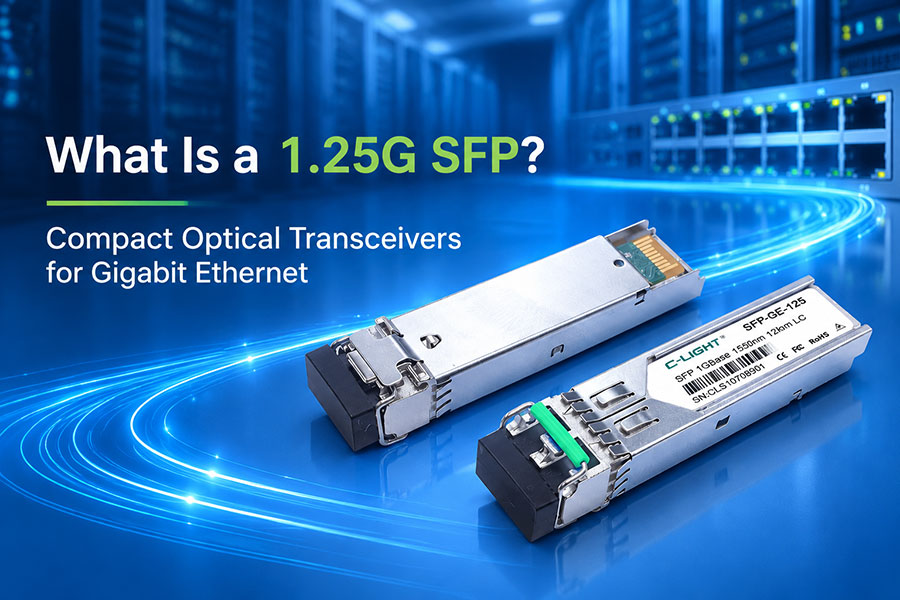
| 100M to 1.25G | SFP | Configuration-dependent, from short links to extended single-mode fiber routes | Legacy Ethernet, enterprise access, and existing fiber upgrades |
| 10G | SFP+ | Examples include 2km, 10km, 40km, and longer-reach variants | Enterprise aggregation, access uplinks, and mobile transport |
| 25G | SFP28 | 10km, 20km, 40km, and 60km in a listed product family | High-bandwidth access and selected data center links |
| 100G | QSFP28 | 2km, 10km, 20km, 40km, and 80km in a listed OTU4 BiDi family | Optical transport, metro networks, and high-capacity interconnection |
These ranges refer to available product configurations, not universal reach limits for every BiDi module at a given data rate. Actual availability depends on the optical interface, wavelength plan, part number, and supported network protocol.
For product details, review the 1.25G BiDi SFP, 10G BiDi SFP+, 25G BiDi SFP28, and 100G OTU4 BiDi QSFP28 product families.
6. Applications in Fiber-Efficient Access Networks
Enterprise access and building networks
Enterprise access networks often connect switches in wiring closets, office floors, campus buildings, and remote facilities. Where fiber availability is limited, BiDi modules can provide a way to establish point-to-point connections without assigning separate fiber strands to the two transmission directions.
This approach is particularly useful when operators want to expand network capacity using existing single-mode fiber rather than installing additional cable routes. The selected transceiver pair must match the required distance, data rate, and switch interface.
Mobile fronthaul and backhaul
Mobile networks connect radio equipment, aggregation devices, and transport infrastructure across different locations. Depending on the architecture, BiDi transceivers can support selected point-to-point optical links where reducing fiber usage is beneficial.
Mobile transport requirements may include specific data rates, latency targets, operating temperatures, and synchronization capabilities. A BiDi module should be selected only after confirming its support for the intended interface and network design.
Metro access and aggregation
Metropolitan networks frequently connect distributed enterprise sites, service-provider access nodes, aggregation switches, and other facilities. Existing fiber routes may be expensive to expand or may have only a limited number of spare strands.
BiDi technology provides an alternative for suitable point-to-point links by sharing one fiber between the two directions. Longer-reach options can support selected metro connections when the optical budget and module specifications match the installed route.
Video surveillance and remote equipment
Remote cameras, industrial systems, and distributed monitoring equipment may need Ethernet connectivity over fiber where copper cabling is unsuitable or where fiber routes are already installed. Compatible BiDi transceivers can reduce fiber strand requirements on supported links.
For industrial and outdoor deployments, pay particular attention to module operating temperature, optical reach, power requirements, and the environmental limits of the host equipment.
Data center and computer-room interconnection
BiDi modules can support selected connections between switches, equipment rooms, storage systems, and distributed network segments. At higher data rates, the choice of optical physical layer, connector, wavelength scheme, and receiver performance becomes increasingly important.
BiDi should not be assumed to be the preferred option for every high-speed data center link. Parallel-fiber and duplex wavelength-multiplexed architectures may be more suitable where the required standard or platform specifies a different optical arrangement.
7. BiDi in Access Networks vs. PON Architectures
BiDi point-to-point transceivers and passive optical network (PON) systems both use optical fiber efficiently, but they address different network architectures.
A conventional BiDi Ethernet link connects two endpoints through one fiber strand, using complementary wavelengths for the two directions. PON systems use an optical distribution network to connect an optical line terminal (OLT) with multiple optical network units or terminals (ONUs/ONTs), typically through passive splitters.
| Characteristic | Point-to-Point BiDi | Passive Optical Network (PON) |
|---|---|---|
| Network topology | Dedicated optical link between two endpoints | Shared optical distribution network connecting an OLT to multiple subscriber endpoints |
| Fiber sharing | Uses one fiber for the two directions of an individual link | Shares an optical distribution segment among multiple endpoints using passive optical components |
| Transmission control | Depends on the supported point-to-point protocol and link configuration | Uses PON-specific downstream and upstream transmission mechanisms |
| Endpoint equipment | Compatible BiDi transceivers at both ends | Compatible OLT and ONU/ONT interfaces within the same PON system |
| Deployment focus | Direct Ethernet or other compatible point-to-point links | Subscriber access, FTTx, and shared optical access infrastructure |
BiDi Ethernet transceivers are not automatically interchangeable with GPON, XG-PON, or XGS-PON optics. PON systems have specific optical characteristics, protocols, and upstream/downstream operating requirements. The module must be designed for the intended access technology.
8. Fiber Planning and BiDi Compatibility Requirements
Single-fiber operation simplifies some aspects of cabling, but requires careful endpoint matching and link validation. Before deployment, confirm the following details for both ends of the connection.
Complementary wavelengths: Match the transmitter wavelength at one endpoint to the receiver wavelength at the opposite endpoint.
Compatible data rates: Confirm that both endpoints support the required operating rate and protocol.
Optical reach: Select modules designed for the actual route length and expected fiber loss.
Fiber type: Verify that the installed fiber matches the module's specification, commonly single-mode fiber for many BiDi access links.
Connector type: Confirm LC, SC, or another specified optical interface and check that the patching arrangement is appropriate.
Host compatibility: Verify the form factor, power requirements, module management support, and any platform-specific restrictions.
Optical power budget: Account for fiber attenuation, connectors, splices, passive components, and engineering margin.
Environmental limits: Check the module's operating temperature and the requirements of the deployed equipment.
When expanding an existing fiber network, document the wavelength assignments for each BiDi link. Clear records help prevent incompatible pairings during maintenance, module replacement, or changes to the patching arrangement.
9. Installation, Diagnostics, and Troubleshooting
Correct BiDi installation begins with verifying the module pairing and inspecting the fiber path. Even when the modules have compatible wavelength assignments, a link may fail because of connector contamination, excessive attenuation, incorrect patching, unsupported host configuration, or a defective component.
| Observed Symptom | Possible Cause | Recommended Checks |
|---|---|---|
| Link does not come up | Incorrect wavelength pairing, fiber fault, incompatible module, or host configuration issue | Verify both part numbers, Tx/Rx wavelengths, module recognition, fiber continuity, and port status |
| Low receive optical power | Dirty connector, excessive insertion loss, damaged fiber, or remote transmitter problem | Inspect connectors, measure optical power, review the link budget, and check remote Tx power |
| Intermittent link drops | Unstable fiber connection, optical power fluctuations, or equipment configuration problem | Review interface logs, module diagnostics, connector condition, and changes to the physical path |
| High error counts | Signal degradation, incorrect physical-layer configuration, or a component fault | Check optical power, error counters, FEC information where available, and host compatibility |
| Unexpected diagnostic readings | Module-specific measurement behavior, threshold differences, or host management limitations | Compare the results with the module datasheet and platform documentation |
| Link works at one reach but not another | Insufficient optical budget or an unsuitable module variant | Confirm the rated reach, attenuation, fiber type, and complete optical path |
Digital diagnostic monitoring (DDM/DOM), where supported, can provide useful measurements such as transmit optical power, receive optical power, module temperature, and voltage. These readings should be evaluated against the exact module specifications rather than a universal threshold.
For longer links or persistent faults, optical power measurements and fiber-loss testing can help isolate problems that module diagnostics alone cannot locate. Successful link-up should also be followed by a traffic and stability check before the connection is considered validated.
10. Choosing Between Standard BiDi and CWDM BiDi
Standard BiDi modules use a specified complementary wavelength pair for a particular link. CWDM BiDi options provide wavelength choices across a broader channel plan, which can help when planning multiple optical links or integrating with an existing wavelength strategy.
| Selection Factor | Standard BiDi | CWDM BiDi |
|---|---|---|
| Wavelength arrangement | Specified complementary Tx/Rx wavelength pair | Product-dependent wavelength combinations across supported CWDM channels |
| Deployment objective | Dedicated bidirectional point-to-point connectivity | Single-fiber connectivity with additional wavelength-planning options |
| Network planning | Requires matched endpoint modules | Requires matched endpoint modules and correct channel assignment |
| Product variation | Depends on data rate, reach, wavelength pair, and connector | Depends on the supported CWDM channel, data rate, reach, and connector |
| Typical application | Enterprise access and direct optical connections | Access aggregation, metro networks, and selected mobile transport links |
CWDM BiDi does not automatically create a multi-channel network from a single transceiver pair. The number of links, channel plan, and optical components must be designed according to the intended topology and supported product configuration.
For additional details, see the CWDM BiDi optical transceiver portfolio, which includes multiple data-rate and reach options. Verify the exact wavelength combination and operating specifications for the selected configuration.
11. Frequently Asked Questions
11.1 What is the main advantage of BiDi optical transceivers?
BiDi transceivers carry transmit and receive signals over a single fiber strand using different wavelengths. They can reduce fiber usage and help expand connectivity where available fiber resources are limited.
11.2 Do BiDi transceivers need to be installed in pairs?
For a typical point-to-point BiDi link, yes. The modules must use complementary transmit and receive wavelengths and support the same required data rate, optical interface, and transmission conditions.
11.3 Can two identical BiDi modules communicate with each other?
Not necessarily. Two modules with identical wavelength assignments may not provide complementary transmit and receive paths. Verify the Tx/Rx wavelengths and the specified endpoint pairing before installation.
11.4 Does BiDi work over multimode fiber?
BiDi implementations vary by design. Many access-oriented BiDi products use single-mode fiber, but the required fiber type must be confirmed from the specific transceiver specification rather than assumed from the BiDi label.
11.5 Can BiDi replace duplex optical modules in an existing network?
It can be a suitable alternative when the endpoints support compatible BiDi interfaces and the fiber route is appropriate. The replacement requires matched BiDi modules at both ends and verification of wavelength pairing, reach, connector type, and host compatibility. A single BiDi module should not be substituted into a conventional duplex link without redesigning the endpoint arrangement.
11.6 Is BiDi the same as GPON or XGS-PON?
No. BiDi describes bidirectional optical transmission over a shared fiber using separate wavelengths. GPON and XGS-PON are specific passive optical network technologies with defined protocols, endpoint roles, and optical requirements. Point-to-point BiDi Ethernet modules should not be treated as interchangeable with PON transceivers.
11.7 How can the reliability of a BiDi link be verified?
Confirm that the endpoint modules form a matched pair, inspect and clean the connectors, check transmit and receive power, validate the link budget, and review interface errors and diagnostics. Sustained traffic testing helps verify operational stability.
12. Summary
BiDi optical transceivers provide an efficient approach to bidirectional communication over a single optical fiber. By using complementary transmit and receive wavelengths, they can reduce fiber requirements for suitable point-to-point connections and help operators extend access networks without allocating a separate strand for each direction.
Available across multiple data rates and reach options, BiDi technology can support enterprise access, mobile transport, metro aggregation, and selected data center links. Successful deployment depends on matched wavelength configurations, compatible host interfaces, correct fiber routing, and a sufficient optical budget.
For access network upgrades, the key decision is whether a BiDi point-to-point architecture fits the required topology and optical performance. When designed and validated correctly, it can improve fiber utilization while maintaining the intended network capacity and link reliability.
Looking for BiDi optical transceivers for access or metro networks?
Review the 10G BiDi SFP+, 25G BiDi SFP28, 100G OTU4 BiDi QSFP28, and CWDM BiDi options to identify a suitable interface for your fiber infrastructure.
Contact C-LIGHT >

 >
 >
 >
 >
 >
 >
 >